

India's AI market is growing rapidly, with a significant share of the global market. However, many enterprise AI pilots struggle to achieve rapid revenue acceleration. The culprit isn't hype fatigue or budget cuts; it's model drift, silently bleeding accuracy over time while your dashboards show green lights. By the time customers notice degraded recommendations or regulators spot biased decisions, you're already behind the damage curve.
This isn't theoretical. Studies across enterprise deployments in India's regulated sectors show drift transforming from technical debt into regulatory challenges. The difference between pilots that scale and those that stall is that enterprises who detect drift before their models do.
Why Indian Enterprises Bleed Accuracy in Silence
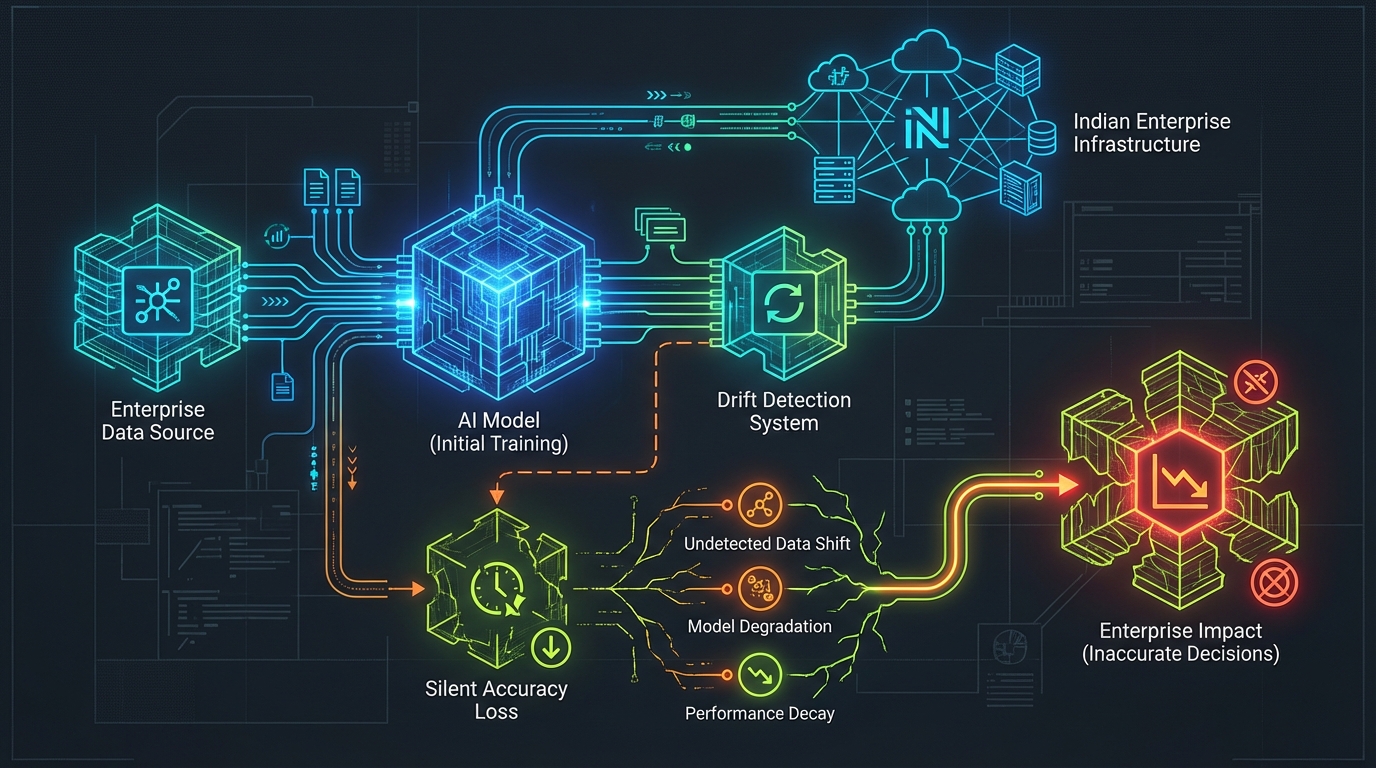
India leads global enterprise AI adoption, but many firms lack formal AI governance frameworks. This governance gap isn't just a compliance checkbox; it's a revenue killer. When transaction patterns shift after policy changes or regulations redefine customer criteria, static models keep making predictions on yesterday's reality.
The impact is significant. Uncaught drift can lead to substantial losses in accuracy. Yet many enterprises miss the early warning signals because they're monitoring infrastructure metrics instead of model behavior. Your infrastructure might be healthy while your fraud detection model confidently misclassifies transactions.
The silent killer: Model accuracy degrades over time in Indian payment volumes, but most enterprises discover drift only after customer complaints or regulatory audits.
This isn't just about lost revenue. In India's regulated industries, drift becomes a compliance liability overnight. Regulators require explainability on drift events. The enterprises winning at scale share one trait: they treat drift detection as production infrastructure, not an afterthought. They deploy enterprise-grade AI observability stacks that catch statistical shifts before they become business problems.
The Two Faces of Drift Tripping Your Models
Drift wears two masks in Indian enterprises, and most teams only watch for one. - Data drift hits when your input distribution shifts. After India's transaction limit changes, payment patterns mutated overnight. Models trained on average transaction sizes suddenly faced new volumes. The features looked normal - same merchants, same customers - but the statistical distribution had fundamentally changed. - Concept drift is sneakier. When regulations tightened, the definition of "customer churn" evolved. Models kept predicting churn based on the old definition; accuracy plummeted, but accuracy metrics showed no change because the ground truth label definition had shifted.
Critical insight: Static models running for years after deployment degrade continuously, but degradation accelerates during regulatory changes and policy shifts.
Indian enterprises face unique drift acceleration factors. Policy shifts create data distribution earthquakes. Models trained before policy changes became obsolete overnight. The same pattern repeats with every regulatory update.
The antidote isn't just monitoring; it's architectural. Leading enterprises deploy hybrid models that ensemble static learners with adaptive components. They maintain prediction confidence distributions and trigger retraining when statistical thresholds are exceeded.
Production Signals That Many Firms Miss
Your model is probably drifting right now, but your dashboards won't tell you. Here's what many Indian enterprises miss while focusing on infrastructure metrics: - Latency spikes often indicate model degradation. When drift forces models into uncertain prediction territories, they require more computational cycles, triggering autoscaling events. Your infrastructure team celebrates optimized resource utilization while accuracy quietly tanks. - Prediction confidence distribution skews reveal the smoking gun. Healthy models maintain stable confidence distributions. When drift hits, you see confidence polarization - predictions cluster around certain certainty instead of maintaining the expected distribution. - Feature attribution ranks drift signals catastrophic shift. If your fraud model suddenly decides certain features are the primary indicators instead of others, you're not just facing drift; you're facing model collapse.
Production reality: Enterprises with real-time ML pipelines detect these signals within minutes, not months.
The pattern is consistent across India's regulated sectors. Banks miss drift until prediction accuracy drops below audit thresholds. Hospitals discover drift when patient readmission models start violating decision audit requirements.
Regulatory Tripwires for Fintech & Healthcare

India's regulators aren't waiting for enterprises to figure out drift detection. They're embedding requirements in compliance frameworks that make drift monitoring mandatory, not optional. - Regulatory guidelines require explainability on drift events. When your model's accuracy drops post-policy change, you need documented evidence of when drift occurred, what caused it, and how you remediated it. - Compliance audits demand documented model retraining intervals for AI systems. If your model hasn't been retrained in a significant amount of time while data shifted, you're facing penalties.
Regulatory reality: Drift isn't a technical problem once regulators notice. It becomes a governance failure with financial penalties and business restrictions.
The enterprises succeeding under regulatory scrutiny share common practices. They maintain model risk files documenting drift thresholds and remediation procedures. They implement dual-control approval for model updates, ensuring no single engineer can deploy drift-compromised models.
Battle-Tested Drift Detection Architecture
After numerous deployments across regulated industries, one architecture pattern emerges for drift detection that satisfies both technical requirements and regulatory audits. - Streaming data infrastructure computes statistical metrics every few minutes. Traditional batch monitoring misses drift events that occur between daily runs. Streaming architecture catches statistical shifts as they happen, not after business impact occurs. - Threshold-based alerts trigger notifications to model owners and compliance teams automatically. When feature distributions shift beyond acceptable bounds, the system triggers alerts. - Canary shadow models run on a portion of traffic before full rollout, catching drift in staging instead of production.
Architecture insight: The difference between enterprises who catch drift early and those who don't isn't monitoring frequency; it's architectural choices.
The technical implementation uses proven components. The system stores historical feature distributions for instant comparison. Kubernetes-native deployments ensure drift detection scales with model inference.
From Reactive to Real-Time Mitigation
Detecting drift is only half the battle. The enterprises scaling AI successfully have moved beyond detection into real-time mitigation strategies that prevent accuracy degradation. - Online learning updates model parameters incrementally as new data arrives. Traditional machine learning requires complete model retraining when drift occurs. - Active learning flags a portion of data for human review. Not all drift requires immediate model updates. Active learning algorithms identify which new examples provide maximum learning value. - Hybrid models ensemble static + adaptive learners for accuracy lift. Static models provide stability and interpretability required for regulatory compliance. Adaptive models handle real-time drift.
Mitigation reality: The goal isn't preventing all drift; it's maintaining business performance while drift occurs.
The technical implementation requires architectural commitment. Streaming feature stores maintain real-time feature availability for online learning. Model serving infrastructure supports hot-swapping model versions without service interruption.
Build vs Buy Decision Matrix for 2026
As drift detection becomes mandatory for regulated enterprises, technology leaders face a critical decision: build internal capabilities or partner with specialized providers. - In-house build: Building enterprise-grade drift detection requires significant resources. You need streaming data infrastructure, statistical monitoring systems, regulatory reporting frameworks, and MLOps automation. - Partner model: Specialized providers deliver pre-built observability stacks with regulatory compliance baked in. They bring proven architectures, established playbooks, and teams experienced in regulated deployments.
Decision framework: Regulated enterprises need compliance baked in from day one. Building compliant systems adds significant time and cost but comes standard with enterprise-focused partners.
The choice becomes clearer when considering opportunity costs. While you're building drift detection infrastructure, competitors are deploying revenue-generating AI systems.
Frequently Asked Questions
Q: How fast can drift tank model accuracy in production?
A: Drift can significantly impact model accuracy over time. Streaming detection reduces response time from months to minutes.
Q: Which drift metric satisfies regulatory auditors?
A: Maintain statistical metrics and document thresholds in your model risk file; deployments pass audits using this threshold with automated reporting.
Q: Does the system support on-premise drift detection?
A: Yes, deployments include Kubernetes-native observability stacks behind firewalls with compliance controls for regulated industries.
Q: How long before a drift alert triggers retraining?
A: Streaming pipelines reduce lag to under a significant amount of time; enterprises typically retrain within a few hours during market hours to stay ahead of regulatory flags and maintain compliance.
Your models are drifting right now. The question isn't whether you'll face drift; it's whether you'll detect it before regulators, customers, or competitors do. In India's regulated industries, the enterprises winning at AI scale have already moved beyond detection into real-time mitigation architectures. The rest are one policy change away from compliance challenges.
Don't wait for your next regulatory audit to discover model degradation. Implement streaming drift detection before your next deployment, not after your next incident.
About the author
Mayank Singh is a software developer at Levitation Infotech, where he builds web and AI-powered applications across the company’s fintech, healthcare, and enterprise projects.