


Introduction
Businesses of all sizes are under growing pressure to keep up with rapid changes. Whether it’s staying competitive, improving how things run, or meeting customer expectations, technology is now a key part of the picture. One area gaining a lot of attention is the use of intelligent tools that can help teams work smarter, faster, and more creatively. These tools are no longer limited to tech giants or innovation labs; they're becoming part of daily business life.
This shift is not just about staying modern; it’s about staying relevant. The way companies use these tools is also changing. Some are just getting started. Others have made it part of their core operations. But one thing is clear: knowing how mature your organization is in using AI can help you grow faster and smarter. In this article, we’ll break down what that maturity looks like, and how small, mid-sized, and large organizations are each moving forward at different speeds and with different strategies.
I. The Generative AI Imperative Across Organizational Scales
The use of generative AI tools that help create content, improve decisions, or handle repetitive tasks is no longer just a nice-to-have. It’s quickly becoming something businesses can’t afford to ignore. Whether you're a startup or a global company, there’s growing pressure to use AI not only to stay efficient but to stand out in the market.

Why now? Because the numbers speak for themselves.
- In 2024, private investment in generative AI reached $33.9 billion, up nearly 19% from the year before.
- On average, each investment was around $110 million, showing that businesses are not just curious, they're serious.
- By 2030, smart use of AI could drive $19.9 trillion in global economic value.
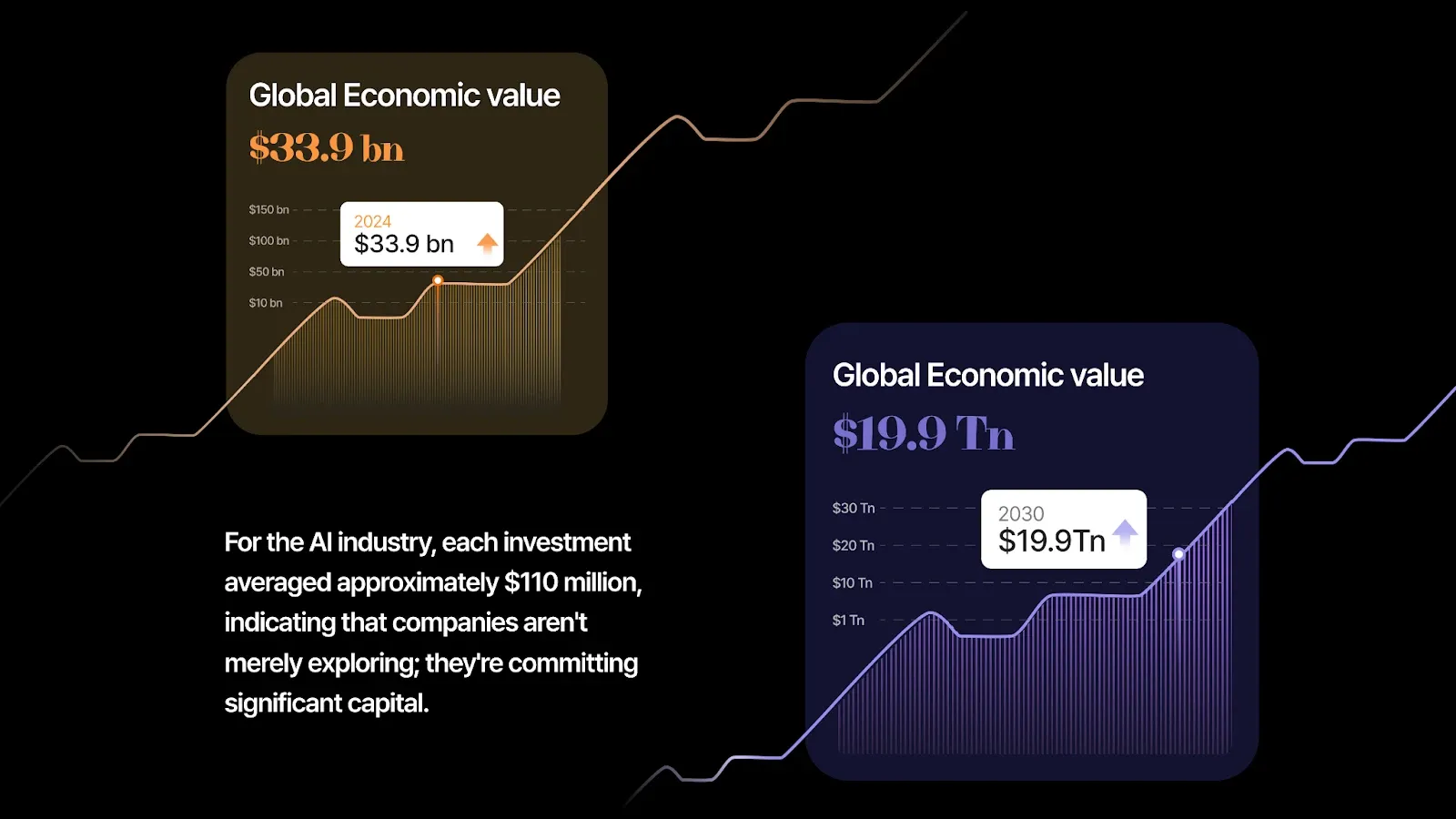
This level of investment tells us something important: companies aren't just experimenting anymore they’re expecting real results. And to see those results, they need to move beyond testing and start using AI in their everyday operations.
But not every organization is at the same stage. The term AI maturity refers to how deeply AI is woven into a company’s way of working. It’s about more than just tools it’s about mindset, culture, and long-term thinking.
Research shows that companies with higher AI maturity are far more likely to keep their AI projects running for the long haul over three years or more compared to others who might see projects drop off quickly. Mature organizations also enjoy real benefits:
- 15–30% improvement in productivity
- Faster response to customer needs
- Better decision-making and insights
In contrast, companies that lag in AI maturity may struggle to keep up or fall behind completely. The risks aren’t just about missed opportunities; they may also face challenges staying competitive in fast-moving markets.
And while it’s true that 78% of companies now use AI in at least one area of their business, how they do it and how well it works varies widely depending on company size. Smaller firms might move faster but face resource limits. Large enterprises may have the funding but struggle with complexity. That’s why this article looks at each size group small, mid-sized, and large to understand how they’re adopting generative AI, what’s working, and where the gaps are.
Before we talk tools, let’s talk progress
Adopting any new technology isn’t just about installing something new, it's about how well you use it over time. The same goes for artificial intelligence. Just having access to it doesn’t mean you’re making the most of it. Some companies are still figuring out where to begin. Others have already built strong systems around it. What makes the difference? It’s something called AI maturity, a simple way to understand how ready your organization is to use AI meaningfully and at scale.
But this isn’t just about speed. It’s about being thoughtful. Knowing where your company stands helps you take the next best step, not just the next big one. That’s where AI maturity models come in. They give leaders a clear way to track progress from early testing to full integration.
II. Understanding AI Maturity: Frameworks and Stages
So, what exactly is AI maturity?

It’s a way to measure how well an organization understands, adopts, and integrates AI into its daily work. Think of it as a progress path. Some companies are at the very beginning testing things out. Others are far ahead, using AI to improve decisions, streamline work, and even build new products. It’s not just about having the tools. It’s about how they’re used, who’s using them, and whether it’s making a difference.
This matters because businesses that reach higher maturity levels often see stronger outcomes. According to recent insights, only 12% of organizations have reached a stage where their AI efforts are actually driving long-term performance and growth. These are called the Achievers, the ones getting it right, both in strategy and in execution.
Meanwhile, about 63% are still in the early or average stages. They may have started, but they haven’t yet figured out how to scale or get consistent value. That’s why understanding where you are and where you’re heading is important.
Let’s break it down with two useful models: one from Gartner, and another from AWS (focused on generative AI specifically).
Gartner’s AI Maturity Framework
Gartner’s framework includes five stages that show how companies grow in their use of AI:
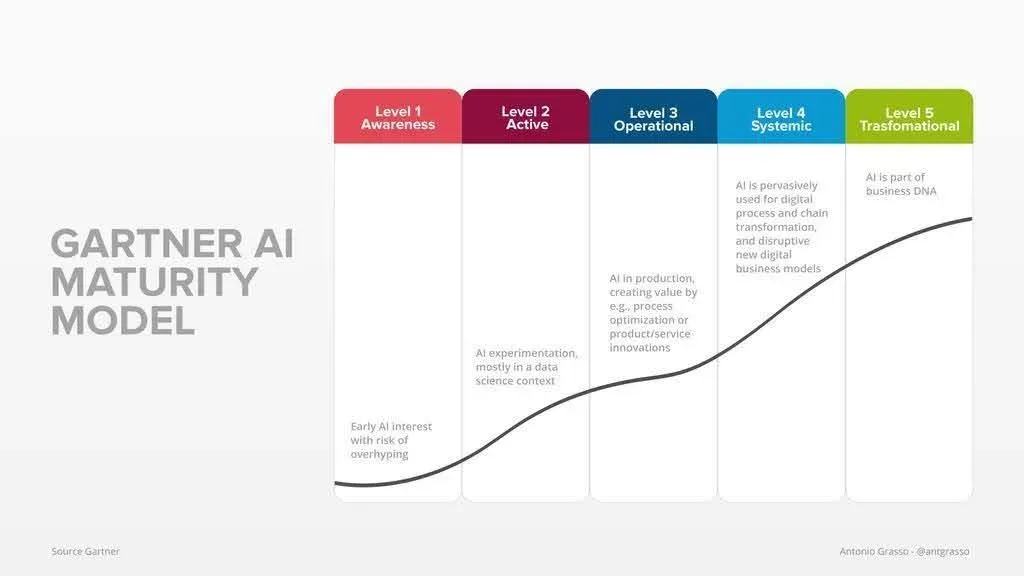
- Level 1: Awareness
The company is just starting to talk about AI. There’s interest, maybe some research, but no real use yet. - Level 2: Active
Some early experiments are happening on small test projects, trying things out, and learning from the results. - Level 3: Operational
AI tools are now part of regular work. Dedicated teams are in place. The value is clear, and results are starting to show. - Level 4: Systemic
AI is now used across multiple parts of the business. It’s not just improving processes, it's starting to reshape how the business works. - Level 5: Transformational
AI is at the heart of the business. It powers decisions, creates value for customers, and shapes what the company offers.
Few companies reach Level 5. But those that do like Google or Netflix aren’t just using AI. It’s built into who they are and how they operate.
AWS’s Generative AI Maturity Model: From Vision to Scale
While Gartner defines overall AI maturity, AWS zooms in on how organizations specifically adopt generative AI with a model that includes four clear stages:
1. Envision
Teams begin by understanding what generative AI is and where it might help. The focus is on awareness, discussions, and idea-sharing.
2. Experiment
Organizations start pilot projects and test use cases. This stage is about building early prototypes and gaining hands-on experience.
3. Launch
Now it gets real. Gen AI tools are deployed in production, and teams shift their focus to measurable outcomes, monitoring, and performance management.
4. Scale
Gen AI becomes deeply embedded across business functions. Best practices are shared, systems are standardized, and the organization accelerates growth using AI.
Bedrock: A Case Study in Gen AI Maturity
A prime example of AWS’s own journey through this maturity model is Amazon Bedrock.
From Experiment to Launch
- Preview Phase (Early 2023):
Organizations experimented with various foundation models (FMs), using Bedrock’s single API to explore real-world use cases in a secure test environment. - General Availability (September 2023):
Bedrock officially launched as a fully managed service, supporting production-grade generative AI. It offered: - Access to leading FMs (from Anthropic, AI21 Labs, Stability AI, and Amazon Titan)
- Guardrails for content safety
- Model evaluation tools for performance tracking
- Private data customization for enterprise-grade use
This shift from “testing” to “production-ready” marked a textbook move from the Experiment stage to the Launch phase.
AWS’s maturity model prompts companies to ask:
- Are we moving with purpose, not just hype?
- Do we have the skills and infrastructure to scale AI responsibly?
- Is AI truly making us better or just making us busy?
Whether you’re starting out or already scaling, this framework offers a practical lens to guide your gen AI journey.
Why does all this matter?
It’s easy to fall into the trap of doing something just because others are doing it. But that’s not how long-term value is built. AI capability maturity is about being intentional. It’s about using AI in a way that fits your goals, your team, and your stage of growth.
Companies that get this right don’t just adopt AI they grow with it. They train their teams, they align AI with real business problems, and they focus on responsible use. These are the traits that move companies from being AI experimenters to AI achievers.
So, if you’re asking whether AI is right for your organization, the better question might be: How ready are we to use it well?
III. The Business Case for Measuring AI Maturity
Why Measuring AI Maturity Matters
Understanding where your organization stands with AI isn’t optional, it's the foundation for scaling it effectively. Without this clarity, you risk wasting time and money on projects that don’t deliver results.
Measuring AI maturity isn’t about competing with tech giants. It’s about being honest about what’s working, what’s missing, and what’s next. This insight helps leaders make better decisions around tech, budgets, and business goals.
Many companies invest in AI without linking it to real outcomes. A maturity assessment connects your AI efforts to strategy helping you stay focused, track ROI, and build systems that deliver long-term value.
As AI evolves, so do the risks. Maturity also means responsibility. Organizations that measure their readiness are better at managing risks, training teams, and building ethical, trustworthy systems.
In short, measuring AI maturity helps you grow smarter, safer, and with purpose.
IV. Generative AI Adoption Landscape by Organization Size
Does Size Really Shape AI Strategy?
Yes and clearly.
Small companies move fast, chasing efficiency and growth. Midsize firms are building structure around what works. Large enterprises? They’re going big, with long-term plans and larger risks. Let’s look at how adoption differs by size and what that reveals about the future of generative AI in business.
Small Businesses: Agility Meets AI
Small businesses are adopting Gen AI quickly. Usage jumped from 39% in 2024 to 55% in 2025, with companies of 10–100 employees seeing a rise from 47% to 68%.
What’s driving it?
Time and cost savings:
- 66% save between $500–$2,000/month
- 60% save 20+ hours/month
Time is reinvested into growth: finding customers, upgrading systems, and scaling up.
Common use cases:
- Data analysis (62%)
- Content creation (55%)
- Chatbots for 24/7 support (46%)
By the end of 2025, 80% plan to use AI chatbots in customer service.
But here's the catch: while 89% use AI tools, most lack a clear strategy. Adoption is real maturity isn’t. Most focus on short-term wins like automating emails or generating content. Long-term alignment with business goals is still emerging.
Still, small businesses are showing that big budgets aren’t required to see results. They're experimenting fast and learning as they go.
Top challenges:
- Lack of in-house knowledge (51%)
- Concerns about reliability
- No clear AI growth strategy
Early-stage, impact-focused adoption. The priority is immediate gains—not yet scaling or governance.
Mid-Sized Enterprises: Building the Bridge
Midsize firms sit in a unique spot less nimble than startups, less burdened than large corporations. That makes them ideal for turning AI experiments into structured strategy.
By 2025, 91% of North American midsize companies were using Gen AI (up from 77%). One in four report it’s fully integrated into operations.
Common applications:
- Text generation and summarization (49%)
- Workflow automation (45%)
- Forecasting and sales content (40%)
AI is now embedded in IT (57%), analytics (58%), and customer service (48%).
The mindset has shifted from “try it out” to “build it in.”
- 79% have a roadmap
- Nearly 50% are working with AI consultants
Still, 92% report adoption challenges mainly around data quality, internal skills, and lack of strategic clarity.
Top challenges:
- Lack of in-house expertise (39%)
- Poor data quality (41%)
- Reliance on external help
Structured adoption is underway. Midsize companies are aligning AI with goals—but scaling and integration are still evolving.
Large Enterprises: Planning Big, Moving Carefully
Larger companies aren’t experimenting, they're investing. By late 2024:
- 70% had at least one Gen AI project live
- AI spending is growing 3× faster than other IT budgets
For many, this is about transforming how business is done:
- 75% use AI operationally
- 44% have moved past pilots to production
- 19% are using AI to redesign core processes
They take a structured approach: define goals, pilot use cases, then scale.
Instead of building from scratch, 65% now rely on customizable, vendor-built AI tools saving time and reducing rollout risks.
Use cases include:
- Generating content, code, images
- Workflow redesign
- Advanced analytics
- Strategic planning
Reported benefits:
- Up to 30% productivity gains
- 15% cost savings
- 10%+ revenue growth for early adopters
Top challenges:
- Data privacy and security (40%+)
- Lack of proprietary data for custom models
- AI talent shortages
- High complexity and unrealistic expectations
Despite progress, fewer than half have scaled AI across the business. Change at this scale takes time, structure, and trust.
What this tells us:
This is strategic, long-term adoption. Enterprises are building AI into the fabric of their business with frameworks, infrastructure, and leadership buy-in.
V. Comparative Analysis: Key Differences and Commonalities in the AI Journey
Why Size Shapes the Journey But Not All the Struggles
The size of your organization affects how quickly you can adopt generative AI, how much you can invest, and how ready your systems and teams are.
Let’s break it down. Not in consultant-speak, just a real look at what changes with size, and what doesn’t.
What’s Different Across Small, Mid, and Large Organizations
1. Data Infrastructure
- Small businesses often have limited or scattered data across disconnected tools. Off-the-shelf AI works, but deeper insights are harder to reach.
- Mid-sized companies have more data but struggle with quality and consistency. Cleaning it takes time and resources.
- Large enterprises deal with volume but much of it is siloed, outdated, or not usable for AI. Even they lack clean, high-quality proprietary data.
2. Talent and Skills
- Small teams often lack technical staff or the budget to hire specialists. Over half of small business leaders say they don’t fully understand how AI tools work.
- Mid-sized firms are too big to wing it, not big enough to build full AI teams. Many rely on consultants to bridge the gap.
- Large companies are hiring fast but still struggle to find or train enough talent to meet demand.
3. Budget and Resources
- Small businesses spend cautiously. AI tools need to deliver clear impact quickly.
- Mid-sized firms are investing strategically. Nearly 80% have AI budgets, much of which goes to external support.
- Large enterprises are scaling fast, with some investing hundreds of millions. For them, AI is a long-term business shift.
4. Governance and Oversight
- Small businesses rarely think about governance until something breaks. Few policies exist.
- Mid-sized companies are starting to define rules around privacy and internal use.
- Large enterprises have formal structures, legal reviews, and full governance teams but complexity slows execution.
5. Use Case Focus
- Small teams focus on quick wins automating emails, content, or basic support.
- Mid-sized firms are improving workflows, data analysis, and customer experience.
- Large enterprises are redesigning operations and embedding AI across core functions.
6. Speed of Adoption
- Small businesses move fast but often without a long-term plan.
- Mid-sized firms are more structured, piloting carefully and rolling out gradually.
- Large companies move slowest due to scale but their AI strategies are built for the long game.
What Everyone’s Struggling With No Matter the Size
Despite the differences, three challenges show up everywhere:
1. Data Quality
- Messy, incomplete, or scattered data is a universal blocker.
- 41% of mid-sized firms call it a major issue.
- Even large enterprises cite poor data as a key reason tools fall short.
2. Talent Shortages
- 51% of small business leaders say they lack internal AI knowledge.
- 39% of mid-sized firms say the same.
- 67% of large enterprises list AI talent as a top challenge.
Hiring, training, and understanding AI remains tough for all.
3. Lack of Strategy
- 43% of small businesses have no AI plan.
- Over half of mid-sized firms feel only “somewhat prepared.”
- Large enterprises are still figuring out how to scale AI and make it stick.
This isn’t just a tech issue, it's a people and planning challenge.
VI. Driving AI Maturity: Recommendations for Organizations of All Sizes
Every business wants to do more with less. That’s why AI adoption is rising across companies from solo founders to global enterprises. But without a clear plan, efforts can lead to wasted time, missed opportunities, or underwhelming results.
So, how can organizations move forward effectively? The approach depends on your size, team, and goals but a few fundamentals apply to everyone.

For Small Businesses: Start Simple, Get Your Data in Order
Smaller operations usually lack time and resources for complex AI projects and that’s okay. What matters is being practical:
- Set clear, useful goals like saving time, answering customer questions faster, or improving marketing content.
- Use simple, ready-made tools no need to build from scratch.
- Ensure your data is clean and reliable. Even basic tools need solid input to work well.
The small businesses that succeed with AI stay focused, realistic, and consistent, not the ones spending the most.
For Mid-Sized Companies: Invest in Tools You Can Grow With and in Your People
You’ve likely moved past initial experiments and are now looking to scale. This is the time to shift from trying AI to using it strategically:
- Choose platforms that can scale with you, not just temporary fixes.
- Train your teams not just IT, but also marketing, operations, and leadership.
- Define a clear strategy: what you want to achieve, how to measure it, and where AI fits in your broader goals.
Many mid-sized companies feel only “somewhat prepared” for AI not due to lack of interest, but lack of planning. Clarity drives results.
For Large Enterprises: Make Trust and Responsibility the Standard
Big organizations often have the budget and infrastructure, but also face complexity and greater risk.
Focus on:
- Responsible AI: Privacy, fairness, and accountability must be built in from the start.
- Leadership: Appoint dedicated AI leaders (e.g., Chief AI Officers) and set up Centers of Excellence.
- Long-Term Thinking: It’s not just about automation it’s about reimagining how the business operates.
Top-performing enterprises treat AI as a core business function, not a side experiment with proper budgets, structure, and leadership support.
What Top Performers Do Differently
High-achieving organizations don’t just use better tools they:
- Invest in people: They train teams and build internal capabilities.
- Build trust: Teams understand how AI works and why it matters.
- Focus on outcomes: AI is tied to real results like better customer experiences, faster decisions, or freeing up time.
VII. The Future of Generative AI: Trends and Outlook
The Road Ahead: What’s Next for Generative AI
Generative AI isn’t a passing trend. It’s here to stay and already changing how businesses operate. But where is it headed? What should companies plan for—whether just starting or already progressing on the AI maturity curve?
Let’s explore what’s coming, what it means for different industries, and how to stay prepared.
What’s Trending Right Now (and What It Means for You)
Across industries, a few clear patterns are emerging:
1. Smarter AI "Co-workers"
AI tools are evolving from helpers into collaborators. These “AI agents” can now manage entire workflows handling customer inquiries, coordinating projects, or keeping teams aligned. You’ll soon delegate entire chunks of work, not just tasks.
2. Multimodal AI
AI is becoming more intuitive, understanding not just text but voice, images, and video together. Imagine an assistant that reads your emails, listens to meetings, scans photos, and summarizes it all in plain language.
3. Smaller Tools, Bigger Impact
“Small Language Models” can now run on phones or lightweight devices, making AI more accessible to smaller teams without heavy infrastructure.
4. Business-Specific AI
More companies are combining AI with their own data using Retrieval-Augmented Generation (RAG), improving accuracy and grounding outputs in real context reducing hallucinations and building tools that reflect their brand and goals.
5. Hyper-Personalization
AI is moving beyond basic personalization. It now learns behaviors, predicts needs, and adapts messages or services in real time reshaping industries like retail, travel, healthcare, and finance.
6. Built-in Security
AI is becoming key to threat detection, compliance, and anomaly detection. For industries handling sensitive data, this is becoming essential.
How These Trends Play Out by Industry and Maturity Level
- Beginner-stage organizations focus on small wins like task automation or content improvement.
- Mid-level companies are investing in tools, talent, and training to scale AI.
- High-maturity businesses are redesigning workflows, launching new products, and integrating AI organization-wide.
Industry examples:
- Retail: smarter recommendations and dynamic pricing
- Healthcare: diagnostics, patient interaction, drug discovery
- Finance: fraud detection, tailored advice, advanced underwriting
- Customer Service: AI assistants and personalized experiences across all sectors
A common thread across all use cases: responsible AI. As capabilities grow, businesses are setting up guardrails to ensure fairness, transparency, and trust with both employees and customers.
What to Expect (and Plan for) Next
- Rapid growth: The generative AI market is projected to surge over the next decade, transforming the global economy.
- Workforce shift: Nearly 90% of jobs will be impacted, and over 97 million new roles are expected. Reskilling will be essential.
- Early movers win: Companies investing now in people, tools, and ethical foundations will lead not just in efficiency, but in long-term relevance and resilience.
By 2026, most customer touchpoints will be powered by AI. Now’s the time to prepare for real transformation, not just cost savings.
Conclusion: The Generative AI Journey Isn’t the Same for Everyone And That’s the Point
Every company is in a different place when it comes to AI. Some are just getting started. Others are scaling fast. A few are already building entirely new ways of working.
And that’s okay.
There’s no one-size-fits-all roadmap here. The real value comes from knowing where you are, and choosing the right next step.
- If you’re small, focus on simple, real results.
- If you’re mid-sized, start thinking long-term.
- If you’re large, lead with responsibility and vision.
But wherever you are, here’s what’s true for everyone:
Understanding your AI maturity helps you make smarter, more focused decisions.
Responsible AI isn’t optional, it's part of staying competitive and trustworthy.
Generative AI is not just a trend, it's a shift in how we work, connect, and grow.
The good news? You don’t need to do everything at once.
You just need to start and keep moving with purpose.
Want to go further? Explore how Agentic AI can become a core part of your growth strategy.
-1.webp&w=2048&q=75)