

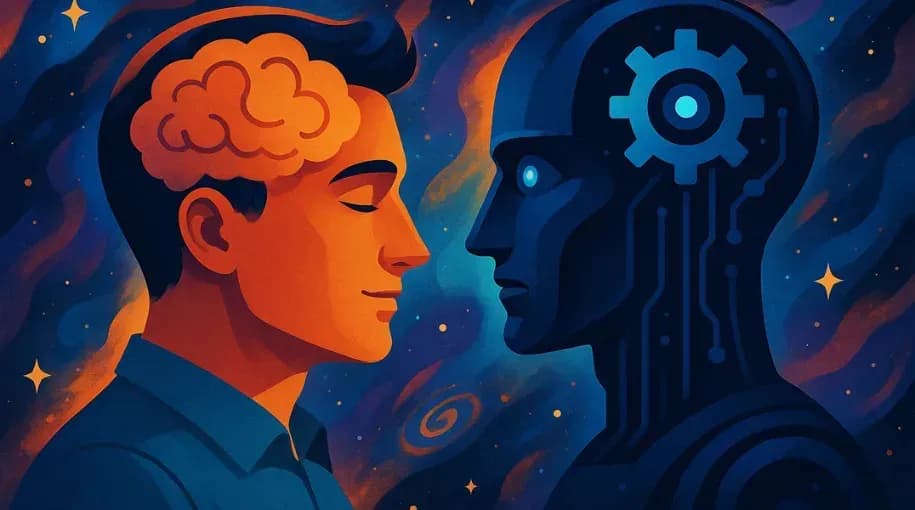
In a world where machines can compose music, diagnose diseases, and even drive cars, the question looms large: how does AI vs human intelligence stack up? The difference between human intelligence and machine intelligence is not just a technical debate but a profound exploration of what makes us human. While artificial intelligence excels at crunching data and spotting patterns, human intelligence shines in creativity, empathy, and ethical reasoning. This blog dives deep into the AI vs human brain divide, exploring their strengths, limitations, and real-world implications. Whether you’re curious about can AI replace human intelligence or the role of emotions in decision-making, we’ll unpack it all with insights, stats, and practical examples.
Understanding the Core: AI vs Human Intelligence
At its heart, the AI vs human debate hinges on how each processes information. Artificial intelligence vs human intelligence compares two fundamentally different systems: one built on algorithms and data, the other on biology and experience. Let’s break it down.
What is Artificial Intelligence?
AI refers to systems that mimic human cognitive functions like learning, reasoning, and problem-solving. Powered by machine learning, neural networks, and vast datasets, AI excels in tasks requiring speed and precision.
- Strengths: Data-driven logic, scalability, consistency.
- Examples: Chatbots, recommendation algorithms, autonomous vehicles.
What is Human Intelligence?
Human intelligence encompasses cognitive, emotional, and social abilities shaped by biology, culture, and experience. It includes reasoning, creativity, emotional intelligence and ethical reasoning.
- Strengths: Intuition, adaptability, empathy.
- Examples: Artistic creation, moral decision-making, interpersonal communication.
A 2023 McKinsey report found that 60% of organizations using AI saw improved efficiency, but 80% still relied on human judgment for strategic decisions, highlighting the human intelligence vs machine intelligence divide.
Key Differences Between Human Intelligence and Machine Intelligence
The difference between human intelligence and machine intelligence lies in how they learn, reason, and adapt. Here’s a detailed comparison across critical dimensions.
1. Learning and Reasoning: Machine Learning vs Human Learning
- AI: Relies on machine learning vs human learning, processing vast datasets to identify patterns. It requires structured data and predefined goals.
- Example: AI in Netflix’s recommendation engine learns from viewing history to suggest shows.
- Limitation: AI struggles with novel situations outside its training data.
- Humans: Learn through experience, abstraction, and intuition, often with minimal data. Humans can generalize knowledge across contexts.
- Example: A child learns to avoid hot surfaces after one burn, applying the lesson broadly.
- Advantage: Cognitive flexibility of humans allows adaptation to unpredictable scenarios.
A 2024 Stanford study showed that while AI models like GPT-4 excel in pattern recognition, humans outperform in tasks requiring learning and reasoning in AI vs humans in ambiguous contexts by 30%.
2. Emotional Intelligence and Ethical Reasoning
- AI: Lacks emotional intelligence and ethical reasoning. It can simulate empathy (e.g., in chatbots) but doesn’t feel emotions or grasp moral nuances.
- Example: AI in hiring tools may optimize for efficiency but overlook fairness without human oversight.
- Limitation: AI limitations vs human judgment include inability to weigh ethical trade-offs.
- Humans: Excel in understanding emotions and navigating ethical dilemmas. The role of emotions in decision-making shapes human choices, from leadership to caregiving.
- Example: A doctor balances clinical data with patient emotions when discussing treatment options.
- Advantage: Humans integrate empathy and ethics naturally.
Use Case: In 2022, an AI recruitment tool was scrapped by a tech firm after it favored male candidates, underscoring human artificial intelligence gaps in ethical reasoning.
3. Intuition vs Data-Driven Logic
- AI: Operates on intuition vs data-driven logic, relying on algorithms to make decisions based on probabilities.
- Example: AI in stock trading analyzes market data to predict trends, often outperforming humans in speed.
- Limitation: AI lacks the gut instinct that guides humans in uncertain scenarios.
- Humans: Use intuition, a blend of experience and subconscious reasoning, to make decisions when data is incomplete.
- Example: A firefighter’s split-second decision to evacuate a building may save lives based on instinct.
- Advantage: AI vs human decision-making shows humans excel in high-stakes, low-data situations.
A 2023 Deloitte survey revealed that 75% of executives prefer human intuition over AI for decisions involving uncertainty, highlighting AI and human complementary roles.
4. Bias: Human Bias vs Algorithmic Bias
- AI: Can perpetuate human bias vs algorithmic bias if trained on flawed data. For instance, biased datasets can lead to discriminatory outcomes in AI systems.
- Example: Facial recognition tools have shown higher error rates for non-white faces due to biased training data.
- Limitation: AI lacks self-awareness to question its own biases.
- Humans: Prone to cognitive biases like confirmation bias but can reflect and correct through critical thinking.
- Example: A manager may initially favor a candidate based on shared background but adjust after reviewing qualifications objectively.
- Advantage: Humans can challenge biases through dialogue and self-reflection.
A 2024 MIT study found that humans are 20% more likely to identify and mitigate biases in decision-making compared to AI, emphasizing HI vs AI strengths in fairness.
Real-World Applications: AI and Human Collaboration
Rather than asking can AI replace human intelligence, the focus is shifting to how AI and human intelligence can collaborate. Here are two examples showcasing their synergy.
1. Healthcare: AI-Powered Diagnostics with Human Oversight
AI tools like IBM Watson analyze medical images to detect cancer with 95% accuracy, surpassing human radiologists in speed. However, doctors provide human intelligence vs machine intelligence by interpreting results in the context of patient history and emotions.
- Impact: A 2023 study in The Lancet showed AI-assisted diagnostics reduced misdiagnosis rates by 15% when paired with human oversight.
- Lesson: AI vs human brain collaboration enhances precision and empathy in patient care.
2. Creative Industries: AI Tools with Human Creativity
AI platforms like DALL-E generate stunning artwork, but human artists curate prompts and refine outputs to align with creative vision. This human artificial intelligence partnership amplifies productivity.
- Impact: A 2024 Adobe report noted that 70% of designers using AI tools reported a 40% increase in output, with humans guiding aesthetic and emotional resonance.
- Lesson: AI vs human synergy unlocks new creative possibilities.
Limitations and Challenges in the AI vs Human Debate
While AI’s capabilities are impressive, AI limitations vs human judgment persist. Here’s a look at key challenges:
- Contextual Understanding: AI struggles with nuanced cultural or social contexts, where humans excel due to lived experience.
- Energy Efficiency: The AI vs human brain comparison shows human brains consume ~20 watts, while AI models like GPT-4 require megawatts for training.
- Trust in AI-Generated Decisions: A 2023 Pew Research survey found that 60% of consumers distrust AI-driven decisions in sensitive areas like justice or healthcare.
- Ethical Boundaries: AI lacks the moral compass humans use to navigate complex ethical dilemmas.
Pro Tip: To build trust in AI-generated decisions, organizations should ensure transparency in AI processes and involve human oversight in critical applications.
The Future of AI vs Human Intelligence
The difference between human intelligence and machine intelligence will continue to evolve as AI advances. Emerging trends include:
- Augmented Intelligence: AI will enhance, not replace, human capabilities, creating AI and human partnerships in fields like education and law.
- Neuromorphic Computing: AI systems mimicking the AI vs human brain structure could improve efficiency and adaptability.
- Ethical AI Frameworks: Regulations will address human bias vs algorithmic bias, ensuring fairness in AI applications.
- Emotional AI: Advances in affective computing may narrow the emotional intelligence and ethical reasoning gap, though not fully.
A 2024 Gartner forecast predicts that by 2030, 80% of jobs will involve HI vs AI collaboration, blending human creativity with AI efficiency.
How to Navigate the AI vs Human Divide
For individuals and businesses, understanding the AI vs human dynamic is crucial. Here’s how to leverage both:
- Upskill in AI Literacy: Learn how artificial intelligence vs human intelligence works to use AI tools effectively.
- Hone Human Skills: Focus on creativity, empathy, and critical thinking ,areas where human intelligence vs machine intelligence shines.
- Foster Collaboration: Use AI for repetitive tasks and humans for strategic and ethical decisions.
- Monitor Bias: Regularly audit AI systems to mitigate human bias vs algorithmic bias.
- Build Trust: Communicate transparently about AI’s role to enhance trust in AI-generated decisions.
A 2023 Harvard Business Review study found that teams combining AI and human expertise outperformed AI-only or human-only teams by 25% in complex tasks.
FAQ: AI vs Human Intelligence
Q: What is the difference between human intelligence and machine intelligence?
A: The difference between human intelligence and machine intelligence lies in learning, reasoning, and emotional capabilities. Humans excel in creativity, empathy, and ethical reasoning, while AI vs human intelligence highlights AI’s strength in data processing and consistency.
Q: Can AI replace human intelligence?
A: While AI excels in specific tasks, can AI replace human intelligence is unlikely due to human strengths in intuition, emotional intelligence, and contextual understanding. AI and human collaboration is the future.
Q: How does AI vs human decision-making compare?
A: AI vs human decision-making shows AI relies on intuition vs data-driven logic, while humans use experience and emotions. Humans outperform in ambiguous or ethical scenarios.
Q: What are the limitations of AI compared to human intelligence?
A: AI limitations vs human judgment include lack of emotional intelligence, contextual understanding, and ethical reasoning, making human intelligence vs machine intelligence complementary.
Conclusion
The AI vs human debate isn’t about choosing a winner but understanding how artificial intelligence vs human intelligence can coexist. By recognizing the difference between human intelligence and machine intelligence, we can harness AI’s efficiency while preserving human creativity, empathy, and ethical judgment. Whether in healthcare, creativity, or decision-making, the future lies in AI and human collaboration. Start exploring this synergy today to unlock a world of possibilities where mind and machine work in harmony.
.webp&w=2048&q=75)
.webp&w=2048&q=75)