


Ever tapped on an app and boom, you’re lost in a neon maze of shiny buttons, smug little notifications, and endless scrolling? One minute you’re checking your bank balance, the next you’re knee-deep in TikTok dog videos, wondering where the last hour went. This isn’t a you problem. This is UX design psychology at work, pulling your brain’s strings like a caffeine fueled puppet master.
Designers: From Artsy Nerds to Masters of Cognitive Biases
Once upon a time, designers just made things look pretty. Now, UX designers are full-blown cognitive psychologists in disguise, tweaking user interfaces to hijack your working memory, nudge your decision-making, and play with your perception like a well-crafted magic trick. Ever noticed how your favorite apps subtly guide your actions without making you think too hard? That’s cognitive psychology in UX design at work, minimizing mental effort so you keep tapping, scrolling, and engaging.
Take the serial position effect, for example. Apps like Instagram and Netflix strategically place the most important items at the top or bottom of your feed because they know you’ll remember them best.
Even the Hick’s Law principle plays a role; the more choices you have, the longer your decision-making takes, so designers streamline user interfaces to speed up your interactions.
How UX Hooks You (And Why You Can’t Escape)
Imagine a digital playground where every tap feels like a tiny win. Up front, a clean, minimalist web design (thanks to the law of proximity) organizes objects in ways that trick your brain into thinking, “Ah, this makes sense.”
In the middle, slick progress bars exploit the endowment effect, making you feel invested in finishing a task just because you’ve started it. Meanwhile, notifications hijack your selective attention, ensuring you have to check that “urgent” update (spoiler: it’s never urgent).
Every interaction is a calculated move, every effect designed for usability, and every decision subtly influenced by psychological principles.
Even the Hawthorne effect plays a role, knowing you’re being observed (hello, analytics) makes you more likely to engage with the app the way developers intended.
More Psychology, Less Choice: How Decision-Making Is Engineered
The banking industry, finance and banking, and even financial services industry aren’t immune to these tactics. With AI-powered UX design, banking apps are now subtly nudging users toward better financial sector habits like saving more or investing smarter, without them even realizing it. And it’s all based on user research and design psychology insights that make sure digital products and services don’t just work, they work on you.
Key Takeaways
- UX psychology’s a brain ninja, sneaky, fast, and addictive as hell.
- Over 70% of apps use it to turn you into a click zombie.
- Dopamine’s the puppet master behind every “ooh, shiny!” moment.
- It’s not just design, it’s a profit-driven mind screw.
- Your attention’s the jackpot, and they’re cashing in big.
.webp&w=1920&q=75)
The Evolution of UX Psychology: From Basic Interaction to Cognitive Load Mastery
UX design has come a long way, from clunky layouts that barely functioned to finely tuned mind traps that make you keep scrolling when you should be sleeping. What started as a humble attempt to improve usability has evolved into a psychological game of “how long can we keep you here?”
From Basic Buttons to Brain Games: UX Design Principles in Action
Once upon a time, websites were so bad you clicked out of pure sympathy. Now, UX design is an entire science built on user psychology, cognitive biases, and decision making, all working together to keep you locked in.
- The ‘90s: Websites were ugly, slow, and chaotic. You clicked because, well, there wasn’t much else to do online.
- 2010s: Enter gamification. Apps like Candy Crush hacked into your mental model and rewired your brain to crave that next dopamine hit.
- Now: AI-powered UX psychology principles predict what you’ll click before you even know you want to. That endless cat video spiral? Yeah, that’s design psychology at work.
"UX used to be a suggestion. Now it’s a hostage situation." – Some Snarky Head of Design
Why UX Designers Study Mental Models (And Use Them Against You)
Tech companies aren’t investing millions into UI UX psychology just for fun. They know that tweaking the right design principles can make decision increases go through the roof. It’s not just about looking pretty, it’s about user motivation, cognitive load, and usability effects that manipulate how you engage with technology.
- Money, Honey: A well-optimized user experience can slash bounce rates by 30%, which means more cash for businesses.
- User Feels: 70% of users prefer apps that make them feel “understood” (translation: that know how to keep them addicted).
- Ego Boost: Every head of design dreams of bragging about daily active users hitting record numbers.
The Competitive Edge of Click-Bait UX: The Hawthorne Effect in Action
Some apps are so good at user psychology that they’ve basically turned their UX into a legal addiction:
- Spotify’s “Discover Weekly” is like a psychic DJ, perfectly curating songs you never knew you needed.
- Twitter’s “What’s Trending” preys on your attitudes toward technology and FOMO, making you check it just one more time.
- Duolingo’s Owl? It’s weaponized design psychology, the isolation effect makes skipping a day feel like a personal failure.
When companies master these UX psychology principles, judgment goes out the window, and users stick around. So next time you wonder why you’re still scrolling at 2 AM, just know, it wasn’t an accident.
Understanding UX Psychology: The Science Behind Selective Attention
UX design isn’t just about making things look pretty, it’s about making sure you can’t stop clicking. Ever wonder why you open an app for “just a second” and somehow lose an hour of your life? That’s not an accident. It’s UX design mixed with psychology, a sprinkle of AI, and a whole lot of manipulation.
Here’s how the user experience hooks you in and refuses to let go:
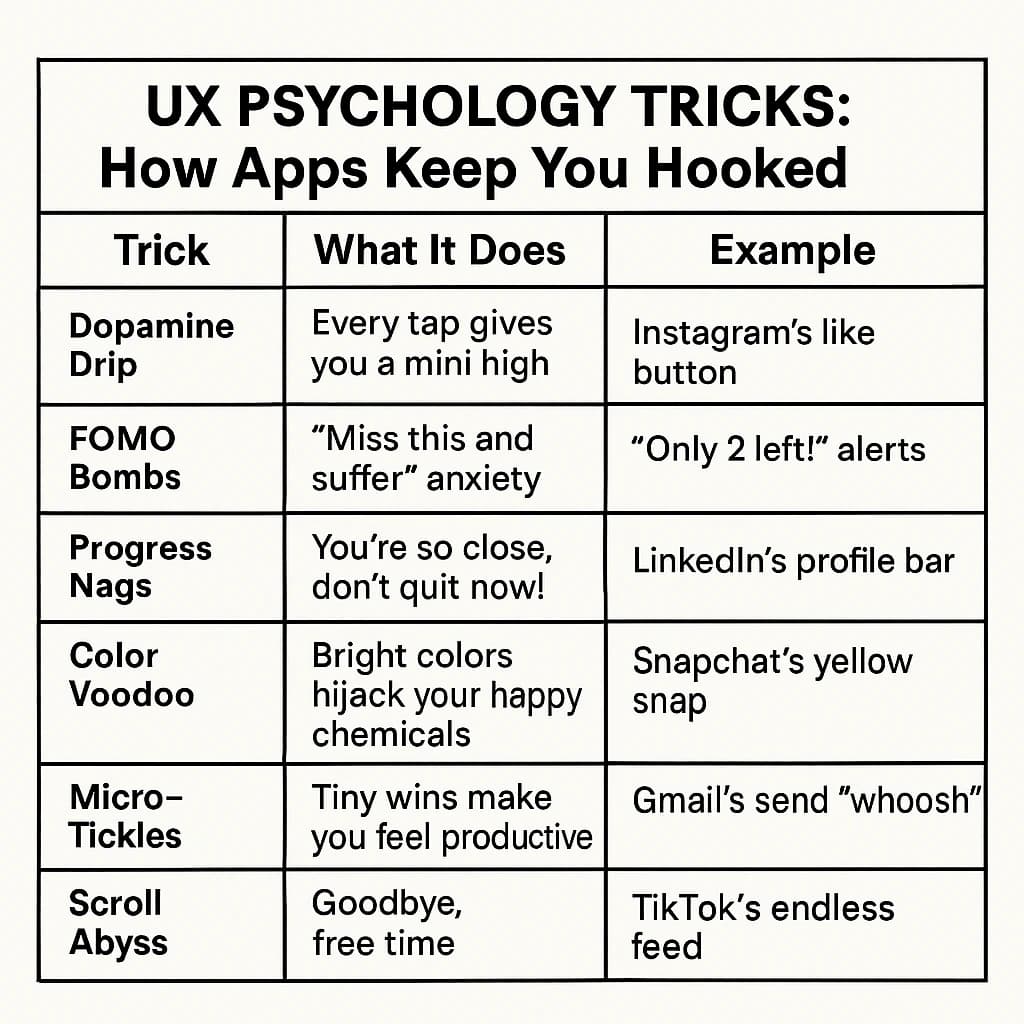
It’s not just social media. Every ux design trick in the book is used to keep you engaged, whether you realize it or not.
- Netflix: “Just one more episode” somehow turns into “Where did my entire weekend go?”
- Amazon: That one-click buy button? It’s why your cart is full, and your wallet is empty.
- Google: Every tiny user experience tweak makes sure you don’t just search once, you keep searching, clicking, and falling deeper into the rabbit hole.
This isn’t just about efficiency, it’s about addiction. And companies know exactly how to make their ux design feel so smooth, so seamless, that you don’t even notice when you’re hooked. It’s the digital version of “just one more chip,” but instead of snacks, it’s your attention being devoured.
The next time an app feels too easy to use, just remember that’s user experience done too well.
How UX Psychology Hijacks Your Brain: Cognitive Load, Bias, and Motivation
Think you’re in control when you scroll, tap, and click? Cute. In reality, every move you make online is part of a well-designed UX experiment, one where you are the test subject, and tech companies are running the lab coats. From the moment you open an app, UX design is working behind the scenes, pulling psychological levers to keep you engaged, entertained, and, let’s be honest, a little addicted.
Dopamine, Memory, and the Endowment Effect: How Apps Keep You Hooked
Ever wonder why a simple notification makes you drop everything? That’s dopamine talking, your brain’s way of saying, “Ooh, that felt nice. Let’s do it again.” UX designers know this all too well. Every badge you unlock, every “ding” from your favorite app, every retweet high, it’s all designed to keep that feel-good cycle going.
Why?
Because user experience is all about keeping you hooked. Twitter (or X, if we’re pretending that rebrand happened) gives you tiny hits of validation with every like and share. Instagram? Those little hearts aren’t just decoration, they’re engineered to keep you chasing the next one.
And now?
AI is making sure your dopamine supply is custom-fit to your cravings. Machine learning fine-tunes your feed, serving up exactly what makes your brain light up. You thought TikTok was just coincidentally showing you videos of dogs in Halloween costumes at 2 AM? Nope. That’s some next-level UX design wizardry.
FOMO Bombs and Peer Pressure
“Everyone’s doing it, so why aren’t you?” That’s peer pressure 101, and apps have turned it into an art form.
Classic Example
Snapchat streaks, skip a day, and suddenly, your best friend is sending you passive-aggressive question marks.
UX Design at Work
The fear of missing out (FOMO) isn’t just a social thing; it’s a user experience strategy. Apps nudge you with reminders like “Your friends are active now!” because they know you’d rather suffer through another group chat than be the one person who’s out of the loop.
Now with AI
Social media platforms are getting even smarter. They know who you interact with most, when you’re most likely to cave, and how to make that notification irresistible. Just when you think you’ve escaped, there’s another alert whispering, “Come back… you’re missing so much.”
Progress Nags and “Almost There” Traps
Ever been this close to finishing something, only for an app to guilt-trip you into completing it? Yeah, that’s not an accident.
What’s Happening?
That progress bar creeping toward 100% isn’t just there for fun, it’s a psychological hack. LinkedIn loves this trick, “Just one more skill to complete your profile!” Oh, so now my job applications are doomed because I didn’t add Leadership & Teamwork?
Why It Works?
UX design taps into the human need for completion. If you’re at 90%, your brain hates leaving it unfinished. That’s why fitness apps push you to complete your step goal, why language-learning apps guilt you over missed streaks, and why your email inbox keeps nudging you with “just one more setting” for a “better experience.”
Now with AI
AI-powered UX is leveling up (literally). Gamification elements like badges, streaks, leaderboards are getting more personalized, adapting to what you respond to. If public shame isn’t enough, maybe a “you’re falling behind” nudge will do the trick.
The best UX design doesn’t just make apps look good, it makes them irresistible. Every part of your user experience, from notifications to color choices, is engineered to keep you engaged. And with AI getting better at predicting what makes you tick, tech companies aren’t just designing apps anymore, they’re designing behaviors.
So the next time you’re glued to your screen at 3 AM, just remember, you’re not addicted. You’re just part of the experiment. 😉
“You’re not clicking; you’re just this close to winning.” Every App Ever
The Sneaky Science: Why You’re a Click Junkie
Behavioral Hooks That Reel You In
- Variable Rewards: Sometimes you score, sometimes you don’t, Facebook’s algorithm loves this.
- Loss Aversion: “Don’t lose your streak!”, Duolingo’s owl is judging you.
- Social Proof: “Everyone’s clicking!”, Uber’s “millions served” flex.
Emotional Design That Sucks You Dry design principles
- Colors: Red yells “DO IT!”, eBay’s bidding war bait.
- Vibes: Cozy fonts, Pinterest’s UX is a warm cookie scam.
- Micro-Magic: That “swoop” when you refresh? X knows you’re a sucker.
Personalization: Your Own Digital Stalker
- What: Spotify’s “made for you” playlist, you’re not leaving.
- Why: AI’s got your number, sad jams or hype beats, it knows.
- Now: Mood-based tweaks, angry? Here’s some metal.
Future Innovations: Clicks That’ll Own Your Life
Technology isn’t just evolving, it’s strategizing ways to make your clicks faster, your decisions easier, and your free will slightly less free. The next wave of UX innovations is coming for you, and no, you’re not ready.
Brain-Click Tech: Think It, Click It, Done.
Imagine scrolling without scrolling, clicking without clicking. Just think about opening Netflix, and boom, it’s already streaming another show you’ll pretend you didn’t binge in one night. Companies like Meta are practically foaming at the mouth over this. Brain-computer interfaces (BCIs) could let you browse, shop, and scroll using nothing but your thoughts.
- Why? Because tapping a screen is apparently too much work.
- How It Works: Tiny sensors read your brain signals and translate them into digital actions. No more fumbling with touchscreens, your brain becomes the remote.
- The Catch: If you think about pizza a little too long, congratulations, you just ordered five.
AR Overload: You Blink, You Buy.
Remember when online shopping required actual decision-making? Cute. Augmented Reality (AR) is turning that into a thing of the past. IKEA’s “see it in your room” feature already lets you plop a couch into your living space before you buy it. Now imagine that on steroids.
- What’s Next? Try on clothes, test out makeup, or preview a car in your driveway, all before touching a “Buy Now” button. AR is about to blur the line between browsing and owning.
- Why It’s Genius: No more “Will this fit?” existential crises. No more guessing if that shade of green is actually moss or just a terrible decision.
- Why It’s Dangerous: Blink twice, and suddenly, your bank account is crying.
Ethics (Ha!): “Responsible” UX Might Cap Your Scroll, But Don’t Hold Your Breath.
Tech companies say they care about your well-being. They promise they’ll help you unplug. That’s why you get those gentle little “You’ve been scrolling for a while” nudges, right before another algorithm-driven dopamine hit lands in your feed.
- What They Say: “We’re designing healthier user experiences!”
- What They Mean: “We’ll pretend to limit your screen time while making content even more addictive.”
- What’s Coming: More “mindful” features like automatic screen dimming or forced breaks. But let’s be real: UX designers aren’t here to make you quit their apps. They’re here to make you stay just long enough.
The Future is Clickless, Seamless, and a Little Terrifying
Tomorrow’s UX isn’t just about making life easier, it’s about making tech unskippable. Whether it’s brain-controlled apps, AR-driven shopping, or ethically questionable engagement tactics, one thing’s clear that the clicks of the future won’t need you. They’ll happen before you even realize what hit you. Sleep tight.
“The future’s not creepy, it’s just really hard to uninstall.” Some UX Prophet
Key Takeaway
UX psychology isn’t just about making apps pretty, it’s a full-blown mind game, and you’re the main player (spoiler: you’re losing). Every “just one more scroll” or “why am I still here?” moment? That’s design doing its job too well. Ethics can file a complaint, but let’s be honest, your attention span is already a lost cause. And with AR, brain-controlled tech, and hyper-personalized experiences on the way, you’re not just using apps anymore. They’re using you.
Good luck breaking free, if they ever let you.
.webp&w=2048&q=75)