


TL;DR: A custom CRM in Noida is regularly quoted at ₹12 lakh when the actual build cost is ₹3.8 to ₹5 lakh. The difference is scope inflation, not market rate. A phased build focused on the core sales workflow delivers production-grade quality at a fraction of the standard quote, and the math shifts in favour of custom as per-seat SaaS costs compound across the team.
Key Takeaways: - Noida quotes cluster around ₹12 lakh because agencies anchor on convention, not because that's what the build costs - Feature scope, integrations, platform choice, and data migration are the primary variables that move CRM cost - A phase 1 build covering core sales features lands at ₹3.8 lakh without cutting engineering quality - Custom CRM beats Zoho on per-seat economics as the team grows, especially with India-specific integrations
You sent the same brief to Noida agencies. They came back with quotes around ₹12 lakh. None of them could explain where the number came from.
The gap between what's quoted and what it costs to build is where most agencies make their margin. It's also where founders quietly lose budget they'll never recover.
The ₹8.2 Lakh Gap: Why Similar Quotes Are a Red Flag
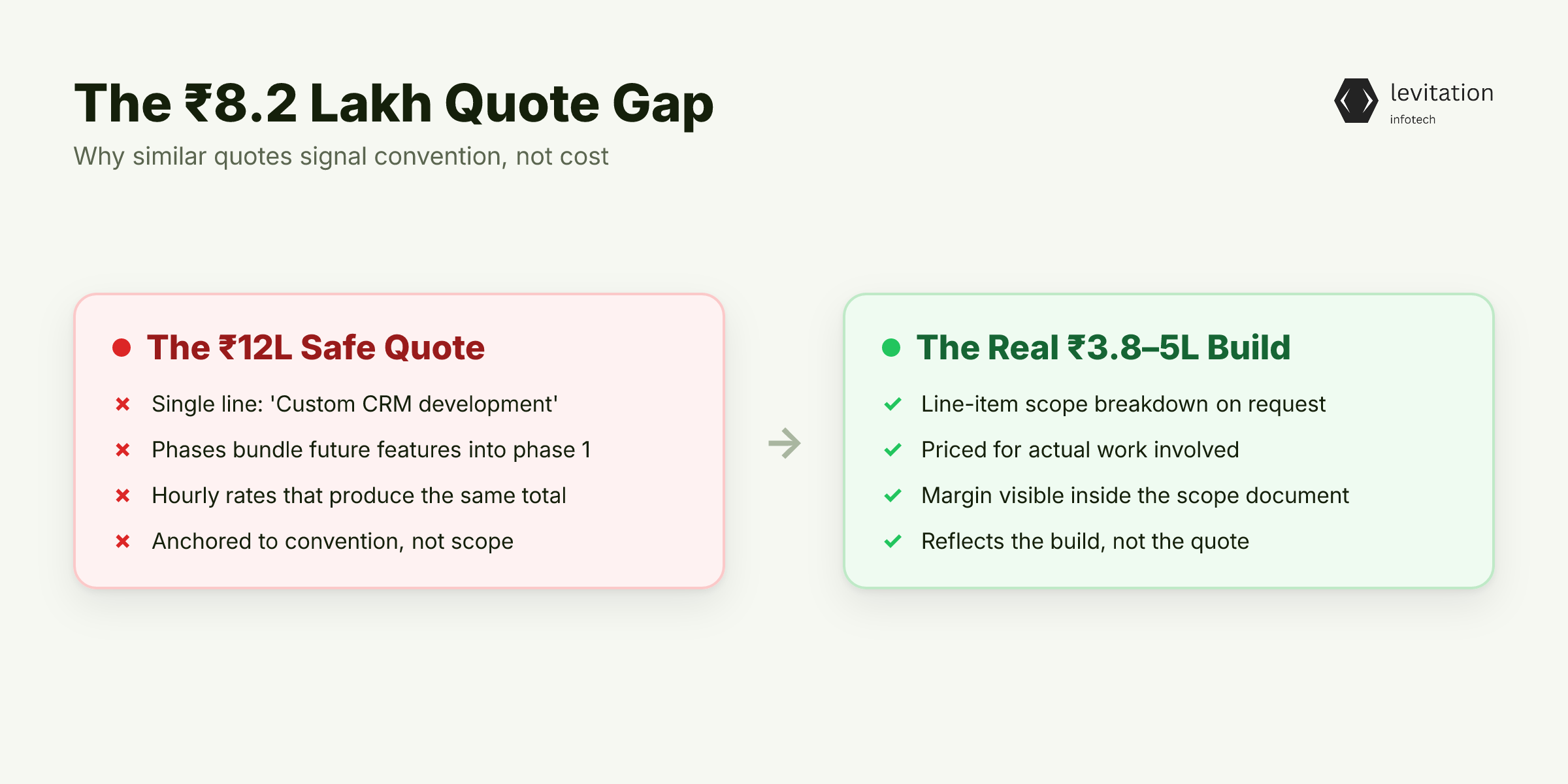
Similar quotes feel like market validation. They reflect convention. Noida agencies have settled on ₹12 lakh as the safe quote for a mid-scope CRM. They anchor there regardless of the actual work involved.
The real cost of a focused CRM development cost in India build sits between ₹3.8 lakh and ₹5 lakh. That's the number an agency gives when it's actually building, not when it's protecting margin.
Consider what happens when you ask for a line-item breakdown: - You'll get a single line: "Custom CRM development" - Or you'll get phases that bundle future features into phase 1 - Or you'll get hourly rates that magically produce the same total
None of this is coincidence. The clustering is a pricing norm. Founders who compare only on price never see the margin hiding inside. They only see "all three say roughly the same, so this must be the market rate."
But the quote isn't arbitrary. The difference hides in plain sight inside the scope document. Once you see how it's built, you can't unsee it.
How Noida Agencies Engineer the ₹12 Lakh Quote
Scope inflation begins in the discovery call. A founder says "we need reporting" and the agency translates that into "custom analytics dashboard with role-based filters and exportable pivot tables." Vague asks become detailed line items. The brief got heavier, and the price followed.
Then comes the future-proofing upsell. Agencies bundle phase 2 features into the phase 1 quote to lock budget: - Native mobile apps for iOS and Android - AI lead scoring - WhatsApp Business API integration - Custom report builder - Marketing automation
Each of these is a real feature, and none of them belong in phase 1. By including them, the agency inflates scope to justify the inflated price.
The founder gets a quote that looks comprehensive but is actually a wishlist with a delivery date.
The CRM development process breaks down differently when you strip the inflation. Sales-led discovery inflates scope because the sales team is paid on deal size, not delivery efficiency.
Founders accept the inflated scope because they don't know what a baseline CRM actually requires. The agency has no incentive to tell them.
So what's actually inside a real CRM build? Strip out the scope inflation and you're left with four variables that move the price. Most of them are smaller than agencies make them sound.
The Four Variables That Actually Move CRM Cost
Feature scope is the biggest variable. A CRM with a focused core feature set costs far less than a bloated multi-feature build. The core includes contacts, pipeline, tasks, notes, email log, basic reporting, user roles, activity tracking, search, and CSV export. Agencies inflate this variable first because it's the easiest to expand without adding real engineering work.
Integrations are the second variable, and they're priced per piece. Each one (Tally, WhatsApp Business API, payment gateway, ERP, telephony) is a sub-project.
The per-integration pricing is real because each one breaks independently. What gets inflated is the number of integrations agencies propose in phase 1.
Platform choice matters more than founders realize. A web-only CRM (responsive, single codebase) costs less than web plus native iOS plus native Android. Most sales teams don't need native mobile in year one. Agencies include it because the line item is high-margin.
Data migration is the silent cost driver. Historical contacts, deal records, and notes from spreadsheets or a defunct CRM add engineering work. This work is often quoted as "free" in the original proposal. Then it gets billed as a change order once the build is underway.
What does not meaningfully move cost? AI features, blockchain, "advanced analytics," custom-branded mobile apps in phase 1. These are scope-inflation theatre. The CRM software development line item doesn't get bigger because you added the word "AI" to a feature.
Production systems still running long after deployment share a common trait. Phase 1 stayed tight around the actual sales workflow, not expanded into a Salesforce replacement on day one.
Knowing the four variables is half the battle. The other half is knowing which features you can defer to phase 2 without breaking the sales team's workflow. That's where the ₹3.8 lakh build comes from.
How to Get a ₹3.8 Lakh Build Without Cutting Corners
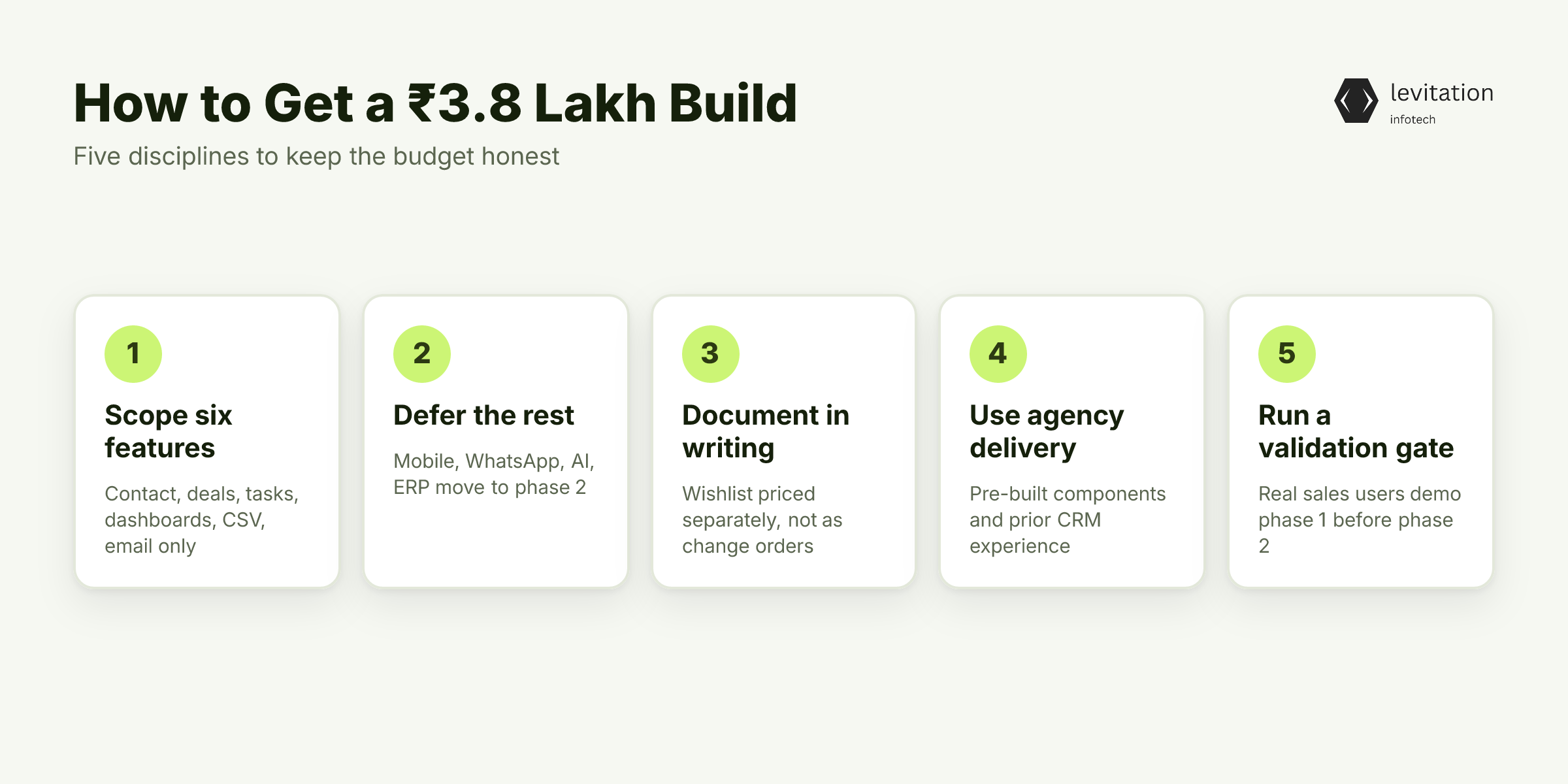
Phase 1 scope must include exactly six features: - Contact management - Deal pipeline with custom stages - Activity and task logging - Basic role-based dashboards - CSV import and export - Email integration
Nothing else. A custom CRM that does these six things well is worth more to a sales team. It beats a ₹12 lakh system that does 30 things poorly.
What gets cut from phase 1? Native mobile apps, WhatsApp integration, custom report builder, AI lead scoring, ERP integration, marketing automation. None of these block a sales team from closing deals this quarter. All of them belong in phase 2.
The key discipline is cutting from the phase 1 budget, not from the roadmap. Document the deferred features as a phase 2 wishlist. Get them in writing. Price them separately. This protects you from the agency that promises phase 2 features and then bills them as change orders.
The deployment approach is where agencies earn their keep. A phased custom CRM build uses pre-built CRM components and prior delivery experience. This is the entire reason agencies can price phase 1 at ₹3.8 lakh and still make margin. An in-house team hiring two engineers needs more time to ramp and build those components from scratch.
Before phase 2 begins, require a validation gate. The agency demos the phase 1 build to a few actual users from your sales team. Their feedback shapes phase 2 scope. This is the step most founders skip, and it's why so many over-scoped builds get half-adopted.
What ₹3.8 lakh delivers in concrete terms: - Senior engineering hours scoped to the six core features - A single web application - Full source code ownership
The phased build works because the alternative, a ₹12 lakh feature dump, almost never gets fully adopted by the sales team. But there's a related decision founders keep getting wrong: when does Zoho actually beat custom?
Custom CRM vs Zoho: The Per-Seat Math Breaks Over Time
Zoho CRM's per-seat pricing means costs scale linearly with team size. The moment you need workflow automation, custom modules, or API-heavy integrations, you move to higher tiers. The per-user bill grows accordingly.
The break-even math is straightforward: per-seat costs compound as headcount grows, while a custom CRM's maintenance stays flat.
When Zoho wins: - Very small teams with standard B2B sales workflows - No ERP, no Tally, no India-specific compliance needs - Teams that need CRM running in a week, not in a phased build
When custom CRM cost wins: - Larger teams where per-seat compounding dominates the cost picture - India-specific integrations (Tally, GST, WhatsApp Business API at scale) - Workflows Zoho can't model without custom modules that cost more than building standalone
The hidden cost SaaS quotes never show is per-seat compounding. A large sales org pays a recurring annual bill to Zoho. They get the same workflow a custom build delivers for ₹3.8 lakh upfront plus modest annual maintenance. This is exactly the trap we broke down in our Zoho cost analysis.
When evaluating CRM application alternatives, the build-vs-buy decision matters less than the build quality of whichever path you pick. So what does ₹3.8 lakh actually deliver operationally, and why do systems built this way stay in production long after deployment?
What ₹3.8 Lakh Buys: The Long-Term Operational Picture
A CRM system built at this price point delivers something SaaS can't: full ownership. You own the source code, the database, and the deployment credentials. The system is built around your actual sales pipeline stages, not a generic pipeline forced into your process.
Maintenance runs ₹2,000 to ₹10,000 per month for hosting and minor changes. This is flat, not per-seat. It doesn't grow when you hire more salespeople. Compare that to a SaaS bill that scales linearly with headcount.
Iteration speed is the underrated benefit. A focused internal CRM lets you ship a new field, report, or automation in a week. The codebase is small and the original engineers know it. A SaaS CRM makes you wait for the vendor's roadmap.
Longevity signal: production systems still running long after deployment share three traits: - Tight phase 1 scope - One tech stack - No abandoned phase 2 features
The operational payoff is that you're not re-platforming in year 3. That's the typical lifecycle of an over-scoped ₹12 lakh build. At Levitation, the pattern holds across engagements. The discipline of saying no to inflated scope in phase 1 keeps the codebase small enough to maintain over the long term.
What you skip and why it doesn't matter in year 1: AI scoring, mobile apps, marketing automation. None of these affect whether a deal closes this quarter.
Frequently Asked Questions
How much does a custom CRM cost in India in 2026?
A focused custom CRM in India in 2026 costs ₹3.8 lakh for a phase 1 build with core sales features. Full-scope builds with native mobile apps, multiple integrations, and custom analytics run ₹8 to ₹12 lakh. Anything quoted above ₹12 lakh usually includes phase 2 features bundled into phase 1. This inflates the scope without delivering proportional value.
How long does a phased custom CRM build take?
A phased custom CRM with core features (contacts, pipeline, reporting) uses an experienced agency's prior CRM delivery. It ships faster than an in-house team building components from scratch. An in-house team of two engineers typically needs more time. The gap comes from hiring ramp-up and the lack of pre-built CRM components. The speed difference comes from prior CRM delivery experience, not from cutting corners.
Is a custom CRM cheaper than Zoho for a small team?
For very small teams with standard B2B sales workflows, Zoho is cheaper in year 1. As headcount grows and per-seat costs compound, custom CRM becomes cheaper. The same applies to any team needing Tally, WhatsApp Business API, or GST-integrated workflows. Per-seat costs compound while custom maintenance stays flat.
What features should a phase 1 custom CRM include?
Phase 1 should include contact management, deal pipeline with custom stages, activity and task logging, basic dashboards, CSV import and export, and email integration. Defer native mobile apps, WhatsApp integration, report builders, AI lead scoring, and ERP sync to phase 2. Real users should validate the core workflow first.
Why do CRM development quotes in Noida vary so much between agencies?
Quoted prices vary because agencies interpret scope differently, not because engineering costs differ wildly. A ₹3.8 lakh quote and a ₹12 lakh quote for the same brief usually reflect two different feature lists. The cheaper one assumes a phased build with core CRM features. The expensive one bundles mobile apps, AI features, and future-phase integrations into phase 1. Ask any agency to break out phase 1 cost separately, and the gap usually narrows dramatically.
If your brief is sitting in front of three Noida agencies right now, ask each one for a phase 1 line-item quote before you sign anything.
Sources
Research and references cited in this article:
- Custom CRM Development Cost in 2026: Pricing Breakdown & Timeline
- Custom CRM Development Cost in 2026: an In-Depth Guide
- Custom CRM Development Cost in 2026 - Perimattic | Perimattic Blog
- Insights on Custom CRM Development Cost
- Medium
- Custom CRM Cost India 2026: vs Zoho & Salesforce Compared
- Salesforce vs Zoho CRM: The Ultimate Comparison for Businesses | Which CRM Is Best in 2026?
- Why Zoho CRM Is a Great Fit for Small and Medium Businesses
- Salesforce vs Zoho CRM: Truth About Pricing & AI
- Zoho CRM Review 2026: Is It Worth It for Small Business? (Pricing, Pros & Cons Explained)
- Custom CRM vs Ready-made CRM: Pros & Cons Guide 2026
- Salesforce vs Custom CRM: Smarter Long-Term Investment
About the author
Mayank Singh is a software developer at Levitation Infotech, where he builds web and AI-powered applications across the company’s fintech, healthcare, and enterprise projects.