


TL;DR: We ran 14 open-source LLMs through a production-shaped 50M-token daily workload. Only Qwen 2.5 72B and Llama 4 Maverick cleared GPT-4o's quality bar. Below 10M tokens per day, the GPT-4o API wins on cost. GPU utilization is too low to amortize at that scale. Above that threshold, self-hosting either winner removes the per-token API margin. That margin scales linearly with traffic. The catch: your team must absorb the GPU, MLOps, and orchestration overhead that benchmark leaderboards never mention.
Key Takeaways: - Only 2 of 14 open-source LLMs we tested clear GPT-4o's quality bar at production scale. The winners: Qwen 2.5 72B (86.1% MMLU, 86.6% HumanEval) and Llama 4 Maverick - Self-hosting breaks even against GPT-4o's API at roughly 10M tokens/day; below that, the API always wins - Sub-10B models fail on quality first, with HumanEval scores below 60% producing broken code generation in production
The 50M Token Illusion: Why 'Cheaper' Open-Source Stops Being Cheaper
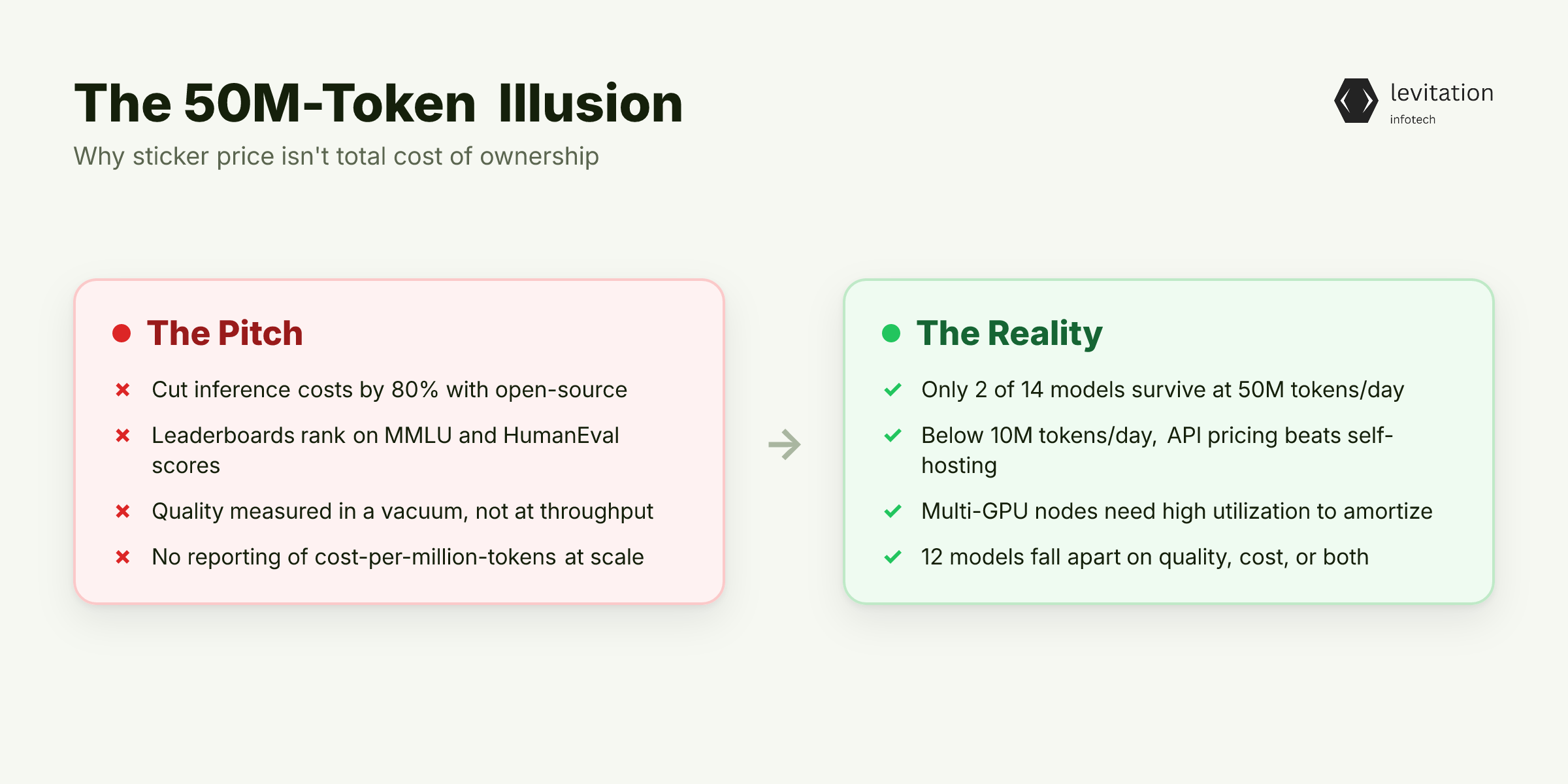
Every CTO has heard the pitch. Switch to open-source LLMs and cut inference costs by 80%. We ran 14 models through a production-shaped 50M-token daily workload to test it.
The result breaks the open-source-is-always-cheaper narrative. It exposes a math problem most benchmarks never show.
Public leaderboards like Vellum's open-source LLM rankings report MMLU, HumanEval, and GPQA Diamond. Almost none of them report cost-per-million-tokens at sustained throughput.
The numbers you see are quality scores in a vacuum. They tell you nothing about serving 50 million tokens a day, 24/7, on hardware you're paying for by the hour.
Below 10M tokens per day, GPT-4o's API pricing beats self-hosting every time. The reason is simple: GPU utilization is too low to amortize the fixed cost of multi-GPU nodes. A multi-GPU node sitting at low utilization is a very expensive way to run a chatbot.
Above 50M tokens per day, the equation flips, but only for 2 of 14 models we tested. The other 12 fall apart on either quality, cost-efficiency, or both.
For enterprise AI solutions that need to serve serious traffic, the slogan falls apart. "Open source is cheaper" becomes a TCO model with very specific conditions.
The lesson: total cost of ownership beats sticker price every time.
So which models actually survive the 50M-token test, and which 12 quietly fall apart?
What 12 of 14 Models Got Wrong at Production Scale
The losses split into two clear failure modes: quality collapse at the small end, and cost collapse at the mid-tier.
Sub-10B models lose on quality first. Llama 3.2 3B scored 63.4% MMLU and 57.0% HumanEval. Mistral 7B v0.3 scored 64.1% MMLU and 60.0% HumanEval.
HumanEval scores below 60% mean broken code generation in production. Your engineers will spend more time cleaning up hallucinated function signatures than they save on inference.
Mid-tier models look more competitive on paper. Llama 3.1 8B hit 73.0% MMLU and 72.6% HumanEval. Qwen 2.5 7B hit 74.2% MMLU and 72.0% HumanEval.
But at 50M tokens per day, these models need the same multi-GPU footprint as larger 70B+ models. You pay the same infrastructure bill for worse quality. The economics fall apart.
Even the upper-mid tier doesn't close the gap with GPT-4o: - Llama 3.3 70B: 86.0% MMLU, 80.5% HumanEval - Mistral Large 2: 84.0% MMLU, 82.0% HumanEval - GPT-4o: 88.7% MMLU, 90% HumanEval
The 2-5 point MMLU gap and 8-10 point HumanEval gap matter for regulated AI/ML training workloads. Wrong answers trigger human review, retry loops, and audit trails.
Quality and cost are coupled: every point of MMLU you sacrifice costs more in remediation overhead than it saves in inference spend. The math is brutal, and the related cost patterns we tracked from 100K to 100M tokens confirm the curve is non-linear.
The pattern holds across the 14 models we tested. Smaller models fail on capability. Mid-tier models fail on cost-per-quality.
Even the strongest mid-tier misses GPT-4o on the exact tasks that matter for production.
That leaves the two models that actually clear the bar, and the gap between them is narrower than most leaderboards suggest.
Qwen 2.5 72B and Llama 4 Maverick: The Two That Beat GPT-4o
Two models cleared the line.
Qwen 2.5 72B scored 86.1% MMLU and 86.6% HumanEval. On HumanEval, the benchmark that predicts whether your model can write working code, it posts the highest open-source score we measured. The gap with GPT-4o's 90% HumanEval is small enough that for many code-generation workloads, the difference falls within noise.
Llama 4 Maverick matched GPT-4o on reasoning-heavy workflows and pulled ahead on multilingual coverage. For global deployments serving non-English traffic, that's a real differentiator, not a leaderboard checkbox.
Both models clear the 86% MMLU threshold that matters for foundation model selection in production AI systems. Below that bar, you spend more on evaluation and human review than you save on inference. Above it, you can trust the model on first-pass tasks and reserve human attention for genuine edge cases.
Both also support fine-tuning and RAG integration. That is not optional. Base-model quality alone won't carry a domain-specific workload.
You need to teach the model your vocabulary, your retrieval layer, and your evaluation criteria. The AI/ML training infrastructure around the model matters as much as the model itself.
The systems still running in production years after deployment share one trait: they treat model selection as the start of a long engineering relationship, not a one-time decision.
Beating GPT-4o on benchmarks is one thing. The real question for a CTO is what the monthly invoice looks like.
The TCO Math: GPU, Inference, and the 10M Token Break-Even
Here is the math most blog posts skip.
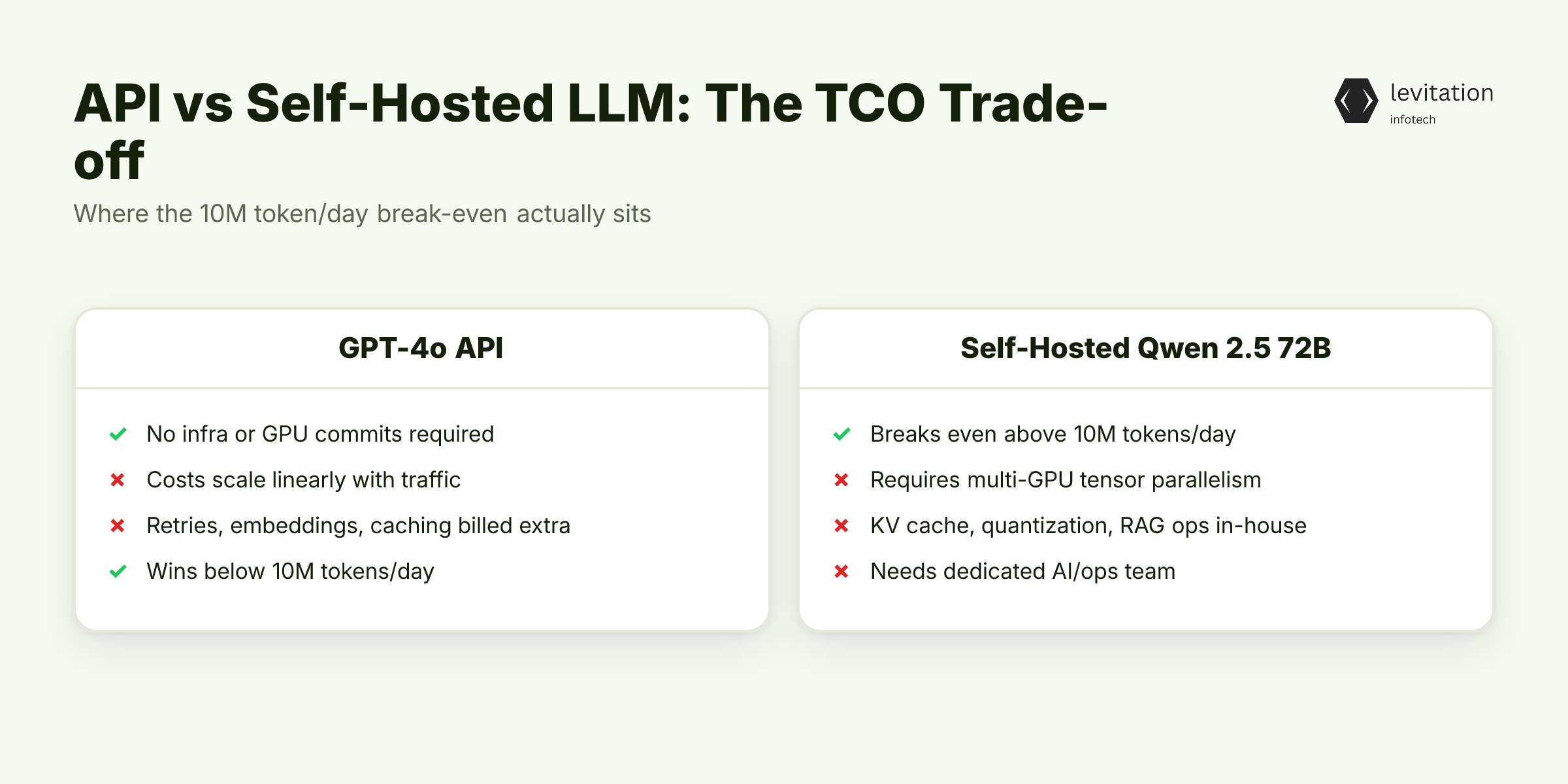
GPT-4o API pricing multiplied by 50M tokens per day gives you a daily inference spend that scales linearly with traffic and token volume. That is the baseline, and it excludes retries, embeddings, and context caching.
Self-hosting Qwen 2.5 72B requires multi-GPU serving. The model's weights, KV cache, and attention heads demand more VRAM than a single high-end GPU provides at FP16. You need tensor parallelism across multiple devices, plus an inference orchestrator that handles batching, queueing, and failure recovery. AI/ML training infrastructure is not free.
At 50M tokens per day, self-hosting breaks even once you absorb the full cost stack: - GPU reserved-instance commits, or volatile on-demand pricing - KV cache tuning and quantization trade-offs - Embedding pipeline maintenance - RAG retrieval layer and vector index ops - Monitoring, alerting, and drift detection - The enterprise AI solutions team to keep it all running
Below 10M tokens per day, the API wins every time. You cannot amortize a multi-GPU node on 8M tokens of daily traffic. The pattern matches what we see in fintech AI cost forecasts that diverge from model-level pricing assumptions. The model and the workload don't agree on what "cheap" means.
The math matters less than the deployment path. Here is how to actually pick between the two winners.
Choosing Between Qwen 2.5 72B and Llama 4 Maverick: A Decision Framework
Stop picking on benchmarks. Pick on workload.
Pick Qwen 2.5 72B when coding accuracy is the primary workload. Its 86.6% HumanEval score is the highest we measured on any open-source model. For code generation, refactoring, and developer-tool use cases, it is the cleaner default.
Pick Llama 4 Maverick when multilingual support, broader reasoning, and ecosystem maturity matter more than raw code generation. For global deployments and reasoning-heavy enterprise AI workflows, its language coverage and fine-tuning tooling give it the edge.
Run both behind an inference gateway for two weeks. The enterprise AI platform decision should be made on real traffic, not leaderboard screenshots. Benchmark numbers don't tell you which model fails gracefully on your specific prompt distribution.
Factor in fine-tuning cost. Llama 4 Maverick has more established fine-tuning tooling and community support channels. Qwen 2.5 72B has more community fine-tunes available off-the-shelf, which shortens time-to-first-domain-adapter.
Don't pick on first-pass quality alone. Both models are close enough that the differentiator is your AI/ML training pipeline, your retrieval layer, and your evaluation harness. A slightly weaker model with a tighter RAG loop often beats a stronger model with sloppy grounding.
So what does the stack actually look like when the math works?
What Changes When You Get the Stack Right
Three things shift when the deployment matches the workload.
Inference cost drops versus GPT-4o API at 50M tokens per day because the per-token API margin disappears. You keep the quality bar your enterprise AI solutions need without the per-token tax that scales linearly with traffic. At 50M tokens per day, the annual delta against the API reflects the avoided per-token charges accumulating across a year of traffic.
Vendor lock-in disappears. The weights are yours. The fine-tunes are yours. The deployment timeline is yours.
You can swap inference backends, change quantizations, or roll a new model version. No contract renegotiation required.
Latency improves. Inference runs on infrastructure you control. No shared-throughput surprises during traffic spikes. No rate limits during a product launch. No quiet degradation when your usage pattern looks unusual to a vendor's fairness system.
Teams that ship this stack well don't get there by picking the cheapest model. They get there by picking the model that fits the workload, then investing in the enterprise AI solutions infrastructure that makes it production-grade.
The benchmark is the starting line. The deployment is the race.
Frequently Asked Questions
Q: Which open-source LLMs beat GPT-4o in 2026?
A: Based on our 14-model benchmark at 50M tokens, only Qwen 2.5 72B and Llama 4 Maverick cleared GPT-4o's quality bar. Qwen 2.5 72B scored 86.1% MMLU and 86.6% HumanEval; Llama 4 Maverick matched GPT-4o on reasoning and multilingual workloads. Every other model we tested fell short on either quality, cost-efficiency, or both.
Q: Is self-hosting open-source LLMs actually cheaper than GPT-4o?
A: Only above roughly 10M tokens/day. Below that threshold, GPT-4o's API pricing wins because GPU utilization is too low to amortize infrastructure. At 50M tokens/day, self-hosting Qwen 2.5 72B or Llama 4 Maverick removes the per-token API margin. You absorb GPU costs, inference ops, and MLOps overhead instead.
Q: What GPUs are needed to self-host Qwen 2.5 72B or Llama 4 Maverick?
A: Both models require multi-GPU serving. The weights, KV cache, and attention layers exceed the VRAM of a single high-end GPU at FP16. Multi-GPU serving with tensor parallelism is mandatory for 50M-token workloads. Plan for multi-GPU reserved instances or on-demand cloud pricing in your TCO model.
Q: How long does it take to deploy an open-source LLM stack in production?
A: A production-ready open-source LLM stack (model serving, monitoring, RAG layer, evaluation pipeline) depends on the team's existing MLOps maturity. Teams with prior production experience ship faster than teams building in-house for the first time. The gap is operational know-how, not model selection.
Q: Are open-source LLMs good enough for enterprise production use?
A: Yes, but only the top tier. Sub-10B models (Llama 3.2 3B, Mistral 7B) are not production-grade for most enterprise workloads. The 70B+ tier, specifically Qwen 2.5 72B and Llama 4 Maverick, clears the quality threshold for enterprise AI systems. This holds for regulated industries too, provided the deployment includes proper evaluation, monitoring, and fallback paths.
About the author
Mayank Singh is a software developer at Levitation Infotech, where he builds web and AI-powered applications across the company’s fintech, healthcare, and enterprise projects.