


TL;DR: A single afternoon saw malicious commits slip into 5,500+ GitHub repositories. The commits impersonated Dependabot-style automated contributions. They harvested cloud keys, CI/CD tokens, and AI service credentials straight from the build pipeline. For fintech, the attack didn't just leak source. It bypassed every existing control. The secrets were never committed in the first place. The fix is structural. Replace static CI/CD credentials with OIDC federation. Pin every action to an immutable SHA. Enforce runtime rotation. Done right, your pipeline itself becomes the audit evidence.
Key Takeaways: - The 5,500-repo attack targeted the pipeline, not the code. Secrets managers and SCA tools were blind to it. - OIDC + SHA-pinned actions + zero static credentials kills the entire class of credential theft the attack exploited. - A 72-hour hardening sprint turns a fintech compliance audit from a weeks-long scramble into provable, continuous control.
The 5,500-Repo Heist That Should Keep Every Fintech CTO Awake
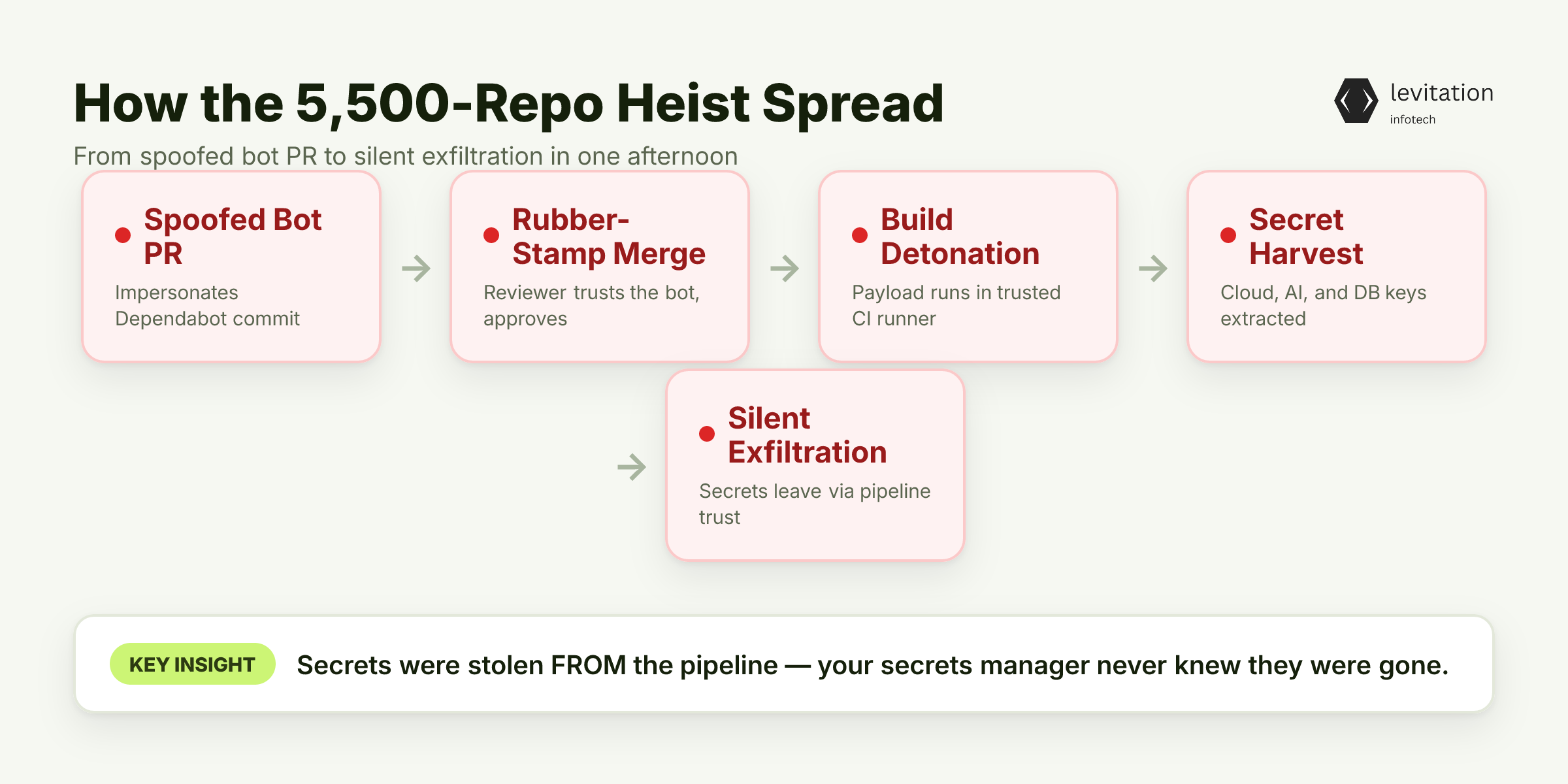
In a single afternoon, malicious commits disguised as routine automated contributions infected more than 5,500 GitHub repositories. They siphoned cloud credentials, CI/CD tokens, and AI service keys.
For fintech, this was never just a supply-chain story. It was a direct hit on the systems that move money.
The spread was measured in hours, not weeks. Attackers impersonated legitimate automated contribution flows. They used the same Dependabot-style commits every reviewer rubber-stamps without thinking. Once the payload landed inside a trusted workflow, it harvested everything the pipeline had access to. That included GitHub tokens, AWS IAM keys, and Google API keys. It also pulled an alarming volume of OpenAI and HuggingFace tokens.
The most exposed secret categories map directly to fintech's own stack. Cloud credentials for core banking software. MongoDB URIs for transaction stores. AI keys now used for fraud detection, risk scoring, and underwriting.
The dependency between a leaked IAM key and a compromised transaction database is a single exfiltration hop. No zero-day required.
The reason this attack spread so fast is mechanical. Dependabot-style PRs are auto-generated, low-ritual, and low-suspicion. Reviewers see a bot, see a version bump, and merge.
The malicious payload travels with the merge. It detonates at build time inside a runner the organization trusts.
But here's what makes this different from every other GitHub leak. The secrets weren't hardcoded by careless developers. They were extracted from the pipeline itself. Your secrets manager didn't even know they were gone.
Why Your Secrets Manager and SCA Won't Save You
A secrets vault secures storage and injection. It cannot stop a malicious action from reading the secret at runtime and exfiltrating it through an outbound network call. Once the payload runs in your trusted job, the secret your vault injected five seconds earlier is in the attacker's hands. The `AWS_ACCESS_KEY_ID` is now in the attacker's S3 bucket.
Software composition analysis reasons from manifests and known-bad databases. It cannot catch a trusted dependency that turns malicious at build time. This is the exact vector the 5,500-repo attack used.
SCA compares your lockfile against yesterday's vulnerability feeds. It has no model for "this package was clean yesterday, malicious today, and still signed by the same maintainer." For a deeper look at how pipelines get fooled by trusted signing paths, see Why Your Secure Pipeline Signs the Malware It Should Block.
Long-lived credentials in CI/CD systems are hard to rotate because every workflow depends on them. A rotation breaks every concurrent build, so teams defer it. Each day a leaked secret remains valid extends the attacker's window, and the deferred rotation becomes that window.
Redaction in CI logs is a bandage, not a fix. Obscure formats, second-order secrets, and split strings all bypass automated redaction. A token can hide inside a base64 blob, a JSON array, or an environment dump. The redactor only matches patterns it has been told to look for.
If the standard stack misses this, a question surfaces. What is structurally different about CI/CD in 2026, and why is the attack surface larger than it was two years ago?
The Two New Pressures Quietly Expanding Your Blast Radius
AI coding assistants are accelerating output and exposure in equal measure. AI-assisted repositories leak secrets at higher-than-average rates because the model has no concept of secret context. A copilot that autocompletes `const apiKey = "sk-..."` has no idea that string should never reach a file.
The same model that writes your fraud scorer at 3x speed writes your AWS credential into a config file at 3x speed. The blast radius from AI-assisted fintech code is just starting to surface. For more on this, see Vibe Coding Built a Compliance Debt Your Auditor Will Find.
The private-repo safety net is gone. Private repositories regularly contain plaintext secrets, and a single misconfiguration or access change can flip a private repo public in minutes.
Internal payment systems that teams assume are invisible are routinely mined. Attackers phish a single contractor with org access to find them.
Fintech adoption of OpenAI, HuggingFace, and vector databases for fraud detection and underwriting has created a new credential class. Most compliance frameworks don't yet enumerate it.
Auditors will ask about your AWS key rotation policy. They will not ask whether your `OPENAI_API_KEY` was leaked from a staging workflow six months ago.
The walls are coming down faster than the controls are being built. The fix is counterintuitive, and it requires eliminating static credentials from your pipelines entirely.
What Actually Stops the Bleed: OIDC, Immutable SHAs, and Zero Static Credentials
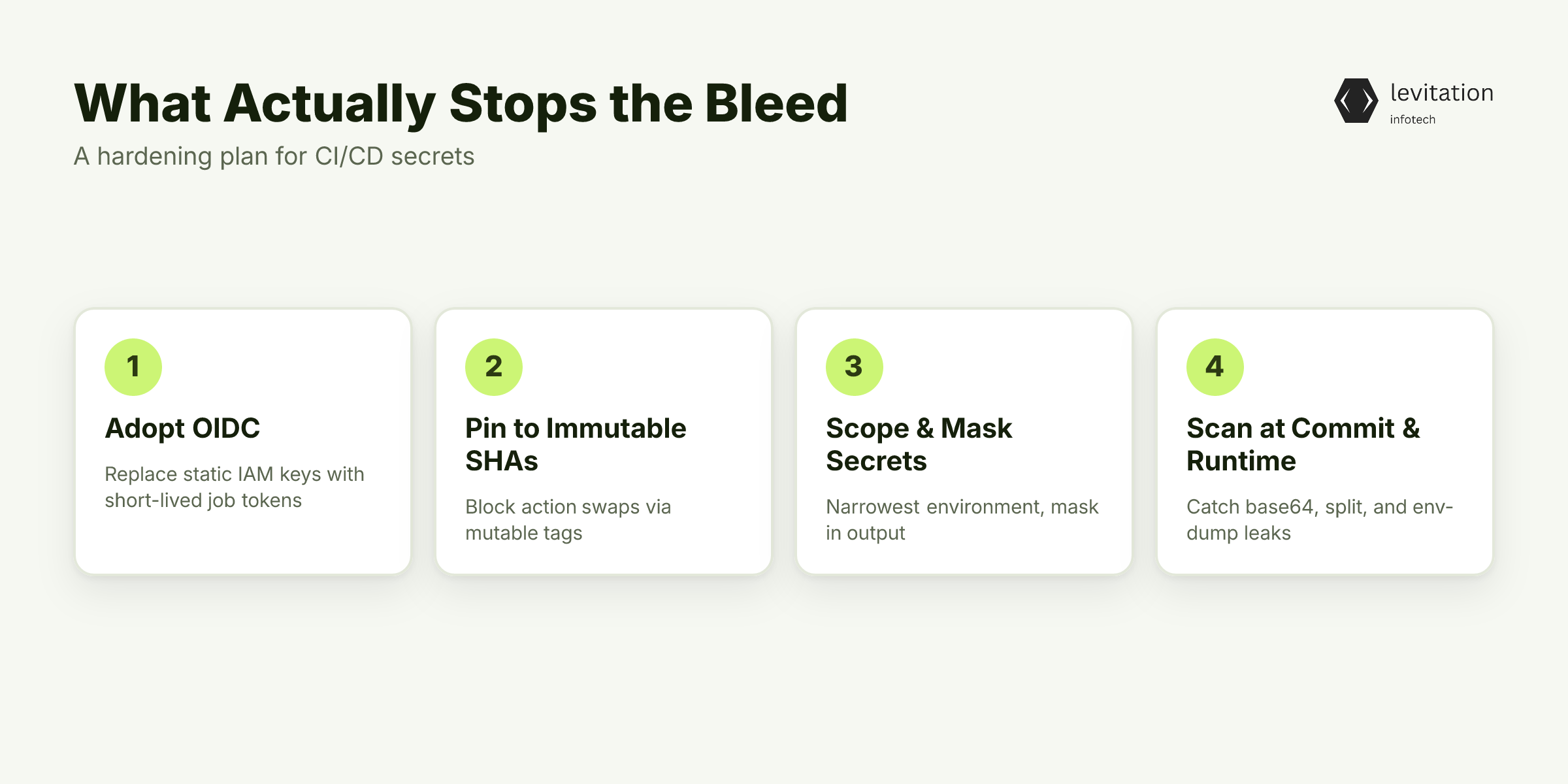
OpenID Connect between GitHub Actions and your cloud provider replaces long-lived IAM keys with short-lived tokens minted per job. There is no static secret to steal because none exists.
The job authenticates with a short-lived JWT. The cloud provider validates the token against the workflow's identity. The resulting session token expires when the job ends.
Pinning every third-party action to an immutable commit SHA prevents code swaps. An attacker cannot swap the action's code under the same name. This is the core of the 5,500-repo propagation method.
Mutable tags like `@v4` get redirected. SHAs cannot. For a financial technology team running 50+ workflows against production, the difference matters. Mutable tags let an attacker pivot in, while SHA-pinned actions hit them with a wall.
1# Mutable tag (vulnerable) - uses: actions/checkout@v423# Immutable SHA (safe) - uses: actions/checkout@b4ffde65f46336ab88eb53be808477a3936bae11 # v4.1.1
Secrets must be scoped to the narrowest possible environment. Mask them in job output. Never pass them to steps that don't strictly require them. Artifacts should never inherit workflow environment variables. They are the second-order leak that most redactors miss.
1permissions:2 contents: read # default-deny everything else3 id-token: write # only what's needed for OIDC45jobs:6 deploy:7 runs-on: ubuntu-latest8 environment: production9 steps: - uses: actions/checkout@b4ffde65f46336ab88eb53be808477a3936bae11 - name: Assume role via OIDC10 uses: aws-actions/configure-aws-credentials@v411 with:12 role-to-assume: arn:aws:iam::123456789012:role/GitHubOIDCDeploy13 audience: sts.amazonaws.com
Pre-commit hooks plus a runtime scanner that understands second-order secrets (base64, split strings, env dumps) close the gap that redaction misses. For broader context on how identity sprawl undermines defenses, see 45 Machine Identities for Every Engineer: Attackers Mapped Them First.
Theory is one thing. Here is the 72-hour hardening plan your platform team can run without freezing the release pipeline.
A 72-Hour Hardening Plan for Your GitHub Actions Pipelines
Day 1: Eliminate the supply-chain entry point.
Audit every workflow file for third-party actions. Replace every mutable tag with a full commit SHA.
Set explicit minimum permissions at the workflow and job level, defaulting to read-only. The default GitHub token is overprivileged by default. Lock it down job-by-job.
1# Add at the top of every workflow2permissions:3 contents: read4 pull-requests: read5# Add per-job where needed6jobs:7 build:8 permissions:9 contents: read
Day 2: Stand up OIDC for the highest-value jobs.
Migrate the highest-privilege jobs first, deploy and production promote, because those are the keys the 5,500-repo attack targeted. Register an OIDC trust in your cloud provider, map it to a narrowly scoped IAM role, and test against staging. The cloud provider's audit log will now show the exact workflow, commit, and actor for every session.
Day 3: Lock down the leak surface.
Wire a secrets scanner into every pull request with second-order detection enabled. Enable strict log redaction with allowlists.
Codify a rotation runbook. Any secret older than 90 days gets rotated automatically. The workflow is rejected at runtime. Bake the rotation check into a pre-deploy job.
1 run: |2 for secret in ${{ secrets.* }}; do3 age=$(./scripts/secret-age.sh "$secret")4 if [ "$age" -gt 90 ]; then5 echo "::error::Secret older than 90 days. Rotate before deploy."6 exit 17 fi8 done
Speed matters here. Every day the mutable tags and long-lived keys stay in place is a day an attacker can reach your financial technology stack.
The OIDC trust setup is the only non-trivial step, and it is well-documented. For background on how misconfigured scanners can give a false sense of safety, see Your Image Scanner Whitelists the Backdoor in Your Base Layer.
Once these controls are in place, the conversation with your auditor changes. You move from defending gaps to demonstrating provable controls, and that shift is where the real ROI lives.
What Compliance Looks Like When CI/CD Secrets Stop Being a Liability
OIDC-backed workflows give auditors a continuous, time-bound proof of identity for every production action.
No static key to present. No rotation evidence to scrape together. The cloud provider's own logs become your control evidence.
An immutable-action and least-privilege baseline maps directly to SOC 2 CC6.1 and PCI DSS 8.2.1. It turns a sprawling secrets inventory into a short, reviewable list.
After OIDC, the set of long-lived credentials shrinks to almost nothing. The auditor can verify that in minutes.
When the pipeline itself emits the audit trail, the math changes. A fintech compliance audit that once demanded weeks closes in days.
For an NBFC running weekly deploys, the difference is stark. A compliance team rebuilds audit trails by hand. A security engineer exports three log queries.
Frequently Asked Questions
What is a CI/CD secrets leak and why is it worse in fintech?
A CI/CD secrets leak occurs when credentials used by automated build and deployment pipelines are exposed. These credentials include cloud keys, database URIs, and API tokens.
The exposure can happen through logs, artifacts, or compromised workflows.
In fintech, the blast radius is larger. A single leaked IAM key can reach transaction databases and core banking software. It turns a code-side mistake into a financial and regulatory incident.
How did the 5,500-repo attack actually work?
Attackers injected malicious code into widely used upstream dependencies or GitHub Actions. Then they let Dependabot-style automated pull requests carry the payload into victim repositories.
Once a trusted workflow ran, the code harvested every secret the pipeline had access to. This included the GitHub token used to push to the repo. The attack spread further in hours.
Can GitHub Actions secrets be used securely, or should fintech teams avoid them entirely?
GitHub Actions secrets are safe for narrowly scoped, short-lived credentials. They should never hold long-lived cloud keys or production database passwords.
The 2026 best practice is to replace them with OIDC federation. OIDC mints a fresh, short-lived token per job. It removes the static credential from the attack surface entirely.
What is OIDC for CI/CD and how does it eliminate secrets?
OpenID Connect lets your CI job prove its identity to your cloud provider at runtime and receive a temporary, job-scoped token.
There is no long-lived secret to store, rotate, or leak. The token expires when the job ends. The cloud provider logs the exact workflow, commit, and actor that requested it.
How often should CI/CD secrets be rotated in a regulated environment?
Long-lived secrets discovered years after exposure can remain valid indefinitely. This is unacceptable for any fintech compliance audit.
A defensible policy includes automated rotation every 90 days at most. Immediate revocation is required on any suspected exposure. A runtime gate fails any workflow using a credential older than the threshold. Run the 72-hour sprint above with your platform team this week, and the next audit will close itself.
Sources
Research and references cited in this article:
- Nearly 13 Million Secrets Spilled Via Public GitHub Repositories - Infosecurity Magazine
- GitHub Actions Security Mistake Leaking Millions of Secrets
- How corporate data and secrets leak from GitHub repositories | CSO Online
- Lab: Detecting and Preventing Secret Leaks in CI/CD Pipelines
- GitHub - TupleType/awesome-cicd-attacks: Practical resources for offensive CI/CD security research. Curated the best resources I've seen since 2021. · GitHub
- Secrets Management For CI/CD Pipelines - Entro
- 7 Security and Compliance best practices for CI/CD Pipelines
- CI/CD Pipelines for Core Banking Applications
- GEN2141 Secure CI CD Pipeline Implementation for Fintech Compliance within compliance requirements - The Art of Service Academy
- 7 Security and Compliance best practices for CI/CD Pipelines
- Top 10 GitHub Actions Security Pitfalls: The Ultimate Guide to Bulletproof ...
- 7 GitHub Actions Security Best Practices (With Checklist)
About the author
Mayank Singh is a software developer at Levitation Infotech, where he builds web and AI-powered applications across the company’s fintech, healthcare, and enterprise projects.