


TL;DR: Your Sales Head signed a six-figure deal for a real estate CRM. Most agents still paste leads into Excel sheets from 2019. The root cause is not training, features, or price. The CRM is structurally wrong for how Indian brokers sell: from cars, site offices, and WhatsApp. A purpose-built, mobile-first CRM that wraps around WhatsApp ships in 3-6 months. That is the only path to adoption. Adoption is the only path to ROI.
Key Takeaways: - Adoption, not license count, is the real ROI metric for any real estate CRM deployment in India. - Enterprise CRMs lose to Excel because they assume a desk, a fixed seat, and a quiet hour that Noida brokers never have. - A custom CRM built around WhatsApp, mobile, and broker hierarchy can deploy in 3-6 months. It beats any 24-month internal build that never ships.
The ₹6 Lakh CRM Sitting Unused on Every Sales Head's Desktop
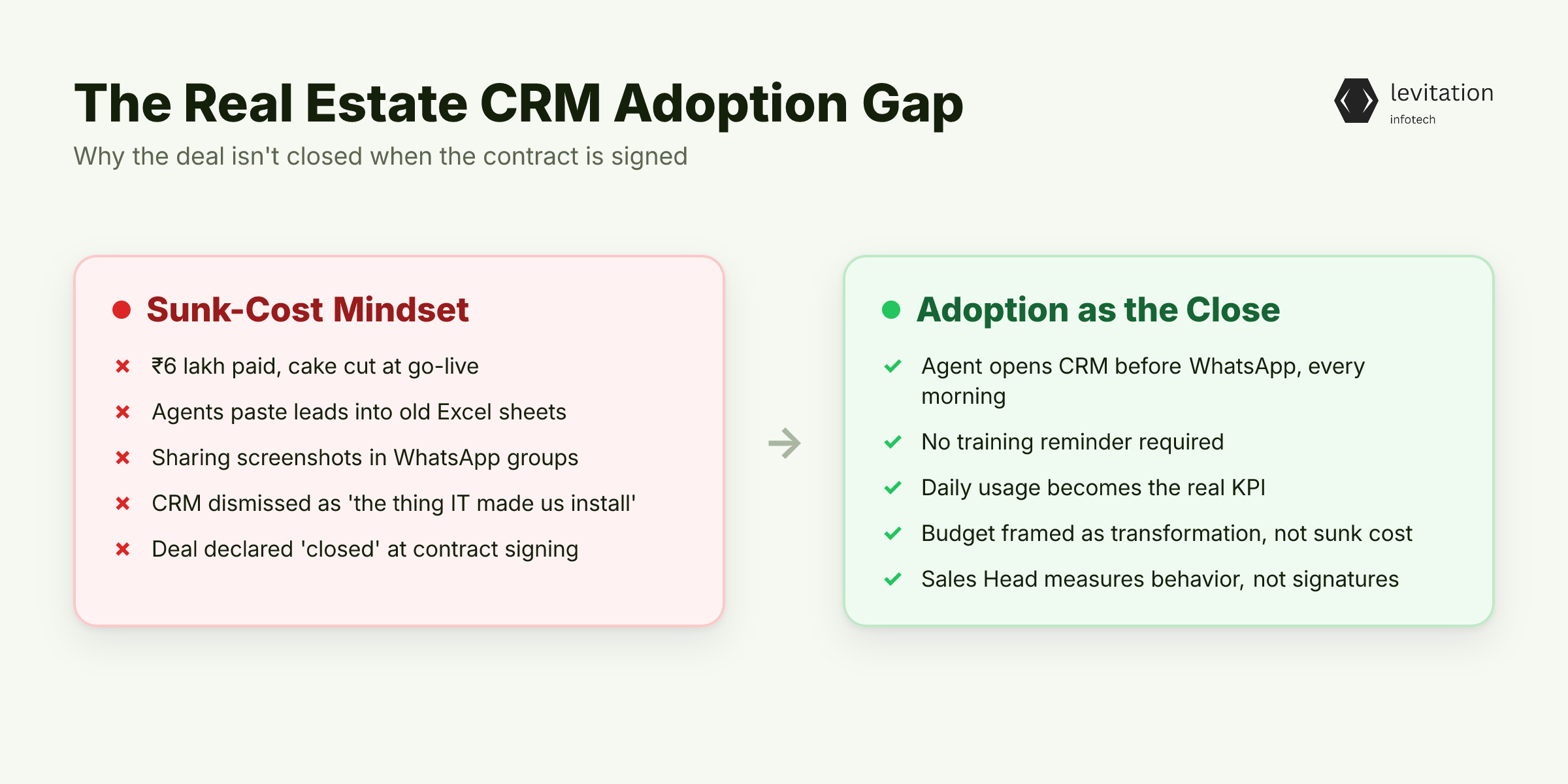
A Noida brokerage paid ₹6 lakh for a custom real estate CRM last quarter. The vendor celebrated go-live with a cake. Months later, most agents still paste leads into Excel sheets from 2019.
They share screenshots in WhatsApp groups. They call the CRM "the thing IT made us install." The licenses are active, the dashboards are built, and the cost is sunk.
This is not one bad deployment. Indian real estate sales crossed 6 lakh units last year. Noida carried a heavy share of that volume.
Lead volume in mid-size Noida brokerages runs into the thousands every quarter. Yet the default workflow at most agencies looks like a chai-stall huddle. One laptop. One Excel file. One WhatsApp group. A lot of memory.
The investment was made. Adoption did not follow. That gap is the real story. It has nothing to do with the price tag.
The Sales Head's blind spot is simple. They assume the deal closed when the contract was signed. It did not.
The deal closes the day an agent opens the CRM before they open WhatsApp, every morning, without being asked. Until that happens, every rupee spent is sunk cost dressed up as digital transformation.
Read the full breakdown of real estate CRM implementation challenges here.
The instinctive response is to blame the agent or schedule another training session. That instinct is exactly why the problem persists. So where does that leave the Sales Head looking for answers?
Why 'Better Training' and 'More Features' Won't Fix Adoption
The instinct to train harder or add features feels logical. It is also wrong.
Enterprise platforms like Sell.Do and LeadSquared ship with hundreds of fields, pipelines, and modules. On paper, that is power. On a broker's phone, after a six-hour day of site visits, it is friction.
The agent has a few seconds between calls to log a lead. They are not opening a 40-field form. They are opening Excel and typing a name and a number.
Training sessions teach the system. They do not rewrite the daily muscle memory of opening Excel and WhatsApp first.
A 2019 Excel file feels native. A CRM feels like homework. No amount of classroom time changes that hierarchy. Here is the real damage: - Every new field in a CRM adds a few seconds of data entry. Multiply that by every lead a broker touches in a day. - Agents type the same lead twice: once in the CRM for the boss, once in the sheet that actually gets read on Monday. - The more features a CRM ships with, the more fields an agent must fill, and the more likely they will quietly abandon it. - A parallel data entry tax is the fastest way to kill adoption. Every duplicate keystroke is a vote for Excel.
If features and training are not the lever, what is? The answer lies in the workflow itself, not the software.
The Workflow Mismatch No CRM Vendor Wants to Admit
Noida brokers do not work from desks with two monitors. They work from cars parked at construction sites, from site offices with no AC, and from chai stalls where the Wi-Fi is patchy and the lighting is worse. Their selling day is a moving day.
A CRM that assumes a fixed seat and a quiet hour is built for a job that does not exist. How Indian brokers actually track leads tells the same story.
The tool that wins opens in two seconds on any phone. It edits offline. It does not punish the user for skipping a field.
Excel wins not because it is better software. It wins because it fits the workflow. Three structural problems make enterprise CRMs fail this test: - Desktop-first design. Most enterprise CRMs still assume a keyboard, a mouse, and a full screen. Brokers live on a 6-inch phone. - Mandatory fields. Skip a field and the form refuses to save. Agents do not skip because they want to. They skip because the site visit ran over and the buyer is still on the line. - No WhatsApp integration. The buyer lives on WhatsApp. The agent lives on WhatsApp. The CRM sits outside that loop, logging conversations it never sees.
ROI in real estate CRM deployments ties directly to agent usage, not license count. Usage drops the moment the tool feels like extra work. Once that happens, the ₹6 lakh becomes a decoration on a dashboard no one logs into.
So if the existing CRMs are structurally wrong for the job, what does a CRM that Noida brokers actually open look like?
What a CRM Built for Noida Brokers Does Differently
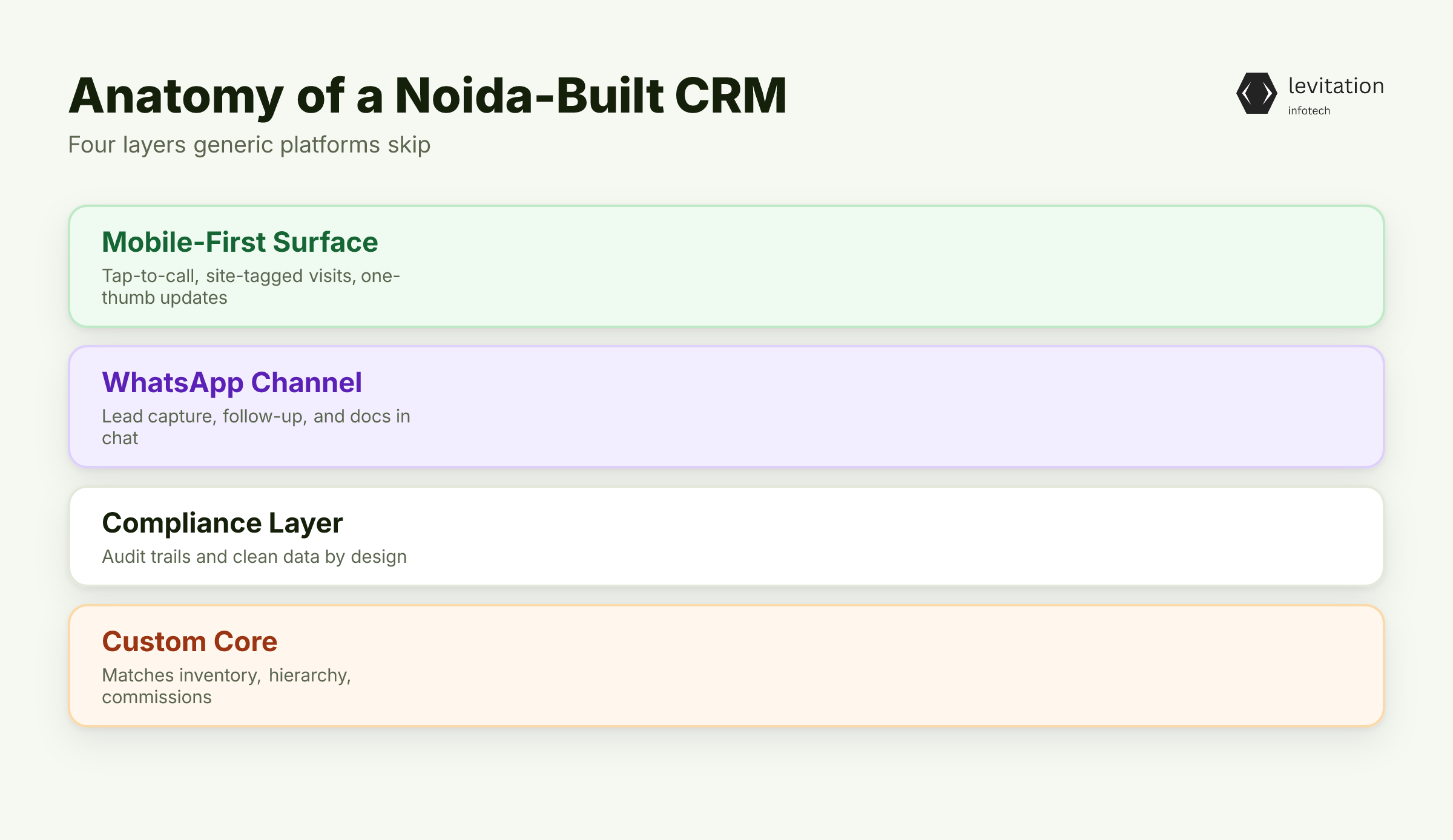
A purpose-built CRM for Indian real estate does not start with feature lists. It starts with the broker's day. Here is what changes when the design is driven by the workflow, not the vendor's template.
Mobile-First or It Dies
The entire interface must assume a phone, not a desktop. Tap-to-call on every lead. Location-tagged visits that auto-populate the lead record. One-thumb status updates that take less than a second.
If an agent cannot update a lead while standing at a construction site gate, the CRM is already dead. The phone is the desk, and the field is the office.
WhatsApp as the First-Class Channel
Noida buyers live on WhatsApp. Lead capture, follow-up, reminders, and document sharing should originate and end there.
The CRM is the silent brain behind the chat, logging every message, tagging intent, and triggering the next action. A CRM that ignores WhatsApp is asking agents to copy-paste conversations into a second tool. They will not.
Compliance and Data Discipline Without Bloat
A vendor experienced in regulated industries understands audit trails, role-based access, and clean data architecture. That same discipline, applied to real estate, means a CRM that survives an audit without bolting on enterprise modules.
The data model is clean by design, not by retrofit. See how regulated-industry CRM architecture works in practice.
Custom Beats Configured for Mid-Size Brokerages
Off-the-shelf platforms force every agency into the same pipeline. A Noida brokerage selling plotted development, builder floors, and commercial leasing has a different buyer journey in every segment.
A custom build matches the actual inventory mix, the broker hierarchy, and the commission structure of the firm. Custom real estate CRM development is not a luxury. It is the only way the tool fits the org chart.
A purpose-built CRM sounds expensive. The real cost question is how long the deployment takes and how soon agents start using it.
Migrating Years of Excel History Without Losing a Single Deal
The migration is where most CRM projects bleed trust. A broker hands over years of Excel data, and weeks later, half the columns are missing or renamed. The agent loses faith before the new tool goes live.
The fix is a four-phase plan that protects the data, the agent, and the deal. - Phase 1: Audit the existing Excel. Identify which columns actually get used, which are noise, and which contain the real buyer journey. Most Excel files carry more dead cells than live ones. Treat the live data with care. - Phase 2: Map, do not migrate blindly. Align Excel columns to CRM fields while preserving agent naming conventions. If an agent calls a lead "Hot-Sector-150," the CRM should accept that label on day one. Renaming fields is how you lose adoption before launch. - Phase 3: Run a 30-day shadow period. Excel and CRM coexist. The CRM becomes the source of truth only after data parity is proven. No agent is asked to abandon Excel until the new system has matched or beaten it for a full month. - Phase 4: Train in the field, not the conference room. Short, on-site sessions at the broker's actual desk beat day-long classroom workshops. Train at 7:30 AM, before the day starts. Train at the chai stall. Train where the work happens.
Deployment timelines for purpose-built CRMs typically run 3-6 months, versus 24 months or more for in-house teams building from scratch.
The deciding factor is not the feature list. It is whether the agent opens the tool on day 31 without being reminded. See the full CRM migration playbook and browse our enterprise CRM case studies.
Adoption is the metric, not the launch date. So how does a Sales Head measure whether the new CRM is paying back the ₹6 lakh?
The ROI Math That Actually Matters for a Sales Head
Forget the vendor's projected ROI. Track three numbers every week, in a one-page report, on Monday morning: - Daily active agents. Not logins. Real, distinct agents who entered or updated at least one lead. - Leads touched per agent per day. A proxy for follow-up discipline. - Average time from lead capture to first follow-up. The lower this number, the higher the conversion.
Excel-driven workflows lose real leads to dropped cells, missed follow-ups, and forgotten status updates every month. Recovery of even half that leakage repays a ₹6 lakh CRM in under two quarters.
The math is not complicated. The discipline is. Here is the test that matters more than any dashboard: - The CRM that wins is the one agents open before they open WhatsApp. Measure that order of operations. - A 3-6 month deployment with weekly adoption reviews outperforms a 24-month internal build that never ships to the field. - A track record of cross-industry enterprise deployments is the proof point that rigour built for regulated sectors applies to real estate.
Book a CRM adoption review if you want to pressure-test your current deployment against these three numbers.
Frequently Asked Questions
Why do real estate agents resist using CRM software?
Agents resist CRMs that add data entry work, slow down their day, or fail to integrate with WhatsApp and mobile calls. Adoption rises only when the CRM is faster and easier than the Excel sheet it replaces.
If the agent has to think before logging a lead, the agent will not log the lead. Friction kills data, and dead data kills deals.
How much does a custom real estate CRM cost in India?
Custom real estate CRM development in India varies widely depending on features, integrations, and compliance needs. The cost is justified only when agent adoption is measured and enforced.
A cheaper CRM nobody opens costs more over time than a well-built CRM that most agents use daily. Price without adoption is decoration.
How long does it take to deploy a real estate CRM?
A purpose-built CRM for a mid-size Noida brokerage usually deploys in 3-6 months, compared to 24 months or more for an in-house team building from zero.
Shorter timelines mean agents start using the system before Excel workarounds take root. Speed is a feature.
Can a real estate CRM integrate with WhatsApp?
Yes. Modern real estate CRMs integrate with WhatsApp Business APIs to capture leads, send follow-ups, and log conversations automatically. This is essential for Noida brokerages where WhatsApp is the primary buyer channel.
A CRM without WhatsApp integration is a CRM the agent will work around. The chat is the workflow.
Is Excel sufficient for managing real estate leads?
Excel works for a small handful of active leads. It breaks at scale. Lost rows, missed follow-ups, and no audit trail are the failure modes.
As lead volume grows, spreadsheet errors compound. Brokers lose many opportunities. The tool was built for finance, not for chasing property leads.
If your CRM is gathering dust on a desktop, book a 30-minute adoption review and bring one Excel file.
Sources
Research and references cited in this article:
- Best Real Estate CRM Software in India in 2026: The Complete Guide for Builders, Brokers, and Agents
- Real Estate CRM Features 2026: What Matters Most?
- Best CRM for Real Estate Agents in 2026
- Real Estate CRM Software 2026: How Top Agents 10X Their Deals
- Real Estate CRM Comparison: 2026 Top Picks
- Real estate CRM adoption study 2026: why agents still use spreadsheets | Pinova | Pinova
- Top 10 Real Estate CRM Software in India (2026 Guide)
- 10 Best Real Estate CRM Software India 2026
- Real Estate CRM: Guide for Brokers, Agents and Businesses
- Top 5 Real Estate CRM Features to Scale Your Business
- The 9 Best Real Estate CRM for Every Budget in 2026
- The #1 Real Estate CRM Agents Are Switching to in 2026
About the author
Mayank Singh is a software developer at Levitation Infotech, where he builds web and AI-powered applications across the company’s fintech, healthcare, and enterprise projects.