


TL;DR: AI agents now outnumber human identities 80 to 1 in enterprise environments. However, they inherit the broad permissions that were originally designed for engineers who exercise judgment. Traditional IAM assumes humans in the loop, and this makes it the wrong model for autonomous software. The fix is agentic IAM. It includes unique identities per agent, short-lived scoped tokens, and runtime authorization. It also adds full lifecycle management. As a result, it turns least privilege from a hope into an enforced boundary.
Key Takeaways: - Agents outnumber humans 80 to 1 in enterprise environments. They inherit permissions that scale risk beyond what any single engineer could cause. In effect, they magnify the blast radius of every mistake. - Human IAM assumes static roles, manual provisioning, and after-the-fact audits. None of those survive machine-speed execution or short-lived agent lifecycles. As a result, the old model breaks under autonomous load. - The fix is agentic IAM. It includes scoped identities, short-lived tokens, and runtime policy enforcement. It also adds an inventory every security team can query in real time. In practice, this turns hope into proof.
Your senior engineer has admin access but uses it carefully. Your AI agent has the same access and uses it carelessly. No concept of blast radius. No intuition about risk. No career on the line.
That gap is the quiet crisis inside every enterprise running agents in production. The permissions weren't broken when a human held them. They become broken the moment an autonomous actor picks them up. In other words, the risk is built in, not added later.
Your AI Agent Doesn't Exercise Judgment. It Exercises Permissions.
Most engineering teams don't notice the problem until something fails. An AI agent escalates privileges to complete a task. A cleanup script fires against a production database. A reasoning loop makes a hundred API calls because it can, not because it should.
The pattern is always the same. A developer wires an agent to a cloud environment. The agent inherits the developer's IAM role. The role was broad because the developer needed flexibility to ship. In that moment, no one planned for an autonomous actor.
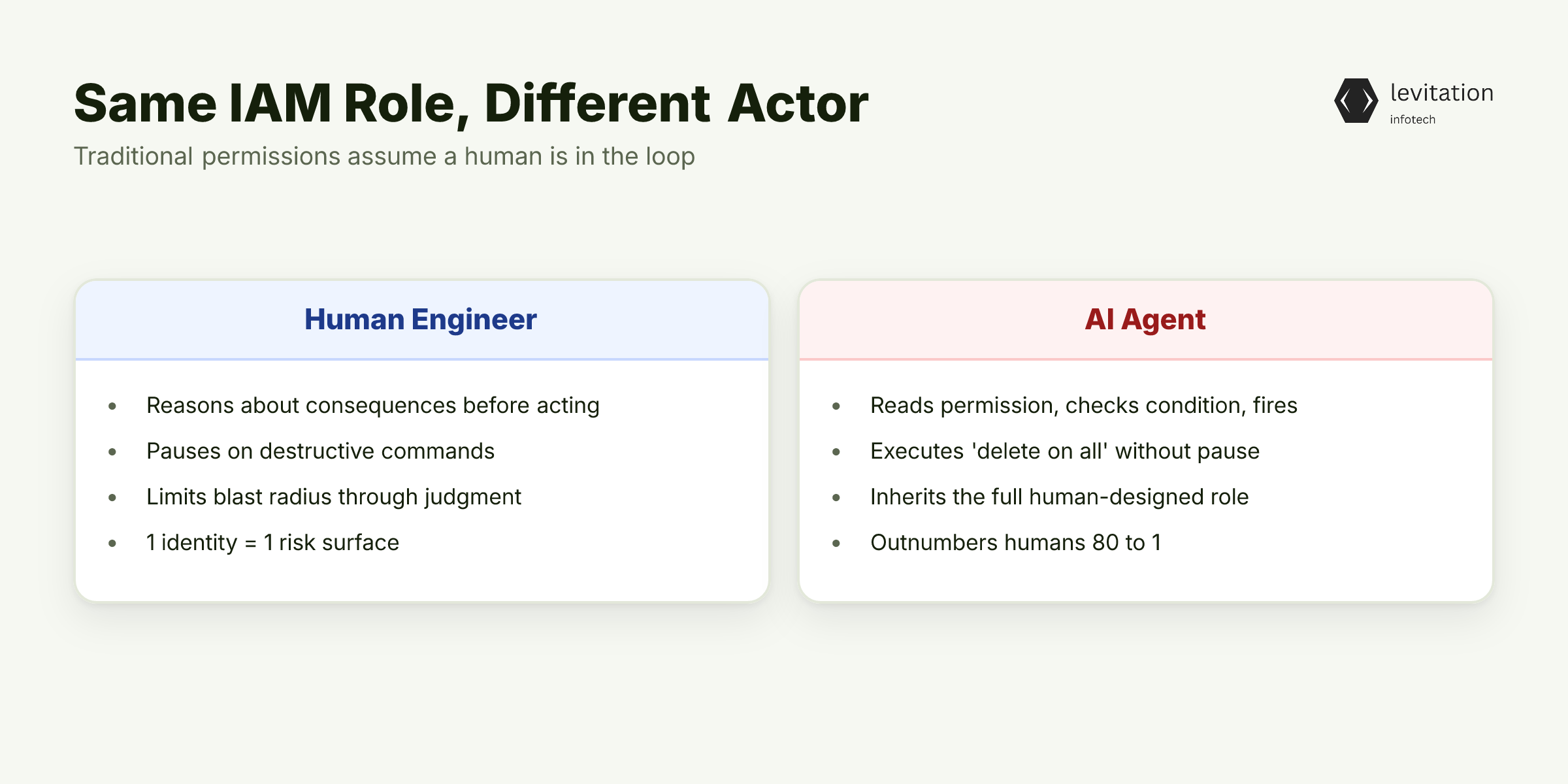
Now the agent holds the same role. The role was designed for a human. A human would pause, think, and reconsider before hitting "delete on all." Agents don't pause. They execute.
The security model that worked for your senior engineer collapses when the actor is a machine. Engineers carry intuition about consequences. They know that dropping a table in production means a 3 a.m. page. Agents carry nothing. They read a permission, check a condition, and fire. The result is an attack surface that scales faster than your governance team can keep up. AI agents now outnumber human identities 80 to 1 in enterprise environments.
The security model assumes a human is in the loop. With agents, the loop is the agent. As a result, the safety net is gone.
Most teams notice the problem only after an agent escalates privileges it should never have had. The question is why traditional IAM let it happen in the first place. In practice, the answer is simple: it was never built for this.
Why Traditional IAM Was Built for the Wrong Actor
Human IAM was built for a world of static identities. A person joins a company. They get a role. They keep that role for months or years. When they leave, an offboarding process revokes access. Audit logs capture what they did, after the fact.
None of this survives contact with AI agents. Agents are short-lived. They spin up, call APIs, finish a task, and disappear. The identity system that issued their credentials is left with orphaned keys and untracked actions. Your IAM inventory becomes a graveyard of service accounts no one remembers creating.
Agents form delegation chains. One agent triggers another, which triggers a third. Each link inherits and amplifies the original permissions. A retrieval agent needs only read access to a vector store. Instead, it ends up with write access to production. This happens because it called a downstream agent that held an admin role. Cloud security architectures never accounted for this compounding effect. In effect, the risk grows with every hop.
The credential model is worse. Hardcoded secrets, shared service accounts, and long-lived API keys give agents continuous access to resources. A task that should have lasted 30 seconds leaves a permanent vulnerability behind. As a result, the window of exposure never closes.
Extending human-centric IAM to agents doesn't just underperform. It creates systemic risk in any production cloud security architecture. Static credentials plus fragmented authorization plus limited visibility equals a breach waiting to happen. In practice, the math is unforgiving.
If bolting human IAM onto agents fails, what's the actual model that fits? The answer starts with an uncomfortable admission: agents are people too. However, they are people who never sleep.
Five Identity Needs Agents Share With Humans, and Four They Break
Agents and humans share the same basic identity needs. Both need unique digital identities. Both need delegated authority to act on someone else's behalf. In that sense, the foundation is the same.
Both need Zero Trust enforcement so no permission is assumed. Both need credential management. Both need auditability so someone can answer "who did what, when?" These are the non-negotiables of any identity system.
The overlap is real. That's why the simple answer of "treat agents like humans" feels right at first. It's also why it fails in practice. The assumptions underneath that answer are wrong.
Where agents diverge is structural. They are short-lived, so identity provisioning and deprovisioning must happen in seconds. They operate at massive scale, outnumbering humans 80 to 1 in enterprise environments. They form multi-hop delegation chains that human IAM never modeled. And they collaborate across domains, clouds, and trust boundaries in ways that break any single-tenant access model.
This is why agentic IAM is emerging as a discipline. It manages the identities, credentials, and authorization for decision-making entities. These are agents, not extensions of developer accounts. It is a natural evolution of identity management. It is not a replacement for the systems you already run.
The core shift is governance. Reactive controls and after-the-fact audits do not work for actors that complete thousands of actions per second. Governance must move to runtime policy enforcement tied to intent, data sensitivity, and risk signals. The policy decision happens at the moment of action, not at provisioning time. In effect, the check moves to the edge.
Compliance-first leaders treating AI agents as first-class identity subjects are seeing faster audit cycles and cleaner evidence collection. The same discipline that secures your cloud security solutions stack applies to agents. However, it runs at a different velocity. The questions are the same; the answers must come faster.
Naming the model is one thing. Building it without slowing your engineering teams to a crawl is the real engineering problem. In practice, this is where most projects stall.
The Least Privilege Architecture for AI Agents
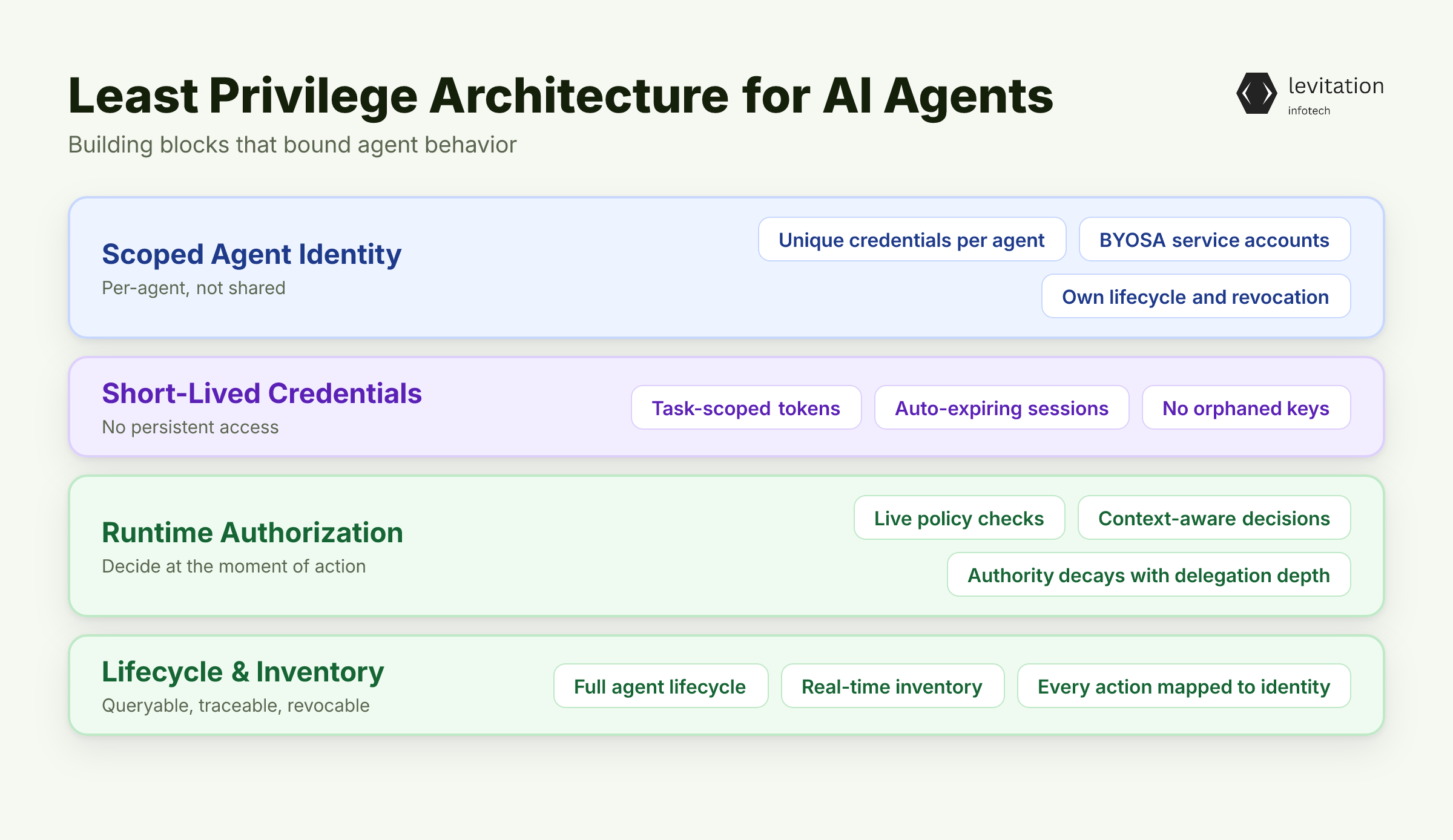
The fix is architectural. Here are the building blocks that turn "agents might behave" into "agents can only behave within the boundaries you set." Each one is necessary, and together they form a working system.
Treat agent identity like human identity. Every agent gets a unique, scoped identity with its own credentials, its own lifecycle, and its own revocation path. No shared service accounts, no inherited developer roles, no shortcuts. The agent stands on its own.
Replace static credentials with short-lived tokens. Tokens scoped to a single task or session. No persistent access, no orphaned keys waiting in a config file for an attacker to find. When the task ends, the token dies. The window of exposure closes with the task.
Enforce runtime authorization. Policy decisions happen at the moment of action, not at provisioning time. The system asks: is this agent allowed to touch this resource, for this purpose, at this moment, with this data sensitivity? If the answer is no, the action stops. The check is live, not historical.
Apply BYOSA: Bring Your Own Service Account. Create specific service accounts per agent use case rather than reusing shared dev credentials. One agent doing data extraction gets one identity. Another agent doing summarization gets another. The blast radius of any single agent is now bounded by its own scoped account. The risk is contained.
Build full agent lifecycle management. From creation to revocation, no agent exists outside an inventory system your security team can query. When an agent is deprecated, its credentials die with it. Nothing lingers.
Tie authorization to context. Data sensitivity, action risk score, and delegation depth all factor into the allow or deny decision. An agent three hops deep in a delegation chain does not have the same authority. The original requester holds more power. In effect, authority decays with distance.
Maintain real-time agent inventory and traceability. Every action maps to an agent identity, a task, and a delegating human or system. This is the same discipline that secures any production cloud security solutions stack. It is just applied to a faster, more numerous actor. The principle holds; the tempo changes.
This pattern is already in production. Teams running regulated workloads in healthcare and finance have shipped agentic systems using these patterns. They prove that least privilege scales when it's built into the platform, not bolted on after the fact. For CTOs already drowning in IAM drift, this architecture is the only path. It leads back to a queryable, defensible identity layer.
But architecture diagrams don't satisfy auditors. What does this actually look like in a SOC 2 review or a HIPAA risk assessment? In practice, the answer is concrete evidence.
What Compliance-First CTOs Actually Get From This
Reduced blast radius. A misbehaving agent can only touch what its scoped identity allows. It cannot reach the full breadth of a developer's admin role. It never held that role to begin with. When something goes wrong, the damage is bounded by the policy, not by hope. The boundary is enforced, not promised.
Auditability you can defend. Every agent action maps to an identity, a policy decision, and a delegating authority. These are the three things auditors always ask for. Your SOC 2 evidence collection becomes a query, not a fire drill. The same applies to HIPAA risk assessments. There, traceability is the difference between a clean attestation and a finding. In effect, the audit becomes a pull, not a push.
Faster regulatory alignment. GDPR, HIPAA, CPRA, and emerging AI frameworks all ask for purpose limitation and least privilege. This architecture delivers both by default. The policy engine encodes the regulatory requirement; the runtime enforces it. The rules are written once and applied everywhere.
Engineering velocity without the security tax. When least privilege is built into the AI agents platform, teams stop filing access tickets. Then they start shipping. The agent gets exactly the permissions it needs, scoped to the task, revoked when done. No waiting on the security team to approve a static role. Speed and safety align.
The bottom line: you stop hoping your agents behave. You start proving they can only behave within the boundaries you set. That shift from "we trust the agent" to "the system constrains the agent" is what separates compliance-first organizations from everyone else. The difference is proof, not promise.
Teams shipping agentic systems across regulated industries have learned this the hard way. The fastest way to slow down is to let an agent inherit a developer's permissions. The fastest way to scale is to treat every agent as a first-class identity subject. Give it its own scoped, short-lived, auditable existence. The pattern is the same; the actor is different.
Frequently Asked Questions
What is IAM for AI agents?
IAM for AI agents governs the identities, credentials, and authorization policies for autonomous software entities. Unlike traditional IAM built for human users, it accounts for several things. These include short-lived lifespans, machine-speed execution, and multi-hop delegation chains. It ensures agents operate within defined scope and leave auditable trails. In effect, it adapts identity for the machine era.
Why do AI agents need different IAM than human users?
Human IAM assumes static roles, manual provisioning, and after-the-fact auditing. AI agents are short-lived. They outnumber humans 80 to 1 in enterprise environments. They also act at machine speed without human judgment. Reusing human IAM patterns gives agents persistent, over-scoped access that creates systemic risk. The mismatch is the danger.
How do you implement least privilege for AI agents?
Use short-lived scoped tokens instead of persistent service account credentials. Enforce authorization decisions at runtime rather than provisioning time. Create one service account per agent use case (BYOSA pattern). Also, maintain a real-time inventory of every agent identity, its permissions, and its delegating authority. In practice, these are the levers that make least privilege real.
What is agentic IAM?
Agentic IAM is the discipline of managing identities, credentials, and authorization for autonomous AI agents. It treats agents as first-class identity subjects. They get unique credentials, lifecycle management, and runtime policy enforcement. They are not treated as extensions of human developer accounts. The shift is from extension to entity.
Can AI agents share service accounts safely?
No. Shared service accounts destroy traceability. They make it impossible to attribute actions, enforce least privilege, or revoke access. Removing one disrupts every agent using the account. Each agent or agent use case should have its own scoped identity with task-bounded permissions. In effect, sharing breaks the model.
Sources
Research and references cited in this article:
- The best authorization platforms for managing AI agent permissions in 2026 — WorkOS
- Identity and Access Management: Guide for 2026
- The Non-Human Identity Governance Vacuum – Lab Space
- How AI Agents Accumulate Permissions Over Time and Security Risks
- Non-Human Identities for AI Agents: How to Govern Access
- Exploring IAM for AI Agents in 2026 | Strata
- Why (Senior) Engineers Struggle to Build AI Agents — Philipp Schmid, Google DeepMind
- From Writing Code to Orchestrating Agents — How the Senior Engineer Role Is Changing - SoftwareSeni
- Why (Senior) Engineers Struggle to Build AI Agents
- Securing AI Agents: Why IAM Becomes Central - RiskInsight
- Secure Vertex AI: Stop Privilege Escalation & Data Breaches
- Securing AI Agents: Data Protection & Least Privilege Access | Adam Grainger posted on the topic | LinkedIn
About the author
Mayank Singh is a software developer at Levitation Infotech, where he builds web and AI-powered applications across the company’s fintech, healthcare, and enterprise projects.