


TL;DR: Most CTOs think they own their AI system. They don't. They own a thin layer of code that glues together six rented vendor layers, and any one of them can rewrite the contract. The fix is not to own every layer but to own the architectural intent above all of them, declared as a formal, machine-traversable artifact your team (and your AI agents) can actually navigate.
Key Takeaways: - "Owning AI" is a strategic question, not a technical one. Owning the model weights is rare; owning the intent that ties the stack together is the real moat. - Every one of the six layers (foundation model, inference runtime, orchestration, vector store, governance, semantic layer) carries contract risk that multiplies across the stack. - Wrapping vendors in an internal API hides the dependency but does not remove it. It also decays into a Big Ball of Mud faster than direct integrations. - The layer worth owning is the AI System Graph: a formal artifact above the rented stack that defines components, dependencies, and impact rules. - A 90-day audit converts this from philosophy into a measurable ownership score you can defend to your board.
You Don't Have an AI Strategy. You Have a Stack of Leases.
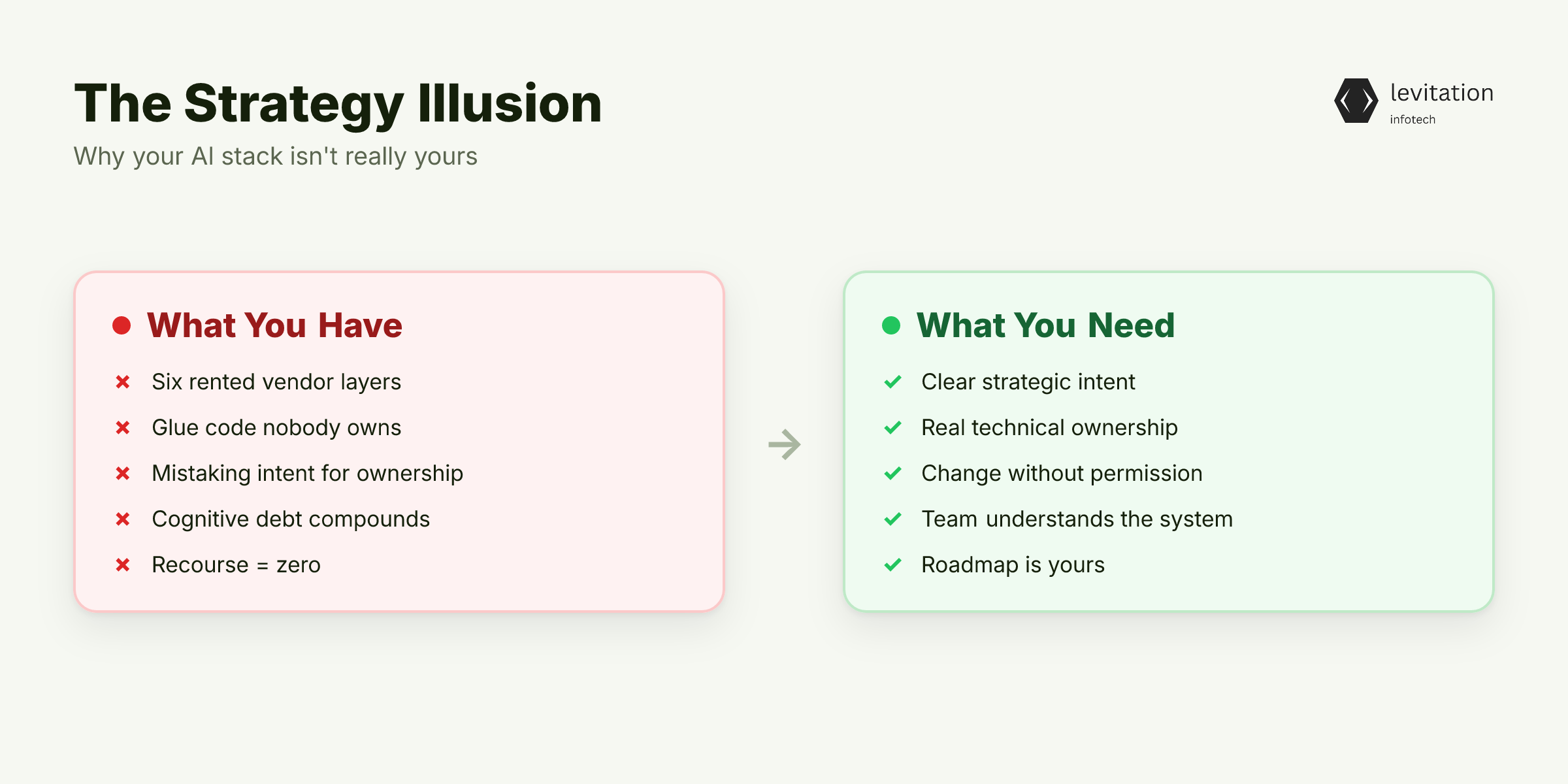
You didn't build your AI system. You assembled it from six rented layers, and when any one of those vendors pivots, prices, or sunsets their API, your roadmap changes with them. You have no recourse.
Most CTOs mistake the feeling of control for the fact of control. They pick a foundation model, wire up an orchestration framework, stand up a vector database, bolt on observability, and call it a strategy. What they actually have is a portfolio of vendor contracts stitched together by code that nobody treats as the product.
The trap is a category error. You confuse strategic intent with technical ownership. Intent is the set of decisions about what your system is, what it does, and why it should change. Ownership is the ability to change those things without asking permission. The rented stack gives you the feeling of intent without the reality of ownership.
This is getting worse, not better. AI-generated code widens the gap between humans and the systems they nominally run, a pattern increasingly called cognitive debt in AI systems. Every line of vendor-glue code your agents produce makes the system harder to reason about, even as it makes the system feel more "yours."
The result is a paradox. Your stack has never been more capable. Your team has never understood it less. And your ability to change any of it has never been thinner.
So what exactly are these six layers, and where does ownership actually break down at each one?
The Six Layers You're Renting, Not Owning
The layers look like this, from the metal up:
1. The foundation model. Weights, training data, alignment behaviour, and capability mix. You license access. You do not own the model. Pricing changes, deprecations happen, and silent capability drift is common. The model that aced your eval six months ago may behave differently today.
2. The inference runtime. The serving infrastructure, quantization choices, batching strategy, and SLA guarantees. All opaque. All controlled by the vendor or by a hyperscaler whose roadmap is not your roadmap.
3. The orchestration framework. The agent runtime, tool-calling conventions, memory abstractions, and prompt-routing logic. Lock-in here is subtle: it locks in data formats, embedding models, and query semantics that are painful to migrate.
4. The vector store and retrieval pipeline. The embedding model, the index structure, the metadata schema, the recall-and-rerank logic. Migration here can take quarters and silently degrade quality.
5. The governance and monitoring layer. Observability tools, eval harnesses, drift detection, audit trails. Vendor-specific schemas and metric definitions make this layer resistant to replacement.
6. The semantic layer. The definitions of business meaning. "Customer," "churn risk," "eligible loan." This is the most underappreciated lock-in of all, because it lives in vendor-specific metric catalogues, dbt packages, and BI tool conventions.
Each layer carries a contract risk. API deprecation, pricing change, acquisition, pivot. Multiply that by six, and the probability that nothing changes over a three-year horizon approaches zero. This is the AI vendor lock-in problem dressed in a new suit, and it is the enterprise AI stack ownership question that most boards have not yet learned to ask.
The obvious response is to wrap all six layers in your own internal API and call it "abstraction." That's where things get worse, not better.
The Abstraction Trap: Why Wrapping Vendors in Your Own API Makes It Worse
An internal API wrapper feels like a solution. It hides the vendor, standardises the interface, and lets your application code stay stable when the underlying provider changes. The instinct is right. The execution is almost always wrong.
A wrapper is a second layer of code that must be maintained, tested, versioned, and migrated. It does not restore ownership; it hides the dependency behind a façade that your team will eventually confuse for the system itself. When the vendor changes, you still change. You just change twice.
Worse, wrappers tend to become tightly coupled to vendor-specific semantics. The "portable" interface ends up exposing capabilities that only one provider has, leaking abstractions back into the application layer. When you actually try to switch, you discover the wrapper was not portable. It was just delayed.
This is a Big Ball of Mud anti-patterns failure mode in disguise. AI-generated code accelerates duplication and unwanted dependencies, and wrappers decay into mud faster than direct integrations, because the wrapper becomes a magnet for "just one more convenience method."
There is a better way. Shumilov (2026) formalises it as AI-readable architecture: structural constraints should not be inferred by agents from code. They should be declared as first-class, formally defined, machine-traversable artifacts that any agent, human or AI, can navigate. The wrapper is the wrong abstraction. The declared graph is the right one.
If you can't own the layers and you can't cleanly wrap them, what exactly is left to own?
The Layer You Must Own: Architectural Intent as a Formal Artifact
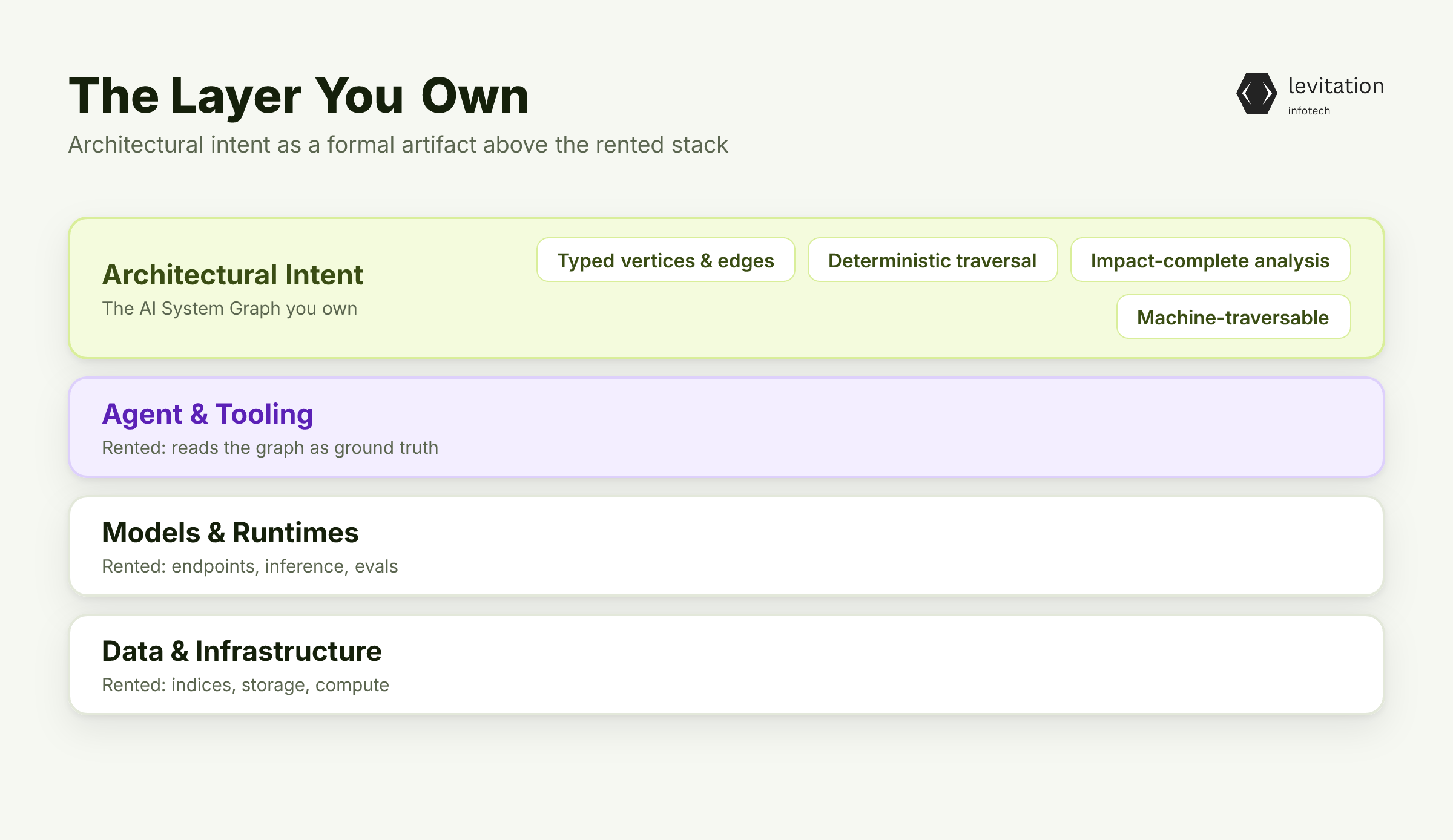
The thing worth owning sits above the six rented layers. It is the description of how your system is supposed to work, independent of who currently serves any given component.
Call it the AI System Graph. Formally, it is G = (V, E, t_v, t_e). Vertices V are components (a model endpoint, a retrieval index, an agent, a metric). Edges E are dependencies between them. The type functions t_v and t_e describe what each thing is: what it does, what it requires, what it must not do, and what changes when it changes.
This is the AI System Graph and SysMARA abstraction: a single source of truth for architectural intent, machine-readable, version-controlled, and treated as the primary artifact of the engineering process.
Two formally defined properties make it useful: - Determinism. Given the same input, the graph produces the same traversal. The same change proposal returns the same impact analysis every time, regardless of which agent or human runs it. - Impact Completeness. Every change traces its blast radius through the graph. You can answer "what breaks if I swap this embedding model?" without grepping the codebase.
A third design goal, machine-traversability, follows naturally: agents can read the graph as ground truth rather than inferring constraints from code. This is the human-AI division of labor in architecture: humans own the boundaries, agents navigate the implementation.
The insight is simple and worth repeating. You do not need to own the rented layers. You need to own the graph that describes how you use them. That graph is your true moat and your true portability. When the foundation model vendor pivots, you change an edge in the graph, not an architecture.
This is elegant in theory. Here is what it looks like when a team actually operationalises it.
Operationalizing Ownership: A 90-Day Stack Audit
Most teams try to do too much at once. The 90-day audit is deliberately scoped to produce a measurable ownership score, not a perfect system.
Weeks 1-2: Map the six layers explicitly. For each layer, document the vendor, the contract terms, the data formats, and the switching cost in engineer-weeks. Put this in a single shared artifact, not in tribal knowledge and not in Confluence pages nobody reads.
Weeks 3-6: Build the AI System Graph for your production system. Declare component boundaries, dependency types, and impact-propagation rules as versioned artifacts. The graph is not documentation; it is a load-bearing part of your codebase. Use the 90-day AI stack audit template to standardise the structure across teams.
Weeks 7-10: Establish ownership boundaries. Assign each vertex in the graph to a team. Define zero-trust permissions for AI agents operating against the graph, as zero-trust architecture for AI agents requires. Permission-hungry agents are the new attack surface. Treat them like employees with the least privilege they need, not like trusted insiders.
Weeks 11-13: Run a simulated vendor outage. Pick one of the six layers, pretend it disappeared overnight, and measure how long your graph-guided team takes to swap it. That number, in hours or days, is your real ownership score. Anything above two weeks means the graph is incomplete.
The graph becomes the contract between humans and AI agents. Humans edit intent. Agents navigate implementation. The graph enforces constraints that neither can violate, and it does so without anyone needing to remember the rules.
What does this buy you in practice? More than a cleaner diagram.
What Long-Term Production Ownership Actually Looks Like
When architectural intent is owned as a formal artifact, vendor churn becomes a routing problem, not a rewrite. You change the edge in the graph. The implementation swaps underneath. The application does not notice.
The test of ownership is not whether you can build it once, but whether you can keep the system alive while the ground shifts. The rented layers underneath will change. The architecture above them does not have to.
The compounding effect shows up in cognitive debt. Every AI-generated change is validated against the same graph. Constraints are checked before code lands, not after. The gap between what humans understand and what the system does stays bounded instead of widening every sprint.
The metric that matters is retention. Enterprise AI architecture services built on this model are sticky in a way feature roadmaps are not. Teams that own their architectural intent do not churn when their foundation model vendor does. The graph survives the vendor; the application survives the graph; the business survives the application.
The rented layers below the graph will keep changing. The graph stays.
The questions below are the ones that surface in every board review, and they tend to expose more about the organization than the technology itself.
Frequently Asked Questions
What are the 6 abstraction layers in an AI architecture?
The six layers are: (1) the foundation model itself, (2) the inference runtime that serves it, (3) the orchestration framework that coordinates agents and tool calls, (4) the vector store and retrieval pipeline, (5) the governance and monitoring layer, and (6) the semantic layer that defines business meaning. Each is typically owned by a different vendor.
How do you avoid vendor lock-in in enterprise AI systems?
You avoid lock-in by owning your architectural intent as a formal, versioned artifact: an AI System Graph that declares component boundaries, dependencies, and impact rules. The rented layers underneath can change. The graph above them is your true moat and your true portability.
What is AI-readable architecture?
AI-readable architecture, formalised by Shumilov (2026), is an abstraction layer in which structural constraints are not inferred by agents from code but declared as first-class, machine-traversable artifacts. The central data structure is the AI System Graph G = (V, E, t_v, t_e) with formally defined properties like Determinism and Impact Completeness.
What is the difference between AI architecture and AI infrastructure?
AI infrastructure refers to the components behind a model: GPUs, serving hardware, data pipelines. AI architecture refers to how those components are designed to work together, including how they are connected, governed, and how ownership is distributed across the stack. Infrastructure is what you rent. Architecture is what you own.
About the author
Mayank Singh is a software developer at Levitation Infotech, where he builds web and AI-powered applications across the company’s fintech, healthcare, and enterprise projects.