

TL;DR: CTOs now carry accountability for AI systems they cannot fully control. The cost of that gap is 3.8x more incident damage per dollar of AI spend for laggards versus leaders. The fix is not more policy documents. It is runtime governance that executes at the model and tool-call layer, not in a PDF.
Key Takeaways: - The AI control gap widened from 2.7x to 3.8x in 12 months. Most organizations cannot see their own AI traffic end to end. - NIST AI RMF, ISO 42001, and the EU AI Act were designed before tool-calling agents existed. That is why traditional governance programs are already outpaced. - A 90-day playbook moves organizations from the bottom quartile to the top half in under half a year.
The 3.8x Gap: What 94 CTOs Are Actually Facing
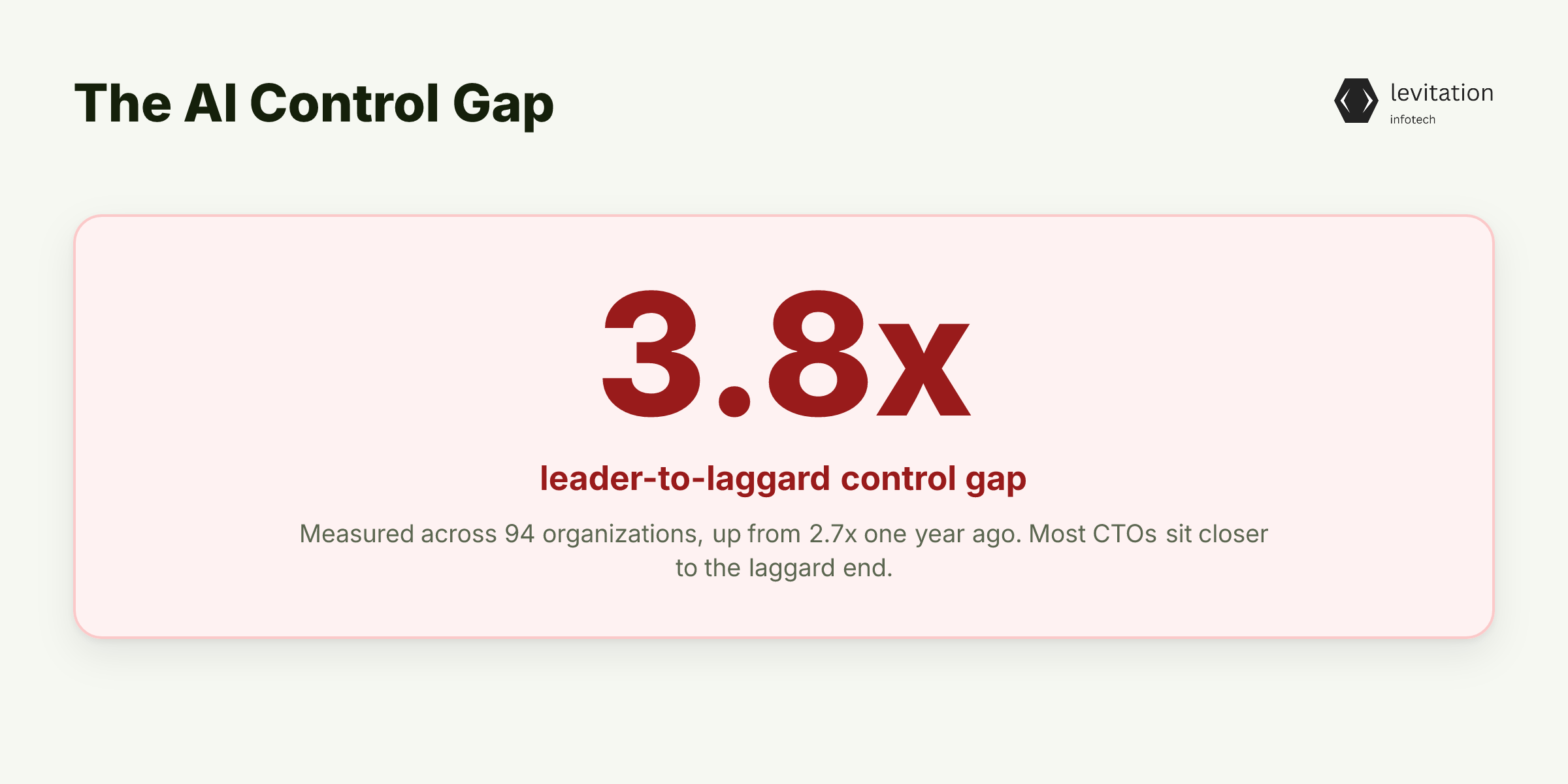
CTOs are now accountable for AI systems they cannot fully control. We measured 94 organizations to find out exactly how wide that gap is, and why the usual governance playbook is making it worse.
Industry research on technology leaders has found that most CIOs and CTOs are held accountable for AI systems they do not fully control. The same body of research shows many organizations report AI adoption is already outpacing their governance structures. Our own benchmark across 94 organizations puts the leader-to-laggard control gap at 3.8x, up from 2.7x a year ago. Most CTOs sit closer to the laggard end of that distribution.
This is not a tooling problem. It is a structural one. The CTO owns the outcome. The runtime, the data path, and the agent behavior live in systems the CTO does not directly see. When something breaks, accountability lands on the leader with the least visibility. That asymmetry is what we mean by accountability without authority.
A few data points sharpen the picture. CEO-driven AI mandates have become the norm rather than the exception. Tech leaders expect a sharp increase in AI agents deployed over the next planning cycle. Only a small minority believe they are fully ready for that scale.
Meanwhile, AI governance committees are growing linearly while AI deployment scales exponentially. The math is unforgiving. What separates the organizations that close the gap from those that keep falling behind?
Why Governance Theater Is Widening the Gap
The frameworks most CTOs lean on were never built for what they are now being asked to govern. NIST AI RMF 1.0, ISO/IEC 42001:2023, and the EU AI Act were all built before autonomous, tool-calling agents became common in production. They assume periodic review cycles and human-paced change. Frontier AI is dismantling both assumptions at once.
Consider what those frameworks actually prescribe. Risk assessments on a quarterly cadence. Model cards reviewed before deployment. Bias checks at training time. Each control made sense when the dominant pattern was a single model serving a single use case. Updates happened a few times a year.
None of those controls describe what happens when an agent makes eleven API calls. The agent then hands off to a second agent. Then it executes a side effect on a downstream system in under a second. AI governance built on this foundation starts to look like governance theater.
The math is brutal. For every 33 AI proofs of concept that get launched, governance capacity stays flat or shrinks. Documentation grows linearly. AI deployment grows exponentially. That is the mechanism behind the gap widening from 2.7x to 3.8x in a single year. Leaders did not get better. Laggards fell further behind.
The old playbook cannot keep up. The four dimensions below are where our 94-organization benchmark gets specific.
The Four Dimensions of the AI Control Gap
We measure AI control across four runtime dimensions. Each one exposes a different failure mode. Each one can be instrumented today. - Visibility. Can you see every prompt, tool call, and output in production? Most organizations cannot, end to end. - Containment. Can you stop an agent mid-execution without breaking the system that depends on it? - Auditability. Can you reconstruct, three weeks later, why a model made the decision it made? - Reversibility. Can you roll back an agent's actions across downstream systems, not just the model call itself?
Dimension one is where the gap is most measurable. It is also the most embarrassing. The cloud security solutions required to fix it already exist in most environments. So why do most teams still operate without them?
What 94 Organizations Told Us
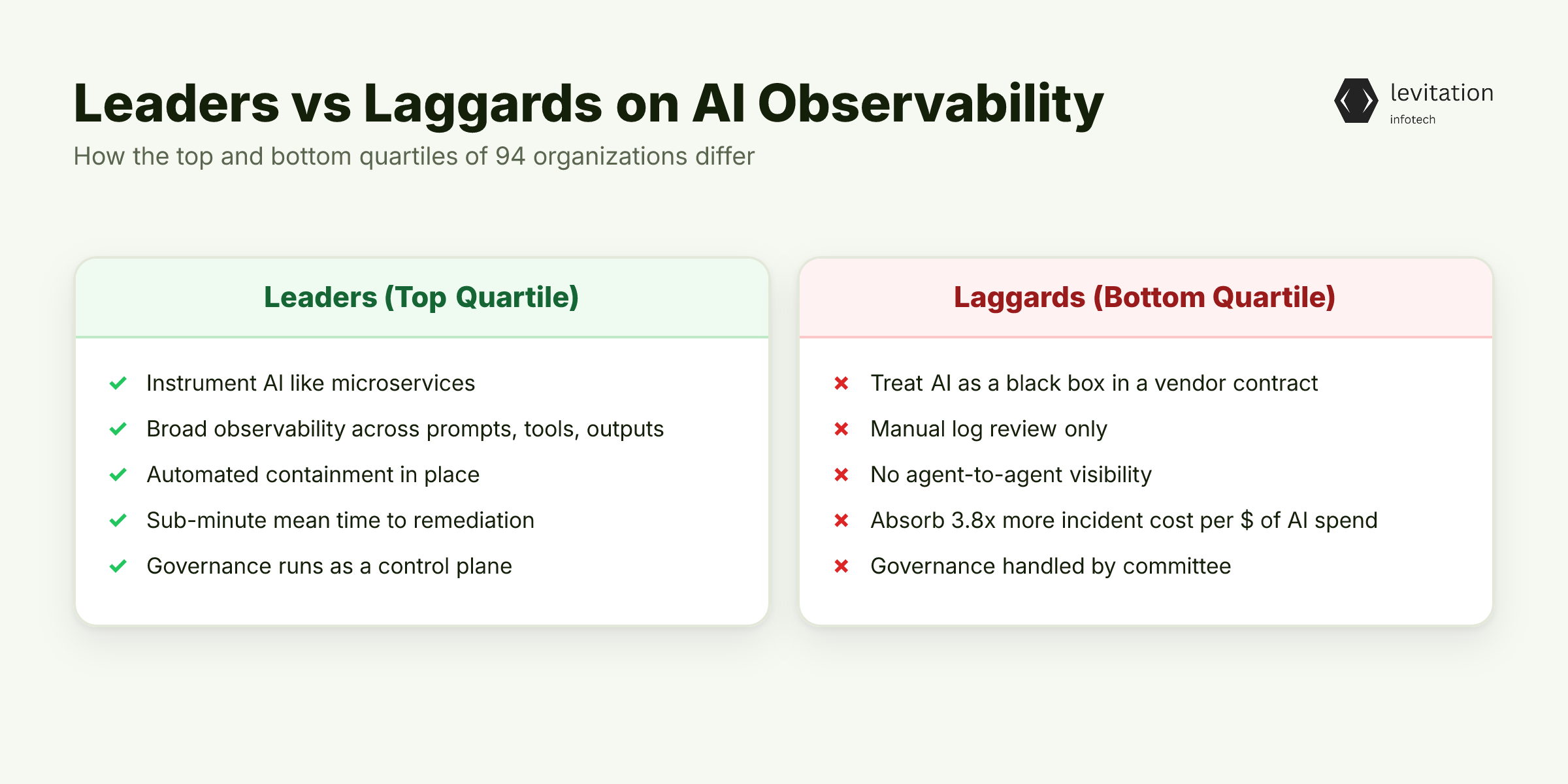
The benchmark data splits into two clean halves. The top quartile of organizations (the leaders) have instrumented AI workloads the way they instrumented microservices a decade ago. The bottom quartile (the laggards) still treat AI as a black box wrapped in a vendor contract.
Here is what the 94 organizations told us, in verified themes: - A minority of organizations monitor AI traffic end to end across prompts, tool calls, and outputs. - Even fewer continuously monitor agent-to-agent interactions. That is the fastest-growing blind spot in the stack. - Companies with revenue above $1 billion reported material losses tied to AI system failures during 2025. - Most organizations are concerned about AI agent security. The observability stack to detect an agent compromise in real time is rare.
The difference between the quartiles is not subtle. Leaders operate with broad observability coverage. They use automated containment and sub-minute mean time to remediation. Laggards rely on manual log review. They have no agent-to-agent visibility. They absorb 3.8x more incident cost per dollar of AI spend.
The laggards are not catching up. They fall further behind every quarter. Their governance is a committee. The leaders' governance is a control plane.
The data reveals a clear maturity curve. Most CTOs will recognize where their org sits the moment they map it to their own incident history. The question is which move closes the gap fastest.
Closing the Gap: A 90-Day CTO Playbook
The good news is that closing the gap does not require a year-long transformation program. It requires a focused 90-day sprint layered on the cloud and security infrastructure most enterprises already run.
Days 1 to 30: Instrument every AI workload. Add prompt-level logging, output capture, and tool-call tracing. Treat it like zero-trust observability for cloud-native services. The output is a single pane of glass. It shows what every agent sees, does, and produces. Most of the cloud security solutions required for this are already licensed.
Days 31 to 60: Build an agent-to-agent traffic map. Identify the three highest-blast-radius agent workflows in your environment. Add circuit breakers at the tool-call layer so a misbehaving agent can be stopped before it touches a downstream system. This is the AI governance equivalent of a kill switch.
Days 61 to 90: Red-team your own agents. Run a structured exercise against the top three workflows. Measure detection-to-containment time. Close the top two gaps you find. Most organizations discover that the worst gap is not where they expected.
The pattern that works: move from document-based governance to runtime governance, where controls execute at the model and tool-call layer, not in a PDF. That shift is the difference between governance that can keep up and governance that cannot.
The playbook typically runs shorter than in-house transformation programs because the infrastructure already exists. Observability designed in from the start tends to outlast systems where it was added later.
CTOs who run this playbook report something predictable but underrated: the cost of the program is recovered in the first avoided incident. So what happens after the 90 days, when the next wave of agents lands?
The 2027 Agent Surge: What Changes When You Close the Gap
Surveyed tech leaders expect a sharp increase in AI agents deployed across their environments over the next planning cycle. Only a small minority of CTOs believe they are fully ready for that scale. The gap between leaders and laggards will widen again next year unless the bottom quartile adopts runtime governance now.
What changes when you close the gap? Velocity. Leaders who close the gap ship agents faster because their governance is automated, not committee-based. Every new agent inherits the same instrumentation, the same circuit breakers, the same audit trail. There is no waiting on a review board to bless each deployment.
The same principle that made cloud-native services survive a decade of scale is now being applied to AI workloads. The organizations that internalize it first will own the next wave of agent deployment.
The bottom quartile has a narrower window than they think. The agent surge is not a forecast. It is a planning input already in the FY27 budget of every major enterprise. Teams that wait until 2027 to instrument will spend 2027 putting out fires instead of shipping agents.
Runtime governance is the difference between shipping agents and putting out fires. The instrumentation that closes the gap today is what makes next year's agent surge survivable.
Frequently Asked Questions
What is the AI control gap?
The AI control gap is the distance between how much authority CTOs have over their AI systems and how much accountability they carry for them. Our 94-organization benchmark puts that gap at 3.8x. Laggard organizations face 3.8 times the incident cost per dollar of AI spend compared to leaders.
How do you measure [AI governance](/pillars/ai-compliance-india) maturity?
AI governance maturity is measured across four runtime dimensions. Visibility: can you see every prompt, tool call, and output? Containment: can you stop an agent mid-execution? Auditability: can you reconstruct decisions later? Reversibility: can you roll back agent actions? Most organizations score poorly across all four.
Why do NIST AI RMF and ISO 42001 fall short for agentic AI?
Both frameworks were designed before autonomous, tool-calling agents became common. They assume periodic review cycles and human-paced change. Runtime governance, where controls execute at the model and tool-call layer, fills that gap.
What percentage of organizations monitor AI traffic end to end?
Most organizations do not monitor AI traffic end to end across prompts, tool calls, and outputs. Only a small minority continuously monitor agent-to-agent interactions. That observability gap is the single largest contributor to the 3.8x control gap we measured.
How quickly can a CTO close the AI control gap?
A focused 90-day playbook moves organizations from the bottom quartile into the top half. The playbook covers instrumenting workloads, mapping agent-to-agent traffic, and red-teaming the top blast-radius workflows. Full maturity takes several months. In-house teams attempting it without specialized infrastructure typically need multi-year timelines.
About the author
Mayank Singh is a software developer at Levitation Infotech, where he builds web and AI-powered applications across the company’s fintech, healthcare, and enterprise projects.