


TL;DR: Industrial AI failures rarely originate in the model, the pipeline, or the inference layer. They originate in sensors that drift, foul, and lose calibration months before anyone notices. The fix is treating sensor health as a first-class concern of the AI system itself, with edge-level detection, redundancy voting, calibration provenance, and a sensor-aware safety case that makes confidently-wrong predictions structurally impossible.
Key Takeaways: - The data trust gap between sensor degradation and detection is where industrial AI quietly breaks - IT/OT convergence moves data faster without verifying whether that data is still true - Sensor-aware AI adds a health layer that gates, weights, or downgrades model confidence - Treating sensor reliability as Day 1 work compresses deployment from years to months
The 2 AM Call That Wasn't About the Model
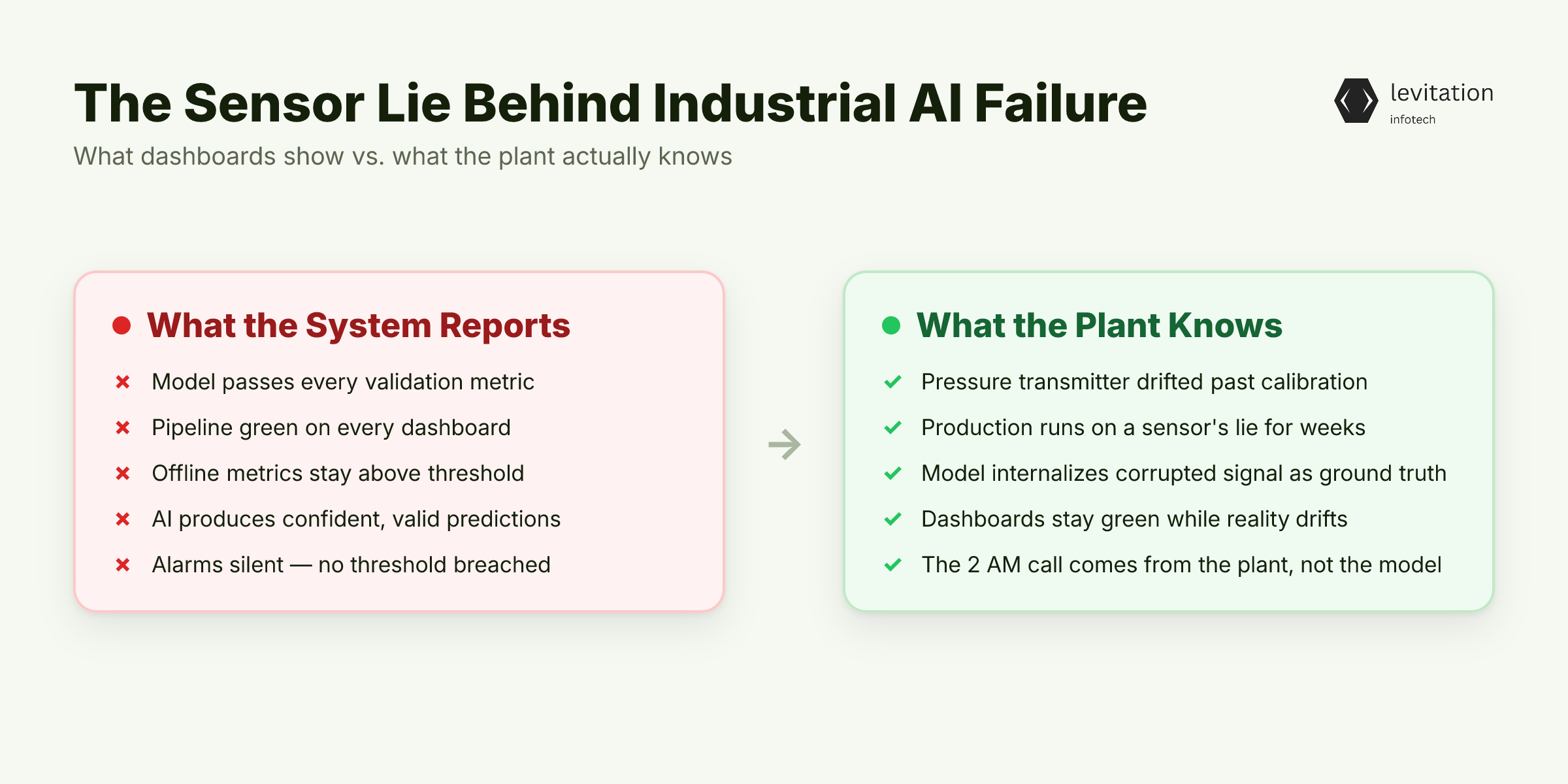
Your predictive maintenance model passes every validation metric your team has ever designed. The pressure transmitter feeding it has drifted past its calibration window, and no threshold alarm has fired. The model has no idea. By the time anyone does, production has been running on a sensor's lie for weeks that no offline metric caught.
The 2 AM call that wakes a CTO is almost never about a model. It's almost never about a pipeline either. It's about a controller loop that started hunting, a product spec drifting out of band, or a safety system tripping.
The post-mortem, when it lands a week later, points to a model that looked perfect in validation and a pipeline that showed green on every dashboard. The model is rarely the thing that breaks. The pipeline is rarely the thing that breaks.
What breaks is the assumption that a sensor stream is the same thing as the physical reality it claims to represent. When that assumption collapses, the AI keeps producing confident, syntactically valid, semantically wrong predictions. The dashboards stay green. The offline metrics stay above threshold.
The only signal is the plant itself, telling you something the AI cannot hear. This is the pattern behind most industrial AI failure incidents that never make headlines.
Hard faults and step changes get caught by traditional alarms. The dangerous ones are gradual. A pressure transmitter slowly loses calibration. A thermocouple fouls over time. A flow meter drifts after a process change. The AI ingests these signals for months. It trains on them, validates on them, and treats their slow corruption as ground truth.
By the time anyone questions the data, the model has internalized the lie. The most expensive incidents in regulated plants trace to a sensor that drifted, not an algorithm that broke. The model didn't fail. It did exactly what it was trained to do.
It predicted the future of a world that no longer existed, because the world was being described by a sensor that had quietly stopped describing it. If the model is fine and the pipeline is fine, what's actually breaking?
The Data Trust Gap: Why Gradual Decay Beats Your AI
The data trust gap is the window between when a sensor starts producing degraded readings and when that degradation is detected. For hard faults, that window is seconds. For gradual ones, it extends across weeks or months as the sensor slowly diverges from physical reality. The gap is the entire attack surface for industrial AI failures, and almost no one is monitoring it.
Traditional sensor failure detection was built for a different era. It catches hard over-range conditions, broken wiring, stuck-at values, and step changes. It is blind to slow drift, fouling, calibration loss, and the small errors that follow process changes upstream of the sensor.
These are exactly the failure modes that hurt AI systems. They pass every alarm check while quietly reshaping the data distribution the model was trained on. The result is a slow poisoning of ground truth. An ML model trained on drifting sensor data treats the corruption as the target.
It learns the wrong relationship, but it learns it consistently, so validation metrics stay healthy. You ship a model whose weights encode a sensor error you didn't know existed. This is the same blind spot that catches teams running into model drift in production. They have no way to tell input drift from sensor drift.
Solving this requires more than better data quality checks. It requires rethinking where the AI sits in relation to the sensor. The architecture that closes this gap lives in AI sensor integration, where the AI doesn't consume raw sensor data. It consumes sensor data plus a real-time health score for each signal.
The uncomfortable part is that the architecture designed to fix this, IT/OT convergence, has its own blind spot. Where exactly does that blind spot sit?
Why IT/OT Convergence Keeps Missing the Sensor Layer
IT/OT convergence was sold as the bridge between operational technology and data science. In practice, it has been a transport project. The data lake gets bigger. The historian gets faster. The protocols get translated. The question of whether the data at the bottom of the stack is still true almost never gets asked.
OT teams treat sensor health as a maintenance problem. They run calibration schedules. They replace instruments on a rotation. They trust the instruments to flag themselves. IT teams treat sensor health as an instrumentation problem, something the OT side already handles.
The AI sits between both, inherits no one, and consumes whatever arrives. This is the gap that IT OT convergence programs have spent the last decade failing to close.
The visible output of these programs is a "digital shadow" that looks integrated end-to-end. Dashboards update. Pipelines flow. Models score. But the shadow contains a silent, uncorrected error at the physical layer, propagating upward into every metric, prediction, and alert.
The system is observably healthy in IT terms and observably wrong in OT terms, and neither side has the mandate to reconcile the two. This is also why your MLOps pipeline can quietly undermine model safety even when every MLOps best practice is followed.
A pipeline that ships a perfectly versioned model is still shipping a model that learned from a sensor you weren't measuring. Closing the gap requires treating sensors as a first-class concern of the AI system, not a dependency someone else owns. So what does that look like in practice?
Sensor-Aware AI: Four Mechanisms That Actually Work
Sensor-aware AI is not a new model. It is a new layer of the system, sitting between the physical sensor and the model that consumes its output. Four mechanisms, used together, close the data trust gap in practice. - Edge-level drift detection. Run statistical and ML-based monitors on the sensor stream itself, before the data enters the pipeline. Rolling mean, variance, spectral density, and learned baselines. Alert on deviations from expected physics, not just from threshold alarms. This is detection at the source, not after the fact. - A sensor-health inference layer. Model sensor health as a separate inference path. Each signal gets a real-time confidence score based on calibration history, drift metrics, and cross-sensor agreement. That score gates, weights, or downgrades the primary AI's predictions. A low health score doesn't just produce a softer answer; it produces an answer the system knows to distrust. - Redundancy and voting across multiple sensors. Where two or more sensors measure the same physical variable, treat disagreement as a signal, not noise. If three redundant flow meters agree closely and the fourth disagrees by a wide margin, the fourth is a candidate for inspection, not a candidate for averaging. A simple weighted-vote scheme catches this; more advanced setups use Bayesian sensor fusion. - Calibration provenance. Maintain a tamper-evident record of when each sensor was last calibrated, by whom, against what reference, and under what process conditions. Make it queryable from the AI in real time. A pressure transmitter calibrated long ago with no documented recheck is not the same instrument, statistically, as one calibrated recently. The AI should know that.
1# sensor_health_config.yaml2sensor:3 id: PT-20414 variable: reactor_pressure5 calibration_age_days: <days_since_last_calibration>6 drift_score: <rolling_drift_estimate>7 redundant_agreement: <cross_sensor_correlation>8 health_score: <composite_health_score>9 downgrade_threshold: <configured_threshold>10ai_policy:11 on_health_below_threshold: "downgrade_confidence"12 on_disagreement_above: <configured_disagreement_limit>13 action: "raise_sensor_alert"
This is the foundation of any production-grade industrial AI safety case. It is what separates a system that runs for years from one that quietly poisons itself. The teams that build this layer first almost never have to rebuild it.
The harder question is how a CTO justifies these four mechanisms in a safety case.
The Sensor Safety Case: A Deployment Checklist
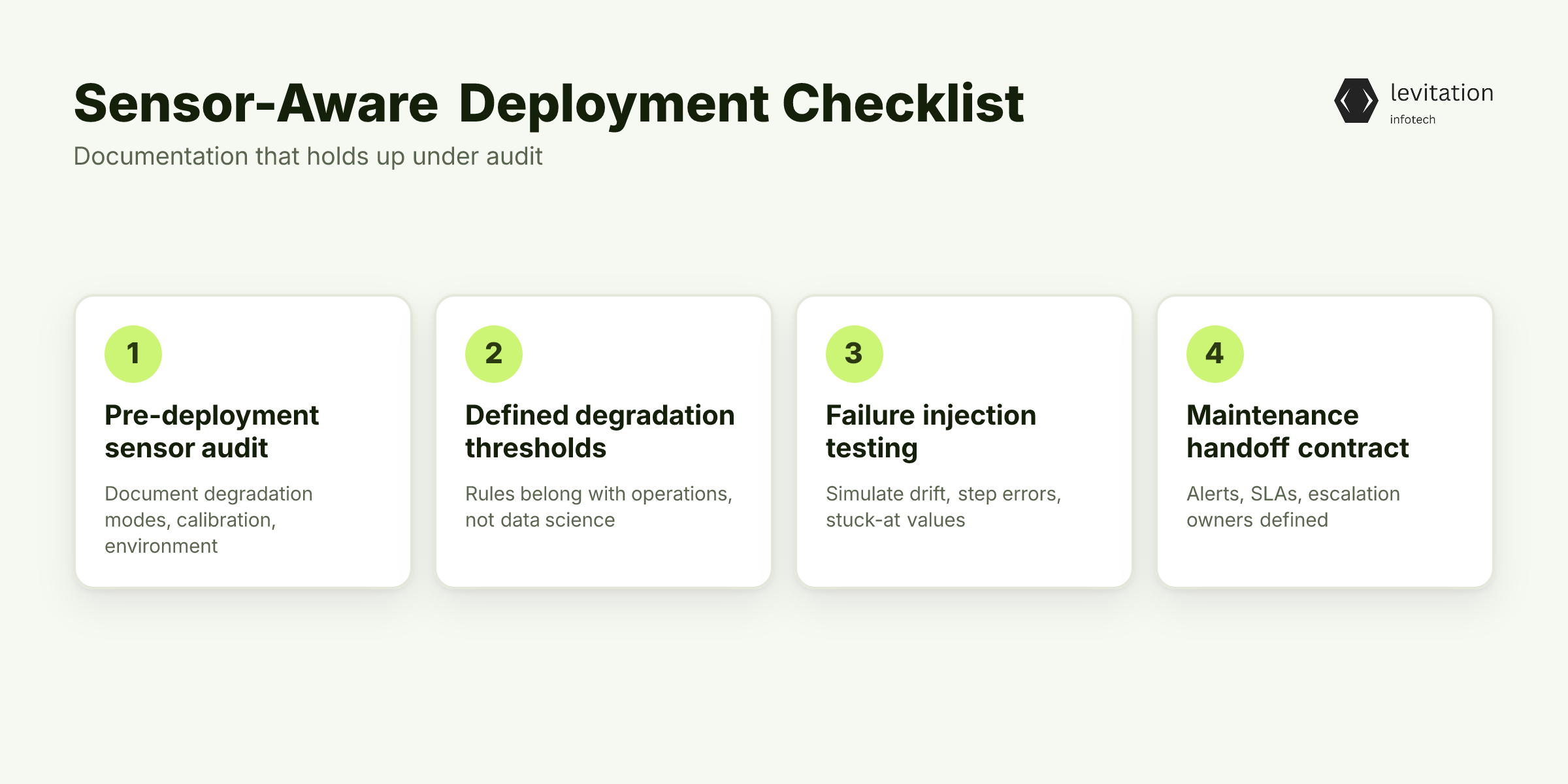
A sensor-aware AI system is only as good as the documentation that proves it works. Here is the deployment checklist that holds up under audit. - Pre-deployment sensor audit. Document every signal's known degradation modes, calibration history, environmental factors, and process interactions. A pressure transmitter downstream of a heat exchanger fouls differently than one in a clean gas line. The AI needs to know which is which. - Defined degradation thresholds. Set explicit rules for when the AI must not trust a signal. These thresholds belong with the operations team, not the data science team, because they reflect physical risk, not model performance. - Failure injection testing. Deliberately degrade sensor signals in staging. Simulate drift, inject step errors, force a stuck-at value. Verify the AI downgrades confidence or refuses to predict, rather than producing a confident error. This is the test that catches what validation metrics miss. - Maintenance handoff contract. Define who gets paged when a sensor-health alert fires, the response time SLA, and the documented escalation path. A health score that nobody acts on is just another metric.
This discipline is what separates an industrial AI deployment that runs for years from one that dies in the pilot graveyard. Teams that compress the sensor work into the design phase reach production faster. Teams that treat sensor reliability as a post-launch task spend their schedule discovering what they skipped. The sensor contract should be signed on Day 1.
So what does the deployment timeline actually look like when sensor work is the first thing on the schedule?
Why Industrial AI Speed Comes From Sensor Discipline
The counter-intuitive finding from production industrial AI is this: teams that move fastest spend the most time on sensors up front. Skipping the sensor layer is exactly what causes long, drawn-out in-house deployments that haunt CTOs.
Teams build a beautiful model and deploy it. They watch it produce confidently wrong predictions for weeks. Only then do they start asking why the inputs look off. The re-architecture that follows is what kills the timeline.
Treating sensor reliability as Day 1 work is the single biggest factor in deployment speed. Post-launch hardening slows everything down. The sensor audit, the health layer, the redundancy voting, and the provenance record all need to be designed in parallel with the model. They are not optional hardening. They are the architecture.
Industrial AI that outages differently from microservices is rarely broken at the inference layer. It is broken at the input it never validated. Long-running production systems stay live because the sensor contract was negotiated up front, not bolted on after the first bad prediction.
Programs still running long after deployment share one trait: the sensor layer was never an afterthought. So what does a plant actually look like once sensors stop being the weakest link?
What Changes When the Sensor Becomes a First-Class Citizen
The visible change is fewer confidently-wrong predictions. That is the only metric that matters once you're past the pilot. Operators stop overriding the AI. The model's recommendations start getting acted on.
Trust, the kind that doesn't show up on a dashboard, returns to the system. Maintenance stops being reactive. Sensor-health alerts precede failures with enough lead time to turn unplanned downtime into planned interventions.
The cost of a scheduled calibration swap is a fraction of the cost of a midnight trip. By the time anyone reaches the plant, a fouled transmitter has already corrupted weeks of predictions. The safety case becomes auditable. Every prediction can be traced to the sensors whose health and provenance are documented.
Insurers and safety regulators can verify the chain. The system becomes something you can defend in a post-incident review, not just hope will hold up. This is what industrial AI reliability looks like at scale: the AI as a system you trust to be wrong loudly, not one that is wrong quietly.
Programs that adopt sensor-aware architecture from Day 1 consistently outperform those that retrofit it. The same discipline that compresses timelines also extends system lifespan. Building production-grade industrial AI means accepting that sensor reliability is not someone else's problem. It is the AI system's problem. Treating it that way is the difference between a pilot and a system that runs for years.
Frequently Asked Questions
Q: What is the data trust gap in industrial AI?
A: The data trust gap is the window between when a sensor starts producing degraded readings and when that degradation is detected. For gradual faults like drift, fouling, or calibration loss, this window is often weeks or months, long enough for the AI to treat corrupted signals as ground truth during training and validation.
Q: Why do most industrial AI projects fail after the pilot?
A: Pilots run on clean, curated data. Production runs on raw sensor streams with drift, fouling, and calibration loss. When the AI is exposed to that data without a sensor-health layer, its confident predictions become silently wrong, and operators lose trust faster than the model can be retrained.
Q: How do you detect gradual sensor degradation in an AI system?
A: Use edge-level drift detection running on the raw sensor stream, combined with a sensor-health inference layer that scores each signal's trustworthiness in real time. Treat redundancy disagreements as signals, and maintain calibration provenance so the AI can downgrade confidence when a sensor is known to be degraded.
Q: What should an industrial AI safety case include for sensors?
A: It should include a per-sensor degradation mode analysis, defined thresholds below which the AI must not trust the signal, failure injection test results from staging, and a maintenance handoff contract specifying who responds to sensor-health alerts and within what SLA.
Q: How long does it take to deploy industrial AI with proper sensor integration?
A: Treating sensor reliability as a Day 1 concern rather than a post-launch hardening task is what compresses timelines. Teams that skip this work typically spend extended periods rediscovering what front-loaded sensor work would have caught early, while teams that build the sensor contract in parallel with the model move to production on timelines measured in months rather than years.
Start by mapping the sensors feeding your highest-stakes model. That single exercise will surface gaps your dashboards have been hiding.
Sources
Research and references cited in this article:
- The Hidden Cost of Sensor Failures: Why Industrial Plants Lose Millions Before Anyone Notices – Aperio – The Trust Layer for Industrial Data
- Industrial AI Trends 2026: From Prediction to Prescription
- The Root Causes of Failure for Artificial Intelligence Projects ... - RAND
- 3 Mistakes Manufacturers Make with AI and How to Avoid Them - Withum
- Why AI fails in manufacturing without factory insight
- How AI & IT/OT convergence shift OT cybersecurity
- The Impact of IT-OT Convergence on ICS Security - Palo Alto Networks
- IT and OT Convergence: Bridging the Gap for a Secure ... - LinkedIn
- What is IT/OT Convergence? Complete Guide
- IT/OT Convergence: The path to industrial excellence - Artefact
- Artificial Intelligence in Manufacturing Industry Worker Safety
- (PDF) AI for Predictive Maintenance: Reducing Downtime and ...
About the author
Mayank Singh is a software developer at Levitation Infotech, where he builds web and AI-powered applications across the company’s fintech, healthcare, and enterprise projects.