


TL;DR: A 2026 study found AI-driven fintech stacks blow their cloud budget by three times. The waste isn’t the models; it’s hidden infrastructure, governance, and tagging gaps. A four-pillar budgeting model and a concrete playbook can dramatically reduce that waste by applying systematic tagging, right-sizing, and cost-per-inference alerts.
Key Takeaways - Layered AI workloads create invisible cost spikes that standard FinOps tools can’t see. - A single-view operating model that ties people, platform, governance, and workflows together turns opacity into action. - Rigid tagging, automated right-sizing, and CPI-based alerts deliver measurable savings without throttling performance.
Why AI Fintech Stacks Bleed Cloud Money
Most CTOs assume AI adds value, not cost. Yet a 2026 study shows AI-powered fintech stacks are burning three times the cloud budget they projected.
The headline number is shocking, but the story behind it is even more unsettling.
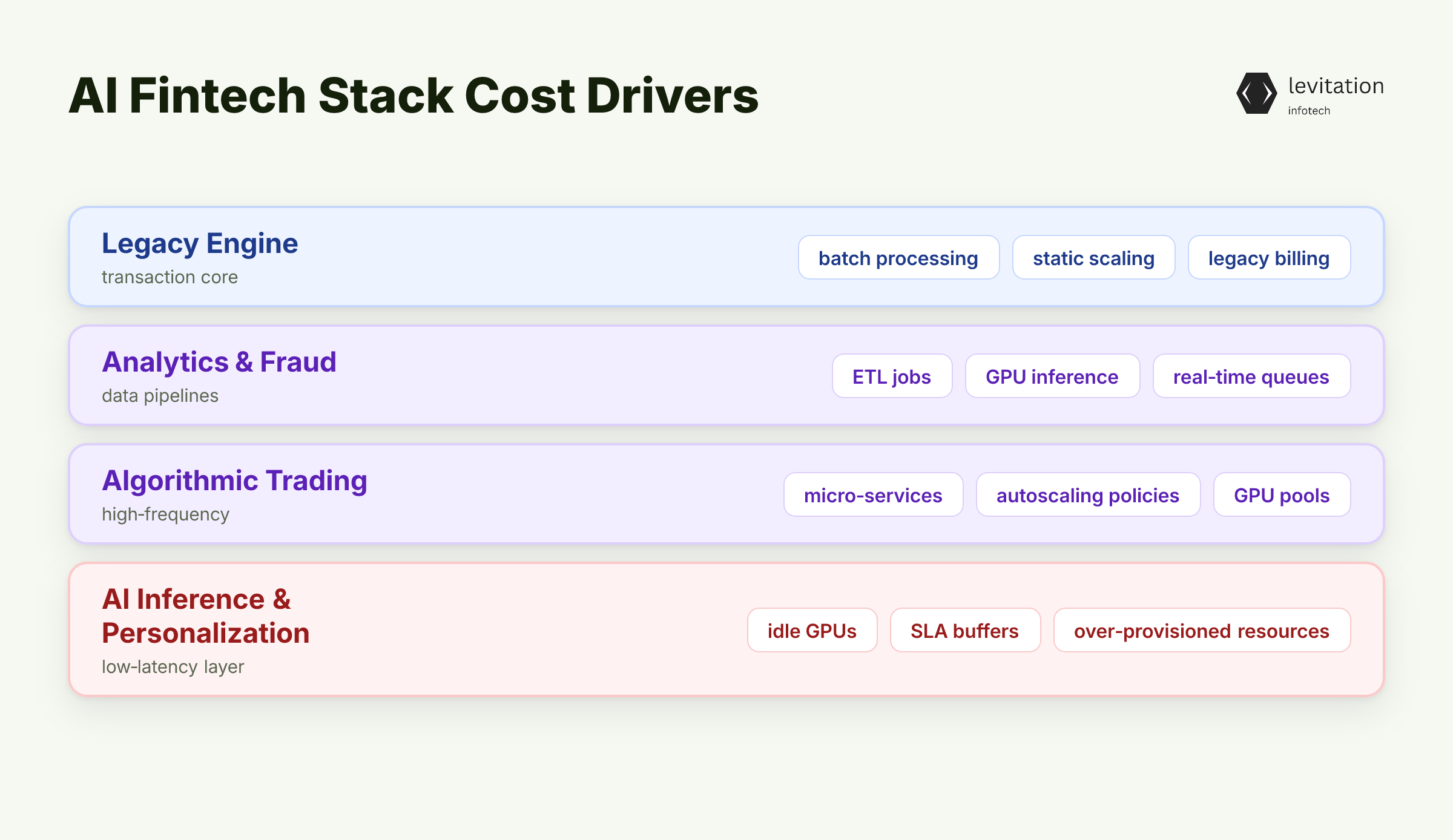
Fintech teams pile analytics, fraud detection, algorithmic trading, and personalization on top of legacy transaction engines. Each layer brings its own data pipelines, GPU-heavy inference services, and real-time streaming queues. The result is a sprawling mesh of compute that multiplies provisioning errors.
A typical stack now runs dozens of GPU-enabled microservices, each with its own autoscaling policy. When one service spikes, the others inherit the load, causing cascade over-provisioning.
Add to that the need for low-latency inference. You end up with idle GPUs humming 24/7 just to meet SLA buffers. - Layered AI services multiply resource footprints. - Over-provisioned GPU pools create silent waste. - Legacy billing dashboards hide per-inference costs.
What hidden traps keep these costs spiraling?
The Hidden Cost Traps That Cost Teams 3× More
Silicon-useful-life assumptions are the first trap. Teams often plan GPU lifespans based on training cycles, then reuse the same hardware for inference without revisiting capacity needs. The study notes that “assumptions around silicon useful life” drive much of the excess spend.
Data-center cost escalation is the second trap. Continuous AI pipelines move terabytes of data through Kafka, Spark, and vector stores every second.
Each hop adds network egress, storage I/O, and compute overhead. When pipelines run nonstop, the marginal cost of each additional inference balloons.
Standard FinOps tools miss the third trap: they lack AI-specific metrics. Most dashboards report CPU-hours, storage GB, or generic “GPU usage.”
They don’t surface cost-per-inference (CPI) or the idle-GPU ratio that matters to fintech. Without those signals, finance teams see a flat line and assume the spend is justified. - Wrong silicon lifespan assumptions keep GPUs over-provisioned. - Always-on pipelines inflate data-movement charges. - Lack of AI-aware metrics blinds finance to true waste.
How can an enterprise model bring that visibility?
Building an Enterprise AI Budget Operating Model
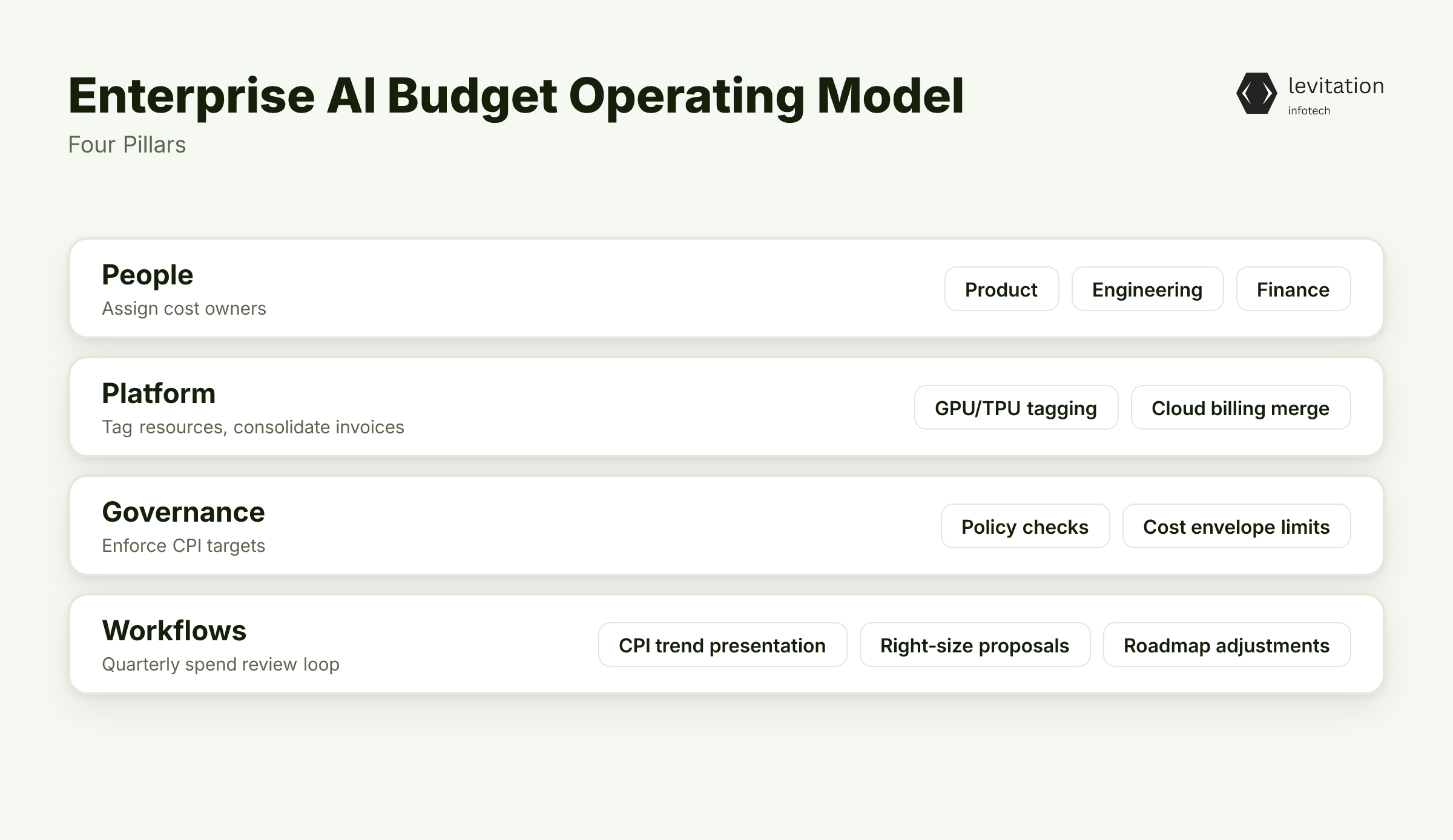
The study recommends treating AI budgeting as a full operating model that includes people, platform, governance, and workflows. Those four pillars give you a single pane of glass for spend.
People - Assign AI cost owners in product, engineering, and finance. Their mandate is to reconcile CPI against business outcomes each sprint.
Platform - Consolidate cloud invoices, tag every AI resource (GPU, TPU, storage, network) with purpose, environment, and product line. A unified tag taxonomy feeds a central spend view that merges procurement orders, cloud billing, and headcount costs.
Governance - Enforce policies that require a CPI target before any new GPU allocation. Use automated policy checks to reject launches that exceed a pre-defined cost envelope.
Workflows - Build a quarterly AI spend review loop. Teams present CPI trends, right-size proposals, and roadmap adjustments. The loop closes the feedback cycle between engineering and finance. - Single-view spend merges procurement, billing, and headcount. - Tag-driven ownership surfaces hidden CPI spikes. - Quarterly reviews turn data into decisive action.
What concrete steps turn this model into real savings?
Step-by-Step Playbook to Reduce Waste
1️⃣ Consolidate invoices and tag aggressively - Pull all cloud bills into a single ledger. Apply a strict tag schema: `team`, `product`, `env`, `resource-type`. Untagged resources automatically trigger a remediation ticket.
2️⃣ Deploy right-size bots for GPU/TPU - Automate scans that compare actual CPI against a baseline. When idle-GPU ratio exceeds a practical threshold, the bot proposes a smaller instance family or a schedule-based shutdown.
3️⃣ Add AI-specific alerts to FinOps dashboards - Create CPI-based thresholds (e.g., “CPI > baseline × 1.5”). Alert the cost owner and the platform team the moment the rule fires.
4️⃣ Align product roadmaps with cost-per-inference targets - Every new AI feature must include a CPI budget line. Engineers estimate inference load, then finance validates the cost against the target.
5️⃣ Institutionalize quarterly AI spend reviews - Bring together product, engineering, and finance. Review CPI trends, approve right-size actions, and re-prioritize roadmap items based on cost impact. - Tag everything; untagged = waste. - Bots automate right-sizing for GPU-heavy workloads. - CPI alerts keep cost front-and-center. - Roadmaps must carry a cost line. - Quarterly reviews lock in discipline.
What does success look like on the balance sheet and the product calendar?
Organizations that adopt the budgeting model report major reductions in wasted cloud spend. The freed budget fuels new AI products - personalized credit offers, next-day fraud alerts - without expanding the cloud bill.
Speed also improves. With right-sized resources, inference latency drops and model deployment cycles shrink from months to weeks. Teams can iterate on AI features faster, delivering value to customers while keeping the CFO happy.
Strategic payoff extends beyond numbers. Board confidence rises when finance can point to a clear CPI target and a quarterly audit trail. Risk perception falls because every GPU allocation is justified and monitored. - Major waste reduction is achievable. - Faster AI rollouts free up market advantage. - Transparent spend builds board trust.
How can teams keep this momentum over time?
Frequently Asked Questions
Q: Why does AI increase cloud waste in fintech more than in other industries?
A: Fintech workloads combine real-time fraud detection, high-frequency trading, and personalized recommendation engines, which keep GPUs/TPUs active 24/7 and amplify data-movement costs that generic FinOps tools don't capture.
Q: What's the first metric a CTO should track to spot AI-related cloud waste?
A: Start with AI-specific cost-per-inference (CPI) and compare it against a baseline CPI set during a controlled pilot; spikes indicate over-provisioned resources or idle models.
Q: Can existing FinOps platforms be extended for AI budgeting?
A: Yes, by adding AI tags, custom right-size policies for GPU/TPU instances, and alert thresholds tied to CPI, you can reuse most FinOps tooling while gaining AI-aware visibility.
Q: How long does it take to see measurable savings after implementing the playbook?
A: Most organizations report meaningful reductions - typically well over half of the previously wasted spend - within the first two quarterly review cycles, roughly 6-8 weeks after tagging and automation are in place.
Q: Is there a risk of under-investing in AI performance when cutting waste?
A: If you tie cost controls to performance SLAs (e.g., latency per transaction), the budget model ensures you only trim idle capacity, not the compute needed for critical AI outcomes.
Related reading: Learn how “Kubernetes Costs Are Killing Your AI Budget” and “Why Your Cloud Fails RBI Data Localization Audits” for deeper dives into cost-visibility pitfalls.
Start tagging today to see the savings unfold.
Sources
Research and references cited in this article:
- Tracking Trillions: The Assumptions Shaping the Scale of the AI Build-Out
- Big Tech AI Spending: 00B Capex Race in 2026 - Tech Insider
- AI Cost Statistics 2026: Forecasting, ROI, and Budget Risk - Mavvrik: AI
- Global AI spend to reach $2.59 trillion in 2026 - CIO Dive
- Is "tokenomics" breaking your AI budget? As AI use cases graduate ...
- A Guide to Cloud Cost Optimization in Financial Services | BizTech Magazine
- Cloud Cost Optimization 2026: Visibility to Automation - Sedai
- FinTech Cloud Cost Optimization & Dev Efficiency Strategies
- IDC - Balancing AI innovation and cost: The new FinOps mandate
- Why Cloud Costs Are Rising and How to Control Them in 2026 | Directio
- Enterprise AI Budgeting in 2026: Benchmarks, Cost Breakdown, and CFO-Ready Planning - StackAI · AI Agents for the Enterprise
- Cloud Financial Management: Strategies and Best Practices
About the author
Mayank Singh is a software developer at Levitation Infotech, where he builds web and AI-powered applications across the company’s fintech, healthcare, and enterprise projects.