


TL;DR
CEOs often buy AI like a plug-in, hoping it will instantly boost performance. The real advantage comes from weaving AI into strategy, data pipelines, and culture. A proven blueprint moves you from vision to production. It does this in a short, disciplined cadence instead of a drawn-out effort.
Why Most CTOs Miss AI's Real Strategic Value
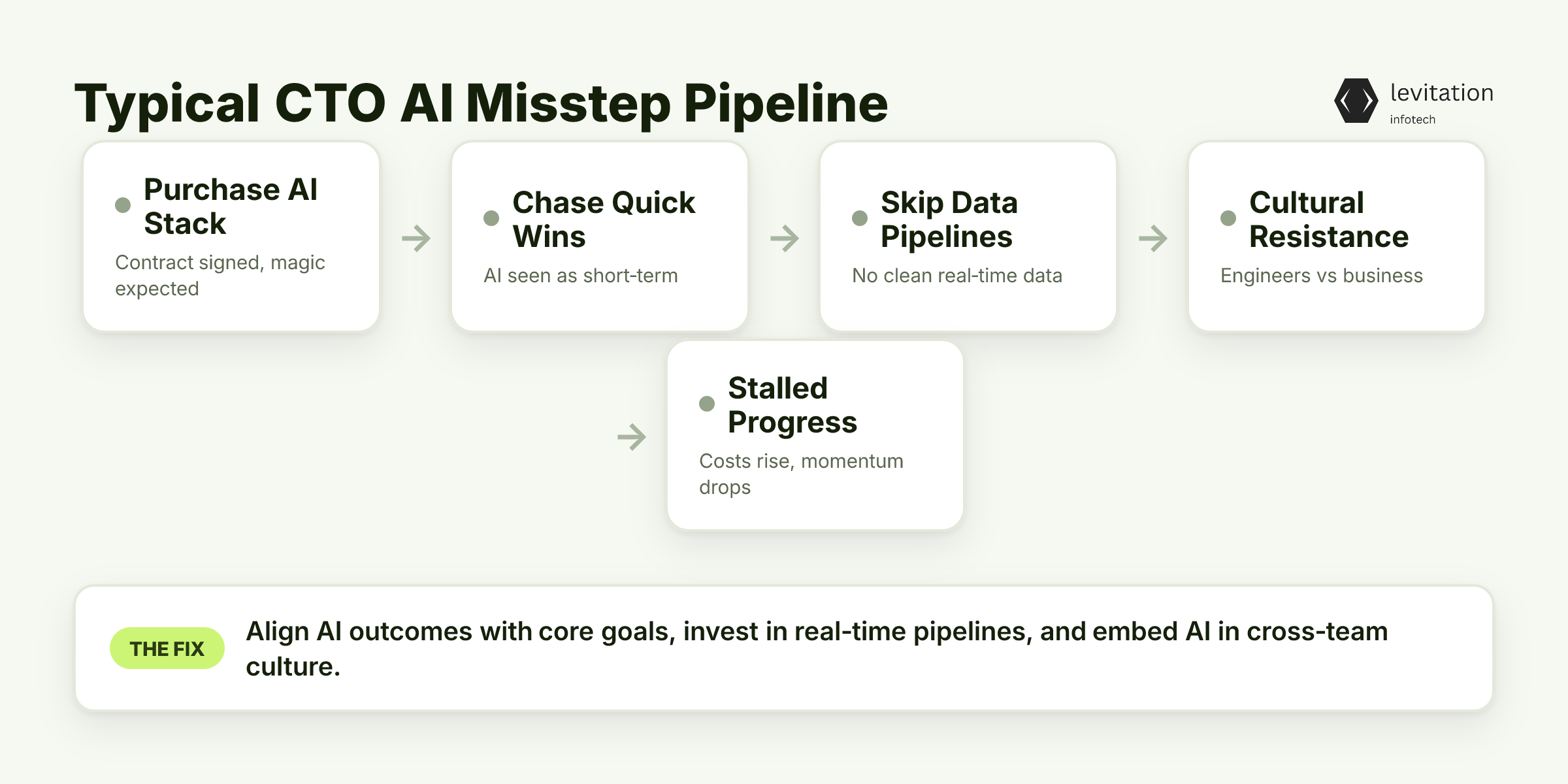
CTOs treat AI as another stack to purchase and install. They sign a contract, wait for magic. Then they ignore the fact that a model cannot run in a vacuum. - Myth of the “quick win.” AI is sold as a short-term project, not a strategic initiative. - Under-invested pipelines. Without clean, real-time data, models starve and drift. - Cultural resistance. Engineers see AI as a side-quest, while business leaders treat it as buzz.
These missteps stall progress, inflate costs, and erode momentum. The bolt-on mindset hides the deeper need for alignment between AI outcomes and core business goals.
What hidden costs appear when AI is forced into existing stacks?
The Hidden Costs of Treating AI Like Any Other Stack
When AI is shoehorned into an existing stack, hidden costs explode. They show up as delayed releases, talent churn, and compliance headaches.
Organizational readiness - Teams lack AI-specific roles, governance frameworks, and change-management plans. Without a data steward, ownership of model performance slips.
Data strategy mismatch - Legacy pipelines were built for batch reporting, not continuous learning. Missing metadata and inconsistent schemas force engineers to spend weeks cleaning data before a model can be trained.
Timeline trap - In-house squads often need many months to deliver a production-grade AI system. Partners that have mastered the end-to-end flow can compress that window dramatically. They deliver value while the market races ahead. - Talent gap. Hiring data scientists without a supporting data platform leads to idle expertise. - Governance lag. Manual model approvals stall deployments and increase risk. - Cost leakage. Over-provisioned cloud resources sit idle while pipelines are re-engineered.
Addressing these hidden drains requires a shift in mindset and architecture.
How can you embed AI so it becomes a core capability?
Embedding AI: A Comprehensive Integration Blueprint
A bolt-on fails because it ignores the ecosystem. The blueprint below turns AI into a core capability, not an afterthought. - Align AI goals with business outcomes. Start with the profit or risk metric you want to move. Then define the AI hypothesis that can shift it. - Audit and prepare data pipelines for continuous learning. Map every data source and enforce schema contracts. Then build streaming ingestion (Kafka, Spark) that feeds models in near real time. - Adopt modular, API-first architecture. Wrap each model behind a stateless service and expose it via REST or gRPC. Then let existing microservices call it like any other dependency. This avoids vendor lock-in and simplifies scaling. - Use a partner with proven scale. Deployments that have survived multiple production cycles show that the engineering choices are robust. - Institutionalize monitoring and iterative improvement. Set up drift detection, automated retraining triggers, and a dashboard. The dashboard surfaces KPI impact to both engineers and executives.
Each element removes a friction point that typically stalls AI projects. By the time you finish data-pipeline preparation, the organization already has the foundation to support rapid experimentation.
What steps turn this blueprint into a working service?
Hands-On Playbook: From Vision to Production in a Structured Multi-Phase Sprint
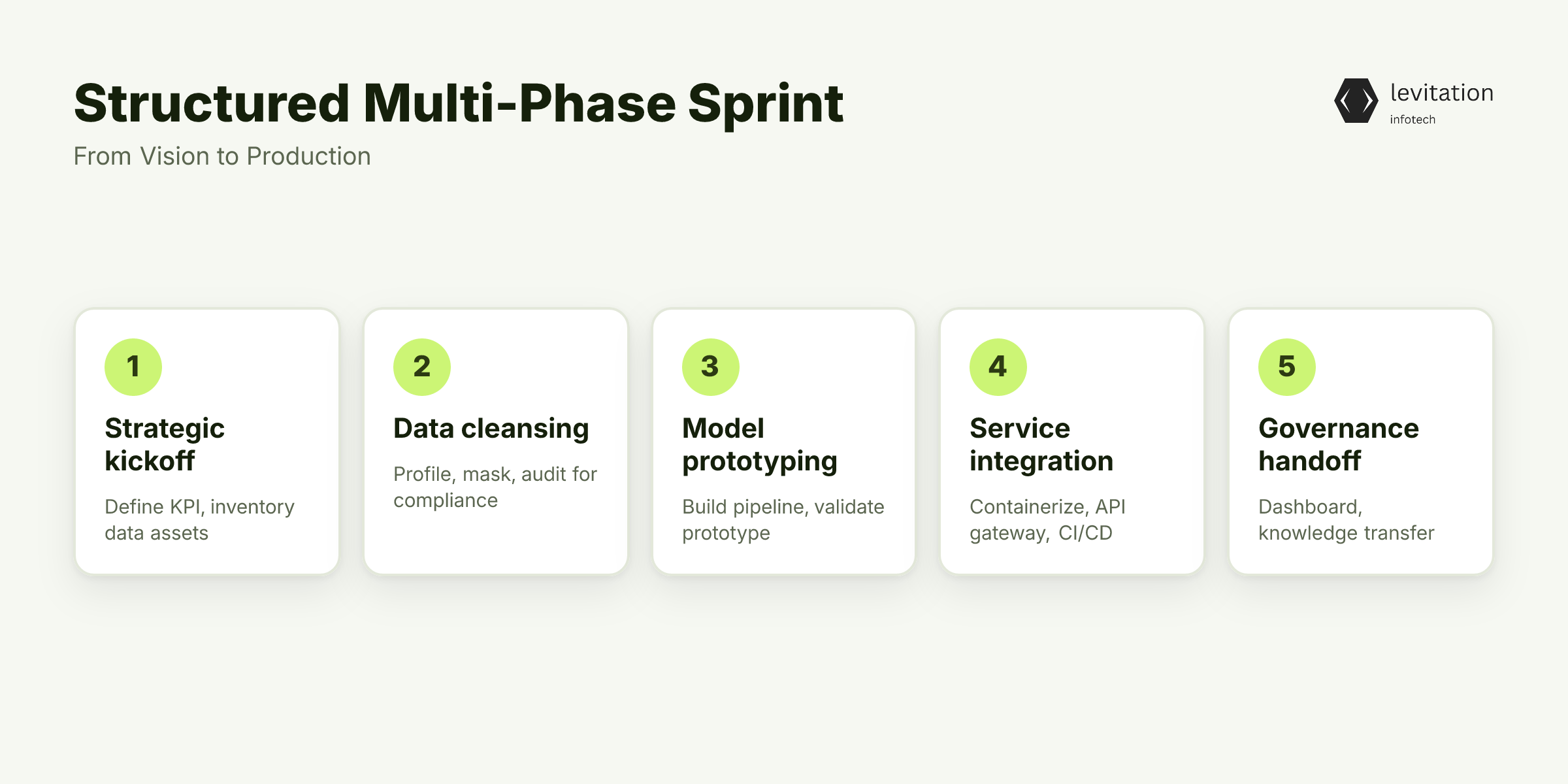
Turning a strategy into a live service requires disciplined cadence. The multi-phase sprint keeps every stakeholder aligned and technical debt low.
Strategic kickoff - Define the business KPI (for example, fraud-loss reduction). - Inventory all data assets; tag owners and freshness requirements.
Data cleansing and compliance - Run automated profiling jobs to flag missing values. - Apply privacy masks and generate audit logs for compliance.
Model prototyping - Build a reusable training pipeline that pulls from the streaming layer. - Validate the prototype against a hold-out set and iterate on feature engineering.
Service integration - Containerize the model, expose it via an API gateway, and register the endpoint in the service mesh. - Write integration tests that simulate real-world request patterns.
Automated CI/CD - Add the model container to the existing CI pipeline. - Deploy a canary release to a small traffic slice, monitor latency and error rates.
Governance handoff - Publish a monitoring dashboard that shows KPI drift, model confidence, and cost metrics. - Conduct a knowledge-transfer session with ops and product owners.
The result is a production-grade AI service that delivers measurable impact in a condensed timeframe. It avoids the drawn-out slog many organizations experience.
What tangible gains appear when AI moves from bolt-on to core?
What Happens When AI Becomes Core: Tangible Business Gains
When AI moves from bolt-on to core, the payoff ripples across the organization. - Revenue impact. Companies that embed AI see top-line growth that outpaces peers who rely on manual processes. - Operational efficiency. Automation reduces manual effort, freeing talent for higher-value tasks. - Risk mitigation. Continuous monitoring flags anomalies early, a crucial advantage for regulated sectors. - Longevity. Systems that survive several production cycles prove that the engineering foundations are solid and the business value endures.
These outcomes aren’t abstract. The same engineering patterns keep a fraud-detection model alive for years. They also power recommendation engines, demand forecasts, and compliance checks across industries.
How can you start bridging the gap today?
Frequently Asked Questions
Q: Why does my AI project keep missing targets?
A: Most misses stem from treating AI as a bolt-on. Instead, align it with business goals, data readiness, and cultural change.
Q: How fast can an enterprise AI solution be deployed?
A: With a proven partner, end-to-end deployment can be achieved in a short, focused effort. This is faster than the many months typical for in-house builds.
Q: What evidence shows AI integrations last?
A: Deployments that remain in production for multiple years demonstrate engineering quality and sustained business value.
Q: Is AI worth the investment for regulated industries?
A: Yes. A well-engineered AI pipeline can meet strict compliance requirements while delivering high impact.
Embedding AI at the strategic level isn’t a nice-to-have; it’s a competitive imperative. Companies that close the readiness gap unlock faster value, lower risk, and lasting growth.
Ready to move beyond bolt-ons?
Further reading - AI Strategy Playbook - how to align AI with corporate goals. - Data Pipeline Best Practices - building streams for continuous learning. - MLOps at Scale - operationalizing models in production. - Zero Trust Architecture - securing AI services end-to-end. - Vector Search Overview - enabling semantic retrieval for LLM-augmented applications.
Sources
Research and references cited in this article:
- 2026 AI Business Predictions - PwC
- The Impact of AI on Business: What Leaders Need to Know
- The Future of AI: How Artificial Intelligence Will Change the World
- Artificial Intelligence's Impact on Business Operations and Its People
- Discover 10 Benefits of AI in Your Workplace - Microsoft
- How AI Integration Services Drive Competitive Advantage in 2026
- AI Transformation 2026: 26 Predictions Redefining CX, EX, Design, and Product Innovation
- How does artificial intelligence help businesses grow in 2026? - Quora
- How AI Industry Growth is Affecting Business in 2026 & ...
- PDF Organizational Transformation in the Age of AI
- Top 10 AI Companies in 2026 | Best Enterprise AI Firms - Intellectyx
- Forbes 2026 AI 50 List | Top Artificial Intelligence Companies
About the author
Mayank Singh is a software developer at Levitation Infotech, where he builds web and AI-powered applications across the company’s fintech, healthcare, and enterprise projects.