


Your model cleared every demographic parity check. Your adverse action notices look textbook. Then the examiner opens a second tab and starts asking about features you didn't even know were in production.
TL;DR: Statistical bias tests measure one thing: outcome fairness at a frozen point in time. Fair lending audits measure something else entirely: the ability to reconstruct, explain, and justify every decision your model makes, from feature selection through production drift. Passing the first does not protect you from the second. The gap between the two is where most fintech AI lending models fail their exams. Closing it requires governance artifacts that no standard bias test produces, and that most engineering teams have never been asked to build.
Key Takeaways: - A passing disparate impact ratio is a statistical snapshot, not a compliance defense; it tells the regulator nothing about how features were selected, who approved them, or whether alternatives were considered. - Fair lending audits are a three-layer exam covering the model itself, the development process, and cross-functional governance, and they can fail on any single layer even when the model layer is clean. - Recurring audit failure patterns include proxy feature contamination, post-decision drift, undocumented feature selection rationale, and missing Less Discriminatory Alternative (LDA) search trails. - Audit-ready governance is an architecture problem, not a documentation problem, and requires building artifact generation into the model lifecycle rather than assembling compliance evidence after the fact.
The Testing Paradox in Fintech Compliance
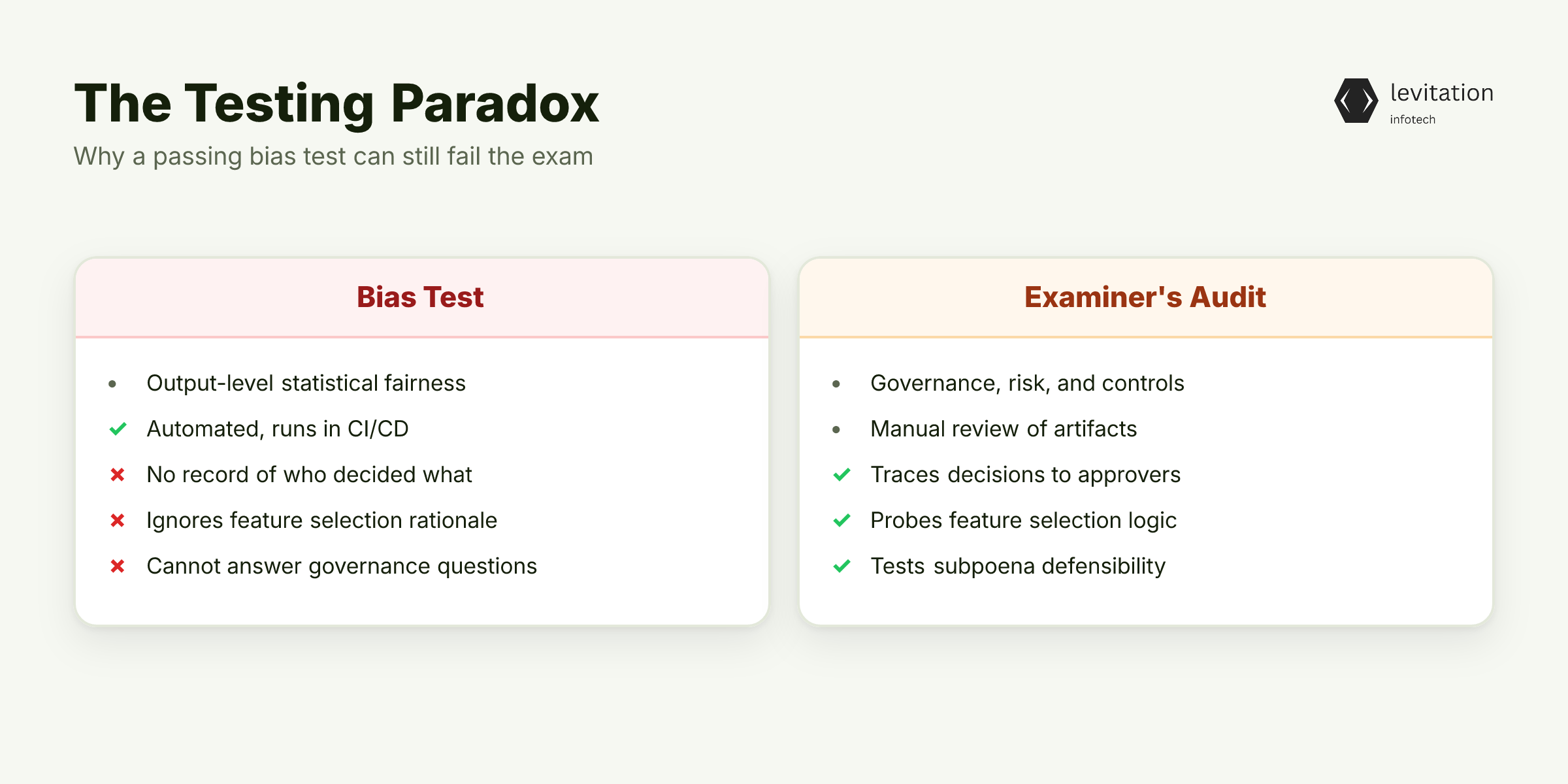
A model can show demographic parity within rounding error. It can generate perfectly structured adverse action codes. It can still walk out of an exam with a Matters Requiring Attention letter. This is not a contradiction. It is the natural result of testing for one thing while examiners evaluate something else.
The five federal financial regulatory agencies, including the CFPB, are concerned with governance, risk management, and controls over AI. They care about more than output fairness. Interagency guidance now demands governance artifacts that most fintech solutions do not produce in CI/CD pipelines.
Teams that built their compliance posture around "we passed our bias test" are learning a hard lesson. The test was never what the examiner cared about.
Think about it from the examiner's perspective. They sit down with your team, open a model card, and start asking questions that have no statistical answer: - Why was this feature included when a less correlated alternative was available? - Who approved that decision, and what alternatives did they consider? - How would you defend this model if a plaintiff attorney subpoenaed the development log tomorrow?
The bias test answers none of these. The audit, however, is structured almost entirely around them. If your model passed every fairness metric, how can the audit still fail? The answer lies in what each process is actually designed to catch.
What Bias Tests Actually Measure (And What They Miss)
Standard fairness tests, including demographic parity, equalized odds, and calibration, are statistical proxies for a legal concept. They treat your model as a black box, frozen at a single point in time, and ask whether the output distribution looks fair across protected groups.
This is a useful diagnostic. It is also catastrophically narrow. These tests tell you nothing about how your features were constructed. They say nothing about whether your training data lineage is defensible. They cannot tell you whether you can reproduce a given decision six months from now in a deposition.
They cannot detect proxy feature contamination because they only see the protected class columns you explicitly labeled. They say nothing about whether your explainability artifacts would survive cross-examination by a plaintiff's expert witness.
Worse, bias tests validate a single moment. Your model passed the test on the holdout set. Production traffic looks nothing like your holdout set after six months of marketing channel shifts, partner integrations, and applicant mix changes. The test result becomes a historical artifact, not a live defense. It is the equivalent of passing a vehicle inspection and then driving the car without maintenance.
Any fintech team still treating bias tests as their primary exam defense is preparing for the wrong test.
What Fair Lending Audits Actually Validate: The Three-Layer Exam
Auditors evaluate three distinct layers, and your model can fail on any one of them while the others look perfect.
Layer 1: The Model Layer. This is where bias tests live, but it is broader than parity ratios. Examiners want adverse action reasons grounded in specific, contestable features, not SHAP value approximations that crumble under cross-examination.
They want to see that you tested for disparate impact using multiple methodologies, not a single metric that flattered your model. They want documentation showing your model performs consistently across subgroups, not a one-time snapshot.
Layer 2: The Process Layer. This is where most teams fail. Auditors need to reconstruct your model development history months or years after the fact. Who approved the feature set? What alternatives were considered? What validation steps were performed, and by whom?
When was the model last reviewed? If your answer is "let me pull up the Git history," you have already lost. They need formal documentation tied to a model risk management framework, not version control logs.
This is also where examiners verify that marketing, initial applicant engagement, and front-end decisioning do not introduce discriminatory patterns. The model alone would never produce them.
Layer 3: The Governance Layer. This is the layer most financial technology teams have never instrumented. Examiners expect documented evidence of cross-functional oversight, with meeting cadence, escalation paths, and written charters.
They expect evidence of Less Discriminatory Alternative (LDA) searches. You must prove you actively looked for less discriminatory models, found them, and had a documented business reason for not adopting them. A passing bias test is not a substitute.
They also expect to see continuous monitoring of production traffic, not just pre-deployment validation.
Regulators have made governance, risk management, and controls over AI an explicit supervisory priority. The issues they surface through this scrutiny are often ones that manual sampling would have missed entirely.
The Four Audit Failure Patterns We See Repeatedly
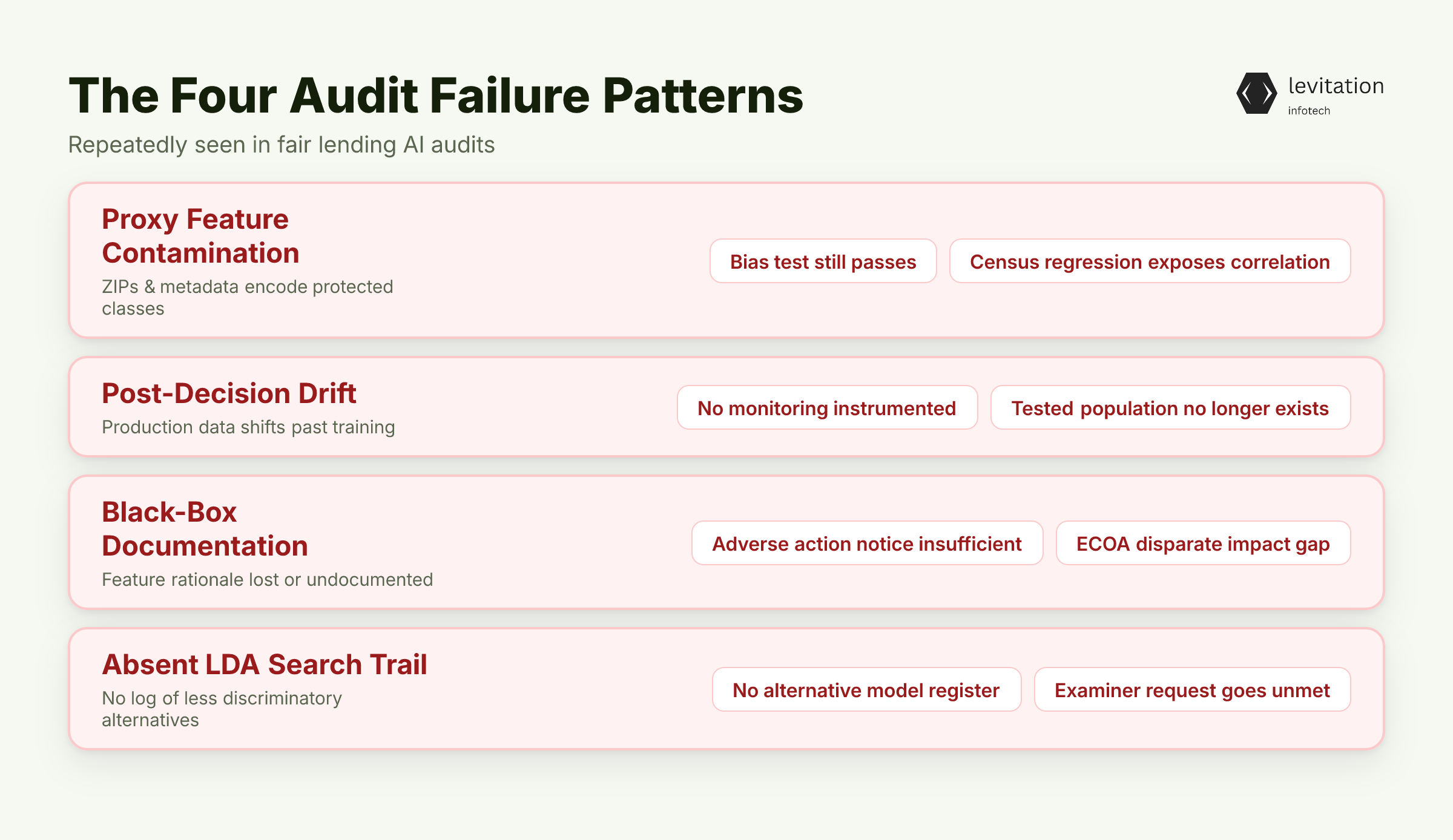
Pattern 1: Proxy Feature Contamination. Your model uses ZIP codes, name embeddings from unstructured data, or browser metadata that correlate with protected classes. Your bias test passes because none of these features are in your protected class list. But examiners can reconstruct the correlation using public census data and standard regression techniques.
The proxy is not the protected class; it is a high-dimensional fingerprint of it. This pattern is especially common in banking software built on third-party data enrichment that nobody on the compliance team has audited.
Pattern 2: Post-Decision Drift. Your training data was fair. Your production data shifted because marketing changed acquisition channels, a new partner integration brought in different applicant demographics, or seasonal patterns altered the mix.
Nobody instrumented monitoring to catch it. The audit finds disparate impact you never tested for, because the test was run on a population that no longer exists.
Pattern 3: Black-Box Documentation. You can generate adverse action codes. You cannot explain why feature X was selected over feature Y. That decision was made in a Jupyter notebook six months ago. The rationale lives only in someone's memory.
ECOA requires that justification under disparate impact analysis. Without it, your adverse action notice is legally insufficient regardless of its format.
Pattern 4: Absent LDA Search Trail. Regulators expect documented evidence that you searched for less discriminatory alternatives. Not a passing bias test. Not a general statement that "we considered fairness."
A register must show the alternative models you evaluated. It must list their fairness metrics, why you chose the one you did, and the business reason for rejecting the others.
This is an artifact examiners frequently request and fintechs frequently lack. Teams that skip this step are functionally gambling on the examiner not asking.
Each pattern is preventable, but only if the fix is built into the model lifecycle, not bolted on after deployment. Bolted-on governance creates documentation debt that compounds with every model refresh.
Building Audit-Ready AI Governance: A CTO's Implementation Roadmap
Audit-ready governance is not a compliance initiative. It is a payment systems infrastructure problem with five concrete components.
Step 1: Instrument feature provenance. Every feature in production must trace back to a documented decision in the model development log. Who approved it. What alternatives were considered. What bias tests were run on it in isolation. This is not optional. Without provenance, your model card is a marketing document, not a compliance artifact.
Step 2: Build an LDA search register. For every model version, log the alternative models you considered, their fairness metrics, and your business justification for the chosen approach. Update it with every model refresh. This single artifact changes exam outcomes more than any other change you can make.
Step 3: Deploy continuous disparate impact monitoring. Run approval rate, pricing, and limit disparity checks on production traffic weekly, not just on holdout sets during validation. When drift exceeds threshold, trigger an automatic review workflow. The same pattern that catches model performance drift catches compliance drift.
Step 4: Create examiner-ready model cards. Go beyond accuracy metrics. Include intended use boundaries, known limitations, protected class testing results across multiple methodologies, and a change log accessible without engineering team involvement. If your compliance officer needs to Slack the ML team to interpret the model card, it is not examiner-ready.
Step 5: Establish cross-functional oversight with documented cadence. Written charters. Meeting minutes. Escalation paths. This is the governance layer examiners test for, and it is the layer most teams treat as paperwork until the exam starts.
Teams that have built this architecture have changed their exam outcomes. The results show up in shorter remediation cycles, fewer MRAs, and a shift in examiner tone from deficiency finding to collaborative model enhancement.
What Changes When Your AI Is Actually Audit-Ready
The transformation shows up in three places. First, examiners stop asking for artifacts you do not have. The conversation shifts from "show me why this is defensible" to "walk me through your monitoring."
Second, legal and compliance teams stop blocking model deployments. Governance artifacts are generated by the system automatically, not assembled manually the week before launch.
Third, your bias tests and audit answers finally tell the same story. They measure the same things through the same instrumentation.
For an nbfc operating at scale, this changes everything. A model refresh that proceeds in days can stretch into weeks as documentation gaps force teams to reconstruct development history from scratch.
The compounding effect matters. Every subsequent model refresh inherits the prior audit trail. The marginal cost of governance decreases with each iteration. The marginal cost of manual documentation keeps climbing.
The uncomfortable truth is that bias tests were never designed to be your compliance defense. They are a diagnostic, not a verdict. Treating them as a verdict is how engineering teams end up surprised in exam rooms.
The fix is not a better test. It is a better architecture. The artifacts examiners need are produced as a natural byproduct of how the model is built. They are not a separate compliance deliverable assembled under deadline.
Frequently Asked Questions
Q: Why do AI models pass bias tests but still fail fair lending audits?
A: Bias tests measure statistical fairness at a single point in time. Fair lending audits examine the full decision pipeline, including feature provenance, governance documentation, and explainability. A model can have perfect demographic parity and still fail an audit. The examiner cannot reconstruct how features were selected or why alternatives were rejected.
Q: What is a Less Discriminatory Alternative (LDA) search in fair lending compliance?
A: An LDA search is documented evidence that your team actively looked for alternatives. The alternatives would achieve similar business outcomes with less discriminatory impact. You need a legitimate reason for not adopting them.
About the author
Mayank Singh is a software developer at Levitation Infotech, where he builds web and AI-powered applications across the company’s fintech, healthcare, and enterprise projects.