


TL;DR: AI agents writing Terraform create a compliance blind spot that single deny rules cannot close. The fix is a six-layer control stack: credential isolation, network boundaries, short-lived identity, PreToolUse hooks, sandboxing, and an append-only evidence log. Done right, the AI stays useful, humans keep the apply step, and compliance officers audit logs instead of HCL.
Key Takeaways: - Read-only deny rules collapse the moment an agent wraps a forbidden action in a bash call - Six stacked controls replace a single deny toggle and survive subprocess escalation - Compliance shifts from quarterly HCL review to continuous evidence-log verification
The Terraform Audit Gap Nobody Talks About
The compliance officer opens a SOC 2 evidence binder. Page one: a Terraform plan diff. Page two: an HCL module with 14 resources. Page three: a state file path she cannot parse.
Her job is to attest that production is governed. Her toolset was not designed for this.
This is the Terraform audit gap nobody puts in the architecture diagram. Compliance teams are trained to read policy documents, access logs, and SOC 2 evidence. They are not trained to read HCL modules, state files, or provider blocks.
The vocabulary mismatch is the first problem. The structural one is worse.
AI coding assistants have emerged as de facto infrastructure operators. They read modules, draft plans, and apply changes. Yet most organizations have no policy layer for how these agents touch Terraform.
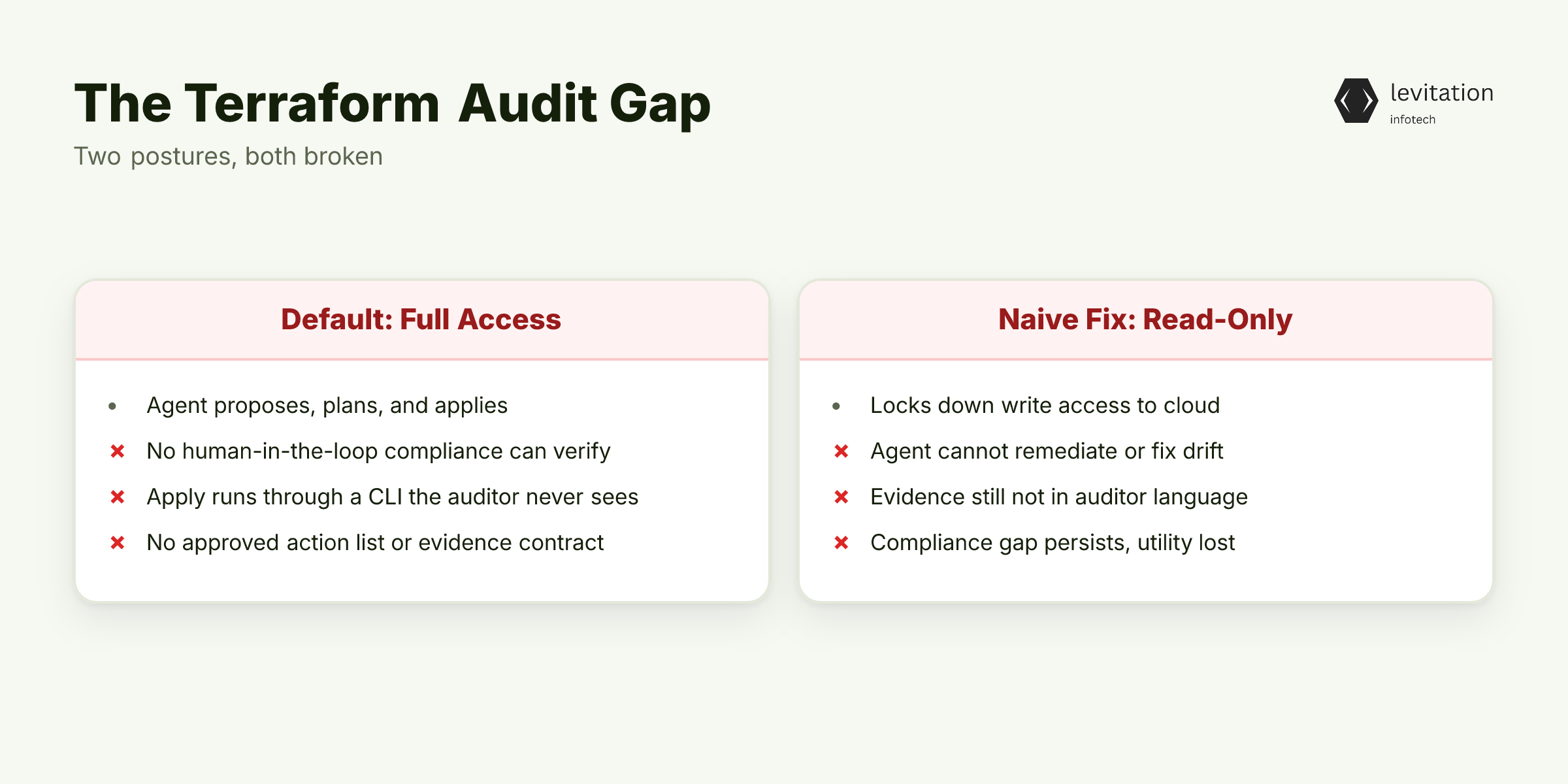
No approved action list. No whitelisted tools. No evidence contract. The agent acts like a power user with the keys to your cloud account.
The default posture in most setups is full read-write access. The agent can propose, plan, and apply changes with no human in the loop that compliance can verify. If the apply step runs through a CLI the auditor never sees, there is no evidence trail in a language she can read.
This is not a tooling problem. It is a governance vacuum. AI governance practitioners have seen this vacuum firsthand.
The agent writes faster than any human. It also disappears faster than any human during a control review.
So the obvious fix is to lock the AI down. Flip on read-only mode, right? That is where things get worse.
Why 'Read-Only' Is a Dangerous Word in IaC
Deny rules feel like the answer. Block the agent from calling `terraform apply`, and the problem disappears. Except the problem is the agent, not the tool.
Here is the bypass in two lines:
1#!/bin/bash2terraform apply -auto-approve
An agent can wrap `terraform apply` in a bash script and execute the script instead. The deny rule on the apply tool misses it entirely. The same trick works for `aws s3 rm`, `kubectl delete`, and any other verb you thought you blocked.
The deeper issue is how the deny rule itself is scoped. `Read()` deny rules only block the agent's built-in `Read` tool. They do not block `cat ~/.aws/credentials` through Bash.
They do not block `python -c "open('/root/.ssh/id_rsa').read()"`. They see the tool name, not the command. The moment an agent can spawn a subprocess, the deny list becomes a suggestion.
A read-only posture that cannot survive a subprocess call is theater, not control. Your auditor will know the difference. The difference shows up in the access logs the auditor can read.
The agent's call to `cat` lands in shell history. The deny rule does not stop it. The cloud security story you tell in the audit is now a lie.
The instinct is to add more deny rules. The instinct is wrong.
Deny rules are name-based. Agents are string-based. They will always be one escape away from each other.
If individual deny rules are porous, the fix cannot be a single toggle. It has to be stacked.
The Six-Layer Control Stack for AI-on-Terraform
One control fails when the agent finds a path around it. Six controls fail only when the agent finds six paths. That asymmetry is the design principle.
The agent has to win every round. You only have to win one.
Here is the stack: - Layer 1 - Credential isolation and least privilege. Give the agent a separate, scoped-down IAM role with read-only permissions to live environments. Not your root account. Not your CI runner role. - Layer 2 - Network and workspace boundaries. Isolate the agent's execution context from production state files. The agent should not be able to reach the S3 bucket where your real `terraform.tfstate` lives. - Layer 3 - Identity scoping. Short-lived credentials that expire before any meaningful lateral movement. STS tokens, not long-lived access keys. - Layer 4 - PreToolUse hooks. Inspect every command before it runs, including wrapped bash invocations. The hook reads the actual command string, not the tool name. - Layer 5 - Sandboxing. A runtime boundary that catches what deny rules miss, including subprocess reads of secret files. Even if Layer 4 fails, the sandbox catches the file read. - Layer 6 - Audit and evidence generation. Every action logged in a format a compliance officer can read without learning HCL. Append-only JSON with timestamp, actor, tool, and outcome.
Layer 1 and Layer 3 are configuration. Layer 2 and Layer 6 are platform work. Layer 4 and Layer 5 are the only layers that require custom code, and even those are usually glue around existing primitives.
This is not a six-month project. It is a stack you can stand up incrementally.
Teams shipping this AI governance framework rely on it for one reason. The controls survive the next agent rewrite, the next model swap, and the next audit cycle. The stack outlives the implementation.
The stack is the insight. The question is which layers you actually have to build versus which you can configure today.
Implementing the Permission Boundary That Holds
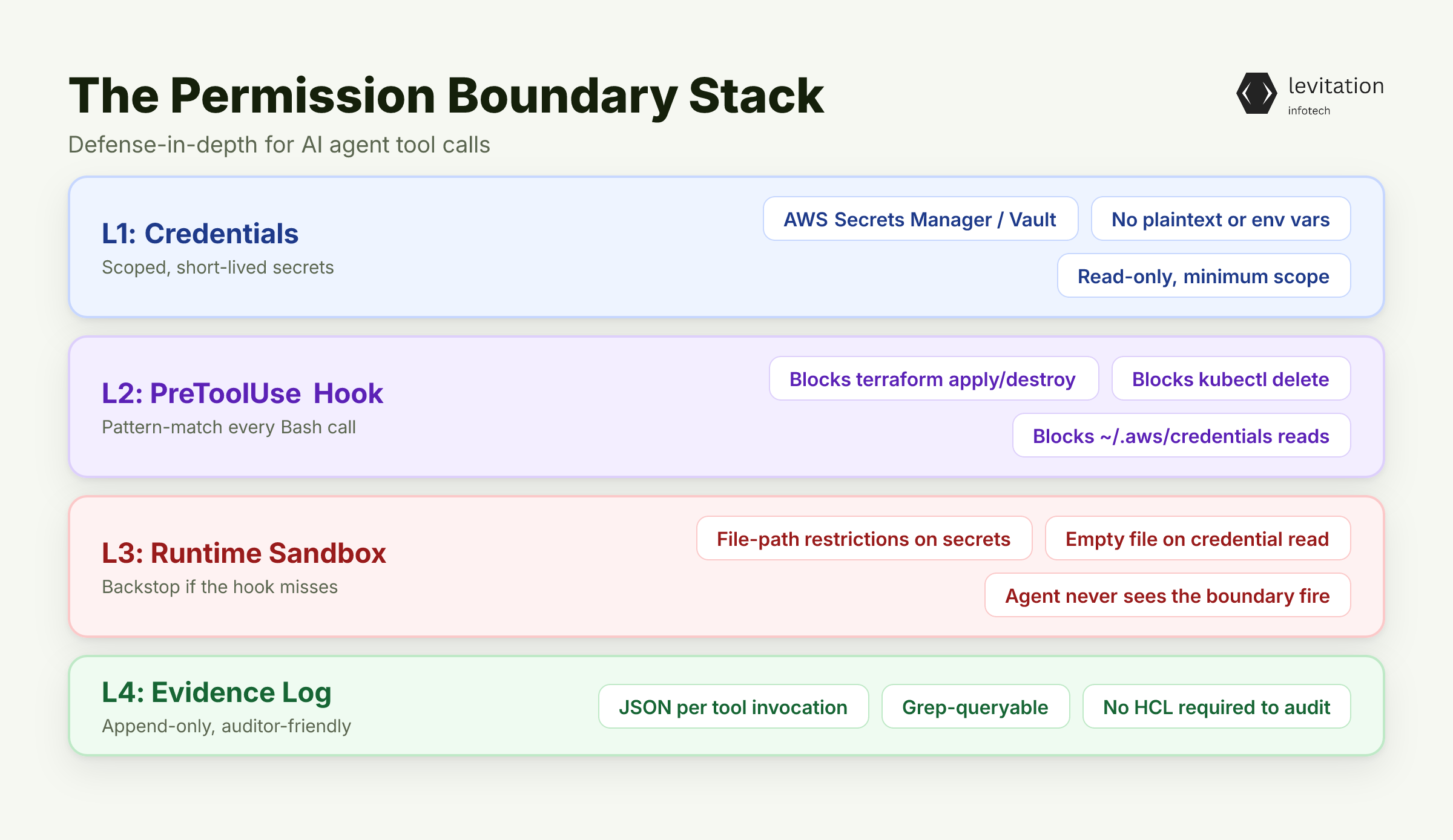
Start with the credential architecture. Store secrets in AWS Secrets Manager or HashiCorp Vault, never in plaintext or environment variables the agent can read. Then issue the agent a short-lived, read-only credential scoped to exactly what it needs.
Here is the shape of a PreToolUse hook in practice:
1def pre_tool_use(tool_name, command):2 blocked_patterns = [3 r"terraform\s+apply",4 r"terraform\s+destroy",5 r"aws\s+s3\s+rm",6 r"kubectl\s+delete",7 r"cat\s+~/.aws/credentials",8 r"cat\s+~/.ssh/",9 ]10 for pattern in blocked_patterns:11 if re.search(pattern, command, re.IGNORECASE):12 return {"decision": "block", "reason": f"matched: {pattern}"}13 return {"decision": "allow"}
The hook runs on every tool call, including Bash. It inspects the command string, not the tool name. This is the layer that catches the wrapped bash script from earlier.
Layer 5 is the backstop. Even if the hook has a bug, a runtime sandbox enforces file-path restrictions on credential directories.
The subprocess that tries to read `~/.aws/credentials` gets an empty file. The agent never knows the boundary fired.
Layer 6 closes the loop. Pipe every action into an immutable evidence log:
1{"ts":"2026-09-17T10:42:01Z","actor":"ai-agent-7","tool":"Bash","cmd":"terraform plan","outcome":"allow","trace_id":"a91f"}2{"ts":"2026-09-17T10:42:14Z","actor":"ai-agent-7","tool":"Bash","cmd":"./apply.sh","outcome":"block","reason":"terraform apply matched"}
Append-only. JSON. Queryable with `grep`. Your compliance team can read it without learning HCL. Cloud security solutions shipped this way hold up under audit because the evidence is in the auditor's language, not the engineer's.
In-house builds that skip the sandbox layer leave the wrap-in-bash path wide open. The boundary has to hold end to end.
With the boundary in place, the question flips: what does compliance actually look like when the AI is contained?
From Audit Theater to Evidence-Grade Compliance
Replace "show me the Terraform code" with "show me the action log." Compliance officers read evidence, not infrastructure-as-code.
The HCL is a means. The log is the artifact.
Every agent action becomes a signed event: - Who asked the agent - What the agent proposed - What a human approved - What was applied or denied - What the runtime sandbox saw
That log maps cleanly to SOC 2, ISO 27001, and HIPAA control frameworks because the evidence is already in the auditor's language. Timestamps, actor identity, outcome, and a non-repudiable trace ID. Nothing in that structure requires a Terraform expert to interpret.
This shift moves compliance from a quarterly code review to continuous control verification. The auditor no longer waits for a pull request snapshot. She queries the evidence log at any time and gets a complete answer.
For teams building responsible AI governance at scale, this is the difference. Pass a Type 2 audit, or watch the auditor walk out mid-review.
The operational shift is just as large. Engineering no longer prepares audit packets by hand. The evidence generates itself.
The compliance team stops chasing screenshots. The agent stays productive because the read path is still open.
Which leaves the part nobody puts in the architecture diagram: what actually changes for the business.
The Payoff: When Compliance and AI Stop Fighting
Audit cycles compress. Code review becomes log review. The compliance team never has to learn HCL.
That is not a small thing. It is the difference between a control function that blocks releases, or one that signs off in the same Slack thread the engineer used.
Engineering velocity holds. The AI keeps proposing, generating, and drafting.
It is the apply boundary that is hard, not the read path. Containment isolates the friction to the apply step, not the entire workflow.
Risk shifts from "we hope the agent did the right thing" to "we can prove the agent could not have done the wrong thing." That sentence is what a board wants to hear. It is also what an external auditor will accept.
The six-layer stack is how you get from hope to proof. It is what zero trust AI infrastructure looks like in practice for teams that ship and maintain the controls.
Long-term, the systems that survive are the ones where the control plane is legible to non-engineers. Compliance officers sign off. CISOs defend the architecture in front of the board.
Engineers keep shipping. Nobody fights the agent because the agent has nowhere to go that the boundary cannot see.
For organizations building this stack on regulated workloads, the pattern is now well-trodden. Teams that partner with Levitation on enterprise AI systems tend to skip the six-month build cycle and inherit the reference architecture directly. The controls land in the first sprint, not the third quarter.
Frequently Asked Questions
How do you make AI read-only on Terraform without losing productivity?
Allow the agent to read code, generate suggestions, and run `terraform plan`. Block every path to `terraform apply`, including bash-wrapped invocations. The agent stays useful for drafting and review. Humans retain the apply step.
What is the Terraform audit gap in AI infrastructure compliance?
It is the gap between what AI agents do and what compliance teams can verify. Agents write HCL and run plan and apply. Compliance teams need logs, access records, and policy evidence. Without an evidence layer, there is no way to attest to what the AI did or did not do.
Why are deny rules alone insufficient for AI agents touching infrastructure?
Deny rules like `Read()` blocks only stop the agent's built-in tools. An agent can wrap forbidden actions in bash, read credential files via `cat`, or invoke helper scripts that the deny rule never sees. You need a runtime sandbox or a `PreToolUse` hook that inspects the actual command string, not just the tool name.
What should compliance teams actually audit when AI manages Terraform?
Audit the action log, not the code. Every agent action should be a signed event with a timestamp, actor identity, tool invoked, and outcome. This log is what maps to SOC 2, ISO 27001, and HIPAA controls, and it is what a non-engineer compliance officer can actually review.
How long does it take to deploy a layered AI infrastructure compliance stack?
With a mature reference architecture, the credential boundary, hooks, and evidence log can be stood up incrementally. A full six-layer control plane, integrated with existing Terraform workflows and audit pipelines, requires more effort when each layer is built independently. The reference architecture compresses that work by bundling the primitives.
About the author
Mayank Singh is a software developer at Levitation Infotech, where he builds web and AI-powered applications across the company’s fintech, healthcare, and enterprise projects.