


TL;DR: AI scribes give clinicians back 40 minutes a day, but their generic, low-specificity notes quietly inflate first-pass denial rates. The fix is not fewer scribes. It's a documentation layer engineered for payer defense as well as clinical speed.
Key Takeaways: - AI scribes save real time (Permanente: 40 min/day; other studies show additional EHR and documentation reductions) but compress the clinical specificity payers require. - Even a small denial-rate swing across a large claim volume can cost more than most annual scribe subscriptions. - Engineers who wire MEAT criteria, denial feedback loops, and AI appeals into the scribe recover both the time and the revenue.
Your clinicians got their evenings back. Your revenue cycle team's existing 19% denial baseline just got harder to manage. The same AI scribe that saved 40 minutes a day is quietly generating notes that payers reject on first pass. Most CEOs don't connect the two events until the AR days climb.
The 40-Minute Paradox Nobody Mentions in the Pitch Deck
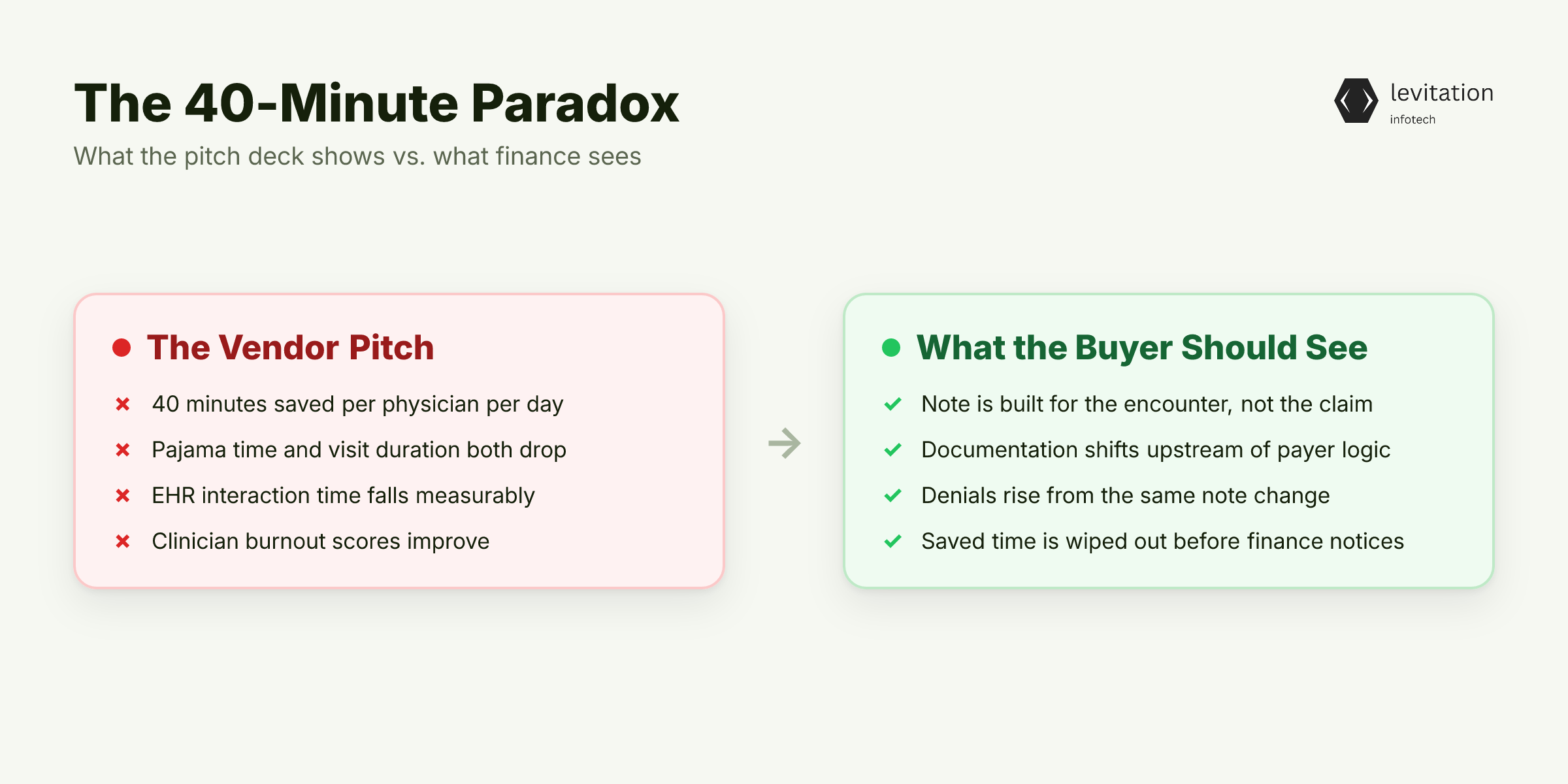
The numbers look great on a vendor slide. Permanente's analysis of ambient AI scribes found 40 minutes per day saved per physician. 'Pajama time' and per-appointment duration both dropped in measurable ways. Other studies have shown corresponding drops in EHR interaction time and clinician burnout.
Then the slide ends. The pitch never asks what the note looks like to the payer on the other end of the claim.
This is the gap that healthcare technology buyers keep missing. The time savings are real. So is the downstream effect. A rise in denials can erase the dollar value of the saved time before finance ever notices. The two events share a cause, and the cause is buried inside the note itself. Most ambient capture systems start with the encounter, not the claim.
Why Faster Notes Are Almost Always Weaker Notes
AI scribes are optimized for readability and brevity. Not for the specificity that coding and medical-necessity review demand. Payers look for MEAT criteria: Monitor, Evaluate, Assess, Treat. Those four hooks justify a claim. Ambient scribes tend to compress the encounter into a tidy summary that drops them.
Consider a typical post-scribe note. The subjective reads clean. The assessment reads confident. The plan reads actionable.
But the connective tissue between symptom, assessment, and treatment plan is missing. The very tissue auditors use to validate a claim gets cut. A 40-minute time saving often comes from cutting exactly that tissue.
Generic templates flatten clinical nuance. A note that reads like every other note in the EHR gives a reviewer no reason to pay.
This is the same failure we covered in radiology AI: speed at the front end, cost at the back end. The note gets shorter, the appeal queue gets longer. The damage is concrete, and it shows up in a single, measurable number, one your CFO is already tracking closely.
The 19% Denial Rate Was Already a Tax. AI Just Raised It.
The baseline was bad. A January 2025 KFF study found insurers denied 19% of in-network claims in 2023. That was the most recent year with available data. Fewer than 1% of consumers appealed the denial.
Of those who did, 56% had the denial upheld.
Now layer in low-specificity notes. AI scribes that strip clinical specificity push more claims into the "denied on first pass" bucket.
They also give the appeal process less to work with. The original document doesn't contain the language a reviewer needs to see.
Here is the irony: the same generative AI that weakened the claim is now being used in reverse. Patient-facing tools like Counterforce and Claimable generate appeal letters, including a documented 20-page appeal that reversed a denial in 48 hours.
If the AI can win an appeal, it can also write a note that survives one. The fix is not to abandon the scribe. It is to engineer the scribe for the payer too. For teams working on AI for healthcare integration, this is where the architecture decision gets made.
This principle is what separates the systems still running in production years after deployment from the ones that get replaced after a short run. Documentation is a revenue input, not a clinical artifact. Treating it that way is the unlock.
Build a Documentation Layer That Defends Claims on First Pass
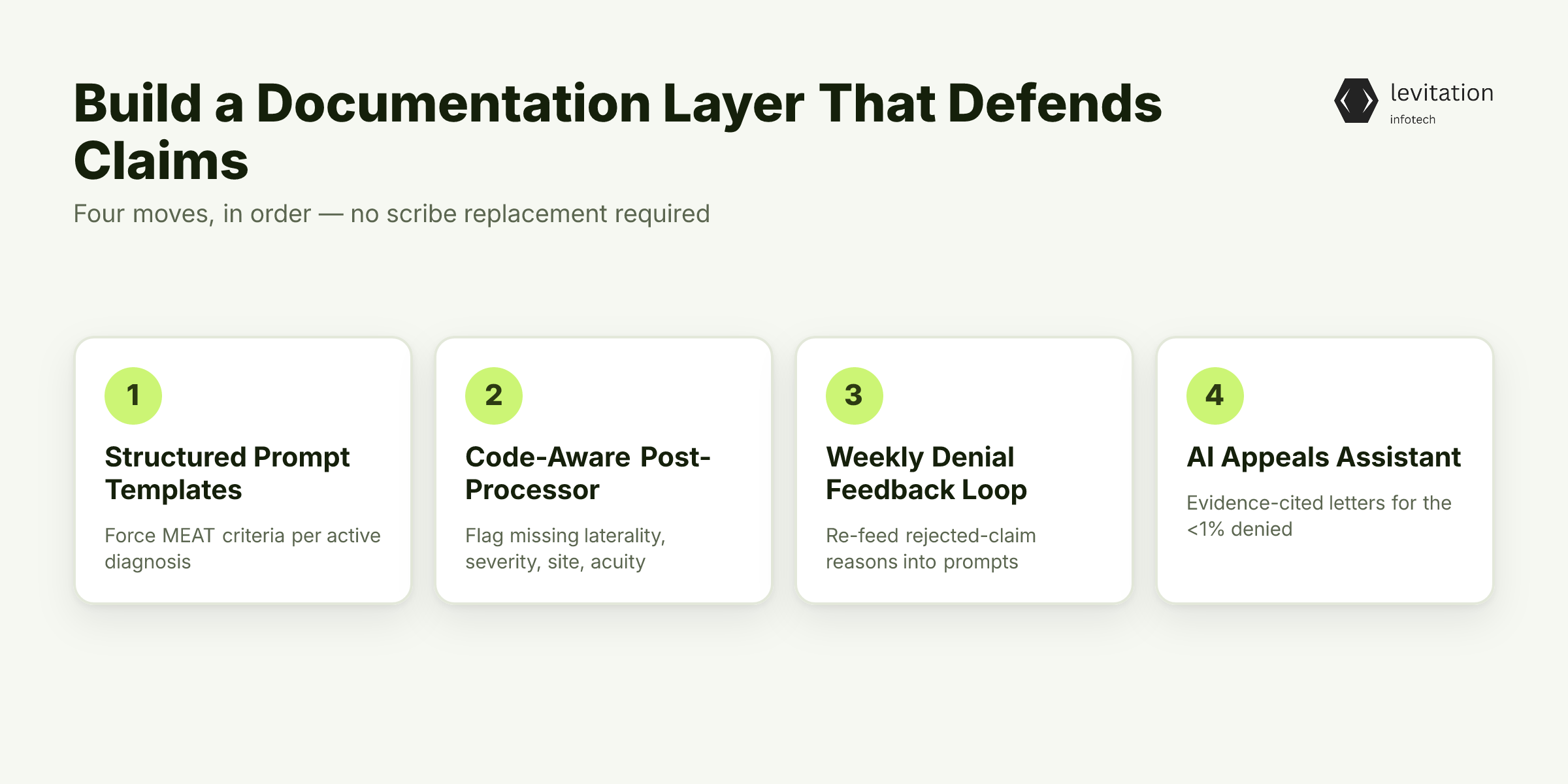
The fix is four moves, executed in order. None of them require throwing out the scribe. All of them require treating the note as a payer-facing object, not a clinical courtesy. - Step 1, structured prompt templates. Replace ambient-only capture with prompt structures that force inclusion of MEAT criteria per active diagnosis. The model is told what to ask, and the physician is told what to confirm. - Step 2, code-aware post-processor. Before the encounter is closed, a second pass flags notes missing specificity: laterality, severity, anatomic site, acuity. These are the four elements a coder reaches for first, and the four elements ambient capture drops most often. - Step 3, weekly denial feedback loop. Take the reasons from rejected claims and feed them back into the scribe prompt library. The model learns payer-specific failure modes the same way a coder learns them: through repetition, with feedback. - Step 4, AI appeals assistant on the back end. For the <1% of claims that still get denied, layer a tool that generates evidence-cited appeal letters. The same 20-page format that worked for the consumer can work at the provider level, in volume.
This is the clinical AI stack that actually defends revenue. Vendor-led deployments that use existing compliance and integration libraries typically reach production faster than in-house builds starting from scratch. That timeline gap is the difference between a budget-cycle experiment and a multi-year program.
None of this matters if you measure ROI the way every vendor deck tells you to. The right formula includes the line item nobody talks about.
Recalculate AI Scribe ROI Before Your CFO Does
The vendor formula is clean. It is also incomplete. Here is the standard version every pitch deck uses: - Annual ROI = (Time saved × hourly cost) + (Extra patients seen × revenue per visit) - Subscription cost
It ignores the revenue line that goes the other direction. The real formula adds one term: - Real ROI = Vendor formula + (Baseline denial rate - Post-deployment denial rate) × Average claim value × Annual claim volume
For most mid-sized health systems, a single-point swing in denial rate, scaled across annual claim volume, can exceed the entire scribe subscription cost. The math is straightforward. The math is also almost never done.
What to measure, starting week one: - Denial rate by note source (AI-generated vs human-written) for at least 90 days - First-pass resolution rate split by scribe use - Average appeal length, when appeals happen - Days in AR, before and after deployment
This is the same pattern we flag in payer-side AI: clearance is not the same as reimbursement. In healthcare technology deployments, the only ROI that survives a board review is the ROI measured in revenue, not in minutes. That distinction is what separates vendors who measure outcomes from vendors who measure utilization.
When you measure it this way, the question stops being "should we buy a scribe" and becomes "which scribe survives a payer audit."
What Separates the Scribes That Survive From the Ones That Get Replaced
The healthcare AI deployments that hold up over time share one trait: documentation quality was treated as a revenue cycle input, not a clinical afterthought. Clinicians got their 40 minutes back AND the denial rate held flat or dropped. The note was engineered to satisfy two audiences at once.
Three architectural choices separate the systems still in production from the ones that get ripped out: - A vendor-led deployment that uses pre-built compliance frameworks and integration libraries reaches production faster than an in-house build starting from scratch. The shorter timeline means a CEO can run the experiment, measure the denial delta, and either scale or pivot before the next budget cycle. - Vendors that own the outcome across both clinical and revenue cycle audiences retain clients longer than vendors that sell a feature. The distinction shows up in the documentation layer, not the marketing pitch. - Systems that stay in production share one architectural choice: the documentation layer is a payer object, built with the same rigor as the clinical capture.
The growth outcome is not just faster notes. It is a revenue cycle that stops leaking the 19% the industry already loses. It is also a clinician workforce that doesn't burn out writing appeals. Appeals are the very thing the health tech AI stack was designed to prevent in the first place.
The Levitation engineering team has seen enough payer audits to know which deployments survive contact with one.
Frequently Asked Questions
Do AI scribes actually increase insurance denials?
AI scribes themselves don't cause denials, but the generic, low-specificity notes they produce often lack the MEAT criteria payers look for. In practices where notes shift heavily toward AI-generated summaries, denial rates on first pass typically rise. The reversal comes only after a code-aware documentation layer is added.
How much time do AI scribes really save per day?
The Permanente analysis found 40 minutes per day of total time saved. Other studies have shown corresponding reductions in EHR interaction time and documentation minutes per day. Across 200 working days, the 40-minute daily saving returns over 130 hours per clinician per year.
Can AI tools help appeal denied insurance claims?
Yes. Patient-facing tools like Counterforce and Claimable have generated successful appeals, including one documented 20-page letter that reversed a denial within 48 hours. The same approach works on the provider side for systematic denial management.
What is the biggest risk when deploying an AI scribe?
Treating documentation as a clinical-only artifact instead of a revenue cycle input. Without structured prompts, code-aware post-processing, and a feedback loop from denied claims, time savings show up immediately while revenue leakage accumulates silently for months.
How long does a clinical AI system take to deploy?
Enterprise healthcare AI systems built by experienced vendors typically deploy faster than in-house teams starting from scratch. The shorter timeline comes from pre-built compliance frameworks and integration libraries. It also comes from tested prompt architectures. These are the same reasons systems built this way stay in production for years.
About the author
Mayank Singh is a software developer at Levitation Infotech, where he builds web and AI-powered applications across the company’s fintech, healthcare, and enterprise projects.