


TL;DR: Most enterprise AI loses 59% of its productivity before it reaches revenue. The models are not the problem. AI output stops at a human review step instead of triggering the transaction it was meant to change. The fix is architectural. Embed the model inside the transaction path. Bind saved capacity to a revenue action. Close the loop so the P&L actually moves.
Key Takeaways: - Shipping AI features and moving revenue run on different systems. Adoption metrics can be green while margin stays flat. - A more accurate model produces more output for humans to review, not less work. The bottleneck moves downstream, not away. - Closing the AI-to-revenue gap requires embedding inference inside the transaction path. Bind saved time to a measurable revenue activity.
The Paradox on Every CTO's Dashboard
Your team shipped five AI features last quarter. Adoption dashboards are green. The P&L line for the year looks identical to the one before any of them launched.
This is the new normal in enterprise AI. Features ship. Usage charts climb. The board asks why revenue hasn't moved.
Research shows that 59% of AI productivity never reaches revenue. The gap is not a measurement problem. It's structural.
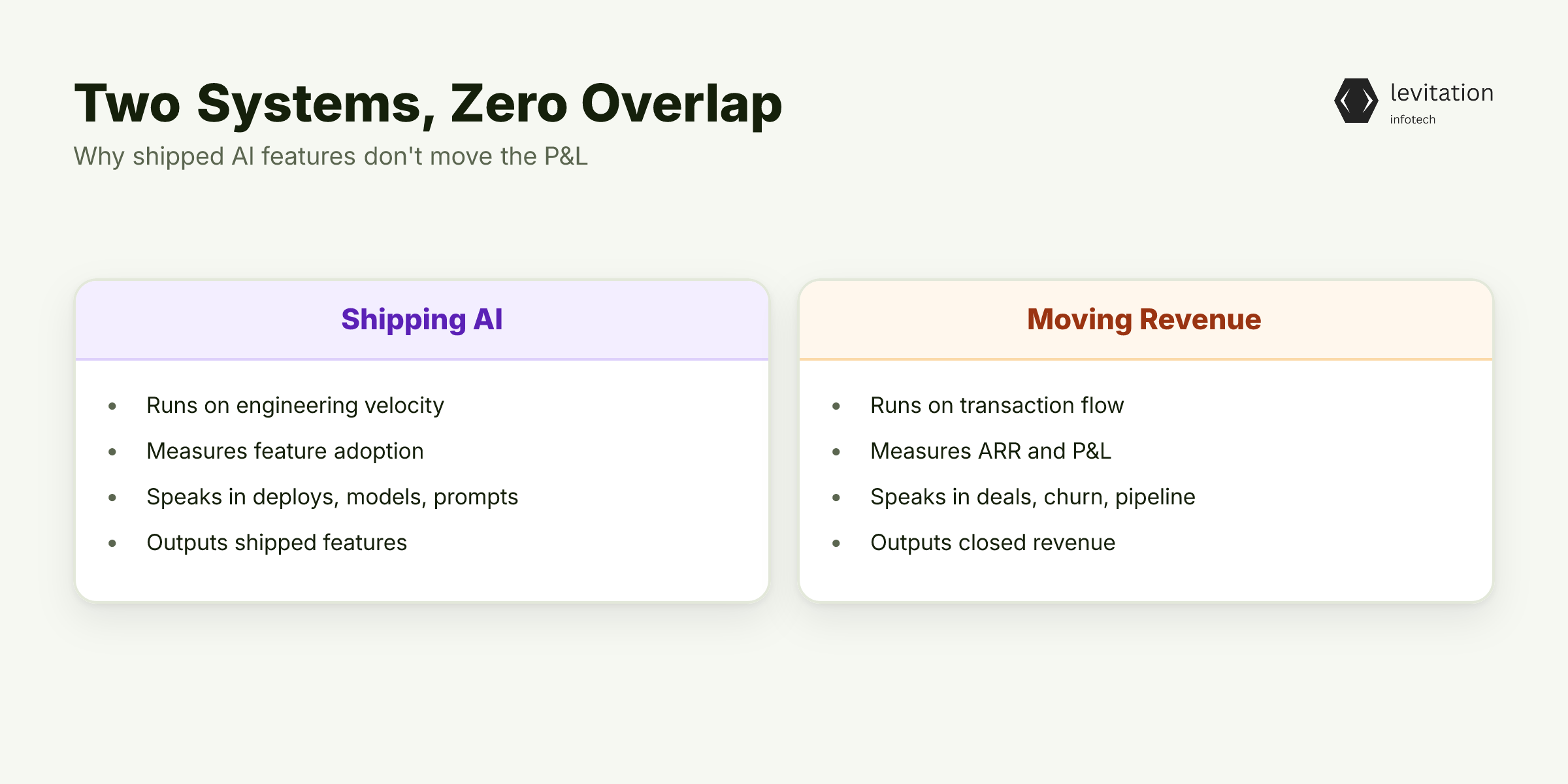
Shipping AI and moving revenue are run by entirely different systems inside a company. One runs on engineering velocity. The other runs on transaction flow. The two barely share a vocabulary.
The instinct is to blame the model, the data, or the prompt. But the leak isn't where most teams are looking.
Why Better Models Make the Problem Worse
Here's the part that should make every CTO uncomfortable: upgrading the model usually makes the revenue problem worse, not better.
A more accurate model produces more outputs. More outputs mean more items landing in a queue for human review. The lead-scoring system that was already filling the queue now overflows it.
Every item still needs a human to interpret, decide, and act. The model's accuracy went up. The human's review burden went up by more.
The output lands in a dashboard, a report, or an email. Then it waits. Nothing downstream triggers automatically.
The insight sits in a queue until a person has time, context, and authority to act on it. By then, the original signal has often expired.
The loop breaks at step two. Step one: the model produces output. Step two: a human has to do something with it. That gap is where the value evaporates. The P&L never sees the work the model did. The work stopped at a human's to-do list.
If the problem isn't model quality and it isn't data quality, what kind of problem is it actually?
The Process Problem AI Made Visible
The real problem is process. AI didn't create it. AI just made it impossible to ignore.
Consider the analyst who saves two hours a day with AI. The productivity dashboard celebrates. The team's output looks the same. The team's calendar looks busier. The P&L doesn't care about either.
What happened to the two hours? They got absorbed. The analyst attends more meetings, answers more emails, and joins more syncs. They finish leftover work that was never anyone's top priority. None of those activities appear on a productivity dashboard. None of them change a transaction outcome.
The time evaporates into a process that has no slot for reallocation. This is a real gap, not a tracking gap. Better analytics won't fix it. A new dashboard won't fix it. Only restructuring the workflow will.
The workflow discipline question is the one most teams never ask: when AI saves time, where does that time go? If the answer is "back into the existing calendar," then the AI is a productivity illusion. The hours saved are real, but they're not committed to anything that changes a number that matters.
We have mapped this pattern across the AI business value gap repeatedly. The firms that close the gap are not the ones with the best models. They are the ones with the tightest loops between model output and business action.
So if the answer isn't a better model and isn't better measurement, what does the system actually need to look like?
What Closing the Loop Looks Like Architecturally
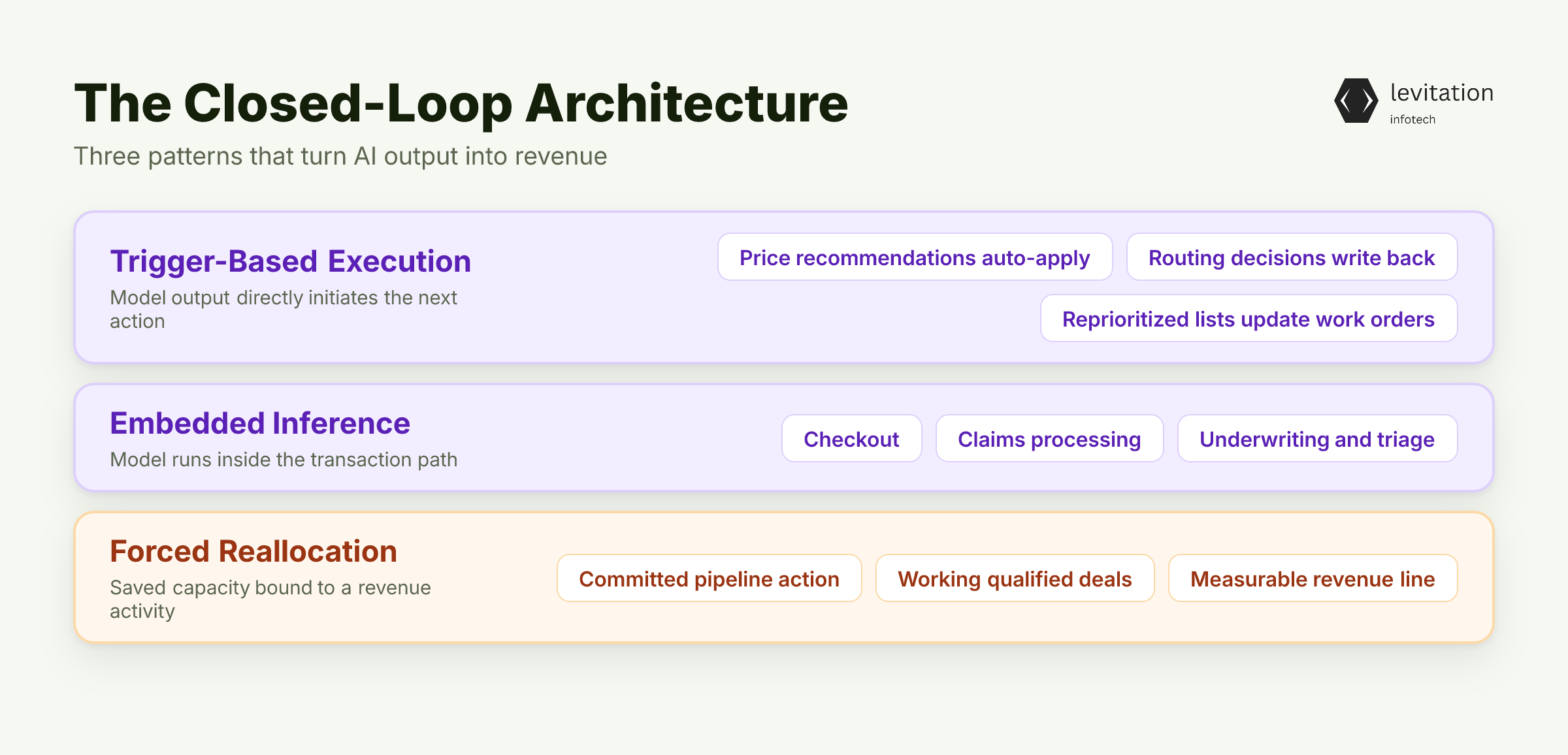
Closing the loop means redesigning the system so the model's output triggers the next step without waiting for a human to translate insight into action. Three patterns make this work.
Pattern 1 - Trigger-based execution. The AI output directly initiates the downstream transaction. A price recommendation auto-applies within a guardrail. A routing decision writes back to the queue. A reprioritized list updates the work order. No human has to copy a number from a dashboard into another system. The model and the transaction are wired together.
Pattern 2 - Embedded inference. The model runs inside the existing transaction path, not as a parallel insight tool that humans have to check. Checkout, claims processing, underwriting, claims triage: the model should call within the flow, not from the sideline. Embedding the model here turns AI from a co-pilot into a system component.
Pattern 3 - Forced reallocation. The saved human capacity is bound to a specific revenue activity. If an analyst recovers two hours a day, those two hours are committed to a measurable pipeline action. Think working the next batch of qualified deals, not absorbing into the general calendar. This is the pattern most teams skip, and it makes the difference between a productivity metric and a revenue line.
The build timeline matters. In-house teams get pulled into adjacent platform work before loop closure lands. A focused deployment that scopes loop-closure first, and measures AI feature adoption against a closed loop, doesn't drift into side projects.
Teams that get this architecture right start seeing a specific signature show up in their revenue reporting. Here's what it looks like.
The Revenue Signal That Actually Moves
When AI output is wired directly into transaction paths, the metric that shifts first is not adoption. It's revenue per existing customer.
This is the signal that breaks the adoption-versus-revenue illusion. Adoption measures whether people are using the tool. Revenue per existing customer measures whether the system produces more from existing customers.
The two diverge sharply when the loop is broken. They converge when the loop is closed.
The org posture changes with it. AI stops being reported as a cost-center experiment and starts showing up in operating margin reviews. That is a very different boardroom conversation. The CFO stops asking how much the AI is costing and starts asking how much more revenue the same customer base produces.
Longevity is the proof point that matters. Systems that keep running in production through team turnover, model drift, and regulatory change signal the architecture was right from the start.
These patterns raise specific questions for any CTO evaluating where their own AI stack leaks revenue. Here are the ones that come up most.
What CTOs Ask After Seeing This Pattern
These are the questions that come up in every architecture review where the AI-to-revenue gap is on the table. The answers come from the patterns above, not from theory.
"How do I know if my AI is actually moving revenue?" Look at revenue per existing customer and operating margin in the segment where the AI output is wired to a transaction. If those numbers haven't moved in two quarters, the loop is broken. The fix is architectural, not analytical. For a deeper framework on AI ROI measurement, the diagnostic starts at the transaction path, not the adoption dashboard.
"We shipped AI features. Why is revenue flat?" Because the output stops at a human review step. The model produces an insight, the insight lands in a queue or an email, and nothing downstream triggers an automatic action. The time saved is absorbed into existing work. Until the output is wired to the transaction, the P&L won't move.
"How long until we see revenue impact?" When the architecture is built around closed-loop execution, revenue impact shows up sooner.
About the author
Mayank Singh is a software developer at Levitation Infotech, where he builds web and AI-powered applications across the company’s fintech, healthcare, and enterprise projects.