


TL;DR: AI coding assistants are generating a growing share of enterprise Terraform. However, IaC scanners and auditors see only the final code, not its provenance. The fix is not a new AI compliance program. It's a provenance layer. It maps AI-authored infrastructure into existing control frameworks. These include NIST, ISO 27001, SOC 2, and HIPAA. Your team already runs on these.
Key Takeaways: - Static IaC scanners are content-agnostic. They check what the code does, not who or what wrote it. - AI-generated Terraform can pass every CIS and NIST check while violating implicit organizational intent like region policy, tagging, or or approved services. - Closing the blind spot needs provenance metadata, AI-aware policy-as-code, and a closed-loop feedback system that treats the model as an untrusted supply chain contributor.
Your Engineers Are Using AI to Write Terraform. Your Auditor Has No Idea.
Copilot, Cursor, and a growing list of internal LLMs now generate infrastructure-as-code in enterprise teams. The volume of AI-authored modules entering pull requests is outpacing the tooling that audits them.
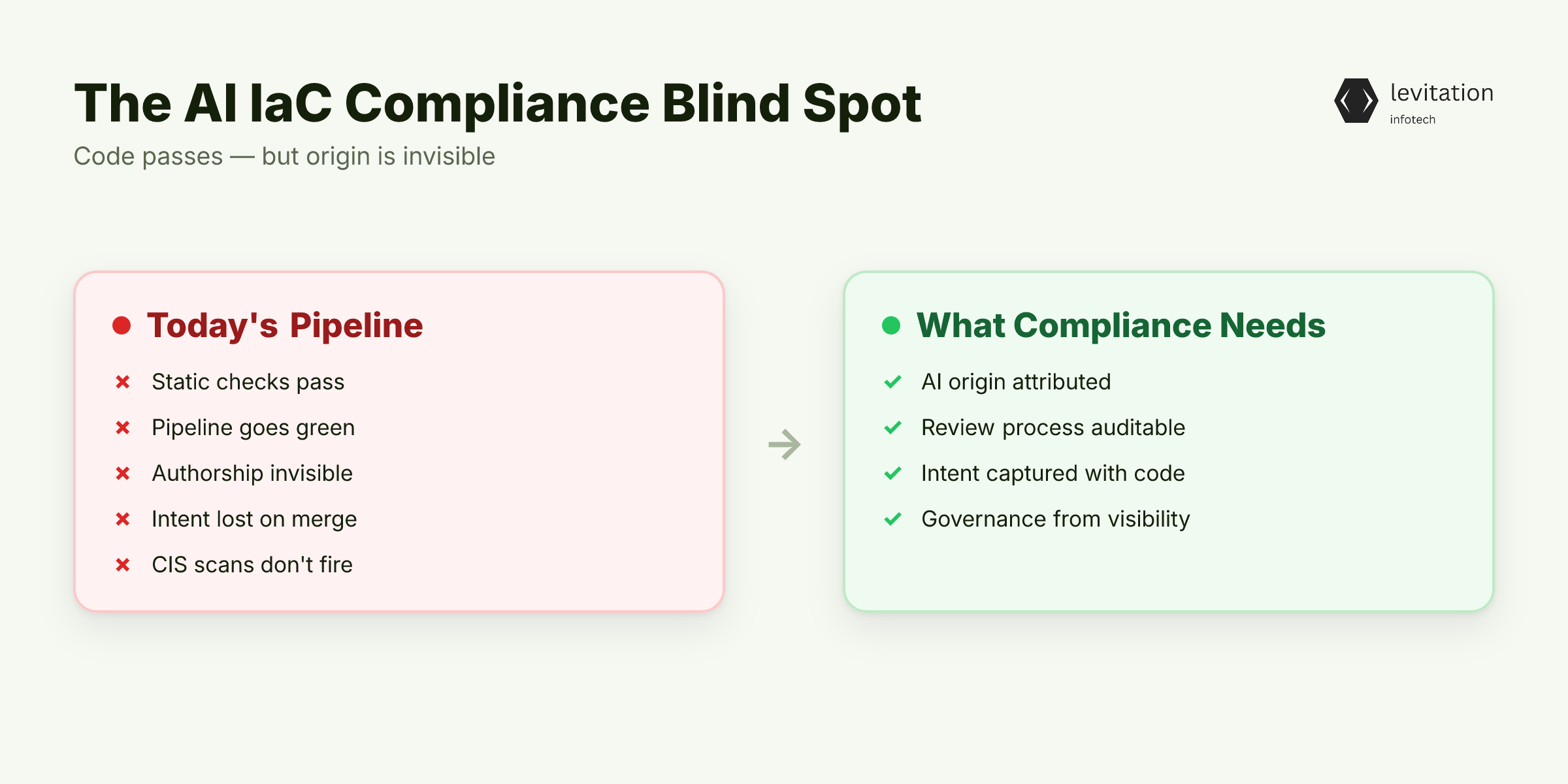
The code passes. Static checks pass. The pipeline goes green. Production gets a new S3 bucket, a new IAM role, and a new VPC peering connection.
And nobody can answer a basic question. Not the scanner. Not the change advisory board. Not the auditor.
Was this written by a person? Suggested by an AI and accepted? Or generated end-to-end by a model that learned from public GitHub repos?
This is the new compliance blind spot. AI-written IaC looks identical to human-written IaC once it lands in a pull request.
The syntax is clean. The structure mirrors well-known Terraform patterns. CIS benchmarks don't fire because the code is technically compliant.
But compliance is more than resource attributes. It's process. It's review. It's intent. And intent is invisible in a merged file.
The problem isn't that AI writes bad code. It's that your compliance pipeline can't tell human-written from AI-generated IaC. The gap widens every sprint.
End-to-end AI infrastructure governance starts at visibility, not policy.
Why Traditional IaC Scanners Miss the AI Layer
Your static analysis tools are doing exactly what they were designed to do. They run in CI, block bad merges, and generate audit reports.
They check IaC against CIS benchmarks, NIST controls, HIPAA Security Rules, and PCI-DSS requirements. They look at resource definitions, attribute values, encryption settings, and network rules.
What they don't do is look at provenance. They see a Terraform module. They don't see the process that produced it.
This is the core architectural blind spot. A scanner evaluates the artifact, not the authorship chain. That gap creates three concrete failure modes.
First, AI can generate code that satisfies explicit security policies while violating implicit organizational intent. A model trained on broad public patterns will happily provision resources in a region your team has restricted. It will use a service your security team hasn't approved. It will skip the tagging convention your FinOps process depends on. The code is technically valid. The intent is wrong.
Second, supply chain risk flows in through the model itself. AI models absorb patterns from public repositories. They include deprecated modules, hardcoded secrets from training data, and code from unvetted sources.
The model becomes a vector for patterns. Your infrastructure as code audit process has never had a chance to review them.
Third, there's no provenance metadata. No field in the Terraform file says "generated by model X on date Y from prompt Z." No Git commit author tag tells human input from AI output. No way exists to trace a production resource. You can't trace it back to a prompt, a reviewer, or an approved module registry.
The blind spot isn't in the code itself. It's in the process and provenance layer. Your current IaC tools were never designed to inspect that layer.
What AI Infrastructure Governance Actually Requires
The instinct is to build a separate "AI compliance" program. That instinct is wrong. AI infrastructure governance should map into the same control frameworks you already operate under. These include NIST, ISO 27001, SOC 2, HIPAA, GDPR, and FedRAMP. It should not create a parallel system that nobody owns.
The starting point is classification. Not every AI-generated resource carries the same risk.
A model suggesting a CloudWatch log group in a dev environment is not the same. A model provisioning a PHI-handling S3 bucket in production carries much more risk.
Risk tiers should reflect data sensitivity, environment, and regulatory exposure. A team that treats all AI-authored IaC identically is either over-restricting dev velocity or under-protecting regulated workloads.
Control ownership matters. A shared "AI team" that nobody audits is a control gap.
Every AI-assisted provisioning path needs a named owner. That owner needs clear accountability for review, approval, and post-deployment monitoring. This mirrors how third-party module authors are treated in a mature supply chain model.
Then comes the definition problem. What counts as "AI involvement"?
A fully generated module with no human review differs from a human-edited AI draft. It also differs from an AI suggestion that a human accepted. Each tier deserves a different control treatment.
Treating them as one category either creates false confidence or kills developer velocity.
Finally, treat the AI as an untrusted contributor. Not adversarial, but unvetted.
It's equal to a third-party module author. You haven't run them through your approval process yet. Every output should be subject to the same scrutiny. Apply that scrutiny as you would to code from an external vendor.
Governance frameworks are simple to draft. Putting them into practice is hard. CI/CD pipelines, PR reviews, and runtime environments are where most enterprise teams actually stall.
The gap is in execution discipline, not policy design. Integration patterns, policy templates, and operational runbooks rarely come pre-built.
The audit trail is where execution discipline begins. Build it first, and every downstream control gets easier.
Building an AI-Aware IaC Audit Trail
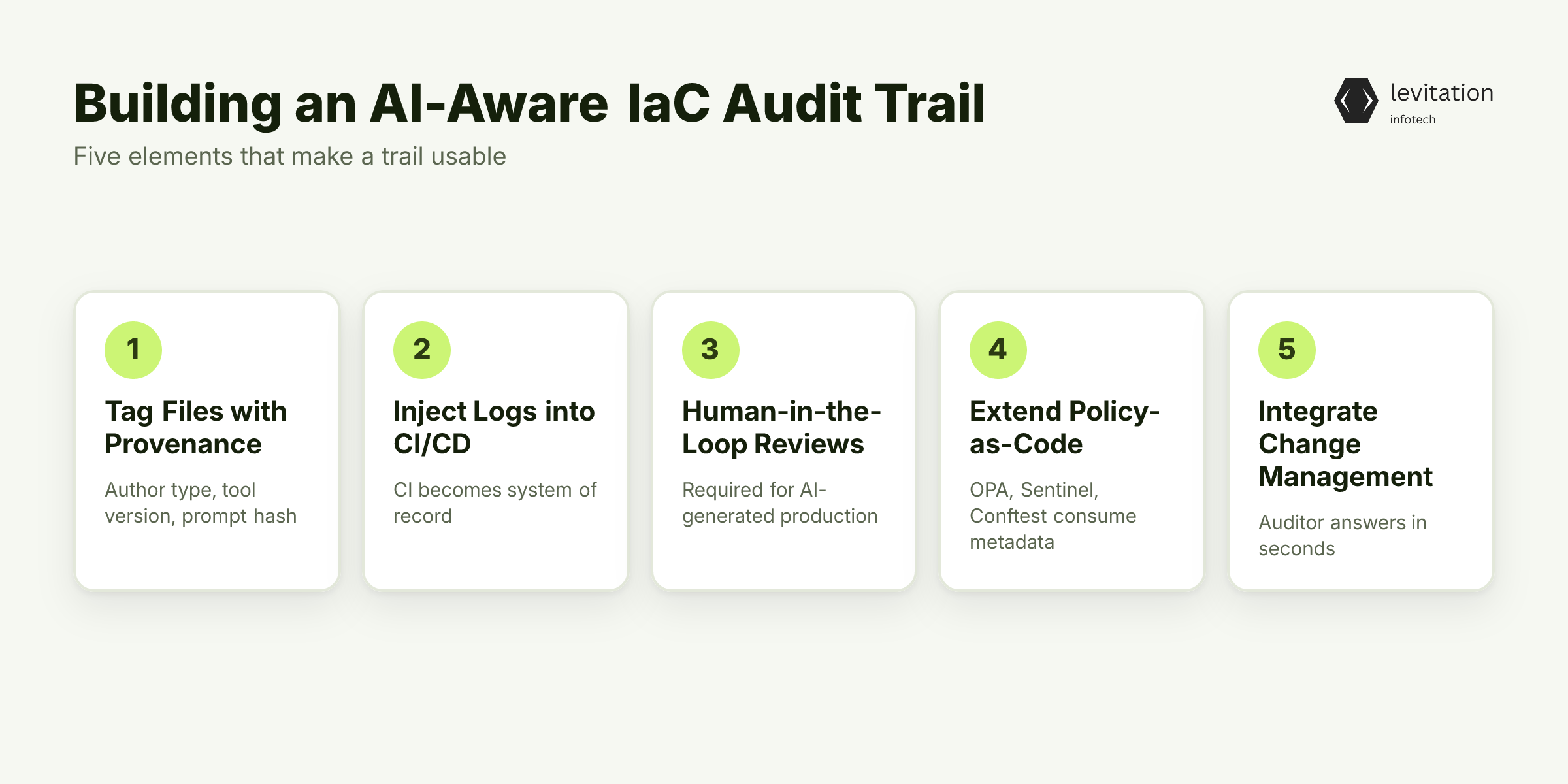
An audit trail is the foundation. Without it, nothing else works. Five elements make a trail usable.
Tag every IaC file with provenance metadata. The author type: human, AI-suggested, or AI-generated. The tool version, because a Copilot build from Q1 will produce different patterns than a Q4 build. Also a prompt hash for reproducibility. An auditor can use that hash to rebuild what input produced a given output. This metadata should live in the file header or a sidecar manifest. It should survive the merge into main.
Inject AI tool logs into your CI/CD pipeline. Every merged module should carry an audit record. The record should show how it was created and reviewed. The CI system becomes the system of record for provenance, not the developer's local environment.
Require human-in-the-loop review checkpoints. These apply to any AI-generated resource touching production or regulated workloads. Not a rubber-stamp approval. An actual review by someone who can answer "why this region, why this service, why this configuration." This is where the difference between AI-suggested and AI-generated becomes operationally meaningful.
Extend policy-as-code engines like OPA, Sentinel, and Conftest. Add rules that flag AI-authored modules for extra validation. The policies don't need to detect AI authorship. They consume the provenance metadata and apply stricter rules.
Higher scrutiny for production paths. Mandatory encryption. Approved region lists. Required tagging.
Integrate provenance data into your change management system. When an auditor asks how a resource was created, the answer should come from your IaC compliance platform. This should take seconds. Not from three weeks of Git archaeology and Slack message recovery.
An audit trail tells you what happened. You also need to validate that the AI's suggestions aligned with approved standards before they ever reached production.
Closing the AI Blind Spot in IaC Supply Chain Security
Trail data is passive. You also need active controls to prevent bad AI output from reaching production in the first place.
Maintain an allowlist of approved AI coding tools, and pin their versions. Model behavior changes.
A Copilot update can shift the patterns it suggests. Your team needs to detect that drift. Version pinning is the IaC version of locking a third-party module version.
Validate AI-suggested modules against your internal module registry before they enter the codebase. If a model generates a new S3 bucket definition, that definition should be compared against your approved patterns. Deviations get flagged for review. Matches get fast-tracked.
Scan for patterns common in AI-generated code. Overly permissive IAM roles, because training data skews toward minimal-friction examples. Missing encryption defaults, because explicit settings are less common in public repos. Region-agnostic resource blocks, because models default to us-east-1 unless told otherwise. These are signals, not proof, but they're worth flagging.
Run post-merge drift detection. It compares the deployed state against the IaC definition. It also compares against the original human-approved intent. A module might pass policy checks but still produce a deployed resource that violates the team's intent. The gap only shows up in runtime.
Feed findings back into your SDLC. When AI output triggers a flag, that signal should update your guardrails, retrain internal models, or refine prompt templates. The goal is a closed-loop governance system. In that system, every audit finding makes the next deploy safer.
This connects directly to broader IaC supply chain security concerns. These concerns go beyond model output. They include module integrity, registry trust, and dependency provenance.
When this system works end-to-end, AI stops being a compliance liability. It starts speeding up the audit process itself. The operational shift shows up first in how compliance reviews actually run.
What Changes When AI-Generated IaC Is Auditable
The shift is operational, not philosophical. Once provenance flows through your pipeline, several things change at once.
Compliance reviews move from manual sampling to deterministic, metadata-driven verification. An auditor asks "how was this resource created?" and the system answers in seconds. No log archaeology. No PR rebuilding. No weeks of interview cycles.
Teams adopt AI coding tools without filing exceptions. They also adopt them without slowing down regulated deployments. The fear that AI help will trigger a compliance review pause goes away. The review checkpoint is already built into the pipeline.
Across healthcare, fintech, and SaaS platforms, the pattern is consistent. AI adoption in regulated environments is not blocked by the technology. It's blocked by the audit layer that surrounds it.
When provenance is first-class, AI-written IaC stops being a blind spot. It starts being a controlled, reviewable, auditable part of your infrastructure.
Want to see what provenance metadata looks like in your own pipeline?
Frequently Asked Questions
How do you audit AI-generated Terraform code for compliance?
Audit AI-generated Terraform by embedding provenance metadata into every module. Include author type, tool version, and prompt hash. Then extend your policy-as-code engine. It should enforce extra validation on AI-authored files. The audit trail should flow through CI/CD and change management. Then reviewers can trace any production resource back to the prompt that created it.
Does using AI to write IaC violate SOC 2 or HIPAA?
Not on its own, but auditors will ask how you govern the process. SOC 2 and HIPAA need clear control over change management, access, and data handling.
If AI-generated infrastructure bypasses review or can't be traced, you have a control gap. This is true no matter whether the code itself satisfies every rule.
What is AI infrastructure governance?
AI infrastructure governance is the set of policies, controls, and audit mechanisms. These govern how AI tools take part in provisioning and managing infrastructure. It maps AI workflows into existing frameworks like NIST, ISO 27001, and SOC 2. It does not treat AI as a separate compliance domain.
How does IaC supply chain security differ for AI-generated code?
Traditional IaC supply chain security focuses on module provenance, registry integrity, and dependency flaws. AI-generated code adds a new upstream: the model itself.
You need to track which AI tool and version produced each module. You also need to validate suggestions against approved patterns. Treat the model as an untrusted contributor. Apply the same scrutiny as any third-party author.
Can policy-as-code tools detect AI-written infrastructure?
Standard policy-as-code tools like OPA, Sentinel, and Conftest do not detect AI authorship by default. You need to add provenance tagging to your IaC pipeline. Then write custom policies. Those policies should flag AI-authored modules for stricter review. Without that metadata layer, policy engines treat AI and human code as identical artifacts.
About the author
Mayank Singh is a software developer at Levitation Infotech, where he builds web and AI-powered applications across the company’s fintech, healthcare, and enterprise projects.