


TL;DR: The "Cassandra vs PostgreSQL" framing wastes engineering time. The real decision is which architecture pattern your product fits: system of record, system of engagement, or system of insight. Pick the pattern first, then the database that matches it, and reach for polyglot persistence only when one engine genuinely cannot serve the workload.
Key Takeaways: - Treat database choice as an architecture pattern decision, not a shootout between two engines. - Public benchmarks measure peak throughput, not the cost per query at your cardinality, schema, and team skill level. - Most production systems contain all three patterns (record, engagement, insight), which is why single-database mandates usually fail in years two or three. - The 2026 default is PostgreSQL plus extensions (TimescaleDB, pgvector, Citus) and a managed streaming layer; reach for Cassandra only when measurement proves the workload demands it.
The "Cassandra vs PostgreSQL" Question Is Asking the Wrong Thing
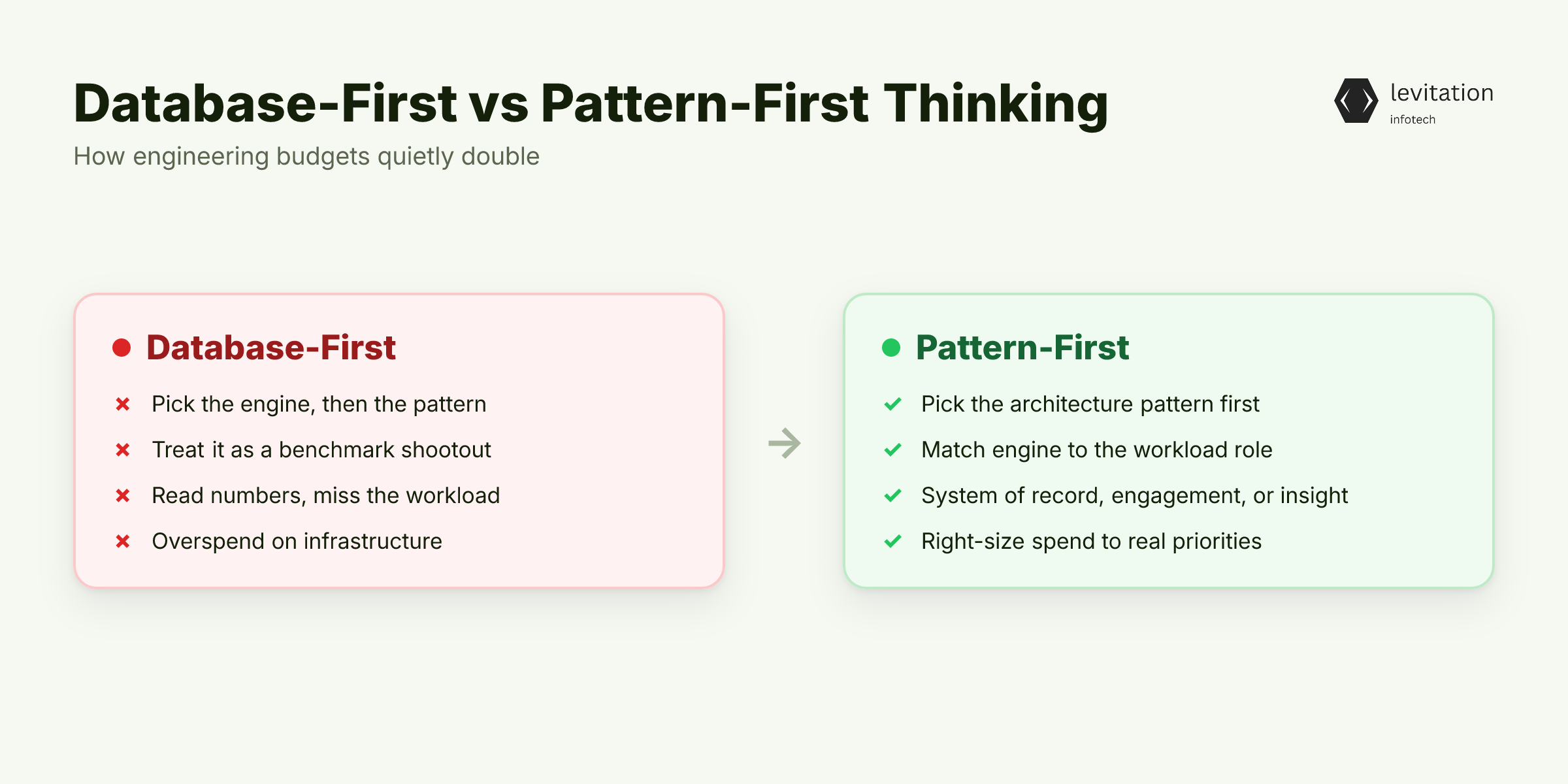
Most "Cassandra vs PostgreSQL" comparisons answer a question CTOs rarely need to answer. The real choice is which architecture pattern your product fits. Treating it as a database shootout is how engineering budgets quietly double over three years.
Both databases can succeed on the same workload, or fail on it, depending on how you deploy them. What actually decides outcomes is the pattern: system of record, system of engagement, or system of insight. CTOs who pick the database first, then the pattern second, consistently overspend on infrastructure. They also underinvest in the workloads that actually mattered. Our cloud architecture decision frameworks work treats this as a starting point, not a footnote.
Getting these foundational choices right starts with pattern-first thinking, not with picking the most popular engine. The same logic applies to vector and retrieval stores for AI pipelines, which we map in our database selection for enterprise AI guide.
The obvious fix is to read a benchmark. That's the second trap.
Why Generic Performance Benchmarks Mislead CTOs
Cassandra's reputation for write throughput is real. Published numbers, however, assume a tuned cluster with even key distribution and predictable access patterns. Skew your partition keys and the same benchmark can collapse by an order of magnitude.
Cassandra's write path is optimized for the case where your data model fits the access pattern. The moment it does not, every "performance" claim evaporates.
PostgreSQL's reputation for analytical reads is also real. The gap narrows dramatically on modern hardware, NVMe storage, and with extensions like TimescaleDB and Citus. A PostgreSQL instance on a current-generation cloud block store can scan large fact tables quickly. This works when the schema is designed for the query.
The popular narrative that PostgreSQL "cannot scale" comes from older deployments. Those lacked modern storage and parallelization. That is not the 2026 reality.
Benchmarks measure peak performance. They do not measure the cost per query at your actual cardinality, schema, and team skill level. Our deeper look at Cassandra PostgreSQL benchmark methodology walks through why the same benchmark produces different answers in different hands. The Cassandra PostgreSQL performance tradeoffs piece goes further into where each engine's design choices show up in production.
The hidden cost no benchmark captures: how many engineers and how much on-call burden your team will absorb to keep the cluster healthy. That is the line item that decides whether your database is a feature or a tax.
Once you strip away the benchmark theater, three architecture patterns explain nearly every successful database choice in production.
The Three Architecture Patterns That Actually Decide the Choice
Pattern one: system of record. Bounded data, strong consistency, complex relationships, audit and compliance requirements. PostgreSQL's ACID guarantees and relational model are the default here.
Your customer table, your order ledger, your consent records, and your audit logs almost always live in this pattern. The query shape is relational, and the consistency model is strict.
Pattern two: system of engagement. High write velocity, append-mostly, partition-tolerant reads by key, global distribution. Cassandra's masterless ring and tunable consistency are the default.
Telemetry, clickstreams, IoT sensor data, and messaging histories fit this pattern. The trade-off is that you denormalize aggressively. Joins do not exist at the storage layer.
Pattern three: system of insight. Analytical scans, time-series aggregations, and reporting. Either database can serve this depending on data volume.
The deciding factor is query shape, not engine. A reporting workload that runs nightly on bounded data should stay in PostgreSQL. One that streams aggregations across billions of events per day belongs in a columnar store, or in a Cassandra table designed for scan paths.
Most production systems contain all three patterns. The teams that fail pick one database and try to force every pattern into it. The teams that succeed apply the polyglot persistence patterns principle: let the workload pick the engine, not the other way around.
For regulated industries, the audit story also differs sharply between engines. We cover that in data architecture for regulated industries.
The single most common architectural error: a single Postgres instance asked to serve real-time telemetry. That data should have flowed through Cassandra or a managed time-series layer.
The patterns tell you what to build. The operational reality tells you whether your team can actually sustain it.
Operational Reality: The Hidden Costs Your Engineering Team Will Inherit
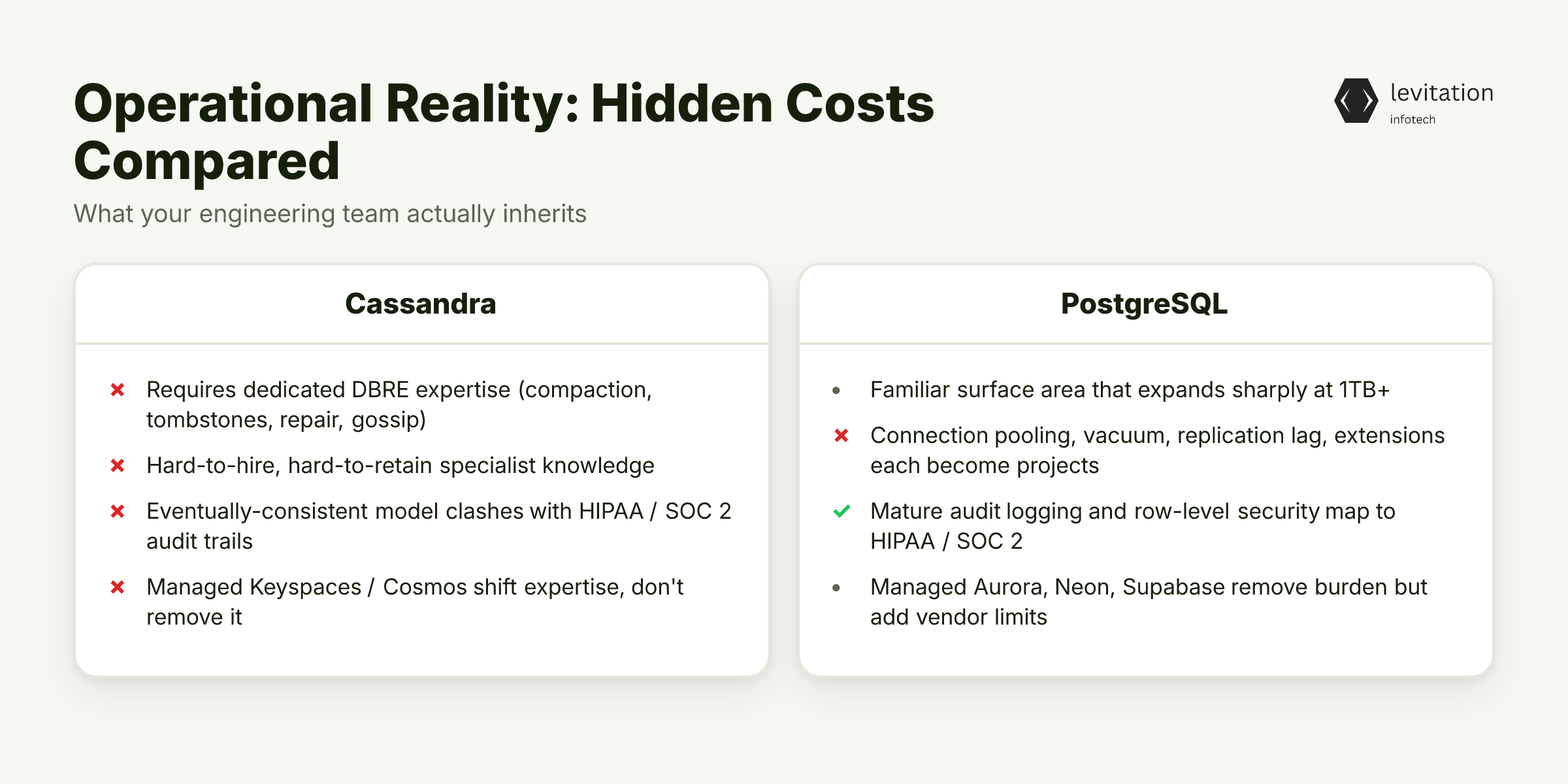
Cassandra's operational footprint is real and often underestimated. Compaction tuning, tombstone management, repair scheduling, and gossip behavior all require dedicated expertise. That expertise is hard to hire and harder to retain.
Teams that treat Cassandra as "just another database" end up rebuilding their operations org around it. The managed Cassandra services compared analysis shows that even AWS Keyspaces and Azure Cosmos DB's Cassandra API shift the expertise requirement rather than remove it.
PostgreSQL's operational surface is more familiar, but it expands sharply with scale. Connection pooling, vacuum strategy, replication lag, and extension management each become their own project.
The PostgreSQL at scale operational checklist covers the failure modes teams hit at 1TB and beyond. None are exotic. All of them are easy to underinvest in.
Compliance postures differ in ways that matter. PostgreSQL's mature audit logging and row-level security map more directly to HIPAA and SOC 2 controls than Cassandra's eventually-consistent model. In regulated healthcare, the audit trail and row-level access controls are non-negotiable.
Managed services in 2026 have shifted the calculus. They have not eliminated the underlying expertise requirement. Aurora, Neon, Supabase, Keyspaces, and Cosmos each remove some operational burden. They also introduce vendor-specific limits you must understand.
That gap between pattern and operations is where the real decision lives. Here are the five questions that settle it.
The CTO Decision Framework: 5 Questions That End the Debate
Question 1: Is your data bounded or unbounded?
Bounded data fits PostgreSQL's design. Unbounded data with predictable access patterns fits Cassandra's design. If you do not know the answer, you have not profiled your workload yet.
Question 2: Do you need multi-region writes with no downtime?
Cassandra's design wins here. If single-region is acceptable, PostgreSQL's read replicas and logical replication often suffice. They do so at a fraction of the operational cost. The Cassandra PostgreSQL comparison 2026 scorecard breaks this down by scenario.
Question 3: Are joins and ad-hoc queries first-class requirements?
PostgreSQL. Cassandra forces denormalization that makes exploratory queries expensive and slow. If your product team needs to ask new questions of production data weekly, the wrong engine will block them.
Question 4: What is your existing team expertise and hireable talent pool?
In 2026, PostgreSQL talent remains far easier to source in most markets. The salary differential for senior Cassandra operators is real and persistent. This gap shows no sign of closing as the broader PostgreSQL ecosystem continues to attract new tooling and contributors.
Question 5: What is your three-year exit cost?
Cassandra migrations are notoriously hard. PostgreSQL's ecosystem has more migration tooling in both directions. That includes YugabyteDB for distributed PostgreSQL and Citus for sharded PostgreSQL. The exit cost often matters more than the entry cost.
Sometimes the honest answer is "both." But the polyglot path has a trap most articles skip.
When You Need Both: Polyglot Persistence Without the Polyglot Penalty
The legitimate polyglot pattern: PostgreSQL as system of record, Cassandra as system of engagement. CDC keeps them in sync for analytics and reporting.
A minimal Debezium connector config for streaming PostgreSQL changes into a downstream consumer:
1connector.class: io.debezium.connector.postgresql.PostgresConnector2database.hostname: postgres-primary3database.port: 54324database.dbname: orders5database.user: debezium6database.password: ${DB_PASSWORD}7table.include.list: public.orders,public.order_items8plugin.name: pgoutput9publication.autocreate.mode: filtered10slot.name: cassandra_sink_slot
The trap: running two databases without a clear ownership boundary creates a consistency gap. That gap surfaces as a customer-facing bug long before the system feels production-ready. The CDC patterns for PostgreSQL and Cassandra guide covers the failure modes.
Our earlier analysis on why CDC pipelines double latency walks through the operational tax.
Unified analytics layers like Knowi or a federated ClickHouse layer can reduce the operational penalty when you genuinely need both. They also add a third system to operate. The trade-off is real.
The 2026 default for most teams: PostgreSQL with extensions (TimescaleDB, pgvector, Citus) plus a managed streaming layer. The PostgreSQL extensions for scale inventory covers what is production-ready today. Escalate to Cassandra only after profiling proves the workload demands it. The pattern decision ripples into retention, headcount, and incident volume, which is what the next section unpacks.
What Changes When You Choose Right (and What It Costs When You Don't)
Teams that match the database to the architecture pattern ship features faster. They spend less on incident response. They retain engineering talent longer.
Teams that force-fit one database to the wrong pattern accumulate operational debt. That debt compounds year over year in both infrastructure and headcount.
Choosing the pattern first is what makes the difference. The database itself is a consequence, not the cause. The questions below come up most often when engineering leaders revisit this decision after a production incident.
Frequently Asked Questions
Is Cassandra faster than PostgreSQL in 2026?
Cassandra is faster for distributed, high-velocity writes at massive scale. It shines especially across multiple data centers. PostgreSQL is faster for complex analytical reads, joins, and workloads with strong consistency requirements. Neither is universally faster. The answer depends on workload shape, cardinality, and consistency model.
When should I choose Cassandra over PostgreSQL?
Choose Cassandra when you need multi-region writes and continuous availability during node failures. Also pick it for write-heavy workloads with predictable access patterns by partition key. IoT telemetry, time-series ingestion, and messaging systems are typical fits. For most SaaS, CRM, and financial workloads, PostgreSQL remains the better default.
Can Cassandra replace PostgreSQL entirely?
Practically, no. Cassandra lacks the relational model, ad-hoc query flexibility, and mature tooling that most applications require. Teams that attempt full replacement usually reintroduce a relational store once the limits of denormalization show up.
The healthier pattern is polyglot persistence with clear ownership boundaries, not replacement.
What is the cost difference between Cassandra and PostgreSQL?
Raw infrastructure costs are often comparable on managed cloud services. Total cost of ownership, however, diverges sharply. Cassandra clusters typically require more nodes for equivalent durability. Operational expertise also commands a salary premium. PostgreSQL's ecosystem of migration, backup, and monitoring tools reduces tooling spend.
Which database is better for AI and ML workloads in 2026?
PostgreSQL with pgvector and the broader extension ecosystem has become the default for AI feature stores, embeddings, and retrieval pipelines. Cassandra remains useful for high-velocity event ingestion that feeds downstream AI systems. The inference and retrieval path, however, is increasingly PostgreSQL-led.
If you are weighing this decision against a deadline, our data architecture advisors can help you pressure-test the pattern fit.
About the author
Mayank Singh is a software developer at Levitation Infotech, where he builds web and AI-powered applications across the company’s fintech, healthcare, and enterprise projects.