


TL;DR: IRDAI's reasonability test asks whether an insurer can explain and defend individual claims decisions. It does not ask whether the underlying AI hit an aggregate accuracy SLA. Meeting a high accuracy target while failing the reasonability test is not a contradiction. It is the expected outcome when explainability and fairness are absent from the architecture. Insurers need an explainability stack and immutable decision lineage to survive scrutiny.
Key Takeaways: - Operational SLAs measure throughput and aggregate accuracy. They do not measure the per-decision explainability IRDAI demands. - Precision, recall, and F1 scores leave a compliance blind spot. They say nothing about why a specific claim was rejected. - The January 2025 sub-committee report clusters around explainability, fairness, and human oversight. It does not focus on raw model performance. - A five-layer explainability stack (model cards, SHAP/LIME, counterfactuals, decision lineage, override capture) is the technical foundation for an IRDAI-ready audit trail. - Reasonability is a strategic capability, not a checkbox. It changes the tenor of regulator relationships and litigation defense.
Your Accuracy SLA Answers the Wrong Question
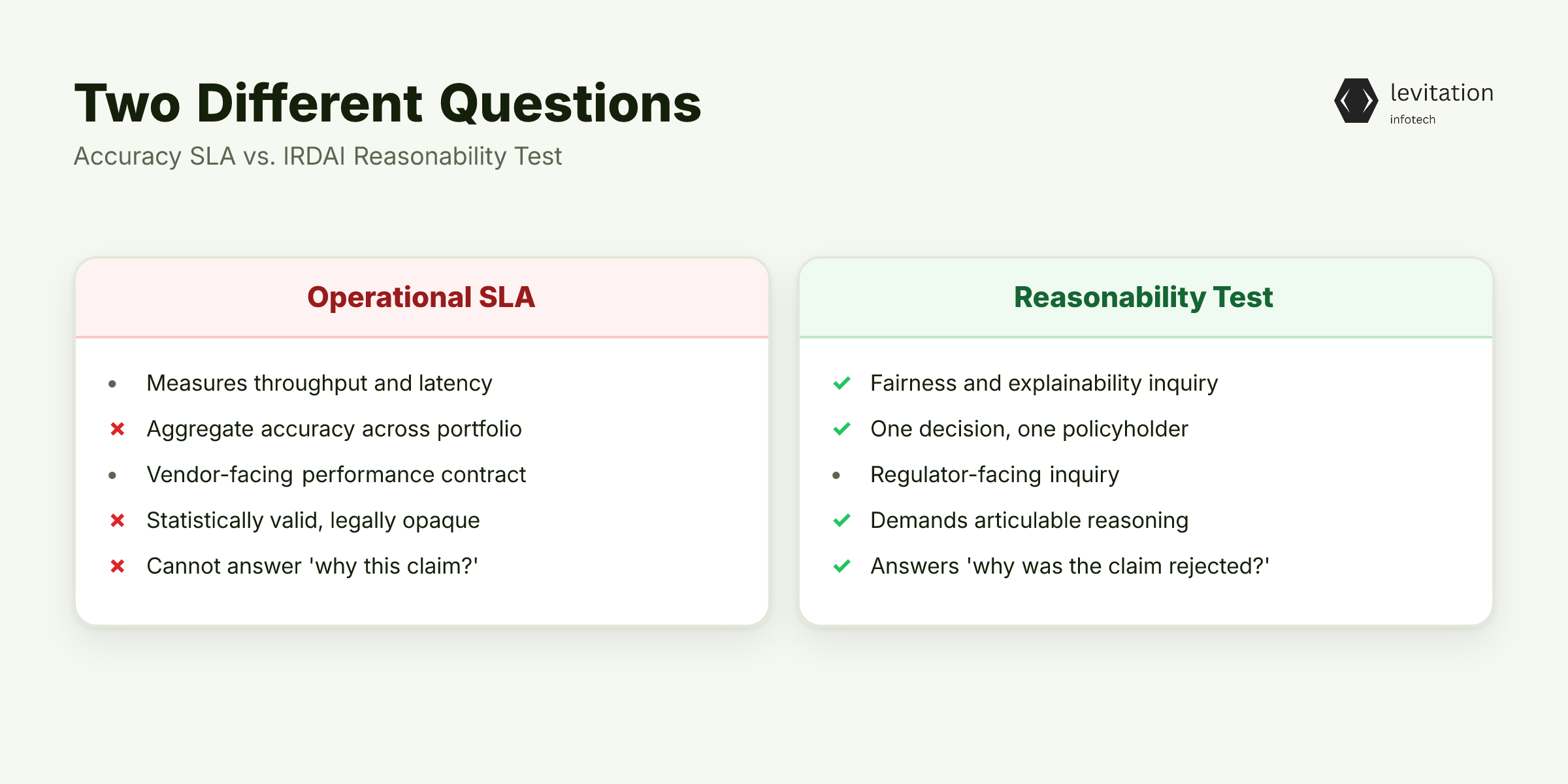
Your claims model processes claims at high aggregate accuracy. Operations is happy. IRDAI is not. The reasonability test isn't asking whether your model is correct. It's asking whether you can prove it made the right call for the right reasons.
An operational SLA is a vendor-facing performance contract. It measures throughput, latency, and aggregate accuracy across the portfolio. A regulator's reasonability test is something different. It is a fairness and explainability inquiry. It is aimed at a specific decision for a specific policyholder. The two are not the same question dressed in different clothes. They are different questions entirely.
Consider a model that clears a high-accuracy SLA. The rejections it produces may be statistically valid but legally opaque. The model sees a pattern your claims team cannot describe in a deposition. That gap is where the reasonability test lives.
Bad-faith litigation in India has already begun using AI opacity as evidence of unreasonable claim handling. The argument is straightforward. If you cannot tell me why my claim was rejected, you cannot show the rejection was reasonable. An SLA report does not answer that argument. It never could.
If accuracy doesn't satisfy the regulator, what does the reasonability test actually measure?
Why Traditional ML Metrics Create a Compliance Blind Spot
Precision, recall, and F1 scores describe aggregate behavior. They tell you nothing about why claim #4821 was rejected. A model with high precision still produces decisions that look wrong in isolation. When a regulator asks for the reasoning behind one of them, the metric offers no help.
Black-box models, especially gradient-boosted ensembles and deep neural networks, generate predictions without human-readable decision logic. The model knows. The documentation does not. This is a structural problem, not a documentation gap. No amount of model card writing will recover a feature-level explanation from a tree ensemble. That ensemble uses thousands of interacting splits.
There is also a non-determinism problem. The same claim can score differently across retraining cycles. This happens because each cycle sees new data. If your audit position depends on the model version, you have no audit position.
The system today is the system that decided the claim. Tomorrow's system is something else.
The benchmark problem runs deeper. AI doesn't behave like software. You can't point to a test suite and say "this passes." A traditional test suite locks in expected behavior. A retrained model has different behavior.
Only systems built to produce stable, explainable outputs survive long-term production across model refreshes. That stability doesn't come for free. It comes from how the system is built.
Recognizing the blind spot is one thing. What does the regulator want to see in its place?
What the January 2025 Sub-Committee Report Actually Demands
The sub-committee's principles cluster around three pillars. These are explainability, fairness, and human oversight. None of them is optional. None of them is satisfied by an accuracy metric.
Explainability, in the report's terms, means the insurer must be able to state which features drove a specific claims decision. It does not mean describing the model in aggregate. That distinction matters. A model card that says "the model uses hundreds of features" is not an explanation for claim #4821. A per-decision attribution is.
Fairness testing requires segmented performance analysis. Does the model perform equally across claim type, geography, and policyholder demographics? If precision on health claims in Tier-1 cities differs from precision on motor claims in Tier-3 cities, the report treats that gap as presumptive evidence of unfairness. The insurer carries the burden of disproving it.
Human-in-the-loop is no longer aspirational. The report treats unsupervised claims decisions as presumptively unreasonable. Every rejection above a defined value threshold needs a human signature. The signature has to carry the reviewer's reasoning, not just an approval click.
Data handling must align with the Digital Personal Data Protection Act 2022. Consent, purpose-limitation, and retention rules apply to training data as much as production data. The compliance automation for explainable AI discipline the report describes is not separable from the DPDPA posture. The insurer already maintains that posture.
This is the bar. It's a meaningful gap from where most production claims systems sit. The question is no longer whether the report is rigorous. It's how to build a system that clears the bar at production speed.
The engineering teams that close this gap are the ones that treat reasonability as a system property. They do not treat it as a documentation project. What does that architecture look like in practice?
The Explainability Stack: Architecture for Auditable Claims AI
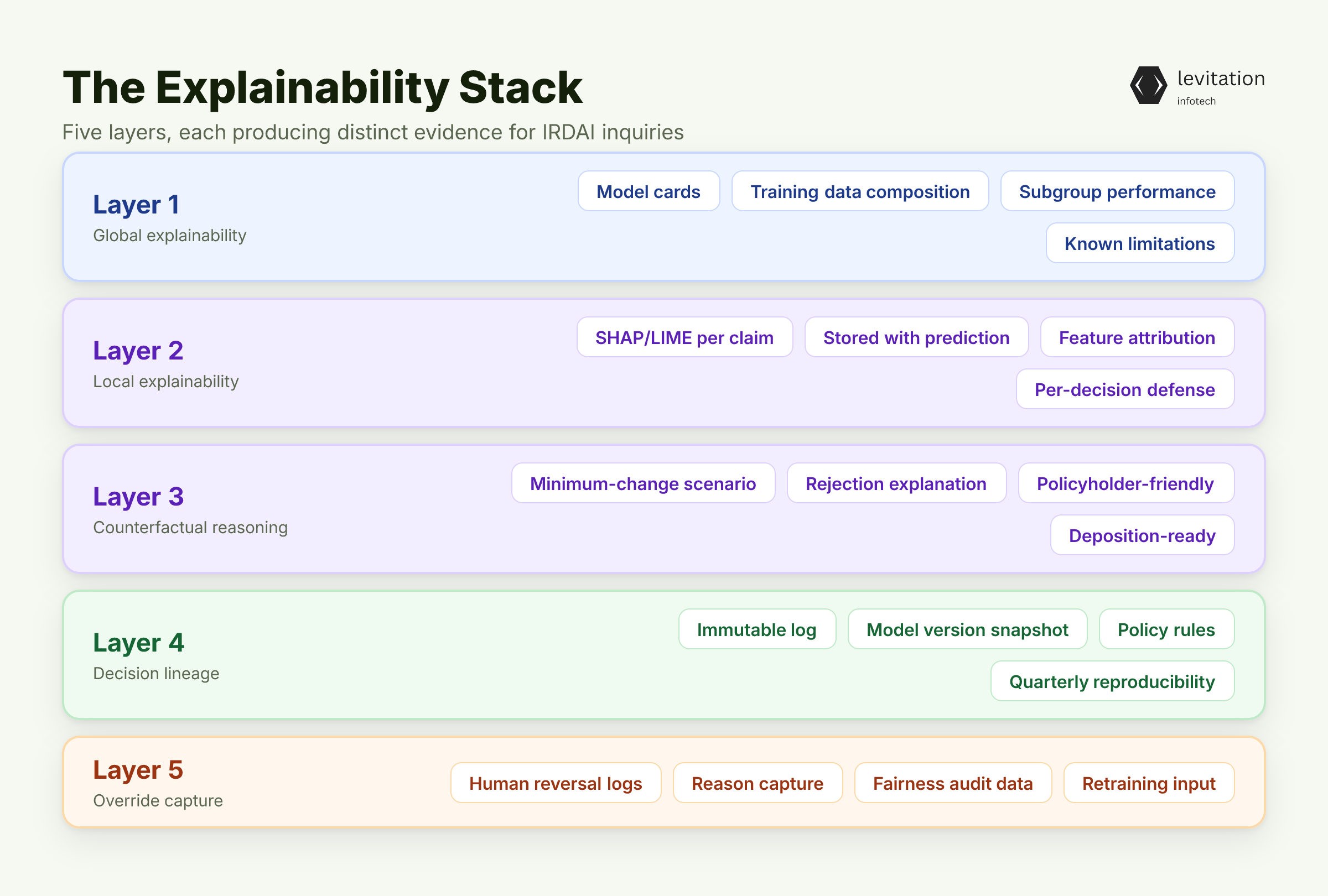
The architecture that survives an IRDAI inquiry has five layers. Each produces a distinct kind of evidence. Skip a layer, and the next regulator's question will find the gap.
Layer 1: Global explainability. Model cards document training data composition, performance across subgroups, and known limitations. This is the layer the regulator sees first. It establishes the model's intended use. It also shows the population it was validated on.
Layer 2: Local explainability. SHAP or LIME values are attached to every individual claims decision. They are stored alongside the prediction. These values say: for this claim, these features pushed the score up. These features pushed it down. Without them, a per-decision defense is impossible.
Layer 3: Counterfactual reasoning. For each rejection, generate the minimum-change scenario that would have resulted in approval. "If the invoice date were 3 days earlier, the claim would settle." That sentence is gold in a deposition. It is also the language a policyholder can understand.
Layer 4: Decision lineage. An immutable log ties every output back to the model version, feature snapshot, and policy rules in effect at decision time. If a model is retrained next quarter, the decision from this quarter must still be reproducible from the artifacts of this quarter. The ai compliance audit infrastructure for this layer is what makes the rest of the stack auditable.
Layer 5: Override capture. When a human reviewer reverses the AI, log the reason. This data is gold for fairness auditing and model retraining. It is also evidence that human oversight is real, not theatrical.
Financial fraud detection and claims adjudication face the same structural problem. Decisions must be explainable, reproducible, and defensible years after the fact.
The explainability stack produces the data. What does an IRDAI-ready audit trail actually look like when a regulator asks for it?
From Model Output to Audit Trail: What an IRDAI-Ready System Logs
Every claim decision should carry a signed evidence packet. The packet includes input features, model version, SHAP values, counterfactual, and human-override history. The packet is the unit of evidence. When IRDAI asks for the file on claim #4821, the packet is what you hand over.
Subgroup performance dashboards are the second artifact. Precision and recall are broken down by claim type, region, and policyholder segment. They are refreshed on every model deployment. The regulator's fairness inquiry starts with these numbers. If the numbers are good, the conversation moves on. If they aren't, no amount of model card prose will rescue the conversation.
A reasonability test simulator is the third piece. Before pushing a new model, run it against a held-out set of historical disputed claims. Measure how many would now produce explainable, fair decisions. This is the closest thing the team has to a "pre-flight check" for reasonability. Skip it, and the first signal arrives. The signal shows the new model is worse on fairness. It arrives in the form of a regulatory notice.
Retention and access come last but matter most. The evidence packets must be queryable for the retention period required under IRDAI's information maintenance regulations. They must also support role-based access for auditors. Regulatory AI readiness is, in the end, a data architecture problem disguised as a legal one.
The systems still running in production years from now will be the ones whose decision-lineage layer was designed for audit survival from day one. They will not be bolted on after a regulatory inquiry. The architecture was always the product.
All of this machinery is expensive and complex. So what does the organization actually gain when it gets reasonability right?
What Changes When Reasonability Becomes Your North Star
Litigation defense shifts first. An insurer with a counterfactual-ready audit trail can defeat bad-faith allegations. They do this by showing the specific reasoning chain for any disputed claim. The "AI said no" defense is indefensible. A defense that names the specific features that exceeded the policy threshold is harder to attack. Pointing to the smallest change that would have reversed the decision makes the defense much stronger.
The regulator relationship changes in tone. Moving from "asked to produce evidence" to "voluntarily submitted continuous compliance reports" reframes every IRDAI interaction. The regulator stops asking "can you show me?" and starts asking "what changed this quarter?" That is a different conversation, and a friendlier one.
Model improvement loops tighten. The human-override data captured in the explainability stack becomes a high-signal retraining dataset. It improves model fairness over time. The reviewers' reasoning is structured feedback the model never had before.
Policyholder trust accrues slowly. A claims process that can explain its own decisions in plain language is harder to challenge publicly. It is also easier to defend. This reasonability-first posture wins enterprise procurement. It also satisfies regulatory scrutiny. The two markets want the same thing, and it's not a higher accuracy number.
Treating AI compliance as a strategic capability is the through-line. Reasonability is not a compliance tax. It is the infrastructure of a defensible claims operation. The teams that build it first will find their regulator conversations measurably easier. The teams that build it last will have a harder time.
Frequently Asked Questions
Q: What is the IRDAI reasonability test for claims AI?
A: The reasonability test is IRDAI's framework. It evaluates whether AI-driven claims decisions are explainable, fair, and subject to human oversight. Unlike an SLA that measures aggregate performance, the test asks whether the insurer can show the specific reasoning behind individual decisions. It also asks whether the model performs equitably across policyholder segments.
Q: Does meeting an AI accuracy SLA satisfy IRDAI compliance?
A: No. Accuracy, precision, and recall describe aggregate model behavior. They do not describe the explainability and fairness criteria the reasonability test evaluates. A model can clear a high-accuracy SLA and still fail reasonability. This happens when its individual decisions cannot be justified with feature-level evidence.
Q: How does the Digital Personal Data Protection Act 2022 interact with IRDAI AI compliance?
A: DPDPA 2022 governs how personal data is collected, stored, and processed. This data is used to train and run claims models. Insurers must ensure that training data has valid consent. Purpose-limitation must be respected. Data handling practices must satisfy both DPDPA requirements and IRDAI's information maintenance regulations.
Q: What makes a claims AI model 'explainable' under IRDAI expectations?
A: Explainability requires that the insurer can state, for any individual claim decision, which features drove the outcome. It also requires stating what alternative inputs would have changed it. In practice, this means attaching SHAP or LIME values, counterfactual scenarios, and full decision lineage to every prediction.
Q: Can an insurer face penalties for using non-explainable AI in claims processing?
A: Yes. IRDAI treats opaque claims decisions as presumptively unreasonable. Policyholders have begun using AI opacity as evidence in bad-faith litigation. Non-explainable AI exposes the insurer to regulatory censure, dispute escalation, and civil liability.
Map your current claims stack against the five layers above to find the first gap a regulator would exploit.
Sources
Research and references cited in this article:
- India's insurance regulator steps in to govern AI adoption | Insurance Business
- IRDAI 2026 AI Cybersecurity Compliance
- IRDAI Forms AI Working Group for Insurance Sector
- Insurance Legal AI — IRDAI & Policy Compliance | Vidhaana
- IRDAI's Digital Insurance Guidelines Transform India's ...
- AI in the Indian Insurance Market: Regulatory Preparedness
- AI could soon be used for insurance claims - Cafemutual.com
- IRDAI forms working group on AI
- Decoding Insurance for India: AI in Underwriting, Claims Experience ...
- Advancing claims efficiency in India's insurance ecosystem
- The Role of Artificial Intelligence in Enhancing Efficiency and ...
- AI in Insurance in 2026: Advantages and Challenges | Insurance Thought Leadership
About the author
Mayank Singh is a software developer at Levitation Infotech, where he builds web and AI-powered applications across the company’s fintech, healthcare, and enterprise projects.