


TL;DR: Passing compliance audits proves your AI has internal controls. It does not prove your AI is trustworthy to the people using it. Closing the gap requires CTOs to engineer transparency, explainability, and tamper-evident audit trails into production systems. They should not treat trust as a post-launch communications problem.
Key Takeaways: - Most consumers suspect companies misrepresent their training data and fear losing control over personal information, even as enterprise AI adoption accelerates and compliance audits multiply. - ISO 27001 and ISO 42001 certify that controls exist. They do not give customers any window into how a specific decision was made. - Trustworthy enterprise AI requires three engineering foundations: transparency, explainability, and tamper-evident audit trails that external stakeholders can inspect. - Retrofitting explainability onto a black-box model produces shallow rationalizations. Decision provenance must be captured during inference, not reconstructed after.
Your AI Is Compliant. Your Customers Are Still Leaving.
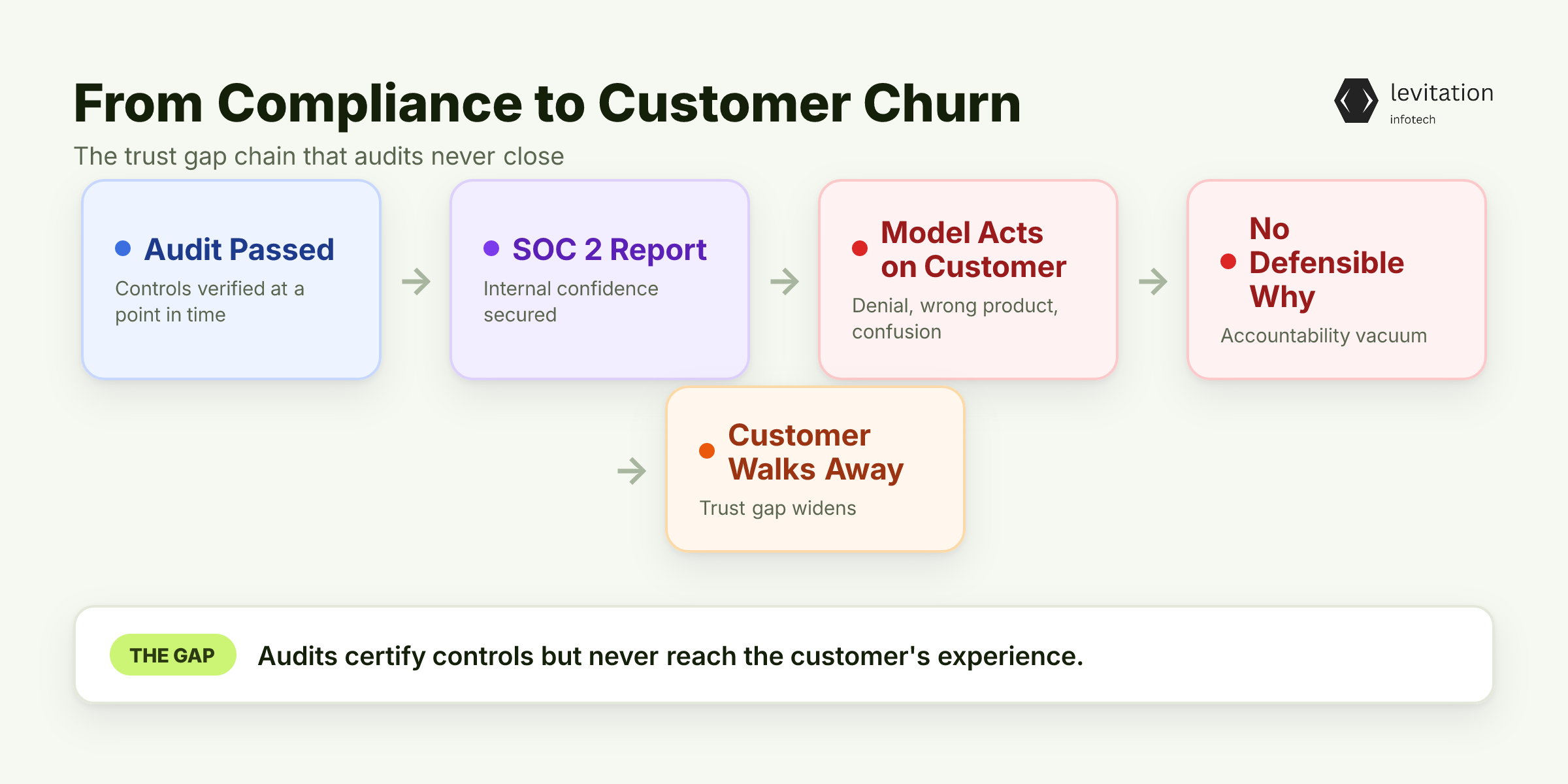
The gap between technical certification and actual trust is widening, not closing. Passing every audit means nothing if the people using the system are walking away. Most consumers suspect companies lie about their training data. They also fear losing control over their data, even as enterprise AI adoption accelerates and compliance audits multiply. Something is broken in the chain between "we passed" and "we're believed."
Consider what happens in a real audit. An assessor at a healthcare group found an AI system checking claims automatically. Everything looked perfect: fast, accurate, efficient. Then someone asked, "Who audits the AI?" The room went silent. That silence is the gap between your SOC 2 report and your customer's decision to leave.
Most CTOs treat audits as the finish line of trust. They are not. An audit measures whether controls existed at a point in time. It checks whether an assessor could verify them. It also confirms whether the organization followed its own policy. None of those signals reach the customer.
The customer sees a model that denied their loan, recommended the wrong product, or generated a confusing answer. They have no way to ask "why" that produces a defensible answer. This is the accountability vacuum behind every clean audit report. It is also where customer trust is actually won or lost.
AI compliance can structure your controls, but it cannot manufacture the customer-facing verifiability that closes the trust gap. The systems behind those certifications must be designed to prove themselves, not just pass review.
If audits aren't the problem and they aren't the solution, what exactly are they measuring, and what are they failing to measure?
Why Passing Audits Doesn't Build Trust
The mismatch is structural, not cosmetic. ISO 27001 and ISO 42001 certify that you have controls in place. They do not certify that customers can verify your decisions.
The auditor sees your model card, your access logs, your bias testing. Your customer sees a black box that just made a decision about them. Audits are point-in-time, internal, and assessor-driven. The customer has zero visibility into the process and no reason to take the report on faith.
Worse, most consumers already suspect companies lie about training data and fear losing control over their own data. A clean SOC 2 report does nothing to address either concern. Neither concern is about whether your controls exist. Both are about whether your system can be interrogated.
This produces a widening trust gap. Compliance investment accelerates. Public confidence flatlines. Organizations spend more on audits and see less movement in the metrics that actually matter: retention, NPS, opt-in rates.
The enterprise AI solutions market keeps expanding. Customer skepticism expands in the same direction, at the same rate.
The deeper problem is that audits answer a different question than the one customers are asking. Audits ask: "Did this organization follow its process?" Customers ask: "Can I see why this decision was made about me, and can I challenge it?" The first question is about your controls. The second is about your system. No certification closes the gap between them.
So if audits answer the wrong question, what question should enterprise AI systems actually be designed to answer?
The Three Foundations Trustworthy AI Actually Requires
Trustworthy AI is not a policy document. It is three engineering requirements, each visible to someone other than your internal compliance team.
Foundation 1: Transparency. Be upfront about how data is collected, stored, and used to train models. Not in a 40-page privacy policy no one reads. In the place where the customer is engaging with the system. Training data sources, model version, data retention period, and the customer's right to opt out should be surfaced in plain language at the point of interaction.
Foundation 2: Explainability. The system must be able to explain how and why a specific decision was made. It must speak in terms a non-technical user can follow.
Not a SHAP plot. Not a feature importance chart. A sentence: "Your loan was declined because the model identified three factors, and here is what you can do about each one."
Foundation 3: Tamper-evident audit trails. Comprehensive, immutable records that let any stakeholder verify what the system did and when. Not just internal compliance teams, but customers, regulators, and auditors from outside your walls.
These three are engineering requirements, not governance statements. The difference between a trust claim and a trust mechanism is exactly this: a claim is what your marketing team writes. A mechanism is what your inference pipeline logs, signs, and exposes.
An enterprise AI platform that bakes these in from day one looks different from one that adds them as a compliance layer after the fact. The teams that ship trust mechanisms early ship faster later. Transparency and explainability are well-trodden territory in the literature. The piece most enterprise architectures are missing is the third: audit trails customers can actually inspect. What does that third foundation actually look like inside a production inference pipeline?
Tamper-Evident Audit Trails: The Engineering Spec
Tamper-evident does not mean "encrypted." It means alteration is detectable. The standard pattern is append-only logs with cryptographic chaining and external timestamping.
Each entry contains a hash of the previous entry. Removing or modifying a record breaks the chain. An external timestamp anchor (a public timestamping authority or a blockchain write) makes backdating obvious.
Here is what actually needs to land in the log for every AI decision:
1{2 "decision_id": "dec_2026_08_01_47f3a1",3 "timestamp": "2026-08-01T14:22:18.412Z",4 "model_version": "credit-risk-v3.2.1",5 "input_features_hash": "sha256:7c4a...",6 "retrieval_context_ids": ["doc_8842", "doc_9103"],7 "feature_contributions": {8 "income_to_debt": 0.42,9 "credit_history_months": 0.31,10 "employment_stability": 0.1911 },12 "output": "DECLINE",13 "confidence": 0.87,14 "human_override": null,15 "previous_hash": "sha256:1b8e...",16 "signature": "..."17}
This is not observability for your SRE team. It is decision provenance for your customer, your auditor, and your regulator.
Observability dashboards tell you the system is healthy. Provenance logs tell you why a specific decision was made, by what version of the model, with what inputs, and whether anyone changed it. The distinction matters.
AI compliance automation can structure the capture, but the schema has to reflect what a non-engineer would need to see. It should not just be what an engineer would need to debug.
The exposure trap is real. You want to reveal decision logic and provenance without leaking proprietary model weights or training data. The fix is to log the inputs, outputs, and feature contributions, not the model internals.
A customer should be able to see that "income_to_debt" carried 42% of the decision weight. They should never see the gradient that produced that weight. The same pattern works for RAG systems: log the retrieved document IDs, not the embeddings. Document the chain without exposing the secret.
An audit trail is only as useful as a customer's ability to understand it. Most teams defer that decision until it is too late. What should the schema capture, and what should it deliberately leave out?
Explainability Has to Be Architected, Not Bolted On
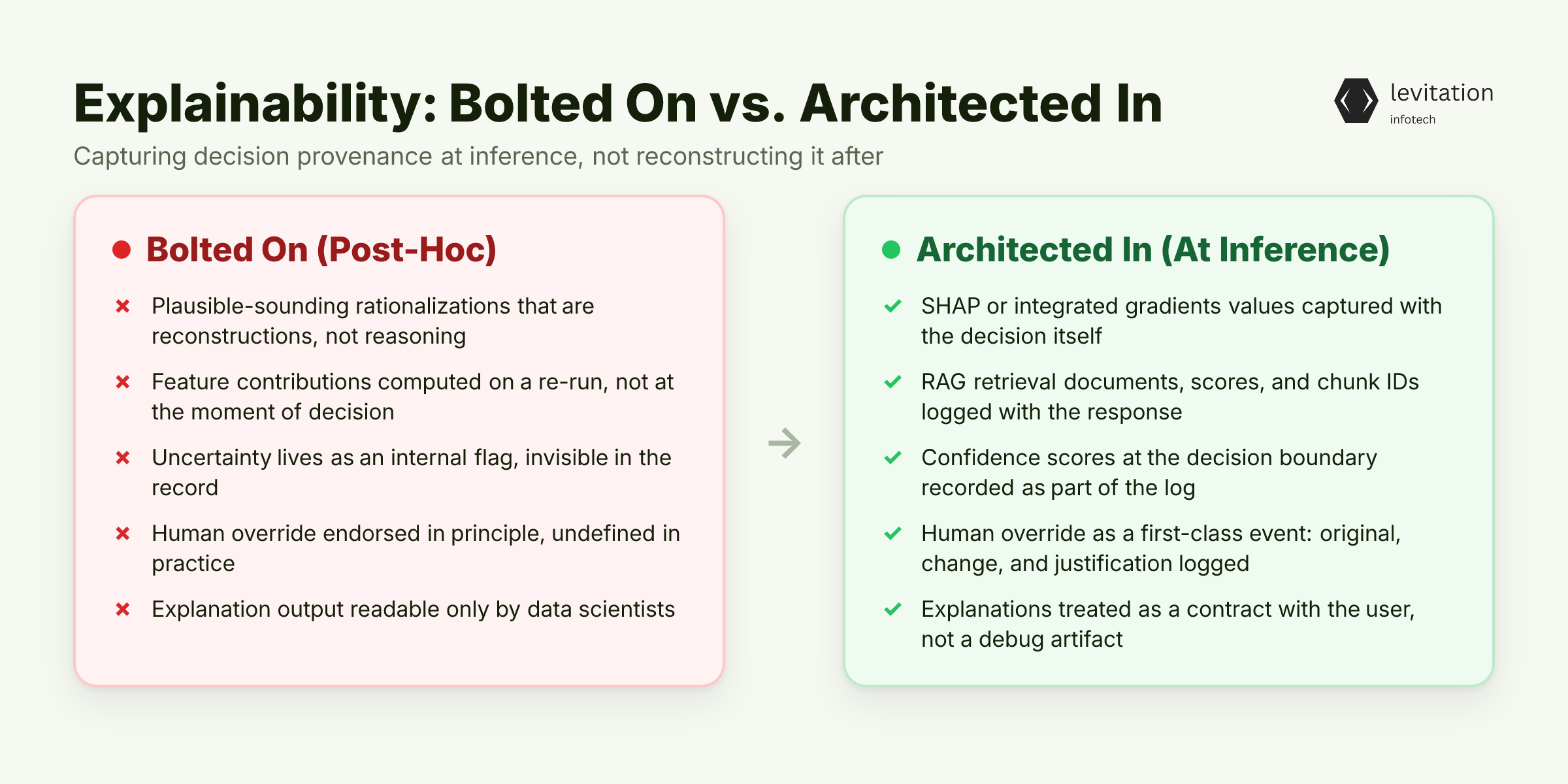
Retrofitting explainability onto a black-box model produces shallow rationalizations. The model says "DECLINE" and your post-hoc explainer generates a plausible-sounding reason. The reason is not the model's actual reasoning. It is a reconstruction, and reconstructions are guesswork.
Decision provenance has to be captured during inference, not after. The patterns that work in production: - Feature contribution logging. Capture SHAP or integrated gradients values at the moment of decision, not on a re-run. - Retrieval context for generative AI. Log which documents the RAG pipeline retrieved, their scores, and the chunk IDs that influenced the response. - Confidence scores at the decision boundary. When the model is uncertain, that uncertainty must be part of the logged record, not an internal flag. - Human override as a first-class event. When a human reviewer changes the model's output, the original prediction, the human's change, and the justification all enter the log.
The human-in-the-loop gap is the part most teams get wrong. When override is endorsed in principle but undefined in practice, trust collapses in production.
A concrete CTO checklist for your inference pipeline: - Does the decision log include feature contributions, not just the output? - Can a customer-facing team access that log without filing an engineering ticket? - Is the human override path documented, authorized, and logged? - Is the explanation output human-readable, or is a feature importance chart that requires a data scientist to interpret?
Enterprise AI implementation that gets explainability right treats the explanation as a contract with the user. It is not a debugging artifact for the engineering team. The teams that treat it as the former ship trust mechanisms. The teams that treat it as the latter ship dashboards nobody outside engineering can read. So what does the inference pipeline itself need to capture at the moment of decision?
What Changes When You Get Trust Right
Three things change, and each is measurable.
Operational. Systems built on transparent, explainable foundations stay in production longer. Customer-facing teams can defend them, not just compliance teams. When a customer asks "why was I denied?", the support agent has a real answer backed by a logged record, not a script that deflects. Churn drops because the conversation stops being adversarial.
Commercial. Trust compounds into retention. Multi-year client retention is the downstream signal of systems customers stop questioning. The relationship shifts from "prove you are safe" to "we already know you are, here is the next use case." Sales cycles shorten. Expansion revenue rises.
Strategic. Organizations with verifiable trust mechanisms move faster on new AI rollouts. The trust conversation is already settled for the prior deployment. The next model launch is not a referendum; it is an iteration. Deployment velocity rises because trust is now a precondition, not a gate.
Reframe trust as a deployment velocity multiplier, not a tax on it. Enterprise AI systems built on tamper-evident foundations are the ones still running in production five years after deployment. Nobody had to rip them out when the next audit cycle started asking harder questions.
If the engineering shifts above are the answer, the remaining question is sequencing: what does a CTO actually do in the first 90 days?
Your First 90 Days
Week 1-2: Audit your current AI workflows for the three foundations. Which of transparency, explainability, and tamper-evident trails are present, partial, or missing per system? Produce a one-page matrix. The goal is not to fix anything yet. The goal is to see the gap in writing.
Week 3-6: Pick the single highest-customer-facing AI workflow. Instrument it with decision provenance logging and a customer-readable audit view. Not ten workflows. One. The one your customers touch most often. The one that determines whether they stay. Ship the schema, the chain, and the customer-facing surface.
Week 7-10: Draft the human-override policy that most organizations are missing. The policy gap is universal: shared human-override guidelines are missing at most companies. Cover when a human must review, who has authority, how that decision is logged, and how the customer is told. Write it for the support agent who will use it at 11pm, not for the auditor who reviews it quarterly.
Week 11-12: Run an internal trust review with customer-facing, legal, and engineering. Treat it as a pre-audit. Walk through a real decision the system made, with the real provenance log open. If your customer-facing team cannot defend the decision to legal in that room, it will not survive a regulator's question.
Regulatory AI compliance does not have to be the slow path. The teams that get trust right treat it as a system property, not a checklist. They engineer it into the inference pipeline on day one. Then the audit follows the architecture instead of the other way around.
Frequently Asked Questions
Why do customers distrust AI even after compliance audits? Audits certify that internal controls exist. They do not give customers visibility into how a specific decision was made. Trust requires transparency, explainability, and tamper-evident audit trails that customers can actually inspect, not just internal compliance certifications under frameworks like ISO 27001 or ISO 42001.
What is the AI trust gap and how is it measured? The AI trust gap is the dissonance between how much organizations rely on AI and how much the public is willing to trust those systems. Most consumers suspect companies lie about their training data and fear losing control over their data. This is a measure of confidence that is largely independent of corporate compliance metrics.
Do ISO 27001 and ISO 42001 certifications improve customer trust in AI? They improve audit posture and regulatory alignment, but customer trust requires more. ISO 27001 and ISO 42001 provide a shared framework for integrated audits and unified policy. They do not address the perceived accountability and verifiability concerns that drive customer skepticism.
How do you build explainability into enterprise AI systems? Explainability must be designed into the inference pipeline from day one, capturing feature contributions, retrieval context for generation, and confidence scores at the moment of decision.
Sources
Research and references cited in this article:
- AI Compliance Guide 2026: Global Regulations | Modulos
- Top 7 industries with stringent AI compliance needs in 2026
- Understanding IT Compliance: Key Regulations for 2026
- AI Regulations Around the World: A 2026 Guide
- Meeting AI Compliance Requirements: The Definitive Guide
- Customer AI Trust Survey: 82% See Data Loss Threat
- AI Audit Failures: 90% of Companies Struggle with Inventory, Bias Testing, and Oversight | Jonathan Marashlian posted on the topic | LinkedIn
- Customers don’t trust AI, and the rift might be hurting business | CX Dive
- Regulating AI Deception in Financial Markets: How the SEC Can Combat AI-Washing Through Aggressive Enforcement
- Bias in AI systems: integrating formal and socio-technical approaches
- AhaChat - 🚀 AI Transparency in 2026: The New Standard for...
- Trust & AI: Relational Trust in AI Transformation | CCL
About the author
Mayank Singh is a software developer at Levitation Infotech, where he builds web and AI-powered applications across the company’s fintech, healthcare, and enterprise projects.