


TL;DR: Clinical AI inference logs create a hidden ePHI exposure surface the moment a model reads patient data. OCR auditors count 9 specific gaps in inference audit trails. Most teams miss all of them because generic observability tools were never built to satisfy 45 CFR 164.312. The fix is a deliberate rebuild: session-bound, authenticated, redacted-at-source, retention-bounded audit logs designed in from the inference SDK, not bolted on downstream. The rebuild moves much faster when compliance is a first-class design constraint. The drawn-out remediation cycle that follows an audit finding forces the work after the fact.
Key Takeaways: - Complete inference observability is not the same as HIPAA compliance. Verbose logs that touch ePHI become a new compliance surface, not a debugging asset. - OCR auditors count 9 specific gaps in inference audit trails. None of them surface in standard observability dashboards. - 45 CFR 164.312 demands session-bound identities, tamper-evident audit trails, payload redaction at the source, and BAA-covered destinations at the inference layer. - The rebuild moves much faster when the inference SDK is selected with 45 CFR 164.312 as a first-class constraint. Bolting compliance on after an audit finding means prolonged remediation.
Your Logs Capture Everything. That's the Compliance Problem.
Your team built a beautiful clinical AI demo. Full request and response logging. Latency metrics. GPU utilization. The CTO signed off.
Then an OCR auditor asked for the inference audit trail and the room went quiet.
Complete observability is not the same as HIPAA compliance. The gap between them is exactly where enforcement actions land.
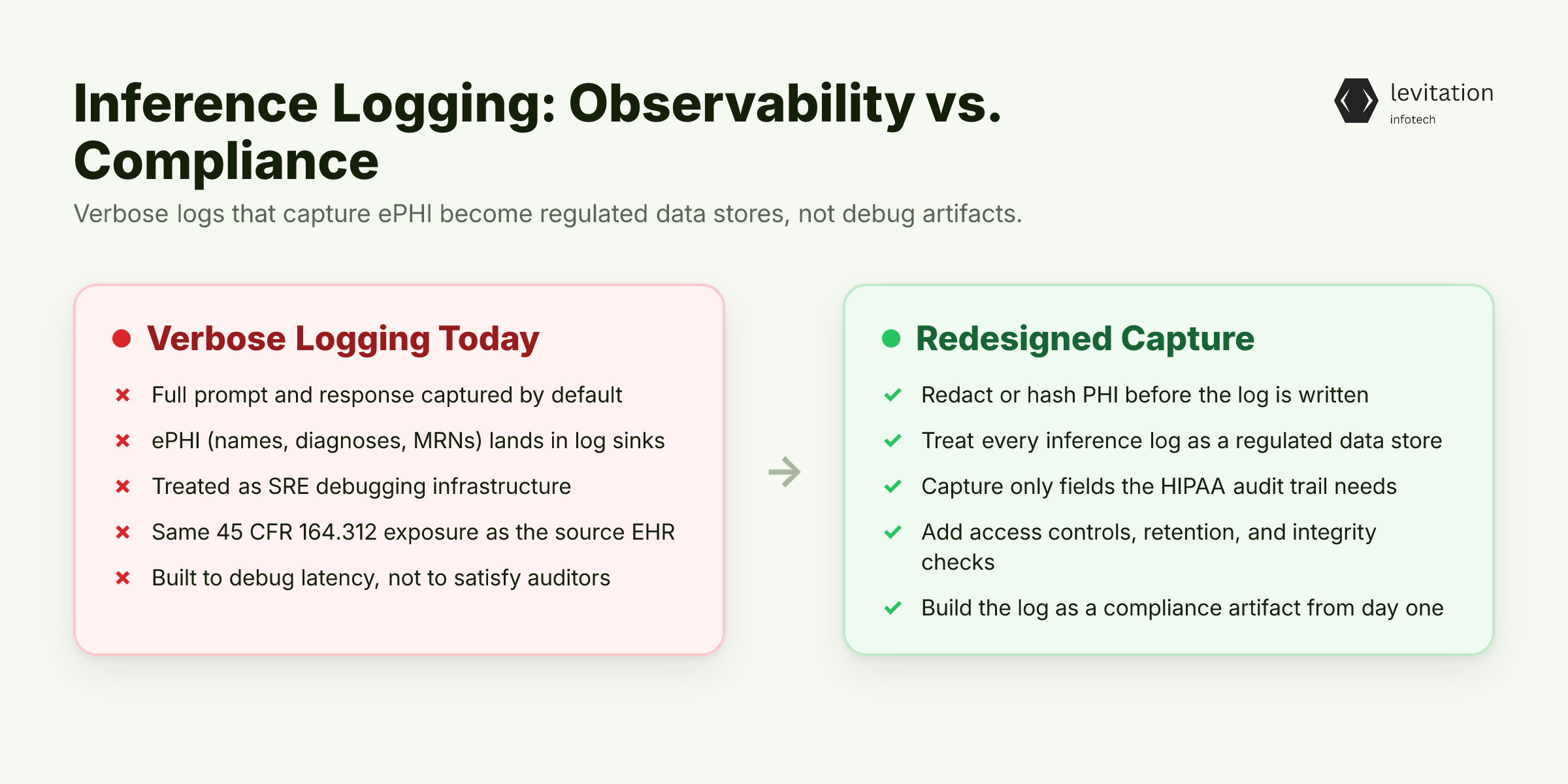
Amazon Bedrock model invocation logging, for example, captures full prompt and response content by default. If a user submits ePHI in that prompt, a patient name, a diagnosis, a medical record number, the logging destination now holds ePHI. It is not a debugging artifact anymore. It is a regulated data store.
Your team treats it like observability infrastructure. HIPAA treats it like a clinical system.
Most clinical AI teams confuse telemetry completeness with the audit controls the HIPAA Security Rule requires. The infrastructure layer is where PHI is actually processed.
HIPAA's Security Rule applies wherever ePHI is created, received, maintained, or transmitted. The moment a model invocation log touches patient data, that log is inside the compliance boundary. The safeguards from 45 CFR 164.312 apply to it with the same force they apply to the source EHR.
This is the part that surprises engineering leaders. Their own logging pipeline is the exposure surface. Not the model. Not the API. The verbose, well-intentioned inference logs the SRE team built to debug latency at 3 a.m.
This pattern surfaces repeatedly in deployments where inference logging was built as observability infrastructure rather than as a compliance artifact. The fix is rarely "add more logging." It is usually "redesign what you capture."
If complete logs are the wrong goal, what does the right one look like? HIPAA auditors count very specific gaps. Most inference pipelines have all nine.
The 9 Gaps OCR Auditors Actually Count
These are not theoretical risks. Each gap below corresponds to a documented finding pattern from OCR guidance and enforcement actions. Together they form the audit surface auditors walk when they pull the inference layer apart.
- No documented risk analysis covering the inference layer specifically. OCR guidance is explicit: the HIPAA Security Rule requires a documented risk analysis, and that document must feed directly into your risk management process. Most teams have a risk analysis for the application. Few extend it to the model invocation pipeline.
- Treating full prompt and response content as non-PHI log data. If a prompt contains ePHI, the log store holds ePHI. Encryption, access controls, and retention policies apply as if it were a clinical database. Generic log streams do not get this treatment by default.
- Missing session boundaries between users calling the inference endpoint. 45 CFR 164.312(a)(1)(1) requires access controls at the record level. If your inference endpoint cannot tell which user is on the other side of a request, that endpoint fails the access control test.
- No person or entity authentication at the inference layer (45 CFR 164.312(d)). A shared API key for an internal service is not authentication. An agent reasoning over PHI without a verified identity behind it is a gap.
- Audit controls that record system events but not who triggered the inference or why. 45 CFR 164.312(b) requires audit controls. Recording "model called at 14:32" without recording the authenticated principal is not an audit control. It is a heartbeat.
- Unredacted PHI payloads in log streams. No tokenization of identifiers before ingestion. A debug log line that says `prompt: "Patient John Smith, MRN 12345, presents with..."` is a breach waiting for a subpoena.
- No structured trace logging for agent reasoning steps. Just request/response pairs that hide decision provenance. When an agent calls three tools and a vector DB, you need to know which step touched PHI and why.
- Missing or unlimited log retention with no automated deletion. Unbounded PHI exposure. Logs kept forever are logs that can be leaked forever.
- No signed Business Associate Agreement covering the inference logging destination. A common blind spot when teams route logs to third-party observability vendors. Your BAA covers the model vendor. It often does not cover the log aggregator.
Notice how none of these gaps show up in a standard observability dashboard. HIPAA's technical safeguards were written before LLMs existed. Generic telemetry pipelines were not designed to satisfy them.
Teams who have shipped production AI/ML infrastructure in regulated industries know this is a category error, not a configuration issue. The frameworks are different. The data is different. The controls must be different too.
Why Generic Telemetry Pipelines Fail at Clinical Inference
OpenTelemetry and similar frameworks were built for distributed system debugging. They were not designed for PHI-bearing clinical workflows. The mismatch is structural, not cosmetic.
Default behavior captures full payloads in spans and traces. The whole point of a trace is to reconstruct what happened. That means preserving the inputs and outputs of every step.
Stripping PHI after the fact is harder than preventing capture at the source. By the time a span reaches your collector, it has already replicated to short-term storage, possibly to a disk buffer, and possibly to a sampling tier.
Centralized log aggregators like Datadog, Splunk, and ELK often lack BAA coverage, or have it only on specific enterprise tiers. When inference logs route through them on a standard plan, that destination is a third party holding ePHI without a contract.
This is a common audit finding. It is also, often, invisible to the team that built the inference layer.
Agentic AI systems compound the problem. An agent's reasoning steps are unstructured, span multiple model invocations, and frequently include patient context in tool calls. A tool call to a calendar, a pharmacy API, or a lab results service can carry PHI in parameters, headers, or response bodies. None of this looks like a traditional audit log line.
Some platforms now offer OpenTelemetry-compatible trace logs of agent reasoning steps. Treating these as audit-ready requires additional configuration around session boundaries, authentication propagation, and payload redaction.
The default is a debugging tool. The target is a compliance artifact. The distance between them is a configuration and code change, but a real one.
When inference tracing layers need to meet HIPAA technical safeguards, the work is closer to a platform migration than a config update. A practical starting point for healthcare teams evaluating vendors is the shortlist at top AI companies for healthcare in India. This shortlist separates generic LLM shops from teams that have shipped HIPAA-grade inference at scale.
The pipeline is the wrong abstraction. The question is what 45 CFR 164.312 actually demands from the inference layer, and how to map those requirements onto the specific logs you keep.
What 45 CFR 164.312 Demands From Your Inference Layer
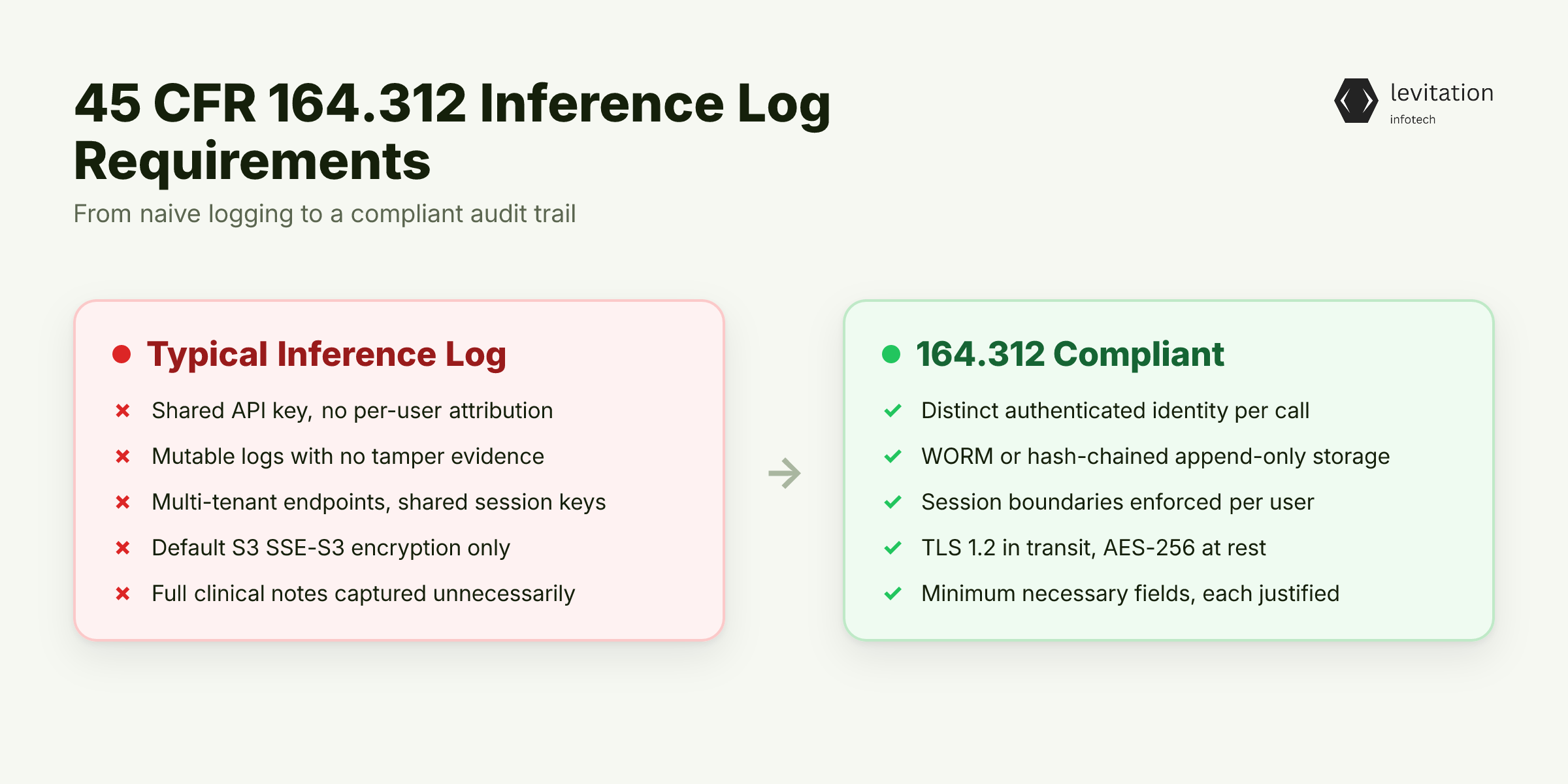
The technical safeguards under 45 CFR 164.312 are not suggestions. They are the binding specification for any electronic system that holds ePHI. They apply to your inference log store the moment it captures patient data.
Access controls (45 CFR 164.312(a)(1)(1)) require that every inference call be tied to an authenticated principal. Not just an API key shared across the application.
A doctor calling a clinical summarizer, a nurse querying a triage agent, an admin running a batch redaction job: each gets a distinct, attributable identity. The audit log has to capture which identity invoked the model.
Audit controls (45 CFR 164.312(b)) require that the log record who triggered inference, what model version answered, what data flowed in, and what came out.
This goes into tamper-evident storage. WORM (write-once-read-many) storage or append-only logs with hash chaining are the common implementation patterns. The point is that the log cannot be edited after the fact to obscure access.
Person or entity authentication (45 CFR 164.312(d)) requires that session boundaries exist. User A's inference history cannot be retrieved or attributed to user B. This sounds obvious. In practice, it is rare.
Multi-tenant inference endpoints with shared session keys fail this test routinely.
Integrity controls and transmission security mean inference logs containing ePHI must be encrypted in transit and at rest. They must match the safeguards applied to the source clinical data.
If your EHR data is TLS 1.2 in transit and AES-256 at rest, your inference audit log gets the same. Not the default S3 SSE-S3 you inherited from a tutorial.
The minimum necessary standard from the Privacy Rule extends to logs. Capture only the fields required for clinical, operational, or audit purposes. Document the justification for each retained field.
A log line with the full clinical note, when a hashed patient ID and a model version would suffice, is overcollection. The audit will treat it as such.
The risk analysis requirement is not optional. OCR guidance states explicitly that the HIPAA Security Rule requires a documented risk analysis that feeds directly into your risk management process.
An analysis that does not name the inference layer, the logging destination, and the agentic reasoning pipeline is incomplete. Incomplete risk analysis is one of the most cited findings in enforcement actions.
A useful pattern we use on our AI compliance engagements is to treat the inference layer as its own system boundary. Give it its own asset inventory, its own threat model, and its own residual risk register.
The harder question is what it takes to actually rebuild the inference audit trail to meet these requirements without slowing down the engineering team shipping clinical features.
Rebuilding the Inference Audit Trail
The rebuild is not a single project. It is a sequence of six changes. Each one is a precondition for the next. Each one is small enough to ship in a sprint when scoped correctly.
Step 1: Classify every log field by PHI risk. Full clinical notes, diagnoses, and patient identifiers get redaction or tokenization before they reach the logging pipeline. Condition codes and operational metadata can pass through.
A simple field-level classifier attached to your inference SDK is usually enough to start.
1# Example: structured audit event emission at the inference boundary2from dataclasses import dataclass3from typing import Optional45@dataclass6class InferenceAuditEvent:7 session_id: str8 user_id: str # authenticated principal9 model_id: str10 model_version: str11 prompt_hash: str # hash of the prompt, never the prompt itself12 response_hash: str # hash of the response, never the response itself13 redacted_payload_ref: Optional[str] # pointer to encrypted clinical store14 tool_calls: list # structured trace of agent tool invocations15 timestamp_ms: int
Step 2: Wrap the inference call in a session-bound context. Propagate authenticated user identity, session ID, and model version into every span. This lets audit logs answer who, what, and when without reconstructing from fragments.
The session boundary is the unit of compliance. A span without a session is not an audit log entry.
Step 3: Strip payloads at the source. Configure the inference client (Bedrock, a custom transformer endpoint, an agent framework) to emit structured trace events with redaction applied, not full request bodies filtered downstream. The principle is simple: never write PHI to a destination you do not already protect as a clinical store.
Step 4: Set retention time-to-live on inference audit logs. Short retention by default for operational logs (weeks to months). Longer only for explicitly designated audit stores with their own access controls.
The minimum necessary standard applies to retention duration as much as field scope. Retention windows that exceed what the audit purpose requires count as overcollection.
Step 5: Encrypt the audit store and restrict access. Treat the inference audit log the same way you treat the source ePHI database. Use encryption at rest, key management, role-based access, and monitoring of who reads the logs themselves. Yes, that last part matters.
The audit log is a record of who accessed patient data. The people who read the audit log are themselves an access event.
Step 6: Update the risk analysis document. OCR expects an annual review and updates whenever models, datasets, or vendors change. Inference layer changes are a triggering event.
If you swap a model version, change an embedding model, or add a tool to an agent, the risk analysis gets a new entry. This is administrative work, but it is the work auditors check first.
Teams that have done this in regulated healthcare environments ship production-grade systems in a fraction of the time when the audit infrastructure is designed in from the start. Compare that to the prolonged remediation cycle that follows an audit finding that forces the work after the fact.
The difference is whether the inference SDK, the agent framework, and the observability stack were selected with 45 CFR 164.312 as a first-class constraint, not a downstream concern.
For healthcare engineering leaders, the practical shortlist question is which vendors have actually shipped this. The answer is a small list. We have published a working evaluation at top AI companies for healthcare in India. The AI/ML training page describes the inference-side implementation patterns we have used in production.
What Changes When You Get This Right
Your inference logs become a defensible audit artifact rather than a latent liability. When OCR asks who accessed a patient's data on a given date, the answer is in a structured, authenticated, retained trail. The auditor is not reading your source code. They are reading the trail your system produced at runtime.
Engineering velocity improves because the team stops bolting on compliance retroactively. The audit boundary is part of the inference SDK rather than a downstream concern.
A new model swap does not trigger a six-week compliance review. It triggers a one-line risk register update. That is the shift. Compliance stops being a phase and starts being a property of the inference stack.
About the author
Mayank Singh is a software developer at Levitation Infotech, where he builds web and AI-powered applications across the company’s fintech, healthcare, and enterprise projects.