


Your clinical RAG system passed every benchmark. Diagnostic accuracy up 15%. Diagnosis time down 20%. So why are your clinicians opening Chrome the moment they need a second opinion?
TL;DR: Clinical RAG fails at adoption because accuracy is necessary but not sufficient. The real blockers are trust (no inline provenance), cognitive load (verbose retrieval), and workflow friction (separate portal instead of the EHR surface). The fix is architectural, not algorithmic: embed citations inside the chart, compress context to three sentences, and pre-filter by patient context before semantic search runs.
Key Takeaways: - A 15% accuracy gain on benchmarks does not translate to adoption if clinicians cannot trace a recommendation back to its source in one click - Google wins on clinical queries because it shows sources, dissenting views, and zero workflow friction in a single scroll - Architecture choices like KV cache reuse, patient-context pre-filtering, and aggressive context compression matter more than model upgrades - Extended pilot timelines create their own adoption risk because clinical priorities shift during long builds - Production clinical RAG requires long-horizon thinking around embedding refresh and clinical guideline drift that pilot thinking ignores
The ₹40 Lakh Reality Check: What the Dashboard Doesn't Show You
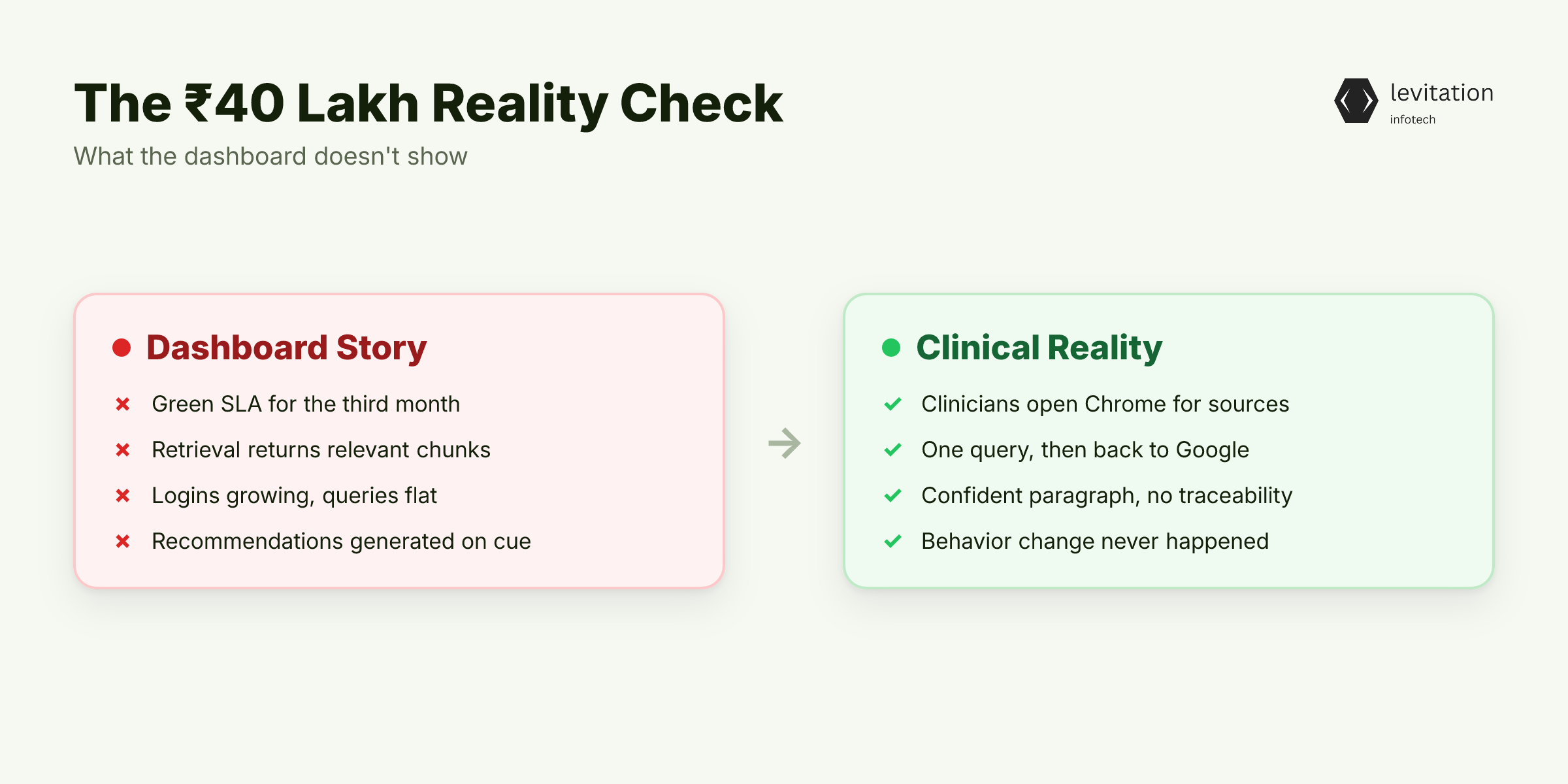
You approved the budget. The vector database is humming. The retrieval pipeline returns relevant chunks. Your MLOps dashboard shows a green SLA for the third month running.
And your clinicians still Google "atrial fibrillation guideline 2024" between patient visits.
Here is what the dashboard does not show. Three features consistently underperform in clinical RAG deployments: explainable AI, specific data retrieval, and real-time clinical decision support.
The system was built, benchmarked, and shipped. Clinicians logged in. They typed one query. They went back to Chrome.
The investment trap is real. Forty lakh buys retrieval infrastructure, vector indexes, and a nice chat UI. It does not buy clinician behavior change.
Engagement metrics hide this trap. Total logins grow, then plateau. Queries per session stay flat. Recommendations are generated, glanced at, and ignored.
This is the same pattern we see across regulated-industry AI deployments. The RAG fundamentals work in isolation but fail in front of the user. The technical pieces that should matter, like RAG's hard limits in clinical settings, get lost behind a cleaner dashboard story.
The Google reflex is a symptom, not a failure of training. Clinicians do not open Chrome because they distrust AI in general. They open Chrome for a simple reason. Chrome shows them five links. Each link has a source they can evaluate in two seconds.
The clinical RAG system they were given shows a confident paragraph with no path back to the source. This is the adoption problem most healthcare technology deployments hit. It is not solved by a better model or a bigger GPU budget.
The gap is rarely technical. It is human.
Budget wasn't the constraint. Model accuracy wasn't either. The real problem starts the moment a clinician sees a confident answer they can't trace.
The Trust Gap: Why Accuracy Is Not Enough
The accuracy paradox is the first wall clinical RAG hits. You can lift diagnostic accuracy by 15% on benchmark tasks, and your clinicians will still Google.
The reason is that benchmark accuracy and clinical trust are different objects. Benchmarks measure whether the model picks the right answer from a closed set. Trust measures whether a human believes the model enough to act on it.
Confidence without provenance is the actual blocker. A clinician reading "Consider switching to a direct oral anticoagulant" needs to see the guideline paragraph, the study, the citation.
If the source is hidden behind a modal or buried in a footer, the recommendation reads as opinion. And opinion is exactly what the clinician came to the system to avoid.
The teams that ship clinical RAG well validate with real users early. A small web UI tested with a panel of practicing clinicians surfaces problems no internal benchmark can catch. Doctors test the solution in practice. The same people who would later use the system at the point of care generate the validation signal.
Internal accuracy tests do not generate that signal.
Google wins not because it is better, but because it shows links, sources, and dissenting opinions in one scroll. A clinician can verify a recommendation quickly. The clinical RAG system, by hiding its sources, asks the clinician to take a confident answer on faith.
Faith is not a clinical workflow. The next failure hides in the system's own answers: paragraphs nobody finishes reading.
This is the single most common reason top AI companies for healthcare in India lose deals. In-house builds look weaker on paper but win adoption. The in-house team embedded citations. The vendor did not. Adoption follows the team that respected the clinician's need to verify.
Trust is the variable. Once you accept that trust is a sourcing problem, the next failure mode appears. The system itself is exhausting to use.
Information Fatigue: The Silent Killer of Clinical RAG Adoption
More retrieval capability does not equal more usage. It often produces longer answers that no one reads. A clinical RAG that retrieves ten chunks when three would do is training clinicians to ignore results.
The system becomes a wall of text the clinician scrolls past to get back to the chart.
Cognitive load during a 12-hour shift is the real enemy. Every extra click, every modal, every disclaimer compounds. A clinician sees six retrieved passages, three citation links, and a "this is not medical advice" banner. They close the panel and reopen Chrome.
The cognitive cost of verifying the system exceeds the cognitive cost of verifying Google.
The benchmark suite matters here, and most teams pick the wrong primary metric. SQuAD rewards extractive precision. Natural Questions rewards brevity. MS MARCO rewards passage-level relevance.
If your team optimizes for SQuAD, you ship verbose answers. If you optimize for MS MARCO, you ship too many sources. Pick the wrong one and you ship a system nobody finishes reading.
The teams that get this right train their AI/ML training pipelines to score outputs on length, not just accuracy. They cap retrieved context at three sentences. They reject any generation over 80 words. They measure "answer completion rate" instead of "answer accuracy rate."
This is unglamorous work, and it is where adoption is won or lost.
The architecture has to solve three problems at once: provenance, brevity, and zero context-switching.
The Clinical RAG Architecture That Actually Gets Used
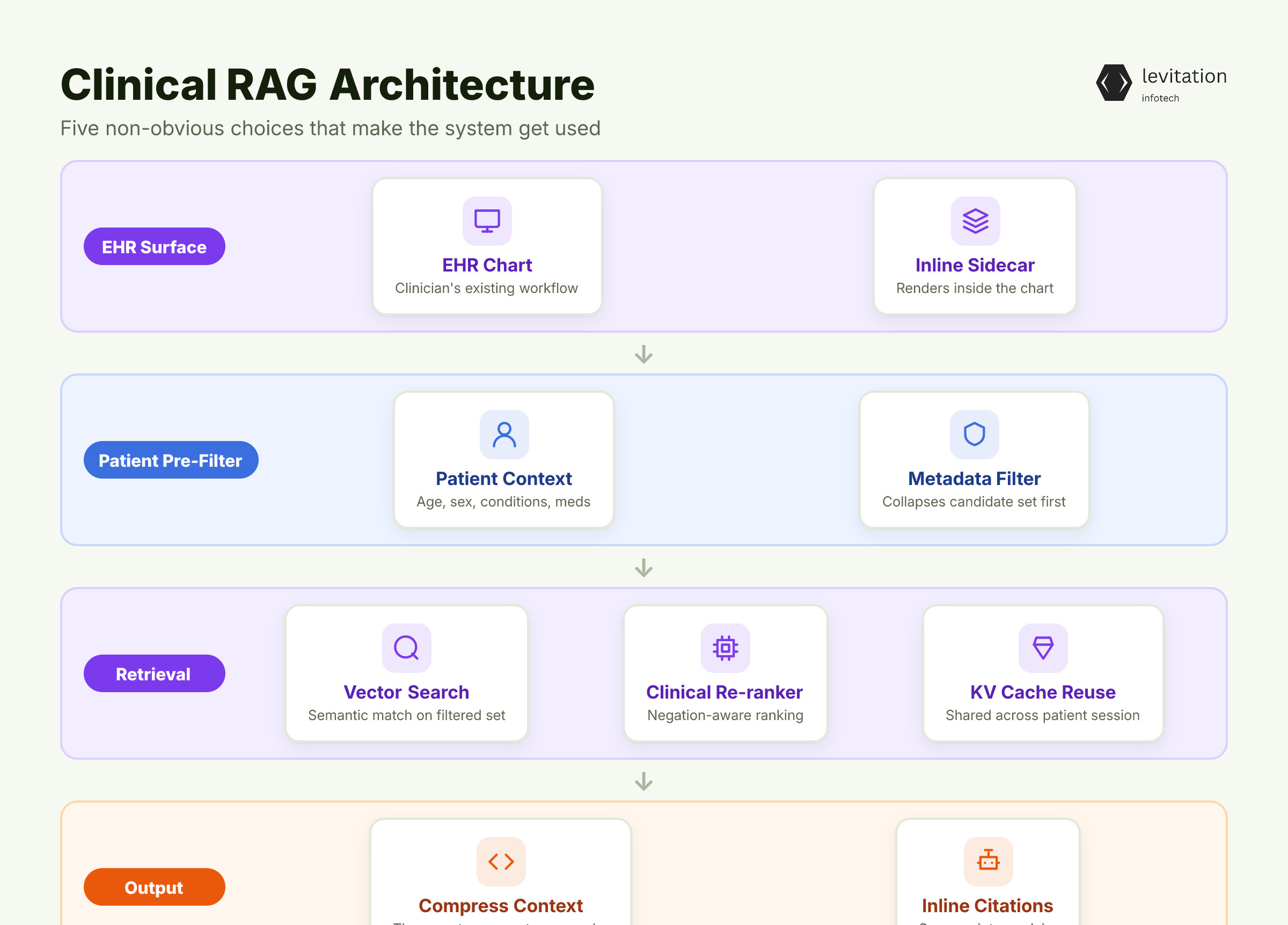
Provenance without context-switching means citations live inside the chart, not behind a separate click. Brevity means three sentences, not three paragraphs. Zero context-switching means the clinician never leaves the EHR surface to consult the system.
The architecture that delivers this has five non-obvious choices: - Embed retrieval inside the EHR surface, not as a separate portal. The clinician is already in the chart. The RAG panel renders as a sidecar or an inline expansion. No new tab, no new login, no new context to load. - Show source citations inline, not in a footer. The pattern: every claim links to the guideline paragraph it came from, rendered as a superscript number next to the sentence it supports. One click, one paragraph, one source. - Pre-filter by patient context before semantic search runs. Age, sex, conditions, medications, and allergies collapse the candidate set before the embedding model sees it. This is faster, more accurate, and clinically safer. - Reuse the KV cache across a single patient session. The same patient context is the prefix for every query during a shift. Caching the KV state cuts time-to-first-token in half without retraining anything. - Compress retrieved context aggressively. The 15% accuracy gain and 20% time reduction cited in the research only hold when the system returns three sentences, not three paragraphs. Anything longer is read by no one.
Here is what a retrieval pipeline tuned for clinical use looks like in practice:
1# Pre-filter by patient context before semantic search runs2def retrieve_clinical_context(query, patient_context):3 # Build metadata filter from patient context4 pre_filter = build_metadata_filter(patient_context)56 # First pass: structured pre-filter (fast, exact match)7 candidates = vector_store.query(8 query_embedding=embed(query),9 filter=pre_filter,10 top_k=2011 )1213 # Second pass: re-rank with clinical negation awareness14 reranked = clinical_reranker.rank(15 query=query,16 documents=candidates,17 patient_context=patient_context18 )1920 # Compress to 3 sentences max21 return compress(reranked[:5], max_sentences=3)
Time-to-first-token is the difference between a tool and a toy. A near-instant first token is invisible. A long delay during a clinic visit is an eternity. Optimize the inference path before you optimize the prompt.
This is the architecture that works. It is also the architecture that takes most in-house teams many months to build. By that point, clinical priorities have shifted. The longer the build, the lower the usage.
The architecture looks clean on paper. Building it without burning internal engineering capacity is the harder problem.
Measuring Clinical RAG ROI That Survives a CFO Review
Three metrics matter. Everything else is a vanity dashboard. - Diagnostic accuracy delta, measured against pre-deployment baseline on the same clinical task set. - Diagnosis time delta, measured from "clinician opens chart" to "clinician closes chart with documented plan." - 30-day patient outcome delta, measured against the same population before deployment.
Run the same benchmark suite on every model upgrade. SQuAD for extractive precision. Natural Questions for real-world clinical phrasing. MS MARCO derivatives for passage-level relevance.
None of these replace clinician validation, but they catch accuracy regressions before clinicians do. A silent regression in extractive precision shipped to production becomes a clinical risk hiding inside a model upgrade.
Track adoption as a leading indicator. Queries per clinician per shift, not total logins. Logins are free. Queries are decisions.
A clinician who types ten queries per shift is using the system. A clinician who logs in once and closes the tab is not. The gap between these two numbers is the gap between your pilot result and your actual result.
Tie the deployment timeline to a hard cap. A system that ships quickly gets iterated. A system that drags gets shelved. The clinical workflow you targeted at kickoff is not the workflow you ship into. Priorities shift, champions leave, and the pilot rots.
This is why CFOs at hospitals evaluating healthcare technology investments anchor the ROI conversation on three numbers. The same goes for top AI companies for healthcare in India that serve them. Accuracy delta. Time delta. Outcome delta.
Metrics tell you whether the system works. Adoption comes from a different mechanism entirely: the people who champion it.
The Implementation Playbook: From Pilot Graveyard to Long-Term Production
Start with a web UI and a small clinician panel. Internal accuracy tests cannot substitute for clinician feedback. A clinician saying "I would not act on this" is a signal no benchmark can generate.
This validation pattern is the only one that works at scale. Start with real users. Iterate fast. Ship something doctors will actually open.
Identify clinical champions. Not the CTO's friend. Not the most senior doctor. The respected practitioner who understands both the technology and the workflow.
Peer-to-peer trust transfers faster than vendor training ever will. One champion who uses the system in front of colleagues does more for adoption than a hundred vendor demos.
Treat the system as a long-lived asset, not a pilot. Production deployments require architecture choices around embedding refresh, model versioning, and clinical guideline drift that pilot thinking ignores.
A guideline published in 2024 is not the same guideline in 2026. Your retrieval corpus has to refresh. Your embeddings have to rebuild. Your evals have to re-run. If the architecture cannot absorb this, the system decays the moment it ships.
Build the feedback loop into the UI itself. Every response needs a thumbs-up, a flag, and a free-text correction. This is how you close the gap between benchmark accuracy and clinical usefulness.
The corrections are the dataset for the next model upgrade. Without them, you are flying blind. The shorter the build, the more likely the system survives clinical priority shifts. Explore production clinical RAG patterns here.
Frequently Asked Questions
Q: Why do clinicians still prefer Google over a clinical RAG system?
A: Google wins on two dimensions that internal RAG systems usually fail: transparent sourcing and zero workflow friction. Clinicians need to see the source of every recommendation, and they need answers without leaving their existing tools. A clinical RAG that hides citations behind a modal or requires a separate login will lose to a browser tab every time.
Q: What is a realistic ROI for clinical RAG systems?
A: Optimized clinical RAG deployments have shown a 15% improvement in diagnostic accuracy and a 20% reduction in diagnosis time on benchmark tasks. The harder ROI to capture is clinician time saved per shift, which typically shows up only after stable production use, not during the pilot phase.
Q: How long does it take to deploy a clinical RAG system in a hospital?
A: The deployment timeline depends heavily on the team's prior clinical AI experience. Teams without prior infrastructure take far longer than teams with reusable components and validated patterns, and the extended timeline is itself a major adoption risk because clinical priorities shift during that window.
Q: Which benchmarks should we use to evaluate a clinical RAG system?
A: Start with SQuAD for extractive precision and Natural Questions for real-world clinical question phrasing. Add MS MARCO derivatives for passage-level relevance. None replace clinician validation, but they catch accuracy regressions before clinicians do.
Sources
Research and references cited in this article:
- Retrieval-Augmented Generation Healthcare Guide
- RAG In Healthcare: Improve Medical AI Accuracy
- Retrieval-Augmented Generation in Biomedicine: A Survey of Technologies, Datasets, and Clinical Applications _(academic)_
- Retrieval-Augmented Generation (RAG) in Healthcare
- 7 Ways RAG in AI Models Supports Modern Healthcare
- CDSS Reduces Errors by 30%, How It Works (2026 Guide)
- Benefits of Clinical Decision Support Systems for the Management of Noncommunicable Chronic Diseases: Targeted Literature Review
- The Value of Clinical Decision Support in Healthcare: A Focus on Screening and Early Detection
- Clinical Decision Support - ONC
- How Clinical Decision Support Tools Can Be Used to Support Modern Care Delivery | ACS
- Optimizing RAG Performance: Key Metrics to Track
- A complete guide to RAG evaluation: metrics, testing and best practices
About the author
Mayank Singh is a software developer at Levitation Infotech, where he builds web and AI-powered applications across the company’s fintech, healthcare, and enterprise projects.