


TL;DR: Cloudflare OS moves agent orchestration, permissions, and durable state into the platform layer. This makes separate AI agent workspace vendors redundant for most enterprise builds. CTOs who keep paying for separate agent layers will end up with extra cost. They will also face extra latency. They will also deal with a security model that was wrong from day one. The migration playbook is simple. Cut the middleware. Keep the data and the model layer. Then rebuild on Workers and Durable Objects.
Key Takeaways: - Traditional operating systems treat agents as users. This is architecturally wrong, because agents write and execute code, not just click buttons. - Capability-based security in Cloudflare OS replaces custom permission layers, proxy tool gateways, and external policy engines. All of these turn into one platform primitive. - Durable Objects collapse the entire workspace state problem into a single authoritative container. This removes the noisy-neighbor scaling issues that hit shared agent processes.
Your AI Agent Workspace Stack Is Solving Yesterday's Problem
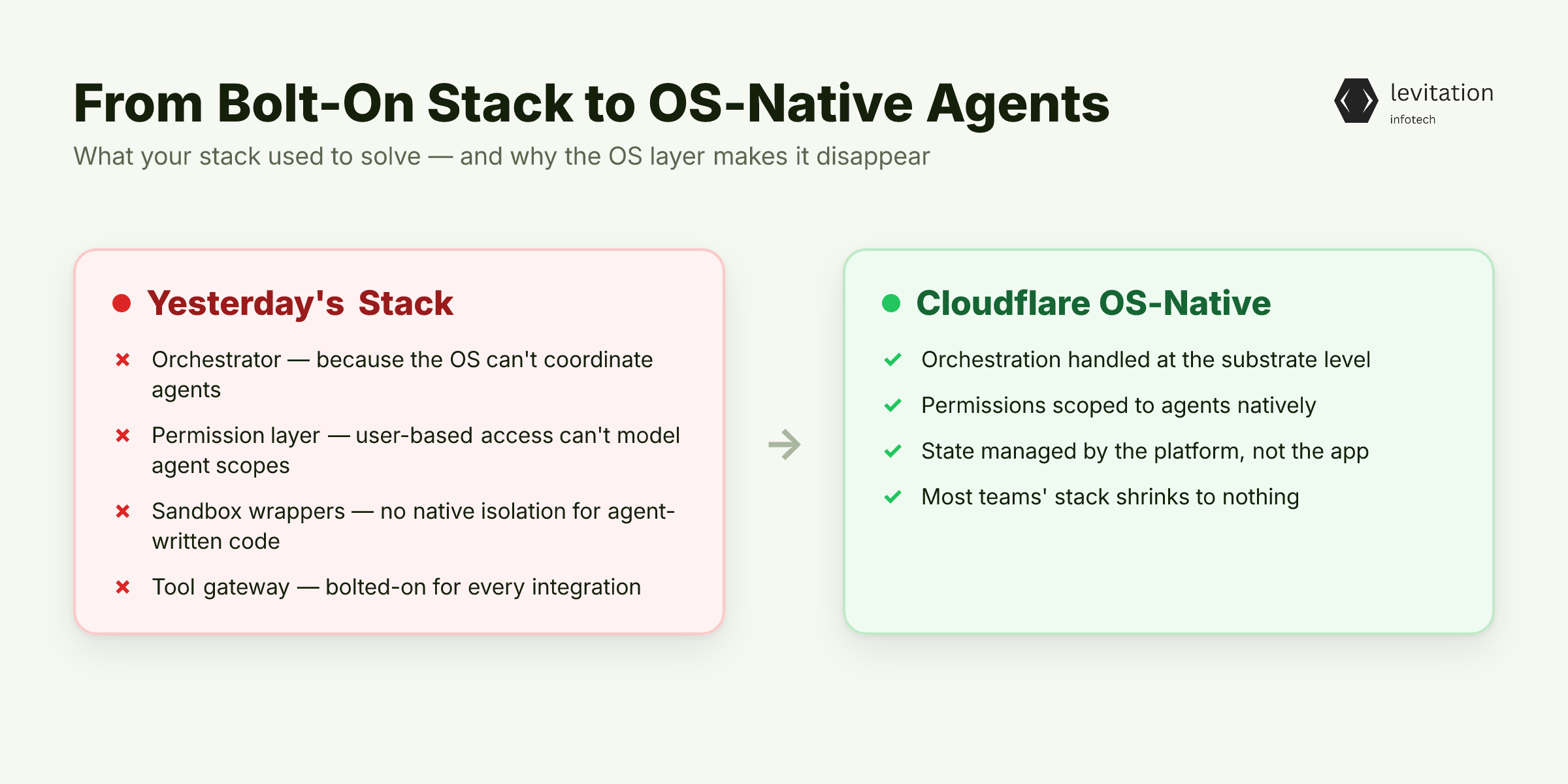
You spent 18 months building it. An orchestrator here, a vector store there, a tool gateway, a permission layer, a sandbox wrapper. Every quarter, another vendor pitched a new piece of the puzzle. Each one solved a real pain point. None of them solved the actual problem.
The actual problem is that your operating system does not understand agents.
Every layer in your AI agent workspace stack is a workaround for a missing OS primitive. Your orchestrator exists because the OS cannot coordinate agents natively. Your permission layer exists because user-based access control cannot model scoped agent capabilities. Your sandbox wrappers exist because the OS cannot isolate code an agent writes on the fly.
Cloudflare OS treats agents as a first-class OS concern, not an application-layer bolt-on. The platform handles orchestration, permissions, and state at the substrate level. That changes what your stack needs to do. For most teams, it changes it to nothing.
If the OS layer already handles agents natively, what exactly have we been building? Why does it stop mattering?
Why Bolting Agents Onto Traditional Operating Systems Fails
Traditional operating systems were designed for humans who click buttons. They were also designed for programs that follow scripts. Agents do not fit either model.
They write code and execute it in the same breath. The user permission model breaks the moment an agent runs.
Consider the typical workaround chain. A custom auth layer sits in front of every tool call. A proxy gateway inspects each request. A sandbox wrapper isolates execution. A policy engine checks context before each action. Each layer adds round-trips. Each round-trip is a place to fail.
The deeper problem is conceptual. The OS treats the agent as a user. The agent then inherits blanket permissions the human owns.
That worked for human employees using browsers. It fails for agents that compose new workflows in real time. These agents also query APIs on the fly. They write code nobody has reviewed.
The fix is not a better workaround. It is a different security model entirely. For production AI systems running at scale, this distinction matters. It separates a defensible architecture from a compliance incident waiting to happen.
So what does a security model built for agents actually look like under the hood?
Capability-Based Security: The Primitive Traditional OSes Never Built
Cloudflare OS introduces capability-based security as the native model for agent permissions. Each agent holds scoped capabilities, not blanket user permissions.
If an agent can read a document, it holds a capability token for that document. If it can call an API, the capability names that API and the actions allowed.
The blast radius becomes explicit by construction. An agent cannot exceed its capabilities because the platform will not let it. There is no privileged escalation path because there is no user-level privilege to inherit.
The agent is structurally bound to a human for accountability. The platform enforces that binding at the substrate level.
This removes the need for external policy engines and custom RBAC layers. It also removes most of the agent governance tools your team has been stitching together.
Your security team stops chasing shadow policies across multiple middleware vendors. The audit trail is built into every capability grant.
The primitive draws on infrastructure with a production track record in regulated environments. The longevity floor is operational history, not a marketing claim.
Most "agent security" products launched recently run on new primitives. These primitives have not yet built that kind of compliance track record. The substrate underneath Cloudflare OS has it. The AI implementation patterns built on it inherit that durability.
Security is the visible win. The invisible win is the one that actually kills your workspace stack. It is what happens to your application layer. So what does that look like in practice?
Every App Gets an Agent-Friendly API for Free
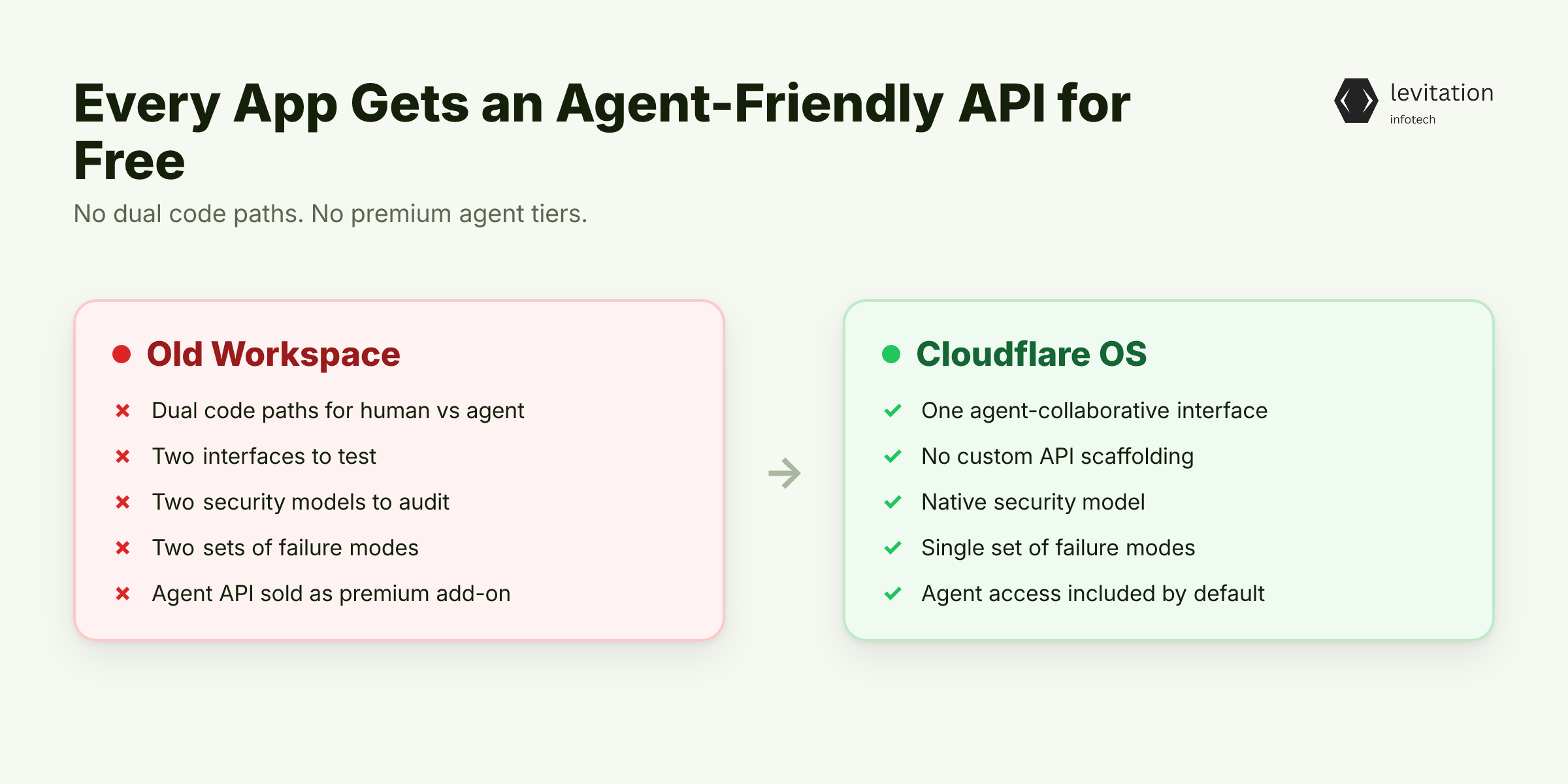
Every app built on Cloudflare OS automatically exposes an agent-collaborative interface. No custom API scaffolding is needed. No separate agent endpoints are needed. No dual code paths for human versus agent access are needed.
This collapses a distinction your team has been maintaining for two years. The distinction is between building an app and building an agent-accessible app. That distinction costs you.
It means two interfaces to test. It means two security models to audit. It also means two sets of failure modes to monitor. Cloudflare OS removes the dual code path entirely.
Workspace vendors charging for agent API layers are now solving a problem. That problem does not exist on this platform. The AI platform treats agent collaboration as a default, not a premium feature. That pricing inversion alone should get your procurement team's attention.
If the API layer is free and the security model is native, the remaining question is about state. How does the runtime actually hold state? Because that is where most workspace architectures fall apart.
Durable Objects as Workspace Authority: Why Architecture Simplifies
Each workspace maps to a single Durable Object running the Agents SDK. One authoritative state container per workspace. That object owns the conversation, the tasks, the schedules, the consent decisions, and the event queue.
It coordinates model calls, tool invocations, file operations, and execution. There is no shared agent process to fight over.
This solves the noisy-neighbor problem at the architecture level. Workspace A and Workspace B do not compete for the same isolate. They scale on their own. They fail on their own. They also persist on their own.
When a Worker isolate restarts or a browser disconnects, work continues. State survives.
The contrast with shared agent processes is stark. A single orchestrator handling many workspaces means shared resources. Every workspace competes for the same event loop and memory ceiling.
They all share the same blast radius. The Durable Object model inverts this. The architecture is clean. The generative AI patterns that run on it inherit that cleanliness.
This is also where the deployment economics shift. Building on Cloudflare's reference architecture compresses the path to production compared to building the same infrastructure in-house.
That gap does not close with more headcount. It closes with fewer abstractions.
The architecture is clean. But the real CTO question is: what do I actually do with this on Monday morning?
The CTO Migration Playbook: What to Cut, What to Keep
Here is the cut list. Standalone agent orchestrators that exist to coordinate Workers, the OS should coordinate. Custom permission layers that model capabilities the platform already models. Separate agent API gateways that proxy calls the platform can route directly. Vector store middlewares whose only job is bridging agents to apps.
Here is the keep list. Your model provider relationships. Your domain-specific data stores, the ones holding your actual business context. Your evaluation and observability tooling, because the platform does not replace those. Your identity provider, because agent accountability still routes through your existing IAM.
Here is what you rebuild on. Cloudflare Workers for compute. Durable Objects for workspace state. AI Gateway for model routing.
MCP server portals handle tool access. The enterprise AI solutions stack becomes platform primitives you compose, not middleware you glue together.
Migrate one step at a time. One workspace, one team, one workflow. Prove the pattern on a contained surface before you bet the enterprise on it.
If your previous architecture was heavy on proprietary middleware, expect the consolidation to feel unsettling at first. That discomfort is a sign the abstraction count is dropping.
The technical cut is clear. The harder question is what this consolidation actually buys you. It also asks whether the speed advantage holds at enterprise scale.
The Compounding Advantage: Why Consolidation Wins Long-Term
Fewer moving parts means fewer failure modes, fewer security audits, and fewer integration contracts to maintain. Each layer you remove is a vendor call you stop making. It is a renewal you stop negotiating. It is a CVE you stop tracking. The compounding effect is quiet, and it is real.
A native agent OS outlasts any application-layer workspace. The maturity floor applies to the substrate, not the features on top of it. Workspace vendors ship features, then rewrite them, then deprecate them.
Substrate platforms persist. The teams that consolidate early will outpace competitors still stitching together agent middleware.
Every quarter, the consolidated team ships features while the stitched team maintains integrations. The gap widens.
The foundation model decisions you made last year start to look like the easy part. The platform handled everything around them. The real question is what you ship now that the integration tax is gone.
Frequently Asked Questions
What is Cloudflare OS and how is it different from a traditional OS?
Cloudflare OS is an agent workspace built on Cloudflare Workers. It treats AI agents as a native OS concern, not an application-layer integration. It introduces capability-based security, automatic agent-friendly APIs for every app, and Durable Objects as workspace state authorities. These are primitives traditional operating systems simply do not have.
Does Cloudflare OS eliminate the need for a separate AI agent workspace?
For most enterprise use cases, yes. The capability-based security model replaces core functions of standalone agent workspace platforms. So do automatic agent APIs and durable per-workspace state containers. You still need domain-specific tools, data stores, and model providers. The orchestration and governance layer that workspace vendors sell is now native to the platform.
Is Cloudflare OS production-ready for enterprise AI deployments?
Cloudflare's enterprise reference architecture documents a full production deployment pattern. It uses Workers, Durable Objects, AI Gateway, and MCP server portals. The underlying primitives have a compliance track record across regulated environments. The agent-specific layer follows the same deployment patterns already proven in regulated-industry deployments.
How does Cloudflare OS handle agent security and accountability?
Agents are bound to a human user for accountability. They hold their own scoped capabilities rather than inheriting blanket user permissions. This capability-based model means an agent can only act within explicitly granted boundaries. Every action traces back to both the agent identity and the responsible human. The platform enforces this directly, not through external policy layers.
How long does it take to migrate an AI agent workspace to Cloudflare OS?
Migrations using Cloudflare's reference architecture follow documented patterns that remove design ambiguity. Timelines are shorter than building the same infrastructure in-house. Timelines compress further when starting from a minimal agent stack. They slow down when you start with a heavily customized stack full of proprietary middleware.
Worth a look if your stack still feels heavier than it should.
About the author
Mayank Singh is a software developer at Levitation Infotech, where he builds web and AI-powered applications across the company’s fintech, healthcare, and enterprise projects.