


TL;DR: Enterprise AI succeeds or fails based on how deeply it plugs into systems of record, everyday task tools, and decision workflows. A better model won't fix a broken integration architecture. CTOs who reverse the sequencing avoid the pattern. They start with workflow mapping and governance, before model selection. Pilots reach production and budgets produce returns.
Key Takeaways: - Model selection is one of several decisions; integration architecture is the part that determines whether enterprise AI produces ROI. - Pilots built as browser-based tools fail at production because they guess at permissions instead of inheriting them from existing systems. - Reverse the sequence: map the workflow first, identify the systems of record, build governance, then pick a model.
The Model Evaluation Trap That's Burning Your Budget
Your team ran a long evaluation cycle on foundation models. They picked the best one. The system is stuck in pilot, the CFO wants answers, and the model is the least of your problems.
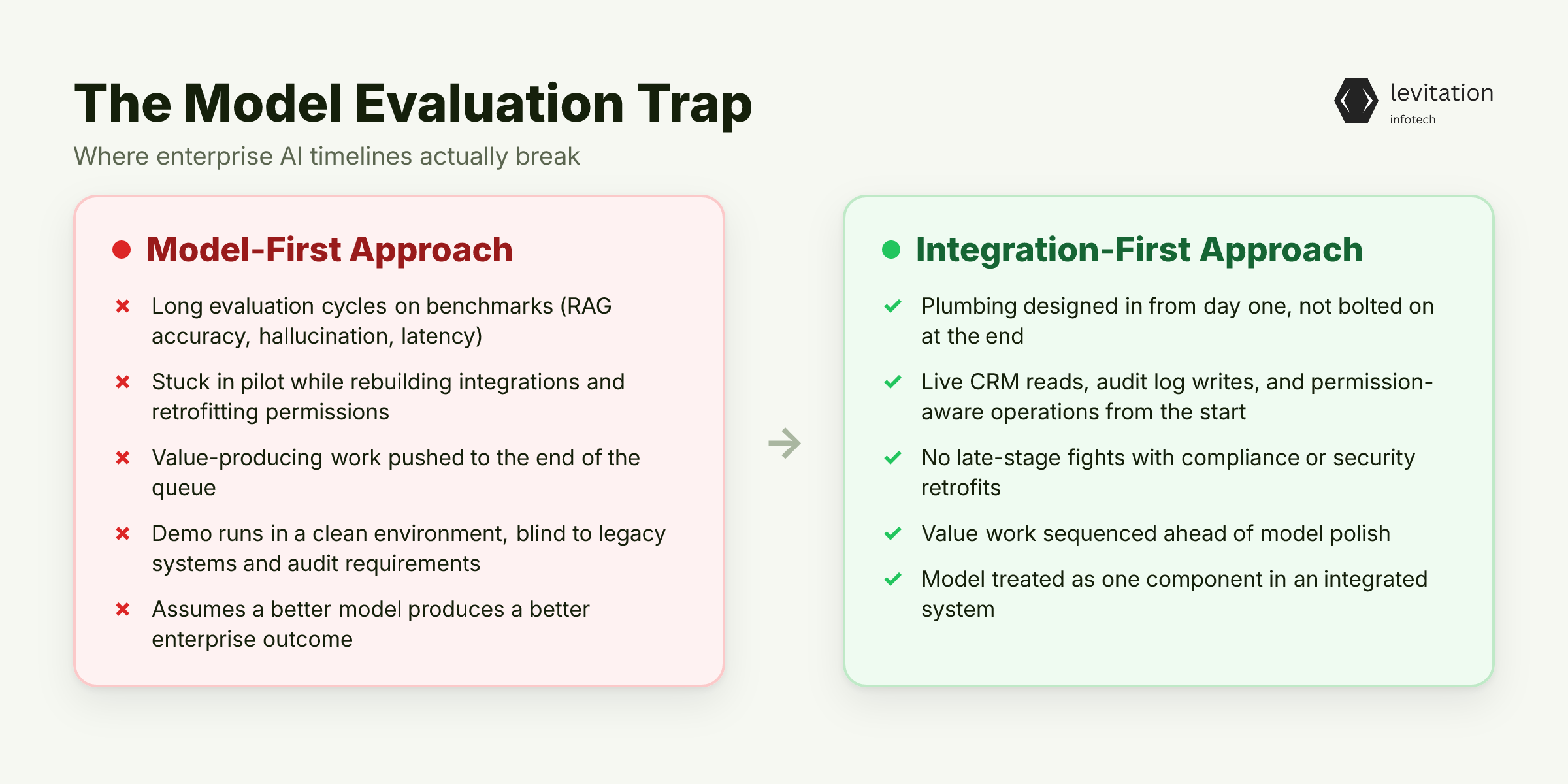
Most CTO evaluation cycles start and end with model benchmarks. RAG accuracy scores, hallucination rates, latency numbers. These measure the wrong variable for enterprise outcomes.
A model can score well on benchmarks. It can still produce no business value. Without live CRM reads, audit log writes, or permission-aware operations, value stays at zero. The benchmark measures the model. The enterprise measures the system.
The in-house timeline tells the story. Teams that start with model selection spend most of their timeline rebuilding integrations, retrofitting permissions, and arguing with compliance. The work that produces value gets pushed down the queue.
Teams that scope around integration first avoid that pattern. The plumbing is designed in from day one, not bolted on at the end. The gap isn't engineering difficulty. It's sequencing.
The pilot-to-production gap is structural, not technical. Treating the model as the deliverable, rather than as one component in an integrated system, is what causes it. The demo runs in a clean environment.
The production environment is full of legacy systems, role-based access, and audit requirements that the model never had to face. Enterprise AI implementation work is mostly plumbing, and most teams start by polishing the faucet.
But the model isn't even where the real failure starts. The deeper problem is the assumption that a better model produces a better enterprise outcome.
Why Browser-Based AI Tools Break at Enterprise Scale
The public AI narrative is shaped by consumer-facing tools, browser-based products built for individual productivity on a single screen. Enterprise environments operate under fundamentally different constraints.
Value in the enterprise doesn't come from switching between models. It comes from embedding AI inside systems people already use for their jobs.
Standalone tools create an interface layer instead of embedded intelligence. Users copy data in, paste results out, and the AI guesses at permissions rather than inheriting them. It reads stale exports rather than live data. It triggers shadow processes outside the system of record.
None of this is visible during a demo. The demo is the cleanest possible environment: a single user, a test dataset, no audit trail.
This is why pilots demo well and fail in production. The pilot runs in a sandbox. Production runs against enterprise AI systems that include identity layers, change data captures, and approval chains. The browser tool can't reach any of that, so it makes its own versions. Those versions drift, and drift kills trust.
So if standalone tools are the problem, what does enterprise-ready AI actually look like in practice?
The Three Layers of Integration That Actually Determine ROI
Most teams that claim "integrated AI" only cover the first layer. Real ROI compounds when all three are wired in, which is what separates a production AI system from a chatbot with API keys. - Layer 1: Systems of record. AI must connect to your CRM, ERP, data warehouse, and core databases. The point isn't just to read. The AI must inherit permissions, see live state, and write back without manual intervention. A sales assistant that can summarize a deal but can't update the deal stage is a toy. - Layer 2: Everyday task tools. AI has to live inside the tools employees already open every day: ticketing systems, document workflows, communication platforms, internal portals. It should update entries, trigger actions, and log events inside those systems, not next to them. When AI lives in a separate tab, it loses context every time the user switches windows. - Layer 3: Decision-making processes. AI must plug into approval flows, compliance checks, and analytical decision points. Recommendations need to be auditable, reproducible, and traceable back to the source data that produced them. If your auditor can't answer "why did the system approve this?", the AI isn't integrated, it's a black box with a UI.
The gap between Layer 1 and Layers 2-3 is where most enterprise AI projects stall. Layer 1 can be wired in first because the data lives in known systems with defined schemas and known owners.
Layers 2 and 3 require a redesign of how the organization uses its own data. That's the redesign that scares teams and gets skipped.
There's a second dimension to integration that most technical teams underestimate until it surfaces in production: the trust layer.
Trust Is an Integration Problem Before It's a Model Problem
Enterprise trust isn't abstract. It answers three operational questions. Where did this answer come from? Does it reflect the current state of our data? Can we control who sees it and when?
None of these questions are answered by a smarter model. They're answered by a system that has read access to source data, write access to audit logs, and role-based access to outputs. That architecture is the AI governance layer, and it has almost nothing to do with the model itself.
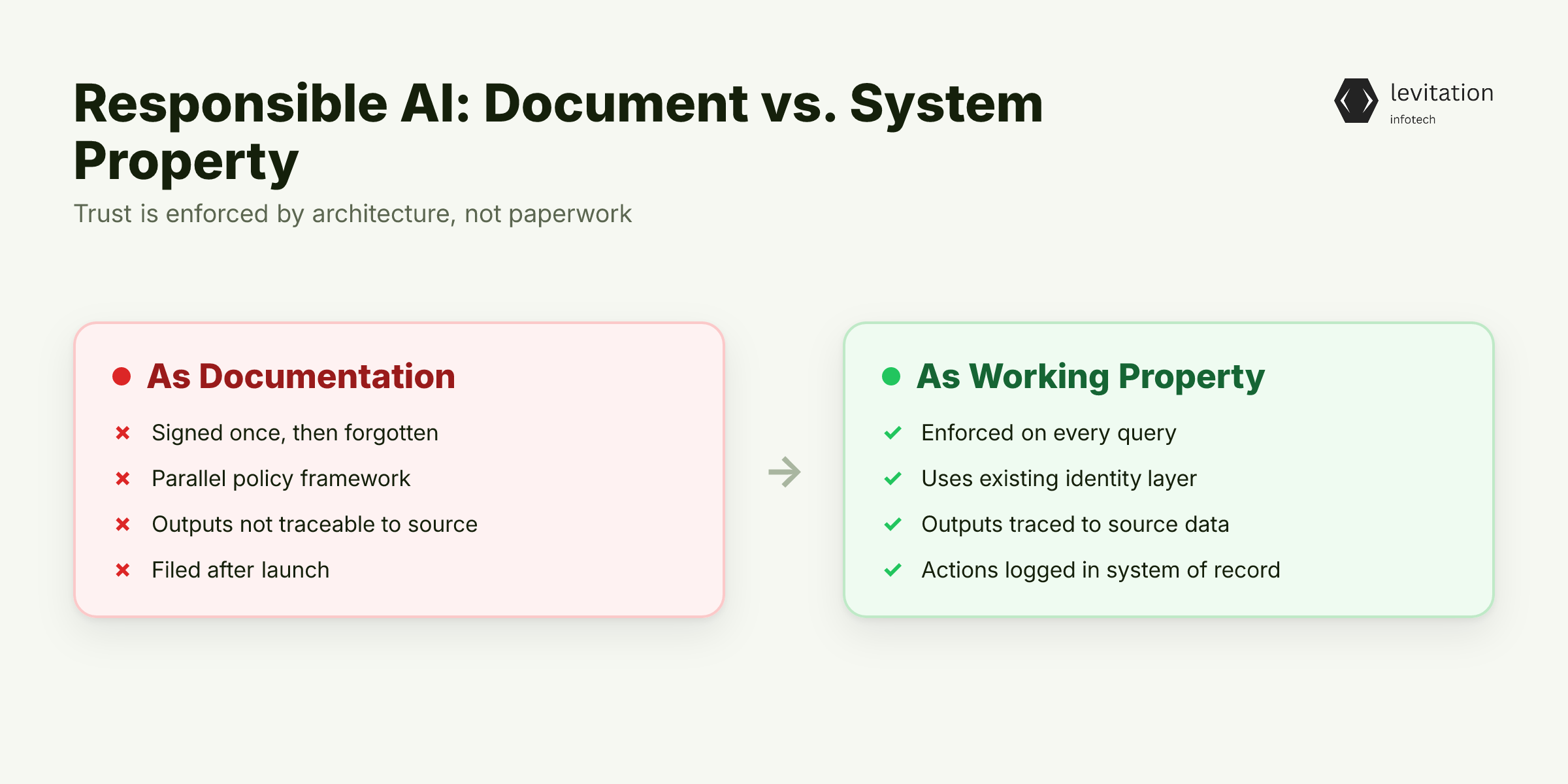
In an integrated system, governance is enforced by the existing identity and access layer. Not a parallel policy framework. Every output is traceable to source data. Every action is logged in the system of record. Every user sees only what their role permits.
This is what makes responsible AI a working property of the system, not a compliance document filed after launch.
The architecture difference is the point. Responsible AI as documentation is what you write when the system is done. Responsible AI as a working property is what the system is. The first is signed once and forgotten. The second is enforced every time a query runs.
Understanding the trust gap is necessary. The harder question is how to close it without committing to a multi-year platform rebuild.
An Integration-First Implementation Strategy
The fix is to reverse the sequencing. Most teams pick a model first, then try to build the integration around it. That order creates the long, painful timeline. The integration-first order looks like this: - Map the highest-value decisions. Not use cases, decisions. Where does someone in your organization make a judgment call that determines revenue, risk, or compliance? Start there. - Identify the systems of record those decisions depend on. What data does the decision-maker need? Where does it live? Who owns it? - Evaluate the model against integration constraints. Now model selection becomes a narrower decision. You need a model that can read your systems, log its actions, and respect your permission model. Most can. - Build the responsible AI framework before the first model call. Every output traceable. Every action logged. Every user authorized by the existing identity layer. If governance is the first thing you build, it costs a fraction of what it costs to retrofit later. - Deploy in slices. Pick one workflow. Integrate end-to-end across all three layers. Ship to a small user group. Expand. This is how enterprise AI implementation reaches go-live without stretching indefinitely, because each slice proves the architecture before the next one is built on top of it.
This sequencing reflects how the systems that actually survive production are built. Late-stage retrofit costs more than upfront architecture. The cost gap grows with every system the AI has to touch.
The architecture is half the answer. The other half is what actually changes inside the business once the system goes live.
What Changes When Integration Is Done Right
AI stops being a tool people use and becomes the way work gets done. The system of record, the workflow, and the decision log collapse onto the same surface. The user doesn't switch tabs to "use AI" because the AI is already inside the tab they were going to open.
Trust becomes a property of the system, not a policy document. Every action is traceable to source data. Every recommendation is reproducible. Every output is governed by permissions that already exist.
The enterprise AI platform you build doesn't need a separate "responsible AI" module. Responsible behavior is the default state, not a feature toggle.
These outcomes don't come from model selection. They come from the integration discipline that gets baked in on day one.
A few questions come up consistently from CTOs running enterprise AI integration projects, and the answers tend to reshape the implementation plan.
Frequently Asked Questions
How long does enterprise AI integration actually take?
For an integration-first project scoped to one high-value workflow, production go-live depends on the systems involved and your governance requirements. The long timelines most CTOs associate with AI are usually a sequencing problem. Teams start with model selection and try to retrofit integration later, instead of designing the architecture up front.
What is the AI pilot-to-production gap?
It is the gap between a working demo and a system that survives real enterprise conditions. Those conditions include legacy systems of record, role-based permissions, audit requirements, and live data. Most pilots fail at this transition because they are built as standalone tools rather than integrated components of the existing stack. The pattern is consistent: the system passes the demo and fails the production environment because production is where permissions, audit, and identity actually matter.
What's the difference between AI model selection and AI integration?
Model selection is choosing which foundation model to use, which is largely a vendor decision. AI integration is wiring that model into your systems of record, task tools, and decision processes. The model inherits permissions, reads live data, and writes back auditable actions. The first is necessary. The second is what determines whether enterprise AI produces ROI.
How does AI governance work in an integrated enterprise system?
In an integrated system, governance is enforced by the existing identity and access layer rather than a parallel policy framework. Every AI action is logged in the system of record. Every output is traceable to source data. Every user sees only what their role permits. This is what makes AI risk management a working property of the system rather than a post-deployment audit finding.
Which enterprise systems should be integrated with AI first?
Start with the system of record that holds the data feeding your highest-value decisions, usually a CRM, ERP, or core data warehouse. From there, extend into the task tools and decision workflows that depend on that data, in that order. Don't build a broad integration surface and try to fill it with AI capabilities later.
Engineering teams that ship this kind of enterprise AI system reliably share one trait. They treat integration as the product and the model as a component. A focused partner like Levitation builds the same way. That sequencing is the whole game.
About the author
Mayank Singh is a software developer at Levitation Infotech, where he builds web and AI-powered applications across the company’s fintech, healthcare, and enterprise projects.