

TL;DR: Running multiple Kubernetes clusters doesn't eliminate the etcd single point of failure; it replicates it. True multi-cluster HA requires redesigning the etcd layer per cluster: external etcd with members spread across failure domains, plus tested backup and restore pipelines. Topology changes buy you time; operational drills buy you recovery.
Key Takeaways: - Stacked etcd across N clusters gives you N copies of the same single point of failure, not N independent failure domains. - External etcd with members distributed across AZs or racks is the minimum viable HA topology for production clusters. - A backup you've never restored is a hypothesis. Quarterly restore drills are the only thing that converts it into a control.
The False Comfort of Multiple Clusters
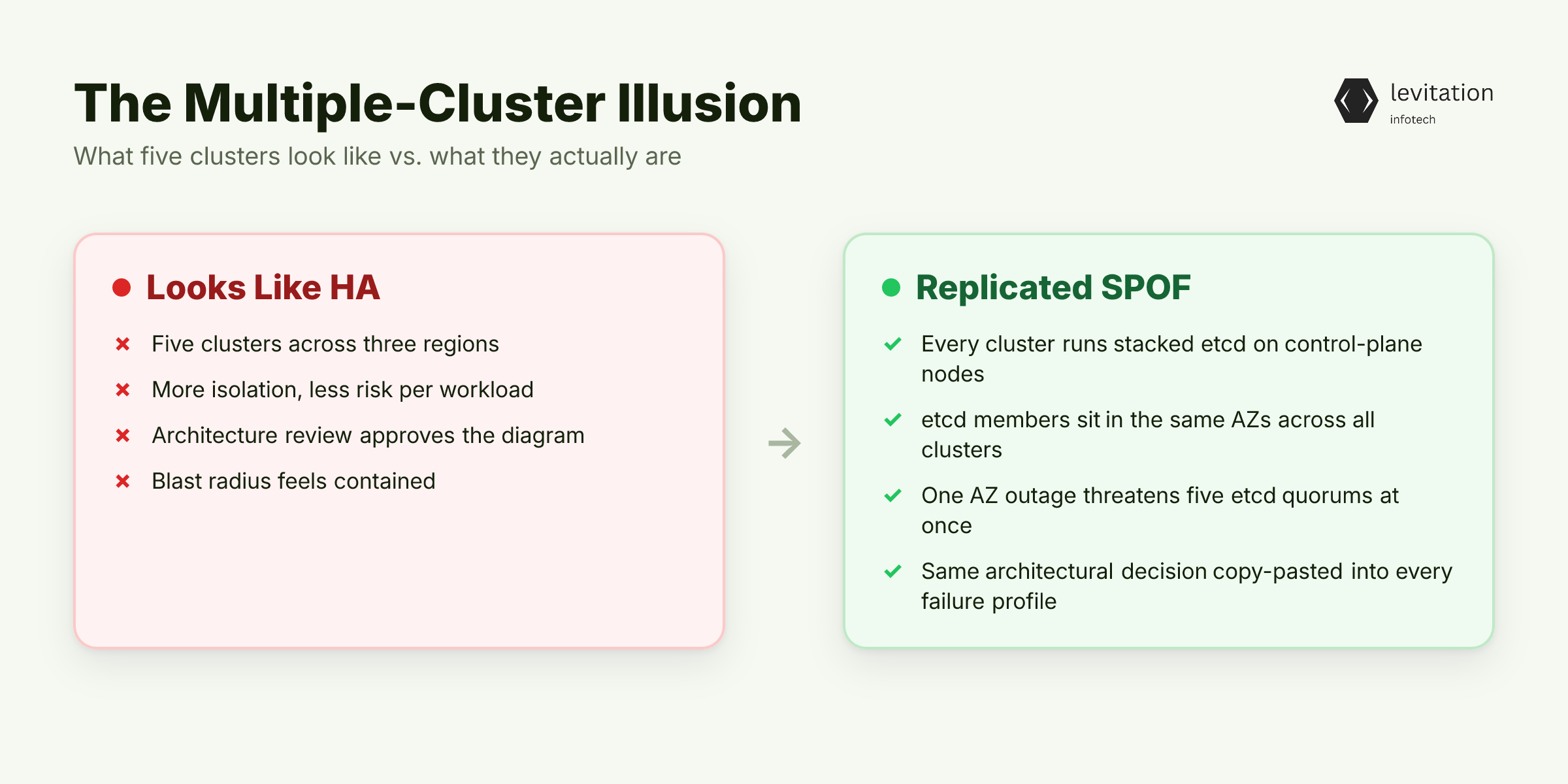
You run five clusters across three regions and call it high availability. But if every one of them runs stacked etcd on the same control plane nodes, you haven't eliminated the single point of failure - you've replicated it five times. This is the trap most platform teams walk into without realizing it.
The mental model is simple: more clusters means more isolation, more isolation means less risk. And in a narrow sense, that holds for application workloads. A bad deploy in cluster A doesn't take down cluster B. A noisy neighbor in cluster A doesn't starve pods in cluster B. The blast radius shrinks at the workload layer.
But the control plane is a different layer. And nobody redesigns it when they add a second or third cluster.
The first cluster gets built using kubeadm with the default stacked etcd topology. The team moves to production, adds two more control plane nodes for HA, and calls it done. When the second cluster spins up a quarter later, someone runs the same `kubeadm init` flow, copies the same Terraform module, and ships it. By the fifth cluster, the topology decision has been made once and copy-pasted everywhere.
The blast radius of an etcd outage is per-cluster. But the root cause is systemic. Every cluster shares the same architectural decision: stacked etcd, same node types, same failure domain placement. A network event that takes out one AZ doesn't just threaten one cluster's etcd quorum. It threatens all five clusters' etcd quorums simultaneously, because the etcd members on every cluster are sitting in the same AZs.
This is the part that the architecture review never catches. The diagram shows five clusters. The diagram looks redundant. The diagram lies. The same cloud infrastructure decisions made once are now baked into every cluster's failure profile.
The problem isn't that teams don't know stacked etcd is risky. It's that stacked etcd keeps winning architecture reviews anyway, and the reasons reveal where the real fragility hides.
Why Stacked etcd Survives Every Architecture Review
Stacked etcd is the default. It's what `kubeadm init` produces. It's what managed Kubernetes services default to unless you specifically request otherwise. It's what every quickstart guide on the internet shows.
So when a team is building their first production cluster and racing to ship, stacked etcd is the path of least resistance. Three control plane nodes, each running `kube-apiserver`, `kube-scheduler`, `kube-controller-manager`, and an etcd member. One Terraform module. One Ansible playbook. One weekend of work.
The trap is that this convenience creates path dependency. By the time the team has shipped the first cluster, the operational tooling is built around stacked etcd. The monitoring dashboards are wired to control plane node metrics, not etcd-specific metrics. The runbook for "control plane node down" assumes the etcd member is on the same node. The disaster recovery procedure assumes you can rebuild from a snapshot stored on the same node as etcd, which is not actually a backup.
Switching to external etcd later means redoing all of that. External etcd topologies decouple etcd members from control plane nodes. The etcd cluster runs on its own dedicated nodes, separate from where `kube-apiserver` lives. A control plane node failure no longer threatens etcd quorum. An etcd upgrade window no longer risks the API server. You can scale the etcd layer independently from the control plane layer.
The tradeoff is operational surface area. Now you have two clusters to manage instead of one, two sets of nodes to patch, two sets of certificates to rotate, two sets of monitoring dashboards to maintain. Most platform teams aren't staffed to absorb that complexity on day one. So they don't.
Treating etcd as a solved layer because three nodes with quorum sounds safe is a form of false zero trust; you've implicitly trusted the topology without examining the failure modes. The "minimum viable HA" calculus, as explored in More Replicas Can Kill Kubernetes HA, treats HA as a checkbox rather than a property of the failure domain topology. The failure modes that actually take etcd down aren't always simple node failures. They're correlated events, the kind that don't show up in your disaster recovery runbooks until after the postmortem.
The Three etcd Failure Modes That Cascade Across Clusters
Most teams plan for the wrong etcd failures. They model "one node dies" and call it good. The actual failure patterns that take multi-cluster setups down come in three flavors, and none of them look like a single node dying cleanly.
Node-level failures in stacked topologies. When a control plane node fails, you don't just lose `kube-apiserver`. You lose the etcd member running on the same node. If it's the leader, etcd must elect a new leader before the cluster can accept writes. If two of three stacked etcd members go down at once, say, a bad kernel upgrade hits two nodes in the same maintenance window, quorum is lost. The cluster stops accepting writes. Worse, failover can't respond because the node is down, and you can't restore quorum without bringing the lost node back. This is the failure pattern that shows up in research on stacked etcd architectures, where etcd and control plane services coexist on the same nodes and amplify each other's outages.
Network partitions. Etcd uses Raft consensus, which requires majority quorum for writes. A network partition that isolates two of three etcd members from the third leaves the third member unable to commit writes because it doesn't have quorum. The cluster becomes read-only or completely unresponsive. This isn't a hypothetical. An AZ-level network split, a misconfigured security group, or a flapping switch can isolate a majority. All nodes are "running" in the sense that they're up and healthy, but the cluster is effectively down. Related reading on this class of failure: Leader Election: The Silent HA Failure covers the same consensus fragility in detail.
State corruption and silent drift. Disk corruption, clock skew, or a botched etcd upgrade can produce a "running but inconsistent" etcd member. It passes health checks. It responds to Raft heartbeats. But its local state has diverged from the rest of the cluster. The failure surfaces only when a leader election forces a comparison, and at that point, you've lost the member and may have lost data. Platform engineering teams often overlook the importance of etcd backup and restore processes, which can minimize downtime in highly available Kubernetes environments, and silent drift is exactly why a tested restore matters more than another dashboard.
These aren't edge cases. They're the patterns that show up in postmortems after multi-cluster outages. Devops teams that survive them have already moved past the "three nodes is enough" thinking. The fix isn't more clusters; it's changing what "redundant" means at the etcd layer.
External etcd and Geographic Distribution: The Real HA Equation
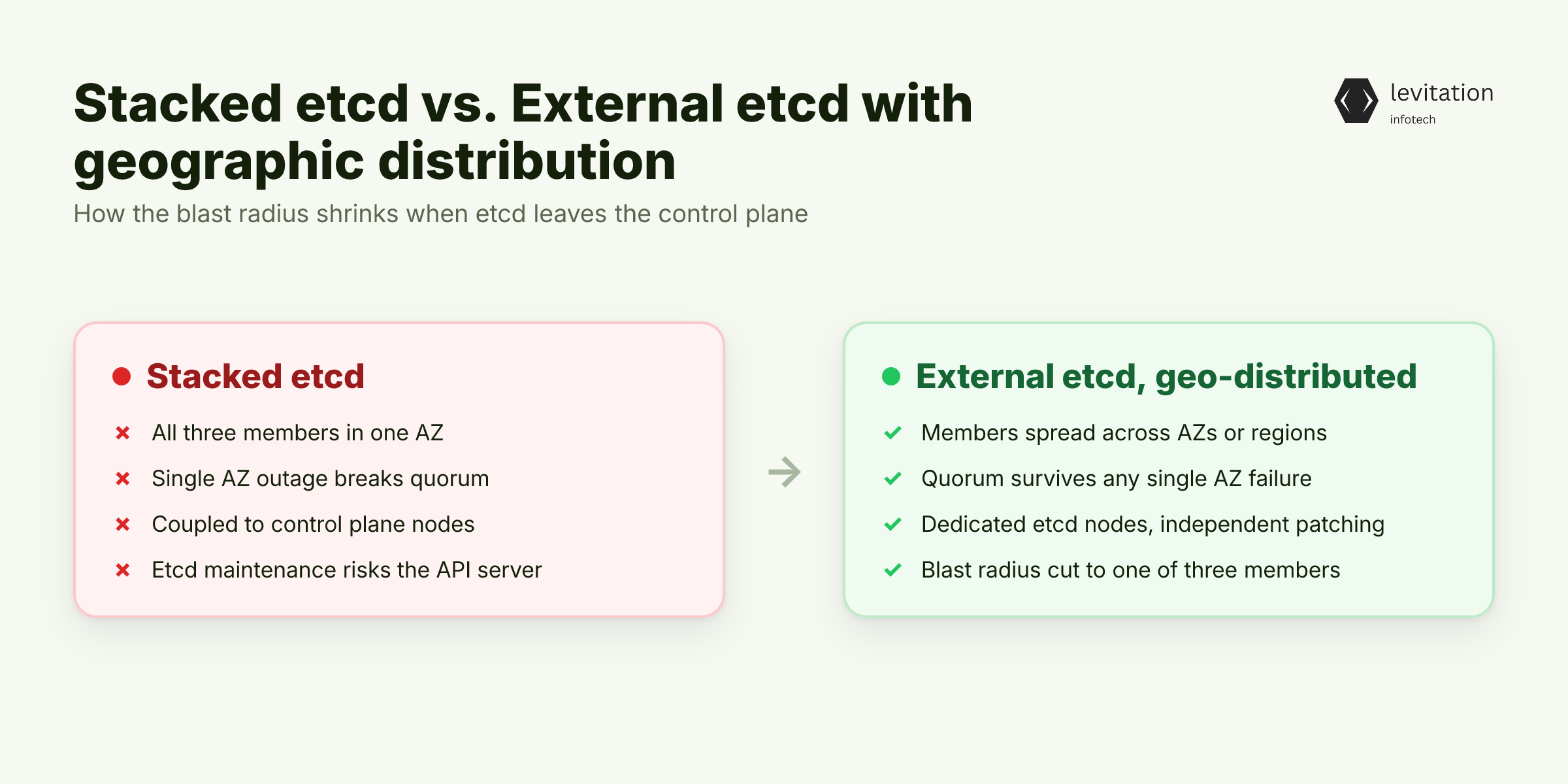
The architectural fix is to separate etcd from the control plane. In an external etcd topology, etcd members run on dedicated nodes. `kube-apiserver` connects to them over the network. A control plane node failure no longer threatens quorum, and an etcd maintenance window no longer risks the API server. This is the minimum viable HA topology for production.
But it's not enough on its own. The next step is geographic distribution of etcd members. In a stacked topology, all three etcd members typically live in the same AZ. External etcd lets you place members in different AZs, different racks, or, for the most critical clusters, different regions. The goal is that no single infrastructure event, whether AZ outage, rack switch failure, or even regional degradation, can isolate a majority of etcd members.
Here's the architecture:
1# Example: kubeadm-config with external etcd, members spread across AZs2apiVersion: kubeadm.k8s.io/v1beta33kind: ClusterConfiguration4etcd:5 external:6 endpoints: - https://etcd-az1.cluster.local:2379 - https://etcd-az2.cluster.local:2379 - https://etcd-az3.cluster.local:23797 caFile: /etc/kubernetes/pki/etcd/ca.crt8 certFile: /etc/kubernetes/pki/apiserver-etcd-client.crt9 keyFile: /etc/kubernetes/pki/apiserver-etcd-client.key
The tradeoff is real. Built-in replication in stacked etcd is easy to operate because the etcd members come for free with the control plane nodes. External etcd with geographic distribution requires dedicated etcd operators (human or otherwise), separate backup pipelines, separate monitoring, separate patching schedules. The operational surface area roughly doubles for that layer alone.
The blast radius shrinks dramatically. A single AZ outage that would have taken down a stacked etcd cluster now takes out one of three etcd members. Quorum holds. The cluster keeps serving. For platform teams running production Kubernetes workloads where regional outages translate directly to customer-facing incidents, this is the difference between a regional outage and an incident ticket.
Architectural change alone isn't enough, though. The teams that recover fastest from etcd incidents all share one operational habit: they treat backup and restore as a tested pipeline, not a documented procedure.
Building an etcd Backup and Restore Pipeline That Actually Works
Backups are not a control until you've restored from one. This is the operational principle that separates teams that survive etcd incidents from teams that get paged at 3 AM and discover their backup is corrupted, empty, or stored on the same node that just died.
The pipeline has four parts.
1. Automated snapshots with etcdctl. Schedule `etcdctl snapshot save` to run on a cron, target every cluster in your fleet, and store the snapshot off-cluster. A snapshot that lives on the same node as etcd is not a backup. It's a copy that will die with the node.
1# Snapshot the etcd database2ETCDCTL_API=3 etcdctl snapshot save /backup/etcd-snapshot-$(date +%F).db \3 --endpoints=https://127.0.0.1:2379 \4 --cacert=/etc/kubernetes/pki/etcd/ca.crt \5 --cert=/etc/kubernetes/pki/etcd/peer.crt \6 --key=/etc/kubernetes/pki/etcd/peer.key7# Verify the snapshot8ETCDCTL_API=3 etcdctl snapshot status /backup/etcd-snapshot-$(date +%F).db
2. Encrypt and store off-cluster. Encrypt the snapshot at rest using a KMS key. Push it to object storage in a different region from the cluster. This protects against both the etcd failure and the region-level disaster that might take the original node down.
3. Pair with Velero for resource-level recovery. Velero backs up Kubernetes resources (Deployments, Services, ConfigMaps) and persistent volumes. It does not replace etcd snapshots for control plane recovery. If you lose etcd, Velero won't help you bring the control plane back. Use both, with clear separation of concerns.
4. Test restore quarterly in an isolated environment. A backup you've never restored is a hypothesis, not a control. Spin up an isolated environment, restore your latest snapshot into a fresh etcd cluster, verify that `kube-apiserver` can read from it, and measure the time it takes. Compare that against your RTO. If the restore takes longer than your RTO allows, you have a problem your dashboard won't show you.
Monitor the metrics that matter. etcd-specific metrics surface degradation before quorum is at risk. Watch leader election frequency (spikes mean instability), fsync duration (jitter means disk pressure), DB size (growth trends toward the 8 GB warning threshold), and WAL fsync latency. More on the observability side: Why Your Observability Stack Is Lying About Kubernetes Health covers related blind spots in cluster monitoring.
With topology redesigned and backups validated, the next question is whether your multi-cluster setup can survive a correlated etcd failure, or whether you need cross-cluster recovery drills to find out.
What Changes When etcd Is Actually Resilient
When the etcd layer is decoupled, distributed, and backed up, the operational character of the platform changes. Control plane outages stop being existential events. An etcd member loss is absorbed by remaining quorum. A control plane node failure no longer cascades into API server downtime because the two layers no longer share a node. The cluster keeps serving while you replace the failed node.
Recovery time drops from "rebuild the cluster" hours to "restore from snapshot" minutes. Platform teams stop treating etcd as untouchable infrastructure; they patch it, upgrade it, and resize it without holding their breath.
This is how you get service mesh and control plane systems still running reliably in production across major version upgrades: by making the control plane boring, not heroic.
Multi-cluster gains real meaning. Clusters become independently recoverable, not identically fragile. You can lose an entire cluster to an etcd incident and bring it back without affecting the others. Your disaster recovery runbook stops being a prayer and starts being a procedure.
This is the architectural work that distinguishes resilient multi-cluster platforms from fragile ones: redesigning the layers that everyone copies from the quickstart but nobody revisits.
Frequently Asked Questions
Q: What happens if etcd fails in a Kubernetes cluster?
A: The API server loses its backing store and stops serving requests. In a stacked topology, this also takes down the control plane components on the same node. The cluster effectively becomes read-only or completely unresponsive until etcd quorum is restored or the cluster is rebuilt from backup.
Q: How do you backup etcd in Kubernetes?
A: Use `etcdctl snapshot save` to create a consistent point-in-time snapshot of the etcd database. Schedule this on a cron, store the snapshot off-cluster and encrypted, and verify the snapshot's integrity with `etcdctl snapshot status`. Velero can complement this for resource-level recovery but does not replace etcd snapshots for control plane restoration.
Q: What is the difference between stacked and external etcd topology?
A: In stacked etcd, etcd members run on the same nodes as kube-apiserver and other control plane components. In external etcd, etcd runs on dedicated separate nodes. Stacked is simpler to deploy; external isolates etcd failures from control plane node failures and allows independent scaling and geographic distribution of the etcd layer.
Q: How many etcd nodes do you need for high availability?
A: Three etcd members is the minimum for HA, providing quorum tolerance for one node failure. For production environments with stricter durability requirements, five members allow tolerance of two simultaneous failures. Members should be distributed across failure domains (different AZs, racks, or network segments) to prevent correlated outages.
Sources
Research and references cited in this article:
- Kubernetes High Availability (HA) Explained | Control Plane, etcd & Production Best Practices
- High Availability Kubernetes Clusters: A Practical Guide
- Bridging the Gap: Hybrid Kubernetes Clusters with Remote Control Planes
- Mastering Kubernetes High Availability: A Comprehensive Guide
- Kubernetes challenge 9: greedy etcd | by Daniele Polencic
- Backup and Restore etcd Deployments on Kubernetes
- From Disaster to Recovery: A Practical Case Study on Kubernetes etcd Backups - DEV Community
- The Ultimate Guide to Disaster Recovery for Your Kubernetes Clusters
- etcd restore, what's the correct process? : r/kubernetes - Reddit
- Learn About Kubernetes Clusters Restore Based on etcd Snapshots
- How to Configure Stacked vs External etcd Topology for HA Control Planes
- etcd & Kubernetes: What You Should Know | Rafay
About the author
Mayank Singh is a software developer at Levitation Infotech, where he builds web and AI-powered applications across the company’s fintech, healthcare, and enterprise projects.