


TL;DR: Event-driven banking architectures consistently deliver impressive demos but buckle under production load. They mix up flexibility with reliability. The same characteristics that make them shine in controlled settings become operational liabilities at scale.
These include async everything, low coupling, and easy fan-out. In production, event ordering collapses. Schema evolution breaks consumers silently. Backpressure hides until it hits a cliff. Exactly-once semantics degrade under partial failure.
Production-grade event-driven banking requires deliberate patterns. These include idempotent consumers, dead letter queues, schema governance, and chaos testing. A strangler-pattern migration earns the right to be the source of truth.
Key Takeaways: - The demo-production gap in event-driven banking is architectural. It starts with misunderstanding what events actually cost at scale. - Real-time responsiveness creates cascade risk. One event fans out to dozens of consumers, multiplying the blast radius of a single bad message. - Five failure mechanisms consistently break event-driven banking in production. They are event ordering, schema drift, invisible backpressure, degraded exactly-once, and ghost consumers. - Production readiness is a pattern stack, not a vendor choice: idempotency, DLQs, schema registry, observability, chaos engineering. - The strangler pattern is the only safe migration path. Start with read-side projections, dual-write to verify correctness, then cut over with proof.
The Demo-Production Gap No One Talks About
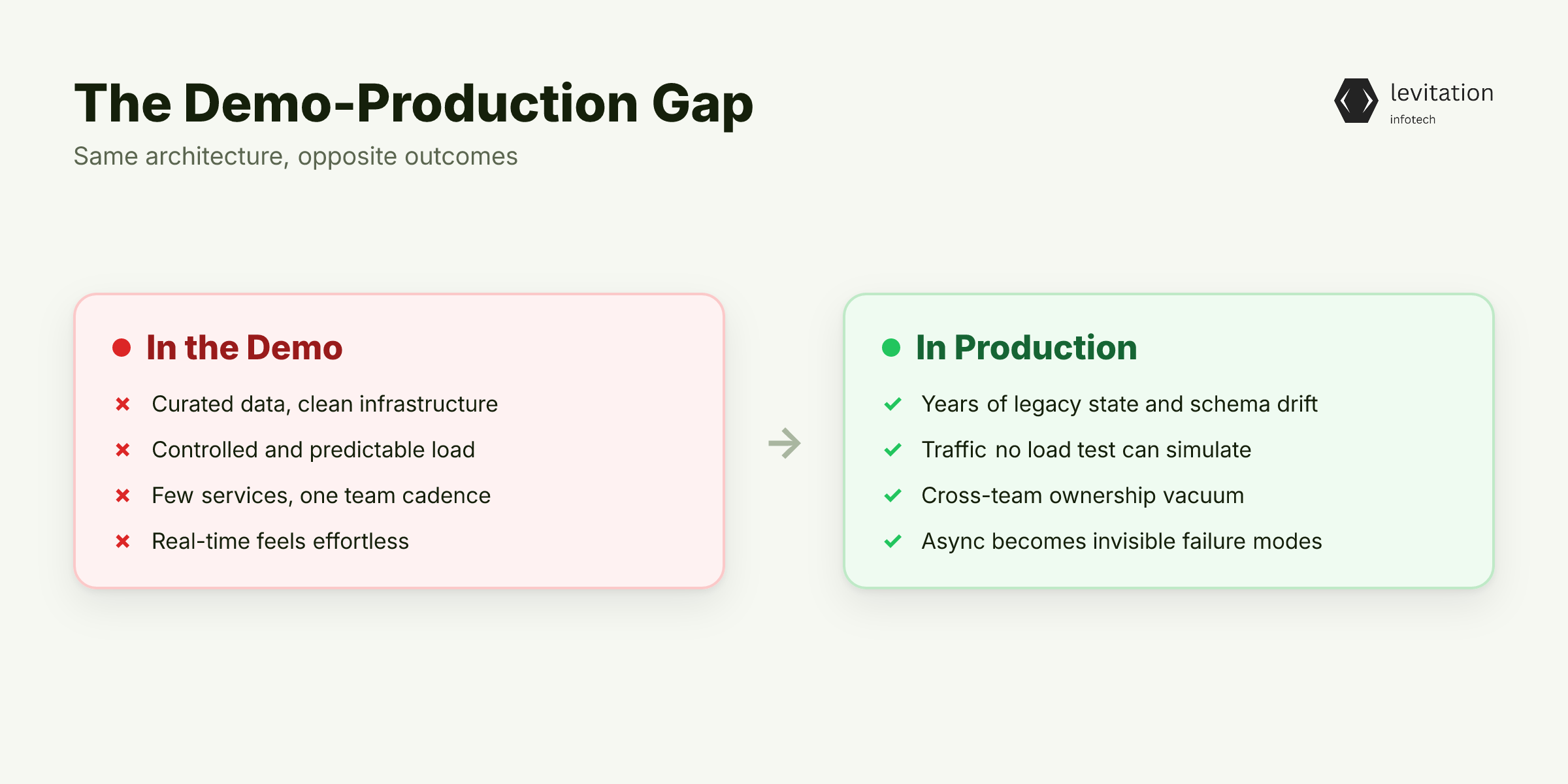
Every bank CTO has watched their Kafka demo wow the boardroom. Then watched the same system buckle under real transaction volume in production. The architecture didn't change. The environment did.
Demos run on curated datasets, controlled load, and clean infrastructure. Production runs on years of legacy state. Schema drift accumulates across teams. Traffic patterns emerge that no load test can simulate.
Event-driven banking demos showcase real-time responsiveness and parallel workflows. Fraud detection fires on a transaction event. Ledgers update in milliseconds. Notifications ping customers within the same second. It looks effortless. And it is effortless, in that environment.
Cloud-native patterns that enable dynamic resource management work beautifully when traffic is predictable. Autoscaling consumers, partition rebalancing, and elastic clusters all behave as designed. Events stay well-formed.
The problem surfaces when the demo meets the real world. The same characteristics that make EDA shine in controlled settings. They become sources of production failure. Flexibility becomes coordination debt. Async everything creates invisible failure modes. Low coupling becomes an ownership vacuum.
A demo might show a small number of services consuming the same event stream gracefully. A production system has consumers at a different scale. Each consumer is owned by a different team. Each team has its own deployment cadence. When one team moves fast, others inherit the cost.
What closes the gap? It starts with understanding what events actually cost when fan-out meets real traffic.
The Paradox: Why Real-Time Responsiveness Becomes a Liability
Real-time responsiveness feels like a pure win. The fraud engine catches a fraudulent transaction before settlement. The customer sees their balance update instantly. The ledger reconciles itself. What's not to like?
The hidden cost surfaces in the math of fan-out. One transaction event triggers many actions. These include a fraud check. They also include a ledger update, a notification, a risk score recalculation, and an analytics write. Each one is a downstream consumer that must process the event.
Scale that across transaction volume, and the math changes. You're not processing one event. You're processing one event times every consumer subscribed to that stream. When one consumer misbehaves, the blast radius multiplies across every dependent service.
Traditional polling systems waste the vast majority of requests confirming nothing changed. Event-driven systems eliminate that polling waste. But they replace it with event-processing overhead. The system still does the work, just differently.
Kafka and stream processing pipelines at scale reveal a second paradox. The flexibility that lets you add new consumers in a demo is great. However, it becomes a coordination nightmare when many services depend on the same event schema.
Real-world fintech deployments show the tradeoff. Ant Group's automated retraining pipelines are a widely-cited example. The pipelines work until model drift and accuracy degradation surface in production. Now every downstream consumer of the model's predictions inherits the drift.
The pattern repeats across fintech production reliability work. What looks like clean decoupling in the architecture diagram. It becomes a dense web of implicit dependencies in production. One team renames a field. Another team's consumer breaks. Nobody finds out until the reconciliation report fails at 3 AM.
So what breaks first when EDA meets real traffic? The catastrophic failures come from mechanisms most architecture diagrams never show.
What Actually Breaks in Production (It's Not What You Think)
Most postmortems focus on the wrong failure modes. "The broker went down" or "the consumer crashed" are surface symptoms. The real production killers in event-driven banking are quieter.
Event ordering collapses at scale. Kafka guarantees ordering within a partition. Partitions rebalance during consumer group changes, deployment rollouts, and broker failures. When a consumer restarts mid-processing, the events it hadn't yet committed get reprocessed. They are reprocessed after newer events from another partition. Financial state becomes inconsistent. A withdrawal event processed after a deposit event creates a phantom balance.
We covered this in detail in our analysis of why more Kafka partitions break Flink exactly-once. The pattern repeats across any stream processing layer that depends on partition-level ordering.
Schema evolution is the silent killer. A producer team renames a field. They deploy. Consumers that haven't updated their deserializers start failing. Or worse: they don't fail, they silently produce wrong results. Exactly-once stream processing cannot save you from this. The guarantee covers delivery, not correctness of interpretation.
Backpressure is invisible until it isn't. Consumer lag accumulates silently. A fraud engine that handles baseline traffic fine starts to struggle as load increases. The tipping point depends on processing capacity, downstream dependencies, and state-store performance. Lag dashboards show linear growth right up until recovery time exceeds the SLA window. At that point, you're hours behind. Manual intervention is the only path back.
Exactly-once degrades under partial failure. Kafka transactions and Flink checkpoints hold under testing. They hold under clean failure scenarios. They degrade under real network partitions, partial broker outages, and consumer group rebalancing during deployments. We've documented this extensively in two areas. First, why Flink's exactly-once still breaks with Kafka transactions. Second, scaling Kafka consumers without breaking Flink state. The theoretical guarantee becomes probabilistic under real conditions.
Ghost consumers accumulate. Services subscribe to events, get deprecated, but the subscription stays active. They consume, process nothing useful, and create phantom load invisible to standard monitoring. Over time, a banking platform accumulates ghost consumers. Each one eats broker throughput and consumer-group rebalancing time.
These five failure mechanisms represent the primary production failure modes in event-driven banking. They're also the ones that pure infrastructure-as-a-service offerings don't solve. So what does a production-grade stack actually look like under the hood?
The Production-Grade Pattern Stack: Beyond the Hello World
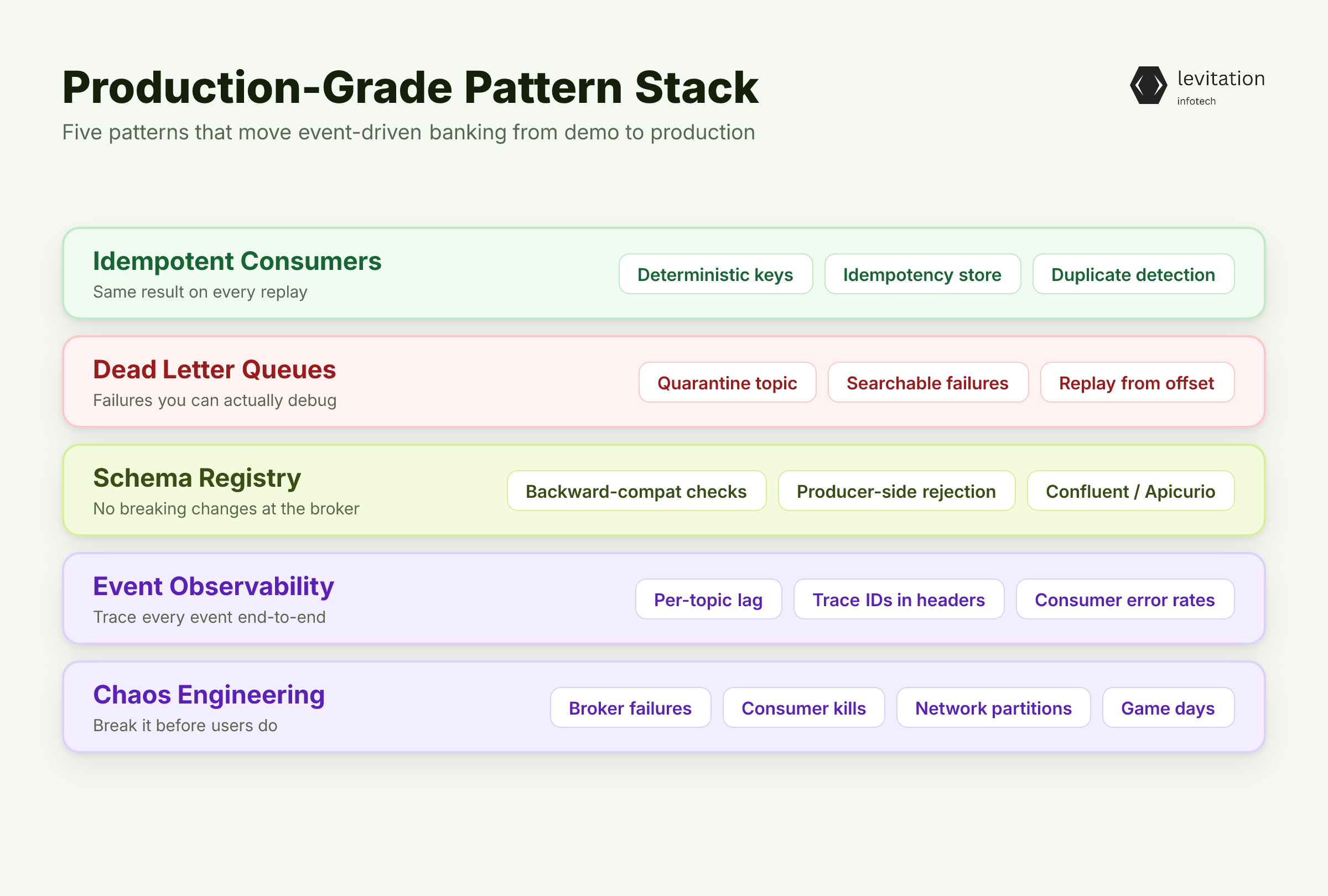
A production-grade event-driven banking stack isn't one technology. It's a stack of patterns. Each pattern addresses a specific failure mode from the previous section.
Idempotent consumers are non-negotiable. Every event handler must produce the same result regardless of reprocessing. The mechanism uses deterministic keys derived from the event payload. It also uses an idempotency store that records processed event IDs. A duplicate event hits the same key, finds a "processed" marker, and skips. This is the only defense against exactly-once degradation.
Dead letter queues with replay capability. When a consumer fails to process an event after N retries. The event goes to a quarantine topic. It does not go into a black hole. The quarantine topic is searchable, inspectable, and replayable. Root-cause analysis happens on the quarantined events. Once the consumer bug is fixed, you replay from a specific offset. This is standard in data pipeline infrastructure at scale. It's the single biggest difference between demo and production behavior.
Schema registry with backward-compatibility enforcement. Tools like Confluent Schema Registry or Apicurio enforce that producers can't publish a schema. Such a schema must not break existing consumers. A producer trying to remove a required field gets rejected at the broker. It does not get rejected at 2 AM in production. This pattern eliminates the silent schema-evolution killer.
Observability must span the event flow. Not just service-level metrics. Event-level metrics matter. They include lag per topic, throughput per consumer group, error rate per consumer per topic. They also include end-to-end tracing from producer to consumer. Distributed tracing must propagate trace IDs through Kafka headers. Without this, you're flying blind. The observability problem in Kafka and Flink patterns gets solved at the event level. It is not solved at the service level.
Chaos engineering for event systems. Inject broker failures. Kill consumers mid-processing. Simulate network partitions. Do this in staging, not in production. Production-grade banking systems run regular game days that exercise the exact failure modes described above. Systems still running in production long-term have one thing in common: they were chaos-tested from day one.
These patterns are the floor, not the ceiling. A production-grade stack includes more. For example: event sourcing for audit, outbox pattern for reliable publishing, change data capture for legacy integration. Also include topic-per-domain-team ownership. The five patterns above are the non-negotiable foundation.
How do you actually deploy them without betting the bank on day one?
From Demo to Production: The Strangler Pattern for Event Systems
The biggest mistake in event-driven banking transformations is the "big bang" cutover. Replace the core ledger with events on day one, flip the switch, and pray. This approach has a near-100% failure rate in regulated banking contexts.
The alternative is the strangler pattern, adapted for event systems.
Start with read-side projections and notification flows. These are failure-recoverable. If the event-driven notification path fails, the customer doesn't get a push notification. However, the transaction still settles correctly. Pick a domain where failure is reversible: customer notifications, read-side analytics views, non-critical risk recalculations. Prove the pattern works before you scale it.
Run a dual-write period. The event-driven path and the legacy path run in parallel. They run long enough to verify correctness through real-world conditions. Every event published to Kafka also writes to the legacy system. You compare outputs. When divergence appears (and it will), you investigate. Only when the event-driven path matches the legacy path's correctness for a full business cycle. Then you cut over. Or when it exceeds it.
Event-first means event-source-of-truth. If your events are just notifications of database changes, you haven't built an event-driven system. CDC patterns that mirror the legacy database also count as notifications. You've built a database with a Kafka tail. Banking software modernization work that succeeds treats events as the primary state representation. The database becomes a query-optimized projection. This philosophical shift makes the difference.
Capacity planning for events is fundamentally different. Don't model request volume. Model fan-out: one event times the number of consumers, times the burst factor. A 10x burst in transaction volume isn't a 10x capacity problem. It's a 10x-burst-times-fan-out-factor problem. Event-driven data infrastructure capacity models that work treat fan-out as the primary scaling dimension.
The strangler pattern isn't slow. With experienced execution, a focused use case (payments, fraud detection, or customer notifications) goes live fast. The full core-banking transformation takes longer. It follows the same pattern: domain by domain, use case by use case, never all at once.
So what does the endgame look like when you get this right?
What Production-Ready Event-Driven Banking Actually Delivers
When the patterns are in place and the migration is done right, the outcomes compound.
Real-time fraud detection that actually fires within the transaction window. Not minutes after settlement. Within the transaction's authorization window. The fraud engine consumes the same event stream as the ledger. It scores the transaction. It returns a decision before authorization completes. This is the difference between catching fraud and documenting it.
Audit trails that are inherently complete. Every state change is an event. The audit log is the event log. There are no reconciliation gaps because there's no separate system of record. This matters in fintech solutions where audit completeness is a compliance requirement, not a nice-to-have.
New product capabilities without touching core systems. BNPL, instant lending, real-time risk scoring. Each new capability is a new event consumer, not a new service in the monolith. The core ledger doesn't change. The deployment risk for a new product drops from "core banking migration" to "deploy a new consumer service."
Operational resilience by default. When one consumer fails, the event backlog processes correctly once it's restored. No manual intervention. No reconciliation script. The system's failure mode is graceful degradation, not data loss.
These outcomes are why teams invest in the pattern stack. Once a bank sees event-driven banking working correctly in production, they don't go back. Systems still running in production for years are the norm, not the exception. This happens when the architectural discipline above is in place from day one.
The demo will always be seductive. Production is where the architecture earns its keep. Start with one domain, prove the pattern, then scale.
Sources
Research and references cited in this article:
- Event-Driven Architecture in Banking: Guide
- Event-Driven Architecture in Banking: Strategic Value
- Core Banking System Integration for Event-Driven Architectures in Tier-1 Financial Institutions - 6B
- Event-Driven Enterprise Architecture for Financial Data Integration
- Event-Driven Patterns for Cloud-Native Banking
- Cloud-Native Banking: The Key To Scalable And Resilient Financial Systems
- PDF Cloud-native microservices in financial services: Architecting for ...
- The Future of Banking: Cloud - Native Banking Solutions
- Cloud Native in the Banking World: A New Foundation for Agile and Scalable Digital Transformation - Collega Inti Pratama
- Banking on the Cloud
- 20+ FinTech Trends to Watch in 2026 and Beyond
- 2026 outlook: Industry leaders give their take on the year ahead - Retail Banker International
About the author
Mayank Singh is a software developer at Levitation Infotech, where he builds web and AI-powered applications across the company’s fintech, healthcare, and enterprise projects.