


TL;DR
FinOps AI often hides token-level, GPU, and SaaS costs that slip past traditional cost controls. Standard metrics can’t see these fragments, but an AI-driven telemetry layer can surface them. Then it lets you plug the leak in weeks, not months.
Key Takeaways - AI workloads generate fragmented spend that traditional FinOps tools miss. - Real-time, token-granular telemetry is the only way to make hidden AI waste visible. - A four-week zero-leak deployment can shrink cloud bills and restore CFO confidence.
The Silent Leak: FinOps AI Adding Hidden Spend
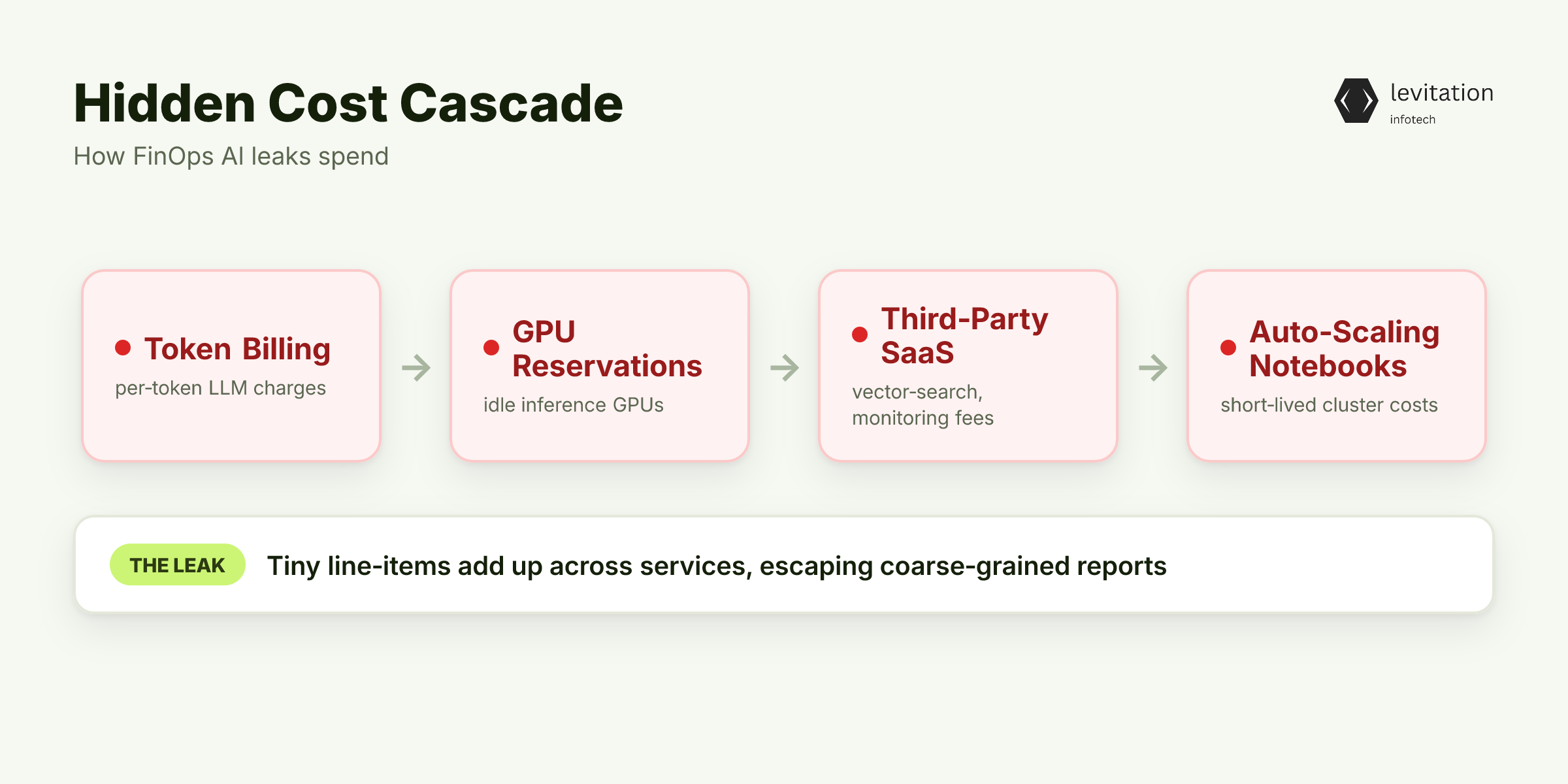
You rolled out a FinOps AI expecting a tidy dashboard and instant savings. Instead, the monthly invoice grew a line item you never asked for. The culprit isn’t a rogue VM; it’s the cascade of per-token calls. Then on-demand GPU reservations and third-party SaaS add-ons add up. Then your AI platform spins them up behind the scenes.
Most CTOs assume AI-powered FinOps only reduces spend because it “optimizes.” The reality is that every LLM request spawns a token count. Then every model-training job reserves a GPU hour. Then every experiment pulls in a micro-SaaS subscription for monitoring or data labeling. These charges appear as tiny line items. Often they are fractions of a cent per token or per GPU minute. They aggregate across dozens of services. Because they are fragmented, they evade the coarse-grained reports that focus on VMs, storage, or network egress.
Typical hidden-cost sources - Token-level billing from LLM APIs. - Managed inference endpoints that keep a GPU reserved even when idle. - Third-party vector-search services billed per million vectors. - Auto-scaling notebook clusters that spin up for minutes and disappear.
The tools you trust are exactly where the leak originates.
What hidden costs could be lurking in your own bill?
Why Classic FinOps Controls Miss AI-Driven Waste
Traditional FinOps metrics were built for predictable, per-resource consumption. They track CPU cores, GB-hours, or data transfer. AI costs, however, live in a different dimension: per-token usage, GPU-seconds, and SaaS subscription seats. Those units don’t map cleanly onto the classic cost allocation tables that finance teams already own.
Rightsizing a VM does nothing for a model that spins up a GPU only when a request arrives. Real-time monitoring that watches CPU percent never sees a spike in “cost-per-token.” As a result, the usual alerts - idle instances, under-utilized storage - remain silent. Then an LLM call silently adds cost to the bill.
Fragmented AI experiments deepen the blind spot. Teams launch notebooks, spin up managed inference endpoints, or attach a third-party vector database. Then they do so without registering the resource in the central inventory. Even seasoned FinOps engineers can’t flag a cost that never appears in the primary cost-center tag hierarchy.
Why the mismatch occurs
- Metric granularity - Classic dashboards aggregate at the VM or bucket level, discarding token-level detail.
- Tagging gaps - AI services often lack the cost-center tags that finance relies on.
- Billing latency - Token and GPU usage reports arrive days after the fact, too late for proactive alerts.
The missing piece isn’t more data - it’s smarter data that can actually surface those blind spots.
How can smarter data turn blind spots into actionable [insights](/insights)?
AI-Powered Telemetry That Actually Finds the Leak
Enter an AI telemetry agent that treats the bill itself as a data source. It pulls raw billing files from every cloud, ingests usage logs. Then - crucially - it collects token-level metrics from LLM APIs and GPU-hour counters from managed services. By fusing these streams, the agent builds a unified, time-series view of “cost per token”. Then it also shows “idle GPU minutes”.
Real-time anomaly detection then flags any deviation from baseline token pricing. Then it also flags any GPU reservation that sits idle for more than a few minutes. When an orphaned inference endpoint is discovered, the system automatically raises an alert and suggests termination. The result is a concrete, actionable list of waste that finance can approve in minutes rather than weeks.
How the telemetry works - A log collector subscribes to CloudWatch (or equivalent) and extracts JSON payloads that contain `prompt_tokens` and `completion_tokens`. - A parser normalizes these fields into a `tokens_used` metric. Then it multiplies by the provider’s per-token price to produce a `cost_per_call`. - GPU-usage exporters emit `gpu_seconds` counters every minute. Then the agent aggregates them per instance and divides by the hourly rate to derive `cost_per_gpu_minute`. - All metrics flow into a time-series database where a sliding-window model computes a baseline cost per token. Any spike triggers an alert.
A recent deployment cut server spend dramatically after adding this telemetry layer, proving that visibility directly drives savings. The same principle applies across industries: once you can see the hidden line items, you can eliminate them.
In practice, the telemetry agent becomes a shared service for both engineering and finance. Then it delivers a single source of truth for AI spend. That shared truth is what turns “unknown cost” into “actionable insight.” What steps are needed to embed this service without disruption?
Deploying a Zero-Leak FinOps AI in 4 Weeks
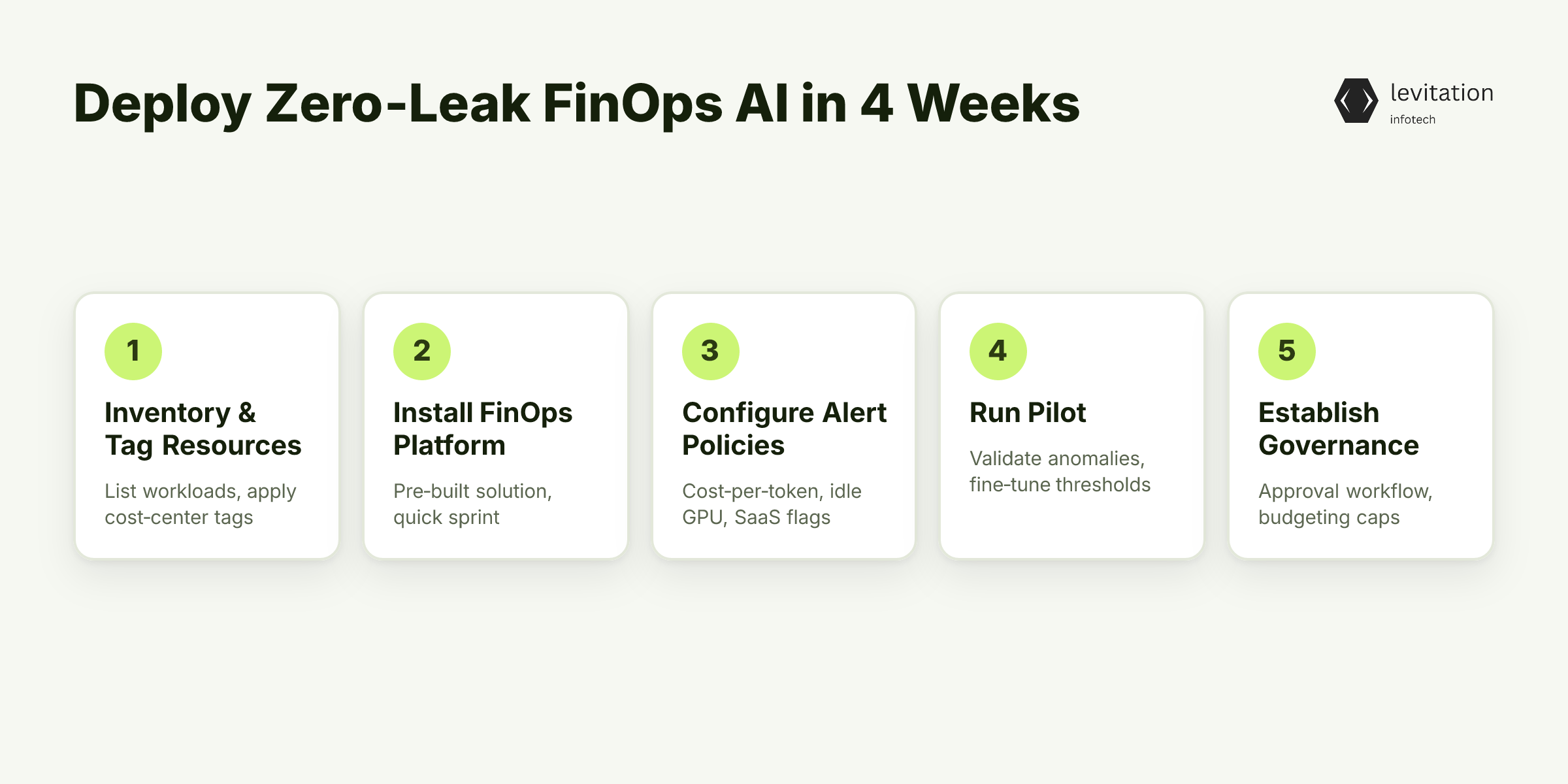
1️⃣ Inventory every AI workload. List token-based services (LLM APIs, embeddings), GPU clusters, and SaaS add-ons.
2️⃣ Tag resources and enable unified billing export. Use consistent tags for cost-center, project, and environment so the telemetry agent can correlate usage with business units.
3️⃣ Install the AI FinOps platform. A pre-built solution skips the lengthy in-house effort and lands quickly. Then the accelerated path fits into a short sprint.
4️⃣ Configure alert policies. Set cost-per-token thresholds, idle-GPU detection rules, and unexpected SaaS subscription flags.
5️⃣ Run a pilot. Validate anomaly reports against known experiments, fine-tune thresholds, and show quick remediation.
6️⃣ Establish governance. Deploy a lightweight approval workflow for new AI experiments and automate budgeting caps. Then it enforces spend limits before resources spin up.
Key actions during the pilot - Compare the agent’s `cost_per_token` view against the provider’s invoice to verify alignment. - Identify any “orphaned” GPU instances that appear in the billing export but not in the orchestration layer. - Review SaaS subscription usage logs for seats that have not been accessed recently.
These concrete steps turn abstract telemetry into tangible cost cuts. What impact will a clean ledger have on your organization’s agility?
The Payoff: A Ledger Free of Hidden AI Spend
When token-level cost breakdowns become visible, overall cloud spend drops noticeably. Teams can forecast AI spend with confidence because every request now carries a predictable price tag. The CFO sees a clean, auditable ledger that matches the expense reports from finance. Then it eliminates the “mystery line items” that previously eroded trust.
Accurate forecasting shortens the finance-engineering cycle. Budget proposals move from quarterly negotiations to monthly, data-driven updates. Stakeholder confidence rises, mirroring the high client-retention rates that mature enterprises enjoy across regulated sectors.
Strategic agility follows. Product teams can experiment with new models, knowing that any cost overrun triggers an instant alert. Then a budget cap stops it. The organization gains the freedom to innovate without the fear of hidden spend silently draining the balance sheet.
Visible benefits - Faster approval cycles for AI projects (days vs. weeks). - Reduced over-provisioning of GPUs after idle-GPU alerts. - Consolidated SaaS subscriptions, cutting duplicate seats.
The journey from hidden leak to transparent ledger shows the right telemetry. Not just more AI, it is the key. Then it delivers real savings. Ready to stop the bleed?
*Take the first step and explore a telemetry-first FinOps approach.
Sources
Research and references cited in this article:
- Top 17 FinOps Cloud Optimization Strategies for 2026 | Sedai
- Hidden Cloud Costs CIOs and CFOs Are Missing for 2026
- AI-Powered Cloud Cost Optimization: Best Practices for FinOps
- 10 FinOps Best Practices for 2026 to Optimize Cloud Spend
- Top 10 Best FinOps Tools for Cloud Cost Optimization in 2026 | Vantage
- Essential FinOps Statistics for Effective Cloud Financial Management
- Finops platforms for monitoring AI Spend : r/sysadmin
- FinOps + AI: How to Hyper-Automate Cloud Cost Optimization
- The FinOps Inform Phase: Ensuring Cloud Cost Visibility - Espresso AI
- AI-Enhanced FinOps: Key to Cutting Cloud Expenses by Virtasant
- FinOps Best Practices: Cloud Centers of Excellence | CloudQuery Blog
- AI-Powered FinOps: 8 Best Practices for Cloud Cost ...
About the author
Mayank Singh is a software developer at Levitation Infotech, where he builds web and AI-powered applications across the company’s fintech, healthcare, and enterprise projects.