


TL;DR: Most fintech AI systems don't fail at launch. They pass every test, ship to production, and look healthy in early production. The collapse happens later, at the post-launch refactor. That's when built-up tech debt, deferred compliance, and silent operational fragility surface all at once. The fix is architecture decisions made before MVP, not a heroic rescue after failure.
Key Takeaways: - The fintech AI failure curve peaks well after launch, not at launch. The MVP is rarely the problem. - AI-assisted coding speeds up output. It also speeds up the build-up of architectural debt that blocks clean refactors later. - Compliance built after launch is the most costly compliance you can build. Plan audit trails, model cards, and explainability hooks before the first line of inference code. - The refactor window is when transaction volume is highest relative to engineering capacity. That's exactly when silent operational risks explode. - Pre-launch decisions decide whether your first refactor is a recovery or a rewrite.
The Launch-Refactor Paradox Most CTOs Miss
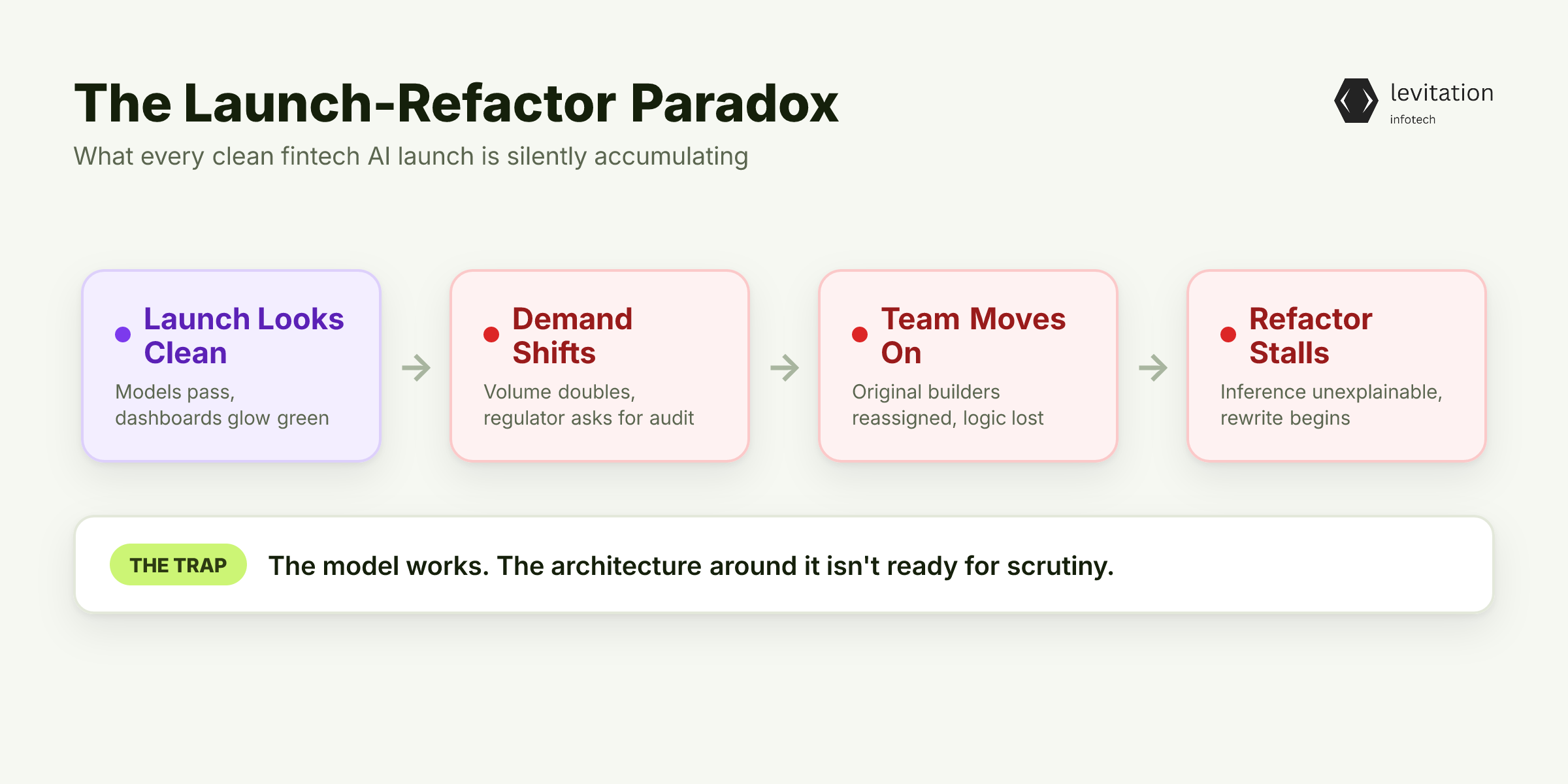
The pattern repeats so often it deserves a name: the launch-refactor paradox. The launch looks clean. Models score above baseline. The fraud team signs off. Compliance reviews the system once and approves it. Users start transacting. Dashboards glow green. Board decks quote the same metrics the CTO used to win the budget.
Then something shifts. Transaction volume doubles. A regulator asks for a fairness audit. A new product line needs the same model. It needs to make a decision type it wasn't trained for. The team that built the system has moved on. The team maintaining it can't fully explain the inference logic. The refactor gets scheduled, and the project stalls or gets rewritten.
This pattern shows up across the industry. Teams that hit the refactor without prepared architecture find they can't prove fair lending compliance. They also can't explain why specific decisions were made. They can't separate model logic from product rules.
The model often works. The architecture around it isn't ready for scrutiny.
The honest question for any CTO shipping fintech AI development today isn't "will the AI work at launch?" It's "will the AI survive the first refactor?" Most teams don't ask this until the refactor is already failing.
But the AI didn't suddenly break after clean early operation. Something was already wrong at month one, and it was compounding silently.
Why AI-Accelerated Development Doubles Your Technical Debt
AI-assisted coding feels like a cheat code. Teams ship fintech solutions faster than they could with fully manual development. The speed edge is real. The hidden cost shows up later, in the architecture nobody fully understands.
The problem isn't that AI generates bad code. The code often runs fine. The problem is that the developer shipping it didn't learn the architecture behind it. AI generates integration patterns, data pipeline couplings, and inference wrappers faster than the team can audit them. The debt per line isn't worse. The debt per hour is, because unexamined code piles up faster than the team can grasp it.
Three debt patterns show up over and over in AI-generated fintech code: - Brittle data pipeline integrations. The model reads from a feature store or stream that nobody documented. Changing the source breaks inference in ways the team can't trace. - Undocumented model assumptions. The training data had a distribution, a freshness window, and an exclusion list. None of it is written down. Months later, the model behaves differently and nobody knows why. - Tight coupling between inference logic and business rules. A fraud threshold and a regulatory cap live in the same function. Refactoring one breaks the other.
The math gets brutal. A system with months of AI-accelerated debt can take many quarters to refactor cleanly. Every fix surfaces additional hidden couplings.
Teams that ship fast using AI in fintech tools often skip the architecture review. That review would have surfaced refactor-blocking decisions. The review feels like a tax on speed.
The honest trade is this: you can ship faster with partners who specialize in banking software. Or you can ship more slowly with an in-house team. The first option wins on time-to-market. The second wins on the ability to refactor from day one. Most CTOs don't realize they're making this choice until the refactor starts.
Technical debt is only half the trap. The other half is regulatory, and it's even harder to refactor.
The Compliance Time Bomb Hidden in Post-Launch Drift
Treating compliance as a post-launch task is the most documented fintech startup mistake. It directly causes refactor failures. The temptation is obvious. At launch, you need velocity, customers, and a product that works. Compliance feels like paperwork. You promise to handle it "next quarter."
Then the refactor arrives, and the compliance gap becomes a structural one.
The deeper problem is regulatory drift. A model that passed compliance review at launch can fail later. The model behavior has changed as new data flows in. The training data has aged past its documented baseline. The use case has grown beyond what was originally reviewed.
The system that was compliant early on isn't compliant when the refactor hits. The audit trail to prove the difference doesn't exist.
Most fintech startups lack the audit trail, lineage, and explainability setup that a refactor demands from day one. Building this retroactively is expensive. Building it into the initial architecture is almost free. The choice is between fintech AI systems designed for scrutiny and systems designed for demo day.
The firms that survive the first refactor treat financial technology as regulated infrastructure from day one. They don't treat it as a software product that gets a compliance wrapper later.
Compliance failures are loud. They trigger audits. But there's a quieter killer that doesn't make headlines until it's too late.
Operational Risk: The Silent Killer Nobody Tracks Until the Refactor
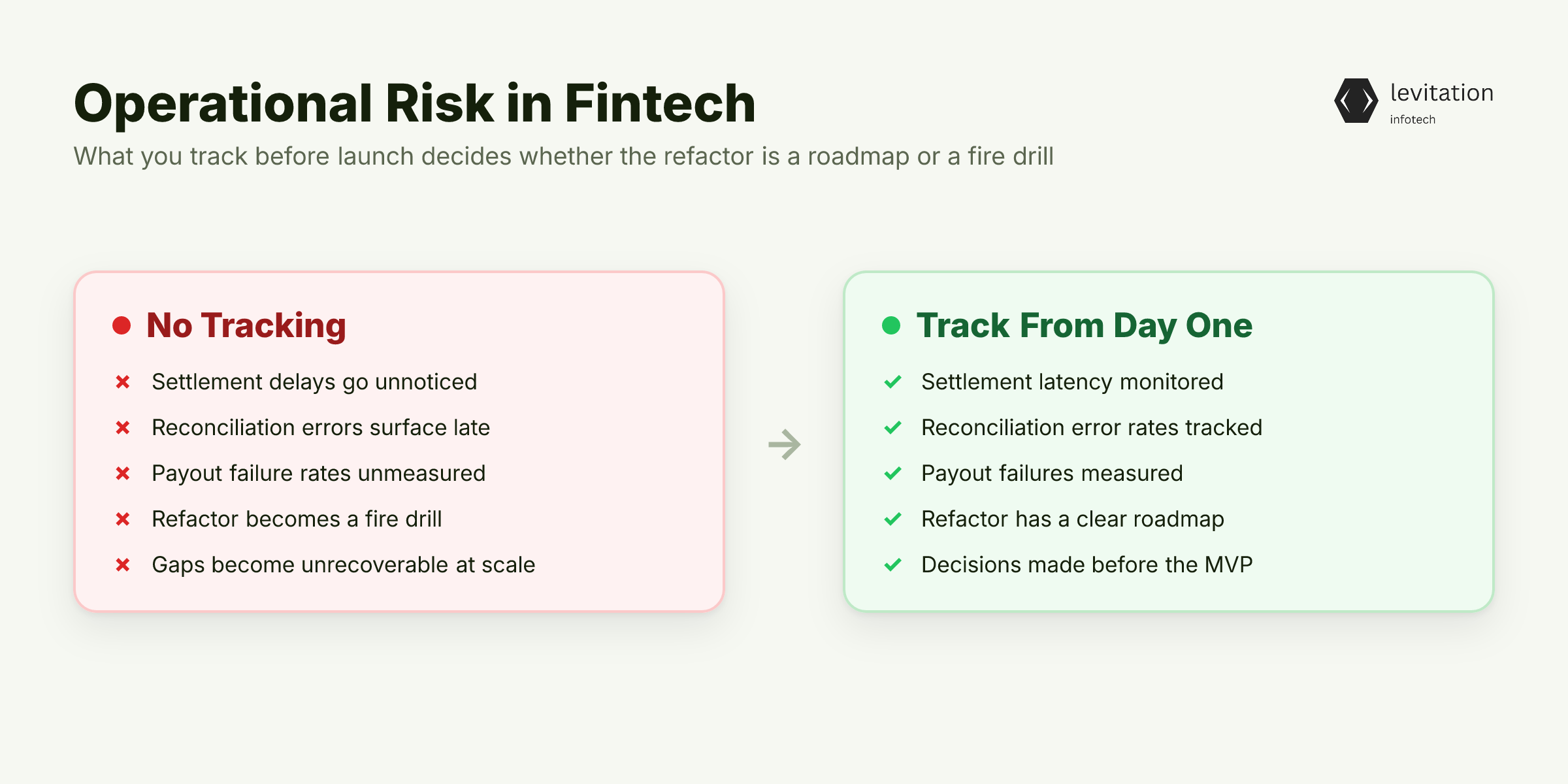
Fintech problems rarely start with headlines. They start quietly. Settlement delays. Reconciliation errors. Failed payouts. Dispute backlogs.
These issues are invisible during pilot because transaction volume is low. They explode when the system scales during or after the first refactor.
The timing is cruel. The refactor window is when transaction volume peaks and engineering capacity is stretched thin. You're shipping new features while the user base is growing. The finance team is asking for new reports. Ops wants to know why payout failures spiked last week.
The refactor competes with all of this for engineering attention. Operational fragility surfaces exactly when nobody has bandwidth to fix it.
The market consequences are real. Operational failures in fintech fraud detection and payment systems aren't just engineering problems. They move stock prices and destroy trust in ways that take years to rebuild.
The pattern holds across the industry. Pilot works. Launch works. Scale exposes the gaps. The refactor window is when the gaps become unrecoverable.
Teams that track settlement latency, reconciliation error rates, and payout failure rates from day one have a roadmap for the refactor. Teams that don't have a fire drill. The difference between the two is decided before the MVP ships, not during the refactor itself.
So what separates a refactor from a rewrite? A set of decisions made before the MVP.
The CTO Refactor Playbook: Five Decisions Before You Touch the Code
The difference between a refactor and a rewrite is decided in the architecture, not the code. Pre-launch decisions, made before MVP, separate systems that survive from systems that get shelved.
Decision 1: Refactor vs. rewrite starts with data architecture, not features. If the data pipeline is sound and the audit setup exists, refactor. If the model logic is tangled with business rules, and if the pipeline itself is the source of operational failures, rewrite. Feature count is irrelevant. Architectural clarity is everything.
Decision 2: Embed compliance from day one, not at refactor. Build audit trails, model cards, training data lineage, and explainability hooks into the initial architecture. Do this even if no regulator is asking at launch. The cost at MVP is small compared to retrofitting. The cost at refactor is a full rewrite. Every AI credit scoring system that survives scrutiny was designed for scrutiny.
Decision 3: Treat operational telemetry as a refactor input, not an afterthought. Settlement latency, reconciliation error rates, payout failure rates, dispute volume, and override frequency must be tracked. This tracking must start before the refactor begins. The refactor should use this data to prioritize, not guess what's broken.
Decision 4: Plan the refactor window before the MVP ships. Budget a large fraction of the original build time for the first refactor. Schedule it before scale targets are hit, not after. The team that refactors while user volume is still manageable is in a better position. The team that refactors under full regulatory attention and high transaction load is in a far worse one.
Decision 5: Separate model logic from business rules using adapter patterns. When the next model swap arrives, it should not trigger a full rewrite. The inference layer should call a stable interface. Business rules, regulatory caps, and product-specific thresholds should sit in a separate layer. That layer can change without touching the model.
This playbook is the pattern that separates systems still running years after deployment from the ones that get shelved. It's the difference between an NBFC platform that scales and one that replatforms often.
What Changes When the Refactor Goes Right
A successful first refactor is invisible from the outside. The system continues serving users. The regulators stay quiet. The board stops asking pointed questions. That's the goal.
The AI stops being a liability that needs defending in board meetings. It becomes infrastructure the business plans around.
The cost gap is stark. A well-planned refactor for a fintech AI system completes quickly when the original architecture was designed with refactor in mind. An unplanned refactor after a compliance crisis or operational failure takes far longer. It also burns institutional trust along the way.
The difference is almost entirely a function of pre-launch architecture decisions.
Long-term production stability follows. Systems designed with refactor-as-a-feature survive regulatory shifts, model upgrades, and scale changes without rewrites. A new compliance rule means a config change, not a multi-quarter project. A new model means swapping the inference adapter, not touching business logic. This is the architecture that lets video KYC and credit decisioning systems run for years without a replatform.
The retention signal is the clearest indicator. Clients who survive the first refactor stay. The architecture is finally sound, not just functional.
The systems that get refactored well don't churn. The systems that limp through the first refactor come back later asking for a full rewrite.
The real outcome isn't a working model. It's a working fintech platform that the business can build on for years. That's the difference between AI as a demo and AI as infrastructure.
Frequently Asked Questions
What are the most common reasons fintech AI projects fail after launch?
The three leading causes are built-up tech debt from rapid AI-assisted development, deferred compliance planning that surfaces during the first regulatory audit, and operational fragility in transaction pipelines. These converge at the post-launch refactor window. This is why failure rates spike there rather than at launch.
How does AI-generated code create technical debt differently from human-written code?
AI-generated code is often functionally correct but architecturally opaque. The developer often doesn't fully understand the integration points or assumptions baked in by the model. This creates debt patterns like brittle data pipeline couplings, undocumented model assumptions, and tight entanglement between inference logic and business rules. The debt isn't worse per line. It's worse per hour, because the volume of unexamined code grows faster than the team's ability to learn it.
When should a fintech CTO refactor versus rewrite an AI system?
Refactor when the data architecture and audit setup are sound, but the model logic or feature layer needs restructuring. Rewrite when model logic is tangled with business rules, when compliance can't be retrofitted, or when the data pipeline itself is the source of operational failures. The decision should be made on architectural criteria, not feature count or team sentiment.
How long does a typical post-launch refactor take for a fintech AI system?
The range is wide. A refactor of a well-architected system can finish in weeks. A refactor of a system that built up AI-assisted technical debt without compliance setup often stretches to many months. This is especially true when it happens under regulatory scrutiny. The range is almost entirely a function of pre-launch architecture decisions, not team size or budget.
What compliance considerations are most often missed in post-launch fintech AI?
The most frequently missed items are model explainability, training data lineage, audit trail completeness, and drift monitoring. Model explainability means being able to justify a specific decision to a regulator. Training data lineage means proving what data the model was trained on and when. Audit trail completeness means logging every prediction and override. Drift monitoring means detecting when model behavior has shifted from the validated baseline. All four are much cheaper to build before launch than to retrofit during a refactor.
Build for the refactor before you build for the launch.
Sources
Research and references cited in this article:
- What Happens When AI Technical Debt Compounds (And ...
- What Is Technical Debt in AI Coding? Types & Impact Explained - Janea Systems
- The next wave of technical debt is architectural, and AI is accelerating it - SIG
- 16 Types of Technical Debt in FinTech - Pragmatic Coders
- Technical Debt (Tech Debt): A Complete Guide - Confluent
- August roundup of regulatory developments and compliance news
- AI Compliance Risk for FinTech Startups
- Why Most AI Pilots in Fintech Fail to Reach Production ...
- AI regulatory compliance priorities financial institutions face in 2026
- How AI is reshaping regulatory compliance strategies in 2026
- Strategic Capital Allocation in AI-Driven Fintech: Navigating the 2025-2026 Investment Landscape
- Strategic Capital Allocation in the Fintech Sector: Navigating Growth, Innovation, and Risk in FY 2025-2026
About the author
Mayank Singh is a software developer at Levitation Infotech, where he builds web and AI-powered applications across the company’s fintech, healthcare, and enterprise projects.