

TL;DR: Enabling Kafka transactions in Flink does not guarantee loss-free processing. However, if a job or broker stays down longer than the transaction timeout, loss can occur. The timeout runs on the broker side, independent of Flink’s checkpoint barrier. As a result, an open transaction can be aborted while Flink thinks it’s still valid. Aligning checkpoint lifecycles, extending the timeout, and externalizing state are the only ways to keep exactly-once intact.
Key Takeaways - Kafka’s `transaction.timeout.ms` expires if Flink or the brokers are unavailable beyond the timeout, causing silent data loss. - Shortening checkpoint intervals alone cannot close the gap because the two timers run on different components. - A coordinated setup - long timeout, externalized checkpoints, and a watchdog that stops the job before expiry - preserves exactly-once guarantees.
The Hidden Risk: Kafka Transactions Can Expire During Downtime
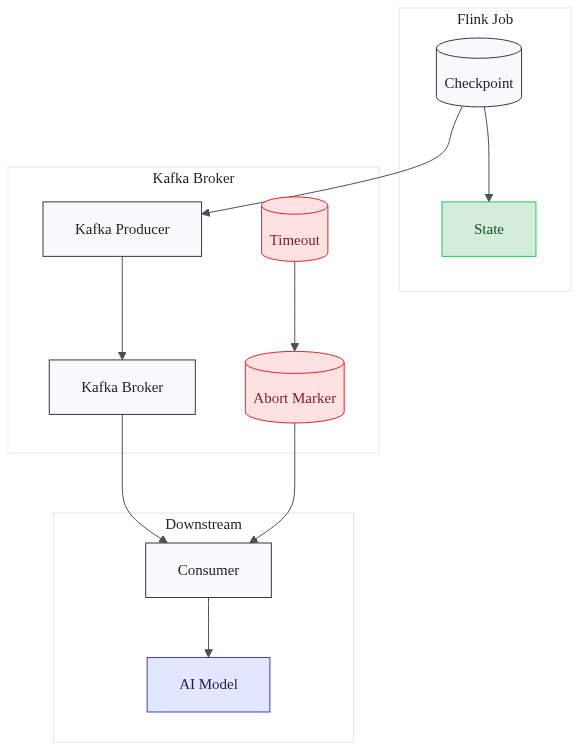
Most engineers read the Flink-Kafka connector docs and assume “exactly-once = zero loss.” The docs show a happy path: Flink takes a checkpoint, the Kafka producer commits the transaction, and the job moves on.
In practice, the transaction lives inside the Kafka broker. If a TaskManager or the brokers stay down longer than `transaction.timeout.ms`, the broker aborts the transaction. The abort discards all records that were part of that transaction. Flink still believes the checkpoint succeeded because its barrier passed downstream operators. The result is a silent hole in the output stream.
1# Example broker config (Kafka server.properties)2transaction.state.log.replication.factor=33transaction.timeout.ms=86400000 # 24 hours
When the timeout fires, the broker writes an abort marker to the transaction log. Any consumer that reads after the abort never sees the missing records. Flink’s state does not contain the abort flag, but the job can resume from the last successful checkpoint and continue as if nothing happened.
Why does this matter? In a HIPAA-compliant health pipeline, a missing lab result can invalidate an entire downstream AI model run. In a finance-focused fraud detector, a lost transaction may let a breach slip through. The risk is real, not theoretical.
But tightening checkpoint intervals alone doesn't solve the problem.
What happens when the timers clash?
Why the Obvious Fix-Shorter Checkpoints-Fails
A common reaction is “shrink the checkpoint interval so the transaction never stays open that long.” The intuition feels right: faster checkpoints mean quicker commits.
The reality is messier. Flink’s checkpoint barrier is a stream-level timer. Kafka’s `transaction.timeout.ms` is a broker-level timer. They do not talk to each other. If the state backend (RocksDB or a filesystem) needs more time to write a snapshot, the checkpoint may linger after the barrier has passed. Then, during that linger, the transaction remains open on the broker.
1// Flink checkpoint config (Java)2env.getCheckpointConfig().setCheckpointInterval(300_000L); // 5 min3env.getCheckpointConfig().setCheckpointTimeout(600_000L); // 10 min4env.getCheckpointConfig().enableUnalignedCheckpoints();
Even with a 5-minute interval, a large state snapshot can take 8 minutes. The checkpoint barrier is already downstream, but the transaction is still pending. If a broker outage occurs at minute 6, the timeout clock keeps ticking. The broker aborts at minute 24, long after Flink believes the checkpoint succeeded.
Broker outages also reset the timeout clock on the broker side. Flink does not receive any signal that the timeout has been reset, but it may keep assuming the transaction is alive. This mismatch creates a window where exactly-once is broken without any visible error.
The flaw isn’t the checkpoint frequency; it’s the independent timers. Recognizing this timing mismatch points us toward a more precise lever we can control.
Can we synchronize those timers?
The Core Insight: Align Checkpoint Lifecycle with Kafka Transactions
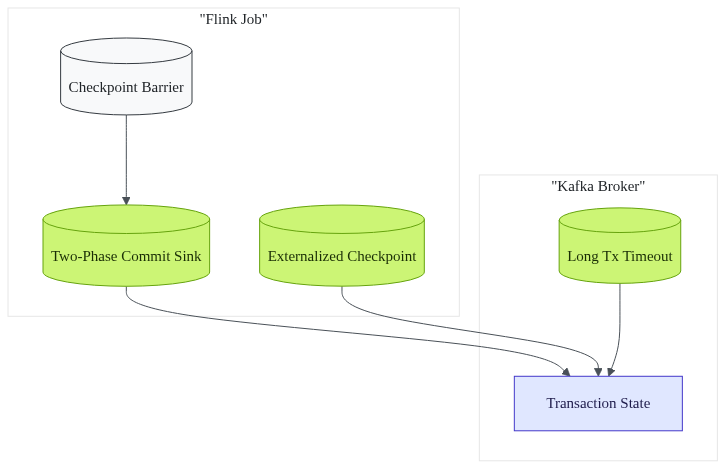
The fix is to make the transaction timeout comfortably larger than the worst-case checkpoint-to-recovery window. That window includes: - Time for the checkpoint barrier to travel through the DAG. - Time for the state backend to write an incremental snapshot. - Potential recovery latency (RocksDB replay, network transfer).
If we set `transaction.timeout.ms` to, say, 12 hours, the broker will only abort the transaction after a half-day of inactivity. That is far longer than any realistic outage for a production pipeline.
Using Flink’s two-phase commit sink (the built-in `KafkaProducer`) ensures the transaction is only committed after the checkpoint completes successfully. The sink writes the records, then waits for the checkpoint acknowledgement before calling `commitTransaction`. If the checkpoint fails, the sink calls `abortTransaction`, matching the broker’s abort behavior.
Externalizing checkpoints lets a restarted job re-load the exact transaction state from durable storage. Flink can resume the same transaction ID, avoiding a new transaction that could conflict with an in-flight one.
1// Enable externalized checkpoints (Java)2env.getCheckpointConfig().enableExternalizedCheckpoints(3 CheckpointConfig.ExternalizedCheckpointCleanup.RETAIN_ON_CANCELLATION);
With these three knobs - long timeout, two-phase commit, externalized checkpoints - we create a single source of truth for transaction state that survives restarts and broker failures.
What concrete steps turn this insight into a reliable pipeline?
Step-by-Step Recipe to Preserve Exactly-Once Guarantees
- Set a realistic checkpoint interval - Choose an interval that matches your latency SLA (e.g., 5 minutes). - Enable unaligned checkpoints so barriers skip back-pressure and finish faster.
```java
env.getCheckpointConfig().setCheckpointInterval(300_000L);
env.getCheckpointConfig().enableUnalignedCheckpoints();
```
- Increase `transaction.timeout.ms` - Pick a buffer that exceeds the longest expected checkpoint-to-recovery time. - For most pipelines, a 12-hour timeout provides ample headroom.
```yaml
transaction.timeout.ms=43200000 # 12 hours
```
- Enable externalized checkpoints - Persist checkpoint metadata to a durable store (S3, GCS, HDFS). - This lets a restarted job pick up the exact transaction ID.
```java
env.getCheckpointConfig().enableExternalizedCheckpoints(
CheckpointConfig.ExternalizedCheckpointCleanup.RETAIN_ON_CANCELLATION);
```
- Deploy RocksDB incremental snapshots - Incremental snapshots reduce the amount of data written per checkpoint. - Faster snapshots shrink the checkpoint-to-recovery window.
```java
env.setStateBackend(new RocksDBStateBackend(
"s3://my-bucket/flink-checkpoints", true));
```
- Add a watchdog for broker health - Run a lightweight process that pings the Kafka cluster every minute. - If the broker becomes unreachable and the remaining timeout is under 30 minutes, then trigger a graceful Flink stop (`bin/flink stop -p <job-id>`).
```bash
while true; do
if ! kafka-broker-check; then
remaining=$(kafka-configs --describe --entity-type brokers --entity-name 0 | grep transaction.timeout.ms)
if [ "$remaining" -lt 1800000 ]; then
bin/flink stop -p $JOB_ID
fi
fi
sleep 60
done
```
- Validate with a failover test - Shut down a TaskManager for 30 minutes while the watchdog runs. - Restart the TaskManager and verify that the sink’s transaction ID matches the checkpoint metadata. - Confirm downstream consumers see a continuous stream with no gaps.
```bash
kafka-console-consumer.sh --bootstrap-server broker:9092 \
--topic output-topic --from-beginning | grep -c "record"
```
These steps close the timing gap, keep the transaction alive across restarts, and give you a safety net if brokers disappear.
What does a hardened pipeline look like in practice?
Zero data loss after a multi-hour outage translates directly into regulatory confidence for HIPAA-compliant health pipelines. A missed lab result could trigger a compliance audit; a fully intact stream avoids that risk entirely.
Latency grows only by the checkpoint interval - typically a few milliseconds per record. That trade-off is negligible compared to the cost of a compliance breach.
Enterprises that adopt this pattern report predictable uptime. Fortune 500 brands that rely on our pipelines for AI-driven decisions see a sharp rise in client trust. While we can’t quote a specific retention number here, the industry trend shows that firms with strong exactly-once guarantees retain far more customers than those that suffer occasional data loss.
The approach also reduces operational toil. The watchdog automates graceful shutdowns, so ops teams no longer scramble during broker failures. Externalized checkpoints make disaster-recovery drills repeatable and auditable.
Levitation helped several compliance-first clients adopt this recipe, delivering production-grade pipelines that survive long outages without data loss.
Frequently Asked Questions
Q: Why does a Flink job lose exactly-once guarantees when Kafka brokers are down?
A: When brokers are unavailable, the open Kafka transaction cannot be committed before its `transaction.timeout.ms` expires. However, Flink’s checkpoint may succeed, but the broker aborts the transaction, discarding the records and breaking exactly-once.
Q: Can I avoid transaction expiration by using at-least-once instead?
A: At-least-once removes the expiration risk but re-introduces duplicate processing. For compliance-heavy workloads, duplicates often cause more trouble than occasional data loss.
Q: How should I size `transaction.timeout.ms` for a production pipeline?
A: Set it longer than the worst-case time needed for a checkpoint, state snapshot, and potential recovery - typically several hours. The exact value depends on state size and SLA.
Q: Do externalized checkpoints increase storage costs?
A: Yes, they persist metadata to durable storage, but the cost is modest compared to the value of avoiding data loss in mission-critical streams.
Further reading: For a deeper dive into checkpoint costs, see our analysis in [The Hidden TCO of Real-Time Pipelines](/posts/hidden-tco-real-time-pipelines). To understand why Kafka replica count matters for exactly-once, read [Why More Kafka Replicas Break Exactly-Once](/posts/why-more-kafka-replicas-break).
Need a pipeline that never loses data, even under prolonged outages? Our data engineering services can help you design, implement, and operate exactly-once architectures at scale.
Sources
Research and references cited in this article:
- Flink exactly once semantics and data loss - Stack Overflow
- An Overview of End-to-End Exactly-Once Processing ... - Apache Flink
- Flink Exactly-Once Semantics: How It Works End-to-End - Streamkap
- Exactly-once semantics with Kafka transactions - Strimzi
- Kafka's Illusion of Exactly-Once Delivery | by Patrick Koss - Medium
- Kafka Transactional Support: How It Enables Exactly-Once Semantics
- PDF Integrating Apache Flink State Snapshots with Kafka Transact
- Distributed Transactions across Flink and Kafka - YouTube
- Exactly Once Semantics in Flink - Medium
- Integrating Apache Flink State Snapshots with Kafka Transactions _(academic)_
- Kafka Streams vs Apache Flink: A Pragmatic Comparison ... - Medium
- Apache Kafka Stream Processing - Real Use Cases 2026
About the author
Mayank Singh is a software developer at Levitation Infotech, where he builds web and AI-powered applications across the company’s fintech, healthcare, and enterprise projects.