


TL;DR
Swapping a REST endpoint for gRPC can shave up to 77 % off latency. Teams stay with HTTP because the migration feels risky. Understanding the real friction points and the technical edge of HTTP/2 + Protobuf lets you plan a low-pain rollout. Then you reap measurable business value.
Key Takeaways - gRPC’s binary payloads are about one-third the size of JSON, delivering a ten-fold data-transfer reduction. - HTTP/2 multiplexing eliminates head-of-line blocking, unlocking the 77 % latency win. - A staged migration - proto contracts, HTTP/2-enabled services, and a gRPC-gateway façade - can be delivered in 3-6 months. It does not take years.
The Paradox: Teams Keep Choosing REST Despite a 77 % Speed Gap
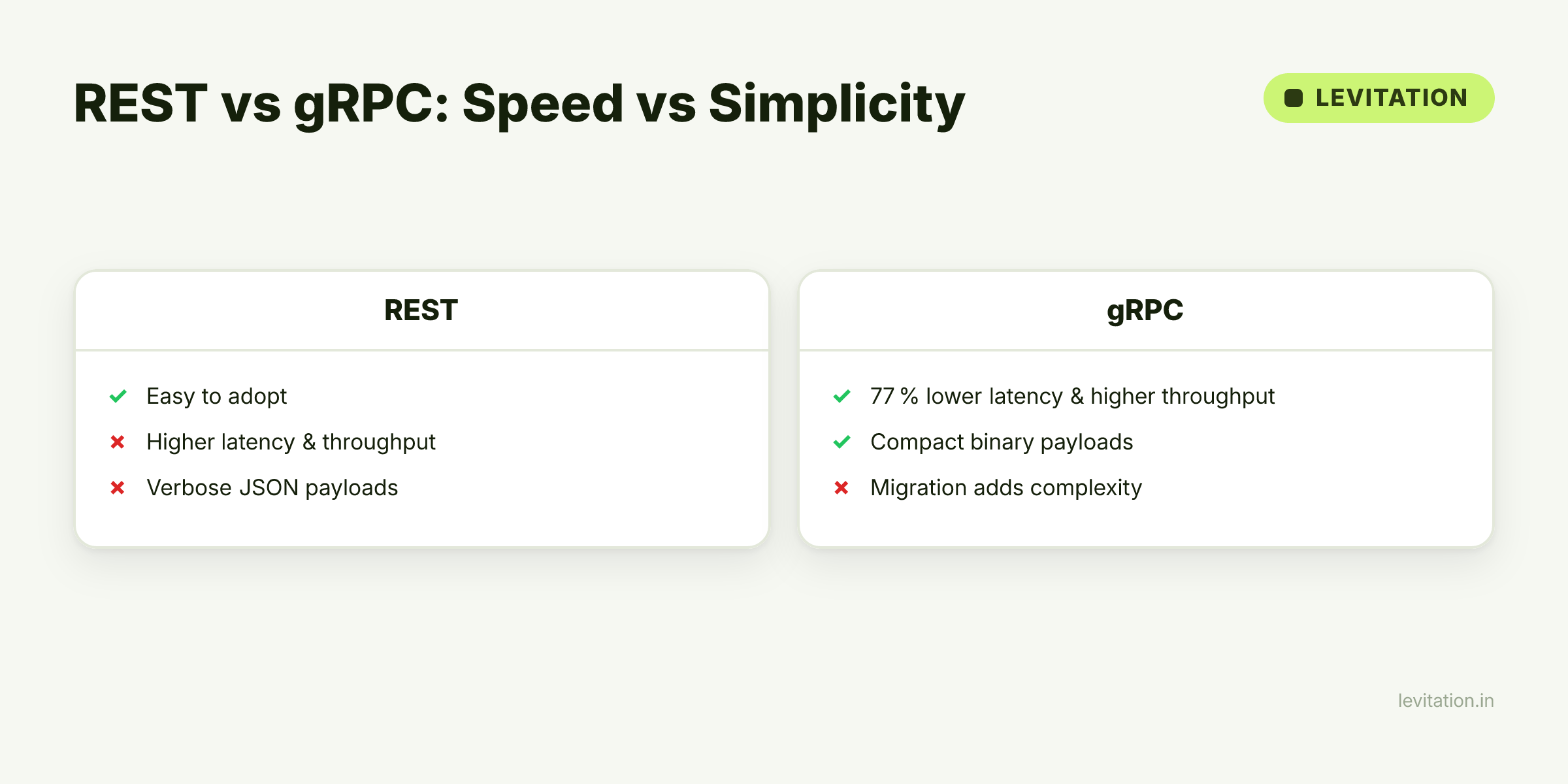
When a senior architect asks why the new microservice still speaks HTTP/JSON, the answer is almost always “it’s simpler.” Simplicity sells, but it hides the fact that every request carries extra bytes and extra round-trips. A single TCP connection stalls when one stream hiccups.
A recent benchmark shows gRPC outpaces REST by 77 % in both latency and throughput. The raw numbers are stark, but the industry keeps building on the familiar stack. Decision-making often skips concrete metrics like payload size or connection reuse, focusing instead on tooling comfort. It also clings to the perception that “JSON works everywhere.”
That comfort is a mirage. It glosses over the hidden cost of JSON’s verbosity and the serial nature of HTTP/1.1. The next logical step seems obvious: replace the protocol. But the swap isn’t a plug-and-play operation. It bumps into a wall of hidden roadblocks that many teams never anticipate.
What exactly trips up a migration that looks so straightforward?
Why the Straight-Swap Strategy Breaks: Hidden Costs of gRPC Adoption
First, your existing load balancers and edge proxies do not speak HTTP/2. Without native support you must end TLS early, re-encode traffic. And you lose the multiplexing advantage you hoped to gain. Upgrading the network layer often means buying new appliances or re-architecting traffic routing. These costs rarely appear in a protocol-swap estimate.
Second, Protocol Buffers introduce a new schema language. Teams used to ad-hoc JSON objects now need a compiled contract, a generated stub. They also need version-control discipline around .proto files. The learning curve reshapes how you think about backward compatibility, field deprecation, and service evolution.
Third, testing and debugging become less familiar. JSON’s human-readable format lets you curl an endpoint and see the payload instantly. With binary Protobuf you need extra tooling to inspect messages, and many CI pipelines lack out-of-the-box support. Browser-based clients also push teams toward a REST façade because browsers cannot speak gRPC directly without a gateway.
If we can isolate the core technical advantage, how does it translate into the 77 % performance gap?
The Mechanics of the 77 % Advantage: HTTP/2 Multiplexing & Binary Protobuf
Imagine a single TCP connection as a highway. With HTTP/1.1 each request gets its own lane, and a stalled vehicle blocks the whole road. HTTP/2 changes the rules: it multiplexes many streams over one connection. So a slow request no longer stalls the others. This alone removes head-of-line blocking, shaving milliseconds off every round-trip.
Now add Protocol Buffers. JSON wraps each field in quotation marks and repeats the key name for every object. Protobuf strips that baggage, encoding data in a compact binary format. The result is a payload about one-third the size of its JSON counterpart. Smaller payloads mean fewer bits on the wire, which directly reduces transmission time. In practice, the data-transfer reduction can be as high as ten-fold, turning a bandwidth bottleneck into a non-issue.
Combine multiplexed streams with tiny binary messages, and the latency improvement adds up to the observed 77 % gain. The math is simple: fewer round-trips + less data = faster response. The performance boost isn’t a magical artifact of gRPC; it’s a natural consequence of the two underlying technologies working together.
Knowing the why, how can we move from theory to a concrete migration plan that respects existing investments?
From Theory to Practice: A Step-by-Step gRPC Migration Playbook
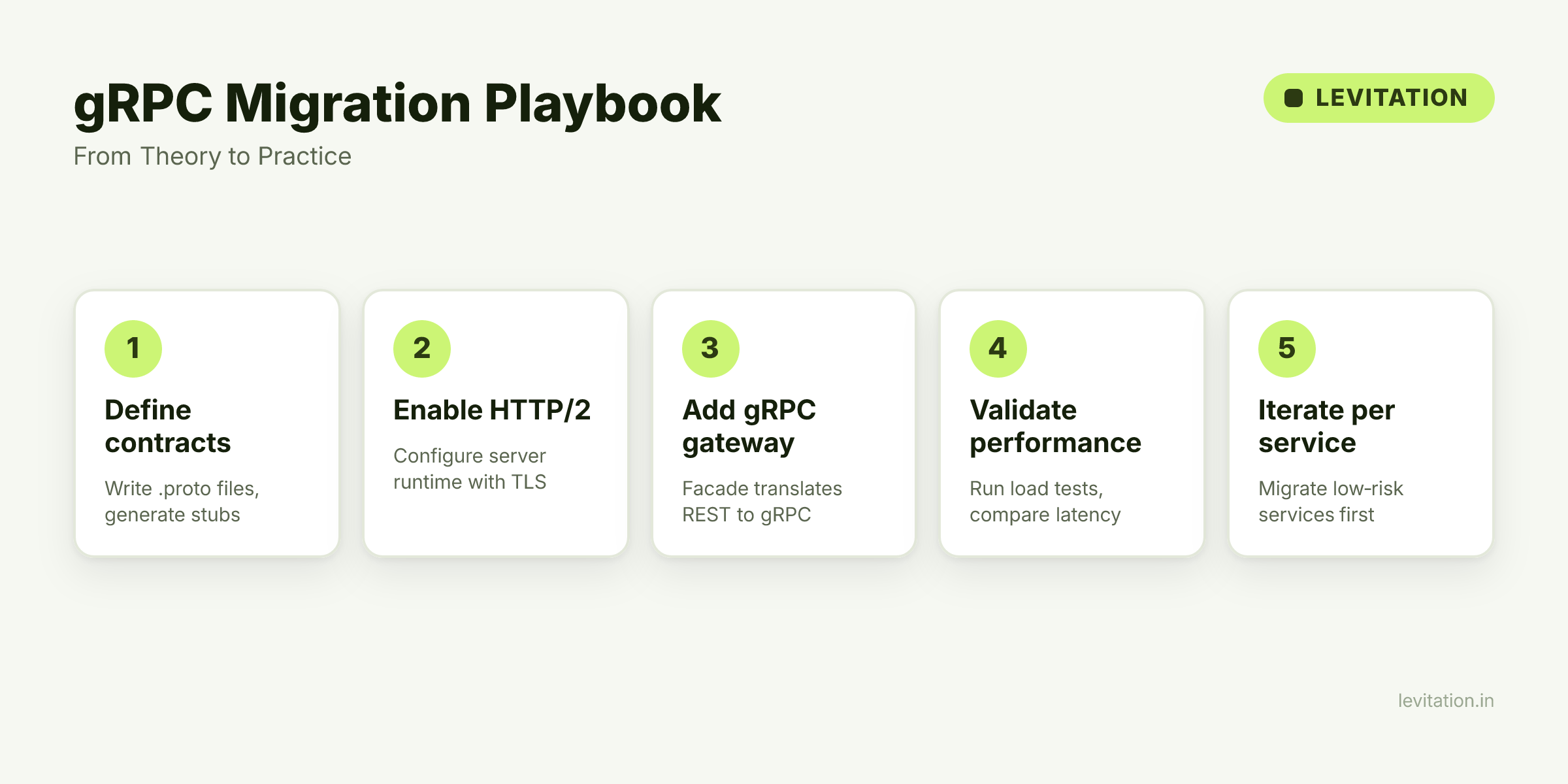
- Define service contracts - Write .proto files that describe request and response shapes. Treat them as the single source of truth; generate stubs for every language in your stack.
- Enable HTTP/2 on the server - Choose a runtime that supports HTTP/2 natively (e.g., Netty, Envoy, ASP.NET Core). Configure TLS end early to preserve the multiplexed connection end-to-end.
- Introduce a gRPC-gateway - Deploy a thin façade that translates incoming REST/JSON calls into gRPC. Existing clients keep calling the familiar URLs while the backend talks the faster protocol.
- Validate performance - Run load tests with tools such as ghz or wrk2, comparing latency against your baseline. Record both throughput and error rates to prove the win.
- Iterate per service - Migrate low-risk services first, then gradually replace higher-value ones. Keep the gateway in place until all external consumers have been upgraded.
A realistic timeline for an experienced engineering organization is 3-6 months for a full-stack rollout. Teams that attempt a “big-bang” rewrite often stretch to 18-24 months, battling integration debt and lost velocity. The incremental approach also lets you reuse existing CI pipelines and gradually upskill developers on Protobuf. It does this without a disruptive learning sprint.
With the roadmap in hand, what tangible business outcomes can an organization expect once the migration is complete?
The Payoff: Real Business Gains After Switching to gRPC - Latency drops up to 77 %, translating into snappier user experiences for any latency-sensitive front-end. It helps mobile apps to internal dashboards alike. - Bandwidth savings from one-third-size payloads cut operational costs. It also makes scaling under load far cheaper. - Faster time-to-market - a 3-6 month migration window means new features can be delivered months earlier. A prolonged REST-only refactor would take longer. - Enterprise confidence - many banks and regulated firms trust high-performance APIs for security-critical systems. It shows that the approach scales beyond hobby projects.
The bottom line is clear: the performance upside isn’t a nice-to-have; it’s a competitive differentiator. When latency directly impacts conversion, churn, or transaction throughput, a 77 % improvement can shift market share.
Ready to move from curiosity to action?
Frequently Asked Questions
Q: How much faster is gRPC than REST in real-world latency?
A: Benchmarks show gRPC delivers up to 77 % lower latency than equivalent REST calls. This is mainly because of HTTP/2 multiplexing and binary serialization.
Q: Does gRPC really reduce payload size?
A: Yes - Protocol Buffers produce payloads about one-third the size of JSON. This can mean a ten-fold reduction in data transferred.
Q: Can I use gRPC with existing REST clients?
A: You can keep a REST façade with a gRPC-gateway, allowing legacy HTTP/JSON callers to operate. Your backend then speaks gRPC.
Q: What tooling should I use to benchmark my gRPC services?
A: Tools like ghz, wrk2, or the official gRPC benchmarking suite let you measure latency and throughput. They also measure resource usage under realistic loads.
Consider a partner with proven gRPC migration experience.
Sources
Research and references cited in this article:
- gRPC vs REST 2026: 77% Faster, 10x Smaller Payloads
- gRPC vs. REST: Choosing the best API design approach
- gRPC vs. REST: Key Differences, Performance & Use Cases | Toptal®
- Is gRPC(HTTP/2) faster than REST with HTTP/2? - Stack Overflow
- REST vs gRPC: Performance, Use Cases & How to Choose - Zuplo
- Scaling up REST versus gRPC Benchmark Tests | by Ian Gorton
- Performance comparison: REST vs gRPC vs asynchronous communication
- Can someone please explain to me why gRPC is faster than REST?
- gRPC vs. REST: Key Differences - PFLB
- kubernetes - REST vs gRPC: when should I choose one over the other? - Stack Overflow
- gRPC vs REST - Difference Between Application Designs - AWS
About the author
Mayank Singh is a software developer at Levitation Infotech, where he builds web and AI-powered applications across the company’s fintech, healthcare, and enterprise projects.