


TL;DR: The headline price of Kafka or Flink hides a massive operational bill. Most of that bill comes from observability, state management, and scaling friction, not just VM or storage costs. Mapping those hidden line items lets you pick a cheaper, more resilient design.
Key Takeaways: - Infrastructure spend is only a fraction of real-time pipeline TCO. - State checkpoints and metric pipelines generate the bulk of hidden costs. - A disciplined playbook can cut observability waste and improve long-term reliability.
The Cost Illusion: Why the Sticker Price Misleads
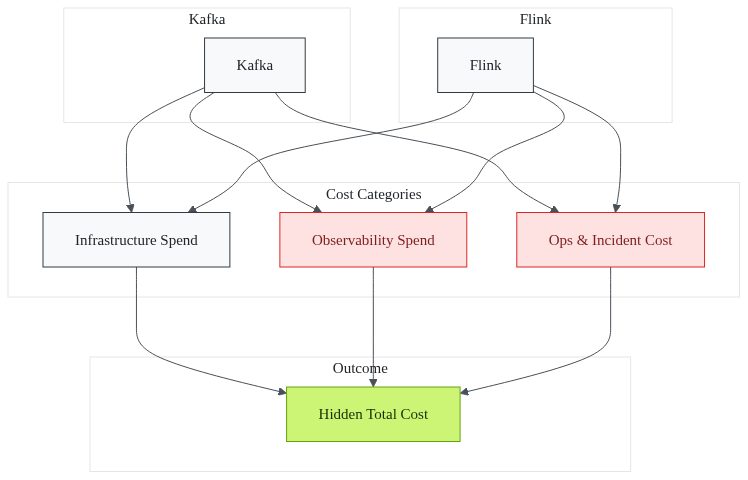
A CFO glances at a cloud bill, sees $X for VMs, and declares the project affordable. The engineering leader nods, because the Kafka-vs-Flink debate is reduced to “more brokers or more task managers.”
What they ignore is the operational tail that follows every metric, alert, and checkpoint. Teams spend most of their time fine-tuning dashboards, chasing lag spikes, and manually rotating state snapshots. Those activities translate into engineering-hour costs that can eclipse the raw compute spend.
Example: A team that adds a new Kafka broker to absorb traffic. However, it also inherits extra JMX exporters, additional ZooKeeper watches, and a larger retention window for internal logs. The resulting log volume alone can double the storage bill. - Infrastructure spend: VM, storage, network. - Observability spend: metrics ingestion, log retention, alert fatigue. - Scaling & incident triage: extra on-call rotations, post-mortems, runbooks.
When you compare Kafka and Flink only on VM count, you miss that Flink’s state backend. Then it can generate gigabytes of checkpoint data per hour. However, Kafka’s broker metrics are already baked into the platform.
But simply adding more servers won’t fix the leak; where does the real problem lie?
The Deep-Dive: Observability and Ops Complexity Hidden in Plain Sight
Kafka ships with a rich set of broker metrics: request rates, ISR lag, partition throughput. Flink adds stateful operators, checkpoint barriers, and exactly-once guarantees. Correlating those two streams of data requires a custom pipeline. Then it pulls metrics from JMX, Prometheus, and the Flink REST API. Then it joins them on timestamps.
That custom pipeline becomes a cost center the moment you store raw checkpoint files, retain them for replay. Then you replicate them across zones. The storage footprint can grow faster than the raw event volume. As a result, each checkpoint contains a full snapshot of keyed state. As a result, the size can increase rapidly.
1# Example: Rolling-window script to prune old Flink checkpoints2#!/usr/bin/env python33import boto3, datetime, sys4s3 = boto3.client('s3')5bucket = sys.argv[1]6prefix = sys.argv[2] # e.g. flink/checkpoints/7days_to_keep = int(sys.argv[3])89cutoff = datetime.datetime.utcnow() - datetime.timedelta(days=days_to_keep)10paginator = s3.get_paginator('list_objects_v2')11for page in paginator.paginate(Bucket=bucket, Prefix=prefix):12 for obj in page.get('Contents', []):13 if obj['LastModified'] < cutoff:14 s3.delete_object(Bucket=bucket, Key=obj['Key'])15 print(f"Deleted {obj['Key']}")
The script itself costs almost nothing to run. However, the operational effort to build and test it can take weeks of engineering time. Then scheduling it adds further overhead. - Metric volume: Kafka emits thousands of per-broker counters; Flink adds per-task latency histograms. - Log retention: Both systems generate verbose logs for retries, leader elections, and checkpoint failures. - Alert noise: Uncorrelated alerts cause on-call fatigue, leading to slower incident response.
Understanding these hidden layers explains why two pipelines with identical throughput can have wildly different bills.
The next question is: where exactly does the money leak in each architecture?
Architectural Cost Drivers: Broker vs. Stream Processor
Kafka’s cost model is storage-centric. Every topic partition is replicated, typically three times, to guarantee durability. More replicas mean more network I/O and disk space. Network egress between brokers and consumers also adds up, especially when cross-region replication is enabled.
Flink’s cost model is state-centric. Each keyed operator maintains a state backend (RocksDB, filesystem, or cloud object store). During a checkpoint, Flink writes a full snapshot of that state. The snapshot size grows with the number of keys and stored data, not with the raw event rate. Task managers must be sized for both compute and state-backend I/O, often leading to over-provisioning.
Cost driver contrast: - Kafka broker: storage replication, network shuffles, ZooKeeper coordination. - Flink task manager: checkpoint storage, state backend RAM/CPU, parallelism factor.
Because the two systems charge on different resources, a naïve “compare CPU cores” approach can be wildly misleading.
Now that we know where the money leaks, how do real companies avoid - or fall into - those traps?
Real-World TCO Snapshots: Intrado, Walmart, and Saxo Bank
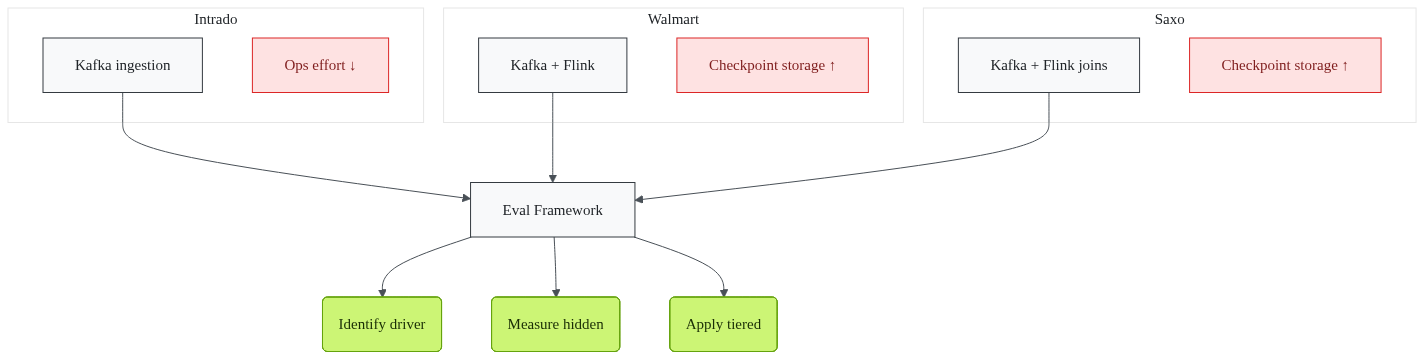
Intrado built a Kafka-centric ingestion pipeline for real-time voice analytics. Moving to Confluent Cloud off-loaded broker-level observability to a managed service. Then it reduced the need for a dedicated ops team. As a result, they saved operational effort. The trade-off was a per-GB pricing tier for metrics, but engineering effort dropped dramatically.
Walmart paired Kafka with Flink for inventory replenishment. Their checkpoint storage grew as product SKUs multiplied, turning storage into a noticeable line item. They mitigated the impact by tiering older checkpoints to cheaper cold storage. Then they pruned checkpoints older than a configurable window.
Saxo Bank runs a hybrid pipeline where high-frequency market data streams through Kafka. While complex event-time joins happen in Flink. When event-time joins exceed a certain throughput, the checkpoint size spikes, pushing the cost curve upward. Their break-even point arrived when the cost of additional checkpoint storage matched the benefit of reduced downstream reprocessing.
These patterns illustrate a repeatable evaluation framework:
- Identify the primary cost driver - storage replication vs. checkpoint size.
- Measure the hidden metric volume - logs, metrics, alerts.
- Apply tiered storage or managed services only where they offset engineering effort.
What concrete steps can you take today to quantify those hidden costs and start cutting them?
Implementation Playbook: How to Quantify and Reduce Hidden TCO
Step 1 - Map every observable to a cost bucket. Create a spreadsheet that lists each metric, log source, and alert. Then assign it to storage, compute, or engineering-hour categories.
Step 2 - Automate checkpoint right-sizing. Use the script above to prune old checkpoints based on a rolling window that matches your SLA. Schedule it via a cron job or Kubernetes CronJob:
1apiVersion: batch/v1beta12kind: CronJob3metadata:4 name: prune-flink-checkpoints5spec:6 schedule: "0 2 * * *"7 jobTemplate:8 spec:9 template:10 spec:11 containers: - name: prune12 image: python:3.9-slim13 command: ["python", "/scripts/prune.py", "my-bucket", "flink/checkpoints/", "30"]14 restartPolicy: OnFailure
Step 3 - Evaluate managed broker services. Compare the per-GB metric ingestion cost of Confluent Cloud or Amazon MSK. Then compare it against the engineering hours you spend maintaining JMX exporters and custom dashboards. This helps decide if the service is worth it.
Step 4 - Consolidate observability stacks. Deploy OpenTelemetry agents on both Kafka and Flink nodes, funnel metrics into a single Prometheus instance. Then
Sources
Research and references cited in this article:
- Real-time Streaming with Apache Kafka and Flink: Architecture for ...
- Apache Kafka vs Apache Flink: The Real Comparison Is ...
- Kafka Streams vs Apache Flink: When to Use What - Conduktor
- Kafka vs Flink | Svix Resources
- Kafka vs Flink: Understanding When to Use Each - Streamkap
- Top Trends for Data Streaming with Apache Kafka and Flink in 2026
- Building Real-time Financial Data Pipelines: A Practical Guide to ...
- Flink, Kafka and Prometheus: better together to improve efficiency of your observability platform
- Flink vs. Kafka and their role in the streaming data pipeline
- Real Time Data Processing: 2026 Architecture & Tools Guide
- Community Use Cases: Real-world Examples of Kafka and Flink in ...
- Apache Kafka Stream Processing - Real Use Cases 2026
About the author
Mayank Singh is a software developer at Levitation Infotech, where he builds web and AI-powered applications across the company’s fintech, healthcare, and enterprise projects.