


TL;DR: Context-aware AI feels safer than RAG because it "understands" user roles and conversation history, but HIPAA doesn't grade on understanding. It grades on provenance, and neither RAG nor context-aware AI ships with a built-in audit trail. The architecture that actually satisfies auditors is policy-grounded RAG with structured data defense.
Key Takeaways: - Context-aware AI and vanilla RAG both fail HIPAA audits because neither tracks which document produced which sentence in the response. - The proposed 2026 HIPAA Security Rule update adds encryption, vulnerability scanning, and network segmentation requirements that apply equally to both architectures. - A HIPAA-defensible stack requires six layers, from structured field nulling to source-citation embedding, wrapped around a policy-grounded retrieval engine.
Your compliance team chose context-aware AI over RAG because it "understands the full situation." The 2026 HIPAA Security Rule update exposes the gap no one planned for: neither approach ships with a built-in audit trail.
The Safer-Than-RAG Illusion: Why 'Context-Aware' Is a Compliance Trap
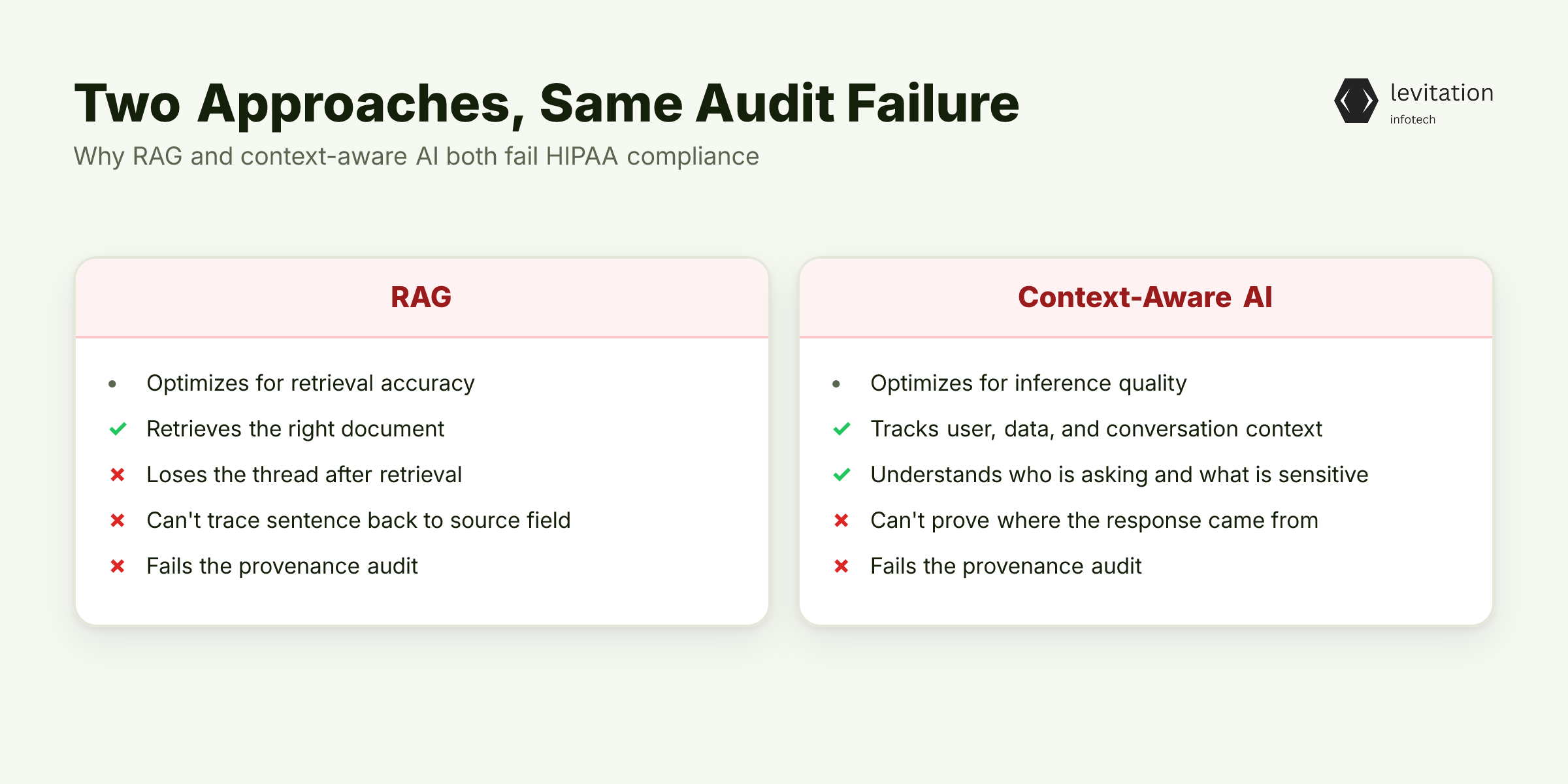
Context-aware AI feels safer to compliance teams. It tracks user roles, data sensitivity, and conversation history. It "knows" who's asking, what's sensitive, and what was said before.
That feels like compliance. It isn't.
"Understanding context" is not the same as "proving provenance." HIPAA grades on the second. An auditor doesn't care that your model inferred the right access level for a cardiologist versus a billing clerk. They care whether you can point to the exact database field that produced the exact sentence in the response.
Context-aware AI optimizes for inference quality. It doesn't optimize for audit trails.
The trust gap is already wide. Distrust of AI for regulatory submissions stems from hallucinations, lack of traceability, and transparency issues. If pharma won't trust AI for submissions, why would a HIPAA auditor trust it for patient-facing decisions?
Teams treat RAG and context-aware AI as opposites: one is safer retrieval, the other is smarter synthesis. Both fail the same audit in different ways.
RAG retrieves the right document and then loses the thread. Context-aware AI maintains the thread and then can't prove where it came from.
The deeper problem: RAG, the supposed alternative, fails the same audit for a different reason. That reason is worth understanding.
RAG's Audit Trail Problem: Why Retrieving the Right Doc Isn't Proving Compliance
RAG models retrieve relevant documents to augment prompts. That's the entire value proposition. But retrieval is not provenance. RAG doesn't natively track which chunk produced which token in the output.
No source provenance means no defensible audit trail. You cannot show an auditor which document, which field, which row produced a specific clinical recommendation. The vector store returned three documents. The LLM synthesized a response. The link between them is lost in the generation step.
This isn't theoretical. Sebastian Gehrmann's research on RAG risks, summarized in "RAG Is Dead for Healthcare AI", shows the "0.3% unsafe" baseline number collapses when context is added. Safety mechanisms were not designed for the combined distribution of safe documents with unsafe queries.
The model has not seen unsafe queries paired with safe documents during safety alignment. So the safety guardrails fire on the query but miss the combined context, and harmful outputs slip through.
Out-of-distribution failure is the strongest hypothesis for why RAG breaks down in production. This is a training-data problem, not a retrieval problem.
No amount of prompt engineering fixes it. The fix is architectural.
The regulatory bar is about to move higher, and it won't favor either architecture.
The 2026 HIPAA Security Rule Update: What Changes for AI Systems
The proposed 2026 HIPAA Security Rule update introduces three new AI-deployment requirements: mandatory encryption, continuous vulnerability scanning, and network segmentation. These are the new floor, not optional.
AI systems now require dedicated risk assessments, not generic data-handling reviews. These must document out-of-distribution failure modes, provenance gaps, and inference-layer attack surfaces. The assessment is AI-specific, not a checkbox on an existing form.
Breach-notification deadlines remain strict. The notification window assumes you can trace exactly which patient data was exposed, which model version processed it, and which user accessed it.
Without provenance, that trace is fiction. You can't meet breach-notification deadlines on a system that can't tell you what it showed a clinician yesterday.
These rules do not distinguish between RAG and context-aware architectures. Both must demonstrate provenance. The architecture, not the marketing label, determines audit outcomes.
So what does a HIPAA-defensible architecture actually look like when neither RAG nor context-aware AI ships with one out of the box?
Six Layers of Data Defense: The Architecture HIPAA Auditors Will Accept
Layer 1: Structured field nulling. An explicit, hand-curated map of PII fields across the database schema. Names, emails, phone numbers, employee IDs, and MRN numbers all get nulled before they enter the prompt. This isn't pattern matching. It's a field registry that evolves with schema migrations.
Layer 2: A context-aware retrieval engine that operates only on the nulled, policy-compliant subset of data. The retrieval layer doesn't see raw PHI. It sees a redacted view governed by access policy.
Layer 3: Field-level encryption at rest and in transit, with keys rotated per the new Security Rule standards. Not table-level encryption. Field-level. Auditors can ask which fields are encrypted, and you answer with a column list, not a vague "everything in the database."
Layer 4: Network segmentation isolating the inference layer from the patient data store. The AI/ML training pipeline, the embedding store, and the vector index run in a separate network zone from the PHI database. Compromise of the inference layer doesn't grant access to patient records.
Layer 5: Source-citation embedding so every generated sentence carries a traceable reference to its source document. A simple example:
1response = generate(2 prompt=prompt,3 citations=True # forces source IDs into output metadata4)5audit_log.append({6 "sentence": response.text,7 "source_doc": response.citations[0].doc_id,8 "source_field": response.citations[0].field_name,9 "timestamp": now()10})
Layer 6: Continuous vulnerability scanning against the inference stack, covering AI/ML training pipelines, embedding stores, and retrieval indices. Not quarterly. Continuous.
The key insight: compliance is structural, not procedural. It lives in the architecture, not in the audit checklist.
One more layer sits above these six, and it changes the compliance equation entirely.
Policy-Grounded RAG: The Hybrid That Actually Satisfies Auditors
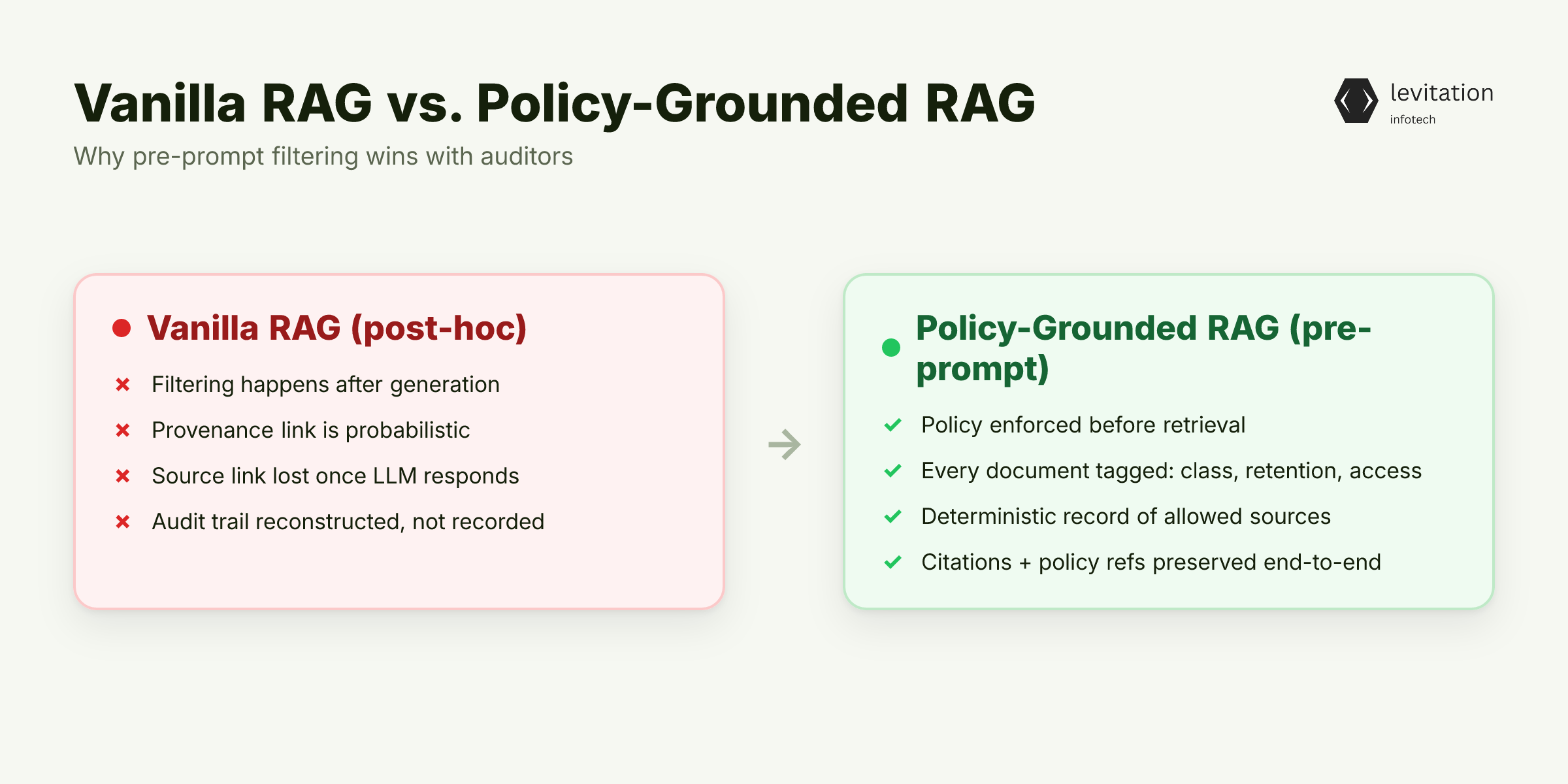
Policy-grounded RAG ensures adherence to regulatory standards by constraining both retrieval and generation to a vetted policy corpus. Every retrieved document is tagged with its classification, retention rule, and access policy before it enters the prompt.
This is where the "safer than RAG" claim transforms from marketing into evidence. Decisions are cross-referenced with legal standards and company policies, producing detailed audit trails and citations. The policy layer is itself auditable.
You can show an auditor not just what the model said, but which policy allowed it, which retention rule applies, and who authorized the document's inclusion.
Unlike vanilla RAG, policy-grounded RAG enforces policy before retrieval, not after generation. The filter is pre-prompt, not post-hoc.
This matters because post-hoc filtering can't recover provenance. Once the LLM has synthesized a response, the link to the source document is probabilistic. Pre-filtering preserves the link as a deterministic record.
This is the architecture that satisfies auditors. Not because it's clever. Because it's inspectable.
Any architecture is only as strong as the checklist behind it. Your auditor will run one.
The Compliance-First CTO's Pre-Deployment Checklist: 7 Audit Questions
Question 1: Can you produce, for any AI response, the exact document and field that generated each sentence? This is the provenance test. If the answer involves "approximate" or "likely," you fail.
Question 2: Is your PII field registry table-by-table, evolving with schema migrations, or pattern matching? Auditors will ask to see the registry. If it's a regex, they will write it up as a finding. If it's a curated schema map, it passes.
Question 3: Does your retrieval layer enforce policy tags before documents enter the prompt, or after? Pre-filter vs. post-filter. Post-filtering cannot reconstruct provenance. Pre-filtering can.
Question 4: Is your AI/ML training pipeline isolated from PHI by network segmentation that meets the 2026 Security Rule standard? Show the network diagram. Show the firewall rules. Show the segmentation test results.
Question 5: Have you run an AI-specific risk assessment documenting out-of-distribution failure modes? Generic data-handling reviews don't count. The assessment must address training-distribution gaps, safety-alignment scope, and combined-context attack surfaces.
Question 6: Can you meet the breach-notification deadline with a traceable data flow diagram? If you can't trace a request end-to-end quickly, you can't meet the deadline. See "Why Your Healthcare LLM Will Fail Its First HIPAA Audit" for the failure pattern.
Question 7: Is vulnerability scanning continuous across the inference stack, covering embeddings, vector store, retrieval engine, and generation model? Quarterly scans miss zero-days. Continuous scanning catches them before auditors do.
Done right, this isn't a compliance burden. It's a competitive moat.
What Changes When Context-Aware AI Is Built for HIPAA From Day One
You stop choosing between RAG and context-aware AI. You deploy policy-grounded RAG as the retrieval backbone with context-awareness layered on top. The architecture is hybrid by design, not by compromise.
Audit cycles shrink because documentation is generated, not assembled. Every response ships with its provenance chain. The auditor's question, "Where did this answer come from?" gets answered in one query.
Risk assessments stop being annual fire drills because the architecture enforces them continuously. Field nulling, policy tagging, and source citations aren't manual processes. They're invariants baked into the system.
The assessment writes itself. You ship faster because the compliance layer is pre-engineered, not retrofitted. The architectures that pass audits are the ones that were designed for audits from the first commit.
Compliance-first AI/ML training and AI compliance aren't add-ons. They're the foundation. Everything else is retrofit.
Frequently Asked Questions
Is context-aware AI HIPAA compliant by default?
No. Context-aware AI systems are not HIPAA compliant out of the box. Compliance requires structured field nulling, policy-grounded retrieval, and source-citation embedding, plus the encryption and network segmentation standards from the proposed 2026 HIPAA Security Rule update. The "context-aware" label describes inference behavior, not compliance posture.
What is the difference between RAG and context-aware AI for HIPAA compliance?
RAG retrieves relevant documents to augment prompts but typically does not track the source of its generated outputs. This makes provenance and audit trails difficult. Context-aware AI maintains conversational and role context across interactions but faces out-of-distribution failure modes when safe documents are paired with unsafe queries. Neither is inherently HIPAA compliant. Both require a policy-grounded layer with structured data defense.
What does the 2026 HIPAA Security Rule require for AI systems?
The proposed 2026 HIPAA Security Rule update introduces mandatory encryption, continuous vulnerability scanning, and network segmentation standards. It also requires AI-specific risk assessments evaluating unique risks such as out-of-distribution failure and provenance gaps. Breach-notification deadlines remain strict, assuming traceable data flow.
How do you audit a context-aware AI system for HIPAA?
Audit by testing provenance: can the system produce, for any response, the exact document and field that generated each sentence? Verify that PII fields are nulled via a hand-curated schema registry before entering the prompt. Confirm that retrieval enforces policy tags pre-filter, and that the inference stack is network-segmented from PHI stores with continuous vulnerability scanning.
What is policy-grounded RAG?
Policy-grounded RAG is a retrieval architecture that constrains both retrieval and generation to a vetted policy corpus. It tags every retrieved document with its classification, retention rule, and access policy before it enters the prompt. This produces a defensible audit trail and cross-references every decision with legal and organizational standards, the architecture that satisfies HIPAA auditors.
Sources
Research and references cited in this article:
- HIPAA Compliance for AI in Healthcare: What Organizations Must Know in 2026 | Medcurity
- Healthcare AI Regulation 2026: New Compliance Requirements Every Provider Must Know
- How to Implement AI in Healthcare Compliance
- HIPAA, Healthcare Data, and Artificial Intelligence
- HIPAA and AI: Navigating Compliance in the Age of Artificial Intelligence
- RAG vs. Context Management DataHub
- Context-Aware AI Systems: All You Need to Know 2026
- Agent Context Layer vs RAG: Architecture and Key Differences
- RAG in AI: Enhancing Accuracy and Context in AI Responses
- What is RAG? A Definitive Guide for Enterprise AI | Contextual AI
- 10 HIPAA Compliant Text Messaging Apps for Healthcare in 2026 | Movius
- Top 7 industries with stringent AI compliance needs in 2026 - Glean
About the author
Mayank Singh is a software developer at Levitation Infotech, where he builds web and AI-powered applications across the company’s fintech, healthcare, and enterprise projects.