


TL;DR: Your hospital's ambient AI scribe is capturing every patient conversation. Most vendor contracts grant the vendor rights to use that data for model training. They hide this in vague "service improvement" language. CTOs can reclaim ownership, but only with specific contract language. The language also needs a technical enforcement layer to make the contract real.
Key Takeaways: - AI vendor contracts claim data usage rights that go well beyond what the service needs. Governance teams rarely catch the expansion. - Three traps hide in "service improvement" clauses. These include output ownership without a true training opt-out, fake opt-outs, and deletion that misses learned model weights. - Contract language and technical controls must work together. Neither one alone protects patient conversations.
The Invisible Listener in Every Exam Room
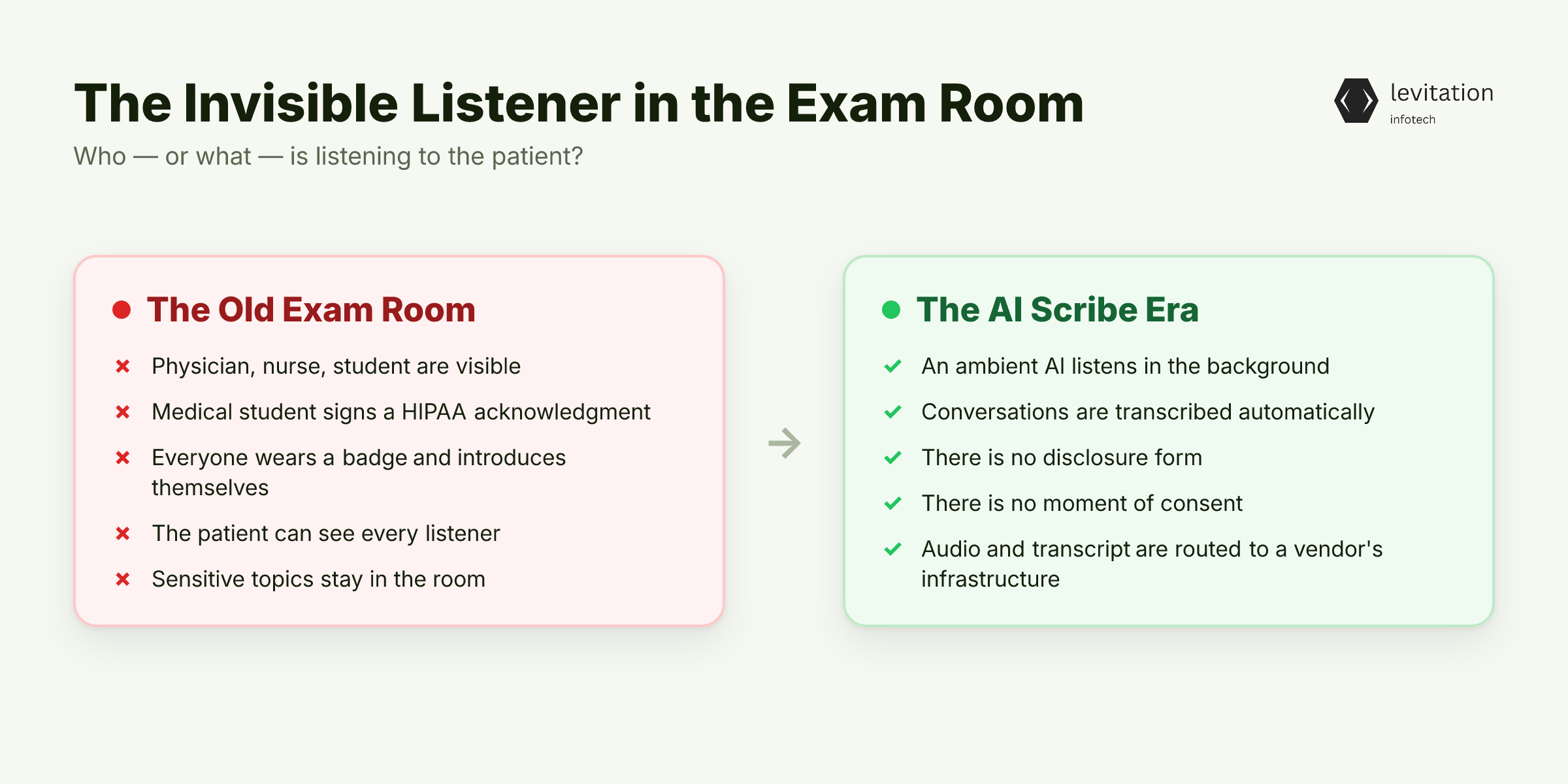
Every word a patient says in an exam room is being captured. It is transcribed. Then it is often used to train someone else's model. And your contract likely says that's fine.
Ambient AI scribes from vendors like Suki and Nuance now sit in major health systems. They record physician-patient conversations in the background. The technology is already deployed at scale. The consent conversation is years behind.
Consider the patient experience. Someone is discussing depression, substance abuse, infertility, or a recent cancer diagnosis with their physician. They assume the conversation stays in the room.
Patients used to know exactly who was present during a medical visit. They could see the physician, the nurse, and the medical student observing the encounter. Everyone in the room was visible.
Ambient AI changes that. The "listener" might be a smartphone on a desk. It could be a microphone connected to a computer. It could be software running quietly in the background. The patient has no idea their most sensitive words are being captured, processed, and routed to a third party's infrastructure. There is no disclosure form. There is no visible human presence. There is no moment of consent.
Unlike a medical student who signs a HIPAA acknowledgment, the AI capture is invisible. There is no badge. There is no introduction. There is no moment when the patient can object.
The obvious answer to this problem sounds reasonable: just check the contract. The hospital's legal team surely reviewed the AI vendor's data processing agreement. The BAA is on file. Everything should be in order.
That assumption falls apart once you see what the contracts actually say.
Why Your 'AI Governance Committee' Can't See What's Happening
AI vendor contracts are written to claim more rights than service delivery requires. This is the first warning sign. The data clauses are typically added later into existing terms of service. They slip into amendments, addenda, or hyperlinks that governance committees never read.
When your top AI companies for healthcare in India procurement team evaluated the vendor, they reviewed the BAA. They also reviewed the SLA and the security questionnaire. They did not read page 47 of the linked terms. That page is where "service improvement" rights are buried.
Here is how the failure compounds. Your legal team approved the data processing agreement two years ago. That agreement said the vendor would process patient data only as needed to provide the service. That sounded like sound governance.
Six months later, the vendor shipped a new AI summarization feature. The feature update email went to a product manager, not the legal team. The updated terms of service were linked in a footer. These terms now include model training rights. Nobody clicked the link.
This is the standard pattern across enterprise AI deployments. The governance committee reviews the original contract. The contract changes quietly through product updates.
By the time someone asks "are we training their model?" the answer is buried. It is buried in three layers of linked terms. Nobody has read those terms.
It mirrors the same problem we saw in Your BAA Covers the Vendor. Not the Inference Layer.. Compliance paperwork covers the surface. It misses the actual data flow.
The gap is not legal incompetence. It is structural. AI vendors change their terms faster than procurement cycles can catch up. Their sales teams promise compliance. Their product teams ship features. The two teams do not sync their contracts.
Once you understand why governance fails, the next question is: what exactly are you missing?
The Three Ownership Traps Hiding in 'Service Improvement' Clauses
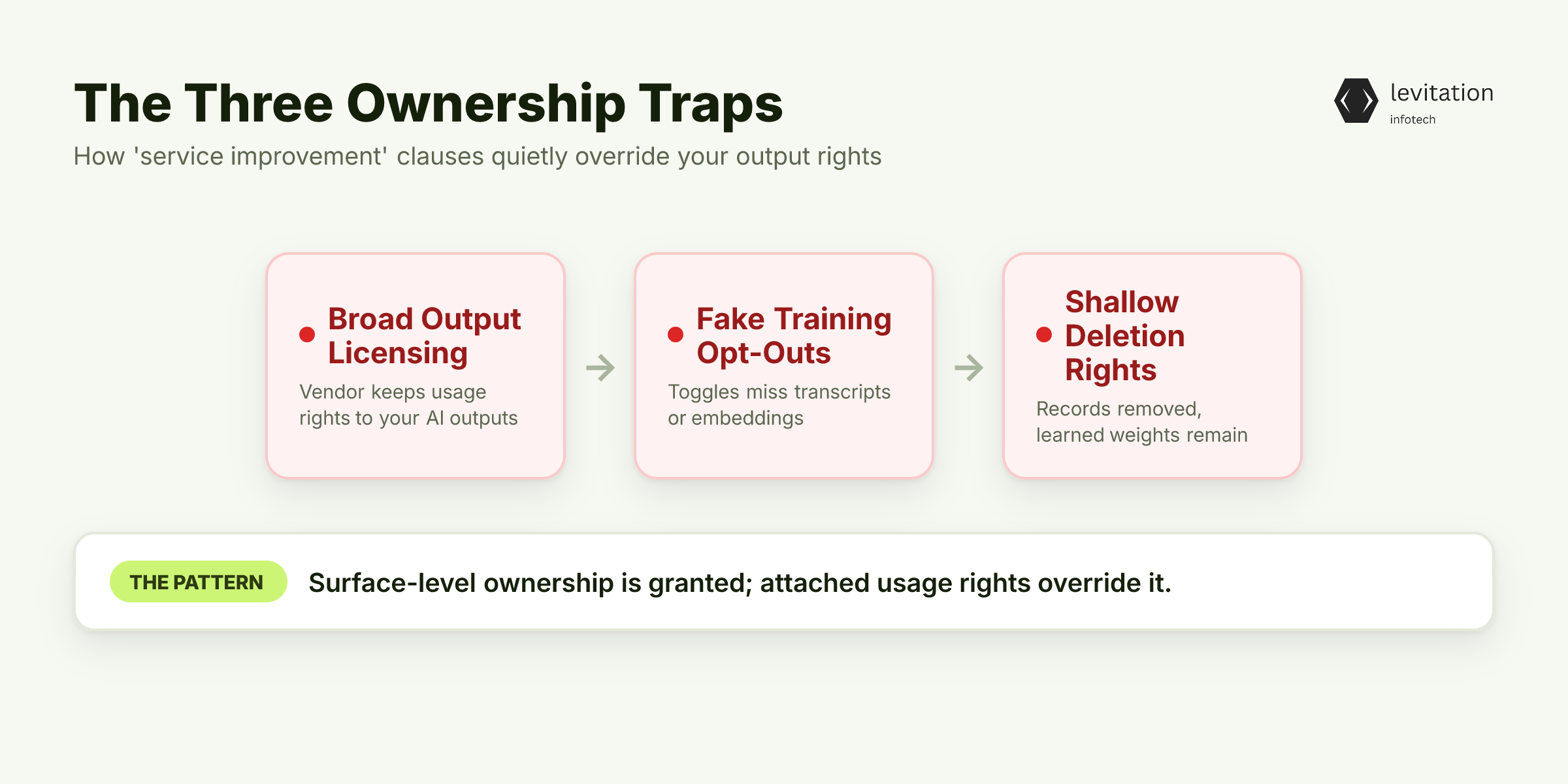
Trap one is broad licensing to outputs. Your hospital technically "owns" the AI-generated clinical note. However, the vendor retains "service improvement" rights. They can use aggregated, anonymized versions indefinitely.
You own the record in your EHR. The vendor owns the pattern extracted from it. This is the uneven framing that vendors rely on.
They give up output ownership to remove your control claims. Then they claim usage rights that undo the concession.
Trap two is training opt-outs that do not exist. Most ambient AI vendors do not offer a true opt-out from training. The toggle is either missing from the admin console. Or it applies only to specific data categories. It might cover session recordings but not transcripts. It might cover transcripts but not embeddings.
Your healthcare technology team requests the opt-out. The vendor says "it's already enabled." They point to a setting that covers only a portion of the data flow.
Trap three is deletion rights that delete the record but not the learned weights. Your patient conversation is removed from the vendor's storage on request. However, the patterns extracted from it remain embedded in the model.
Deletion, in this framing, means the spreadsheet row is gone. It does not mean the intelligence derived from it is gone. The vendor can no longer point to your specific patient's transcript. They can still benefit from everything your patient taught their model.
The pattern runs through all three traps. Each one gives up a surface-level right. That right sounds like protection. But a usage right is attached that overrides the concession.
You signed the contract believing you own the output. The vendor's lawyers drafted it knowing the usage rights override the ownership rights.
This is the exact pattern that leaves hospitals scrambling. It happens when they try to switch vendors. We explored this in our analysis of hospital AI vendor replacement patterns. The replacement cycle is driven not by poor performance. It is driven by data entrapment.
Knowing the traps is only useful if you can rewrite the contract. Here is the language that actually shifts the balance.
The Contract Language That Actually Works
Establishing default ownership. The clause should read: "All output data shall be the exclusive property of the Customer. This includes transcripts, summaries, and derivatives. Vendor receives no license except as required to provide the service."
The word "exclusive" matters. "Shared" or "joint" ownership leaves room for the vendor to claim usage rights. The phrase "except as required to provide the service" narrows the vendor's rights. It narrows them to operational necessity, not business development.
Killing the training opt-out ambiguity. The clause should read: "Customer data shall not be used to train, fine-tune, or improve any model. This includes all inputs and outputs, whether customer-specific or general-purpose. Aggregated or de-identified versions are included in this restriction."
The final sentence is the kill shot. Without it, vendors will argue that aggregated data is no longer "customer data." They will say it falls outside the prohibition. The clause must clearly cover de-identified and aggregated forms.
Data deletion that means deletion. The clause should read: "Upon termination, Vendor shall delete all Customer data. This includes model weights, embeddings, and derivative artifacts. Vendor shall provide written certification within 30 days."
The inclusion of "model weights" and "embeddings" is what makes this clause enforceable. Without it, deletion applies to stored records only. The learned patterns persist.
Exception handling. Narrowly define what the vendor can keep. They can keep system logs, billing records, and aggregated usage statistics that contain no PHI. Require that exceptions cannot be expanded by one side only. A vendor should not be able to amend the exception list through a product update.
The leverage window is open now but it is closing. As AI becomes embedded in standard top AI companies for healthcare in India procurement, vendors will push back harder on these clauses.
The hospitals that renegotiate today set the precedent. The hospitals that wait will be told "we do not offer that to any customer."
These clauses work, but only if you can build and enforce them at the technical layer too.
Building the Technical Layer That Enforces What the Contract Promises
A contract without technical enforcement is a wish list. The vendor's product team can ship features that violate the contract. You will not know until the next audit.
The first control is a vendor-agnostic data egress layer. This layer logs every payload sent to AI vendors. It includes transcripts, metadata, and embeddings. The log is your audit trail.
When the vendor claims "we did not receive that data," your egress log proves otherwise.
The second control is a patient conversation firewall. This is an API gateway. It redacts PII and PHI before sending. It enforces retention policies at your perimeter, not the vendor's.
The firewall sits between your clinical applications and the AI vendor's API. Sensitive identifiers never leave your network in clear text.
The third control is ephemeral processing tokens. For ambient AI sessions, the vendor receives only the minimum data needed for the encounter. The tokens expire automatically.
The session token expires after the clinical note is generated. The vendor's system cannot retain data beyond the session. That is because the access credential no longer works.
When these controls operate as production systems rather than prototypes, the patient data story changes completely.
What Changes When You Actually Own Your Patient Conversations
Regulatory exposure drops. You can prove data minimization and purpose limitation on demand.
When an auditor asks "where does patient data go?" you have a technical answer, not a contractual one. No scrambling during an audit. No relying on the vendor's self-reported compliance.
Vendor lock-in risk drops. You can switch AI providers without losing years of clinical context and learned workflows.
Your transcripts, summaries, and embeddings live in your data layer, not the vendor's proprietary system. Migration becomes a data export, not an extraction negotiation.
Patient trust becomes a competitive advantage. Your consent forms become honest instead of theatrical.
Patients can ask "what happens to my conversation?" Your team can answer with specifics. The conversation is transcribed by vendor X. It is not used for training. It is deleted after Y days. The answer is verifiable, not aspirational.
AI innovation speeds up. Your team can test new models against your own governed data. You don't have to wait for vendor roadmaps.
When a better ambient AI scribe launches, you can evaluate it. You do not need to rebuild your data pipeline. Your healthcare technology strategy shifts from vendor dependency to vendor optionality.
The combination of contract language, egress logging, conversation firewalls, and ephemeral tokens is the operational baseline. It is the baseline for hospitals that treat patient data as a liability they control. They do not treat it as an asset they outsource.
Frequently Asked Questions
Can an AI vendor legally use my hospital's patient conversations to train their models?
Under most current contracts, yes. The vendor may have secured a broad "service improvement" or "model training" license. They often justify it as anonymized or aggregated. Without clear contractual restrictions, AI contracts claim data usage rights that go beyond what service delivery needs.
Does HIPAA prevent AI vendors from training on patient data?
HIPAA requires a Business Associate Agreement. It limits use to specified purposes. It does not fully block model training if the vendor's contract frames it as a permitted use. The protection comes from the BAA's scope language, not from HIPAA itself.
What should I look for in an AI vendor's data ownership clause?
Look for three things. First, clear customer ownership of all outputs, including derivatives. Second, a complete ban on training use of your data. Third, deletion duties that extend to model weights and embeddings, not just stored records.
Can a hospital switch AI vendors without losing clinical context?
Only if the hospital owns its data. The hospital must also keep it in a vendor-neutral format. If the transcripts, summaries, and learned workflows live inside the vendor's proprietary system, migration becomes extractive and incomplete.
What is the fastest way to audit my current AI vendor contracts?
Pull every AI-related addendum, ToS link, and BAA. Do this for your ambient AI, EHR AI, and documentation tools. Search for four phrases. Search for "service improvement," "model training," "aggregated data," and "derivative works." If those terms appear without restrictive language, you have exposure to renegotiate.
Pull one contract today and search for those four trigger phrases. The gap usually shows up on the first read.
About the author
Mayank Singh is a software developer at Levitation Infotech, where he builds web and AI-powered applications across the company’s fintech, healthcare, and enterprise projects.