


Every clinical AI pitch deck leads with a time-saved number. The Ardent pilot cut documentation by 45%. It also freed 5 hours per clinician per week. Dragon Copilot users report 70% less burnout. Oracle's Clinical AI Agent cuts documentation time by over 40%. It also frees more than an hour per day. These are real wins. They are also a deliberate distraction from a different question. How many decisions did the AI get wrong? And did anyone catch them?
TL;DR: Clinical AI vendors lead with time saved because it is easy to measure on day one. The metric that predicts whether a deployment survives 24 months is decision reversal. It measures how often clinicians override AI recommendations. It also measures whether those overrides are correct. CTOs who track override behavior will outlast the hospital AI pilots that fail early. They also separate disagreement from error. They also gate expansion on decision quality.
Key Takeaways: - Time saved is the vendor's metric because finance can count it on day one. Decision quality takes months to track, so it stays out of the deck. - Administrative AI returns investment faster than clinical AI. Clinical AI compounds over a longer horizon. As a result, the wrong return curve is being sold under the right logo. - Override-by-error rate, not total override rate, is the truest safety signal in clinical AI. - A 7-question scorecard separates vendors who track decision quality from those who only count clicks.
The 45% Documentation Time Cut That's Hiding the Real Number
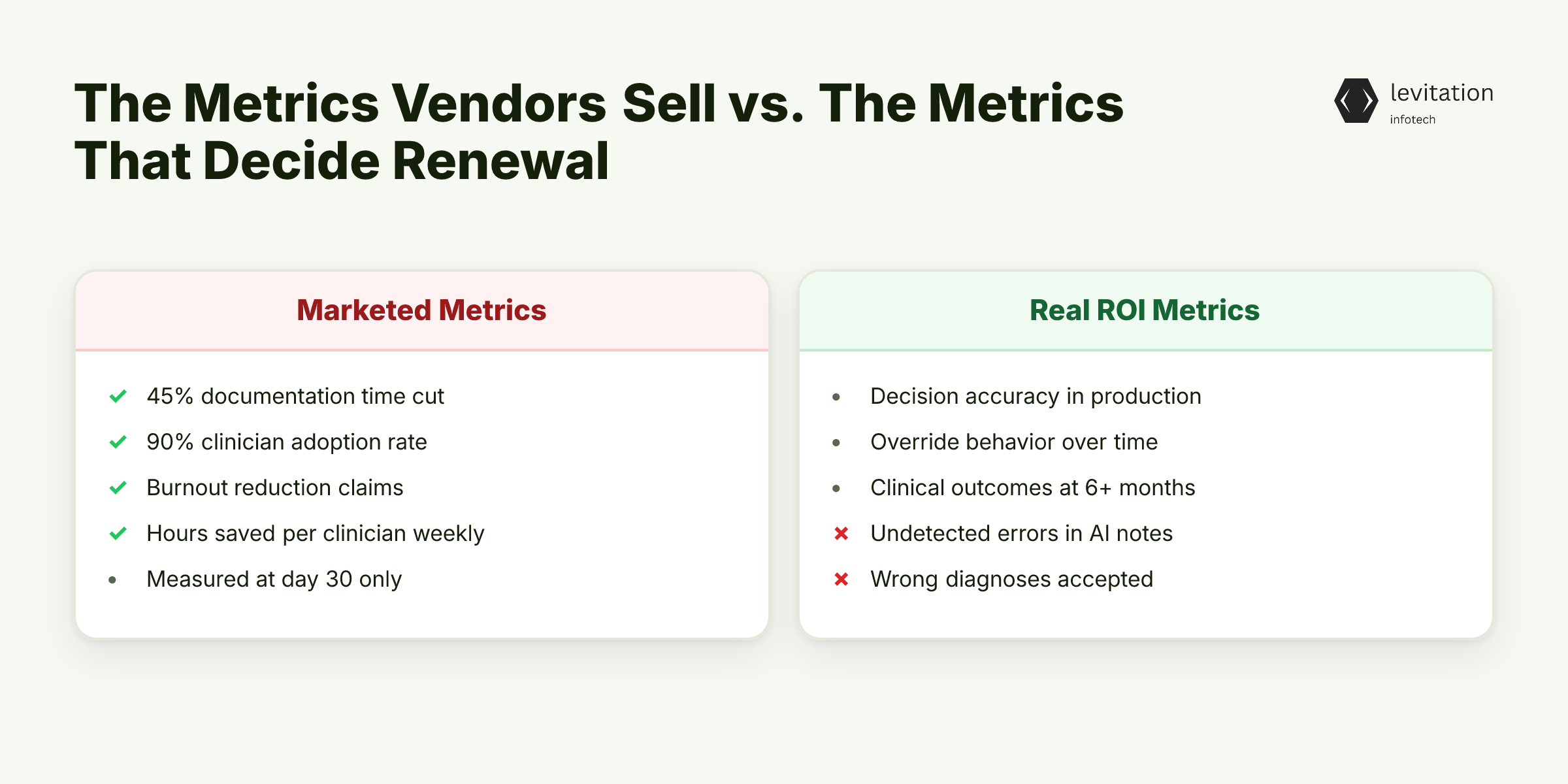
The Ardent pilot numbers are impressive on their own. 45% reduction in documentation time. 90% clinician use across 17 specialties. Five hours saved per clinician per week, sustained.
One of the two dominant ambient AI platforms has built its entire go-to-market on similar figures. It is a 2026 KLAS/CHIME Trailblazer. Dragon Copilot reports 70% of clinicians experiencing reduced burnout. Oracle's Clinical AI Agent claims over 40% documentation time reduction. It also claims more than an hour per day freed.
These numbers are real. The problem is what they don't measure. - They don't tell you how many AI-generated notes contained errors a clinician missed. - They don't tell you how often an AI-suggested diagnosis was wrong but accepted. - They don't tell you what happened to patient outcomes six months later.
Time saved is the metric clinical AI vendors put on slide three. It is the only number they can produce on day 30. The questions that decide whether your deployment survives its second annual review take months of tracking. These include decision accuracy in production, override behavior over time, and downstream clinical outcomes. Most vendors never commit to that work.
That is the fine print nobody reads until the procurement renewal arrives. Time saved is easy to count and easy to sell. Decisions reversed is a number nobody wants to surface. That silence is exactly why it matters more.
Why Time-Saved Became the Default Clinical AI ROI Metric
Administrative AI delivers ROI faster than clinical AI. Clinical AI compounds over a longer horizon. That gap is structural, not accidental. Administrative AI removes a manual process. Clinical AI has to earn trust inside a clinical workflow. The market has merged these two return curves anyway.
Why? - Administrative AI funded the pilots that gave healthcare AI vendors their first reference logos. - Finance teams want fast ROI, and time saved maps cleanly to labor cost models. - Vendors discovered that "minutes saved per clinician" is the one number a CFO will sign off on. They don't need an outside review for this. - Decision quality takes months of production data to surface, so it never makes the pilot deck.
The administrative AI tailwind is funding clinical AI programs whose true return curve doesn't match the pitch. The compounding pattern of clinical AI gets buried when vendors race to publish month-one dashboards. For example, a radiology model at 90% accuracy in year one becomes a different system by year three. This happens after retraining on institutional data.
The deeper problem with measuring minutes is real. The clinical AI systems which actually scale don't optimize for time at all. They optimize for the right decision being made, once.
Decisions Reversed: The Metric That Actually Predicts Whether Clinical AI Survives Year Two
Decision reversal, or override rate, is the truest signal of clinical AI trust. It measures how often a clinician rejects or changes an AI recommendation after seeing it.
A high and stable override rate means clinicians are filtering noise. A near-zero override rate means either perfect trust or over-reliance. You need other data to tell those apart. A climbing override rate means trust is eroding.
The danger is structural. Time-saved metrics can rise while accuracy degrades. This happens if the AI is confidently wrong on cases clinicians rubber-stamp. NEJM AI has published long-term work confirming that AI-powered documentation improves clinician efficiency. Efficiency without decision-quality tracking is incomplete evidence. It tells you clinicians moved faster, not whether they moved in the right direction.
Mature programs separate two kinds of overrides: - Override-by-disagreement: the clinician knows something the model didn't, and the model was actually close to right. - Override-by-error: the model was wrong, and the clinician caught it.
The second category is the real safety metric. The first is a signal of clinician expertise and institutional context. It is valuable, but not a system failure. Most AI in healthcare platforms publish use dashboards. Few publish sustained override paths over time. Almost none separate disagreement from error. A vendor selling minutes saved will not surface this split.
Knowing you should track decisions reversed is the easy part. Building a framework that survives clinical audit and finance review is where most CTOs stall. They also need to pass a CISO's risk register.
Building a Clinical AI ROI Framework That Survives Audit
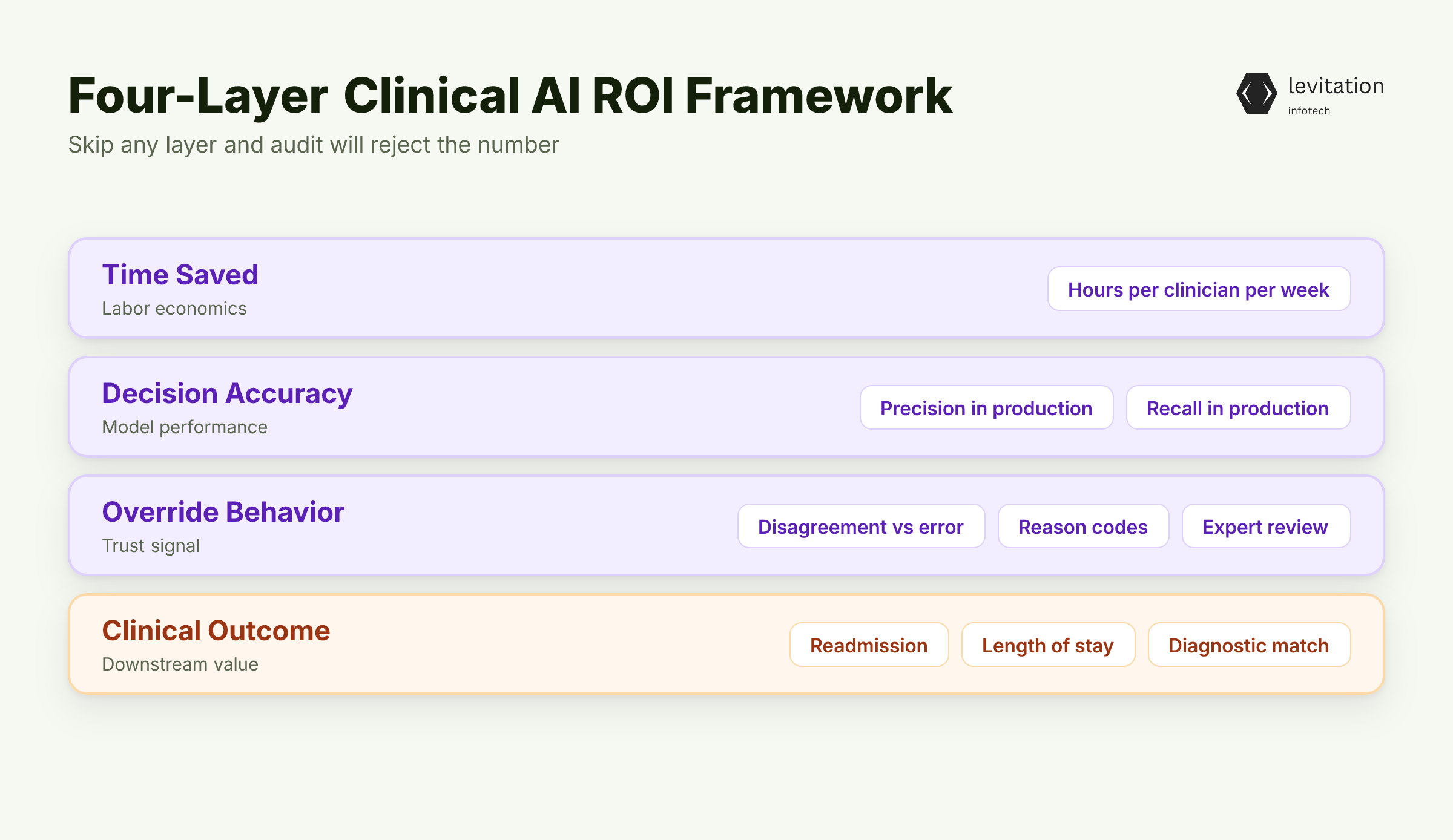
Four measurement layers are required. Skipping any one of them produces a number finance will sign and audit will reject. - Time saved (labor economics): the easy layer, measured in hours per clinician per week. - Decision accuracy (model performance): precision and recall in production, not validation. - Override behavior (trust signal): broken into disagreement versus error. - Clinical outcome (downstream value): readmission, length of stay, diagnostic match.
A typical deployment via an experienced partner reaches production faster. It takes less than the 18 to 24 months an in-house team would need. That speed means faster time to first decision-quality data. It also means faster time to time-saved data. The speed is only useful if the tracking captures the right signals.
At the patient level, you need several things. These include the AI recommendation, the clinician's action, a reason code, and the downstream outcome. Override data needs its own governance. Someone must review it. Disagreements need review by another expert. The signal must feed back into model retraining, not sit in a dashboard nobody opens.
The engineering discipline to keep these pipelines running five years after deployment matters. It is the difference between a case study and a renewal. Once the measurement framework exists, the harder question surfaces. Can your vendor actually answer the questions it raises? Or will they redirect you back to minutes saved?
The 7 Questions That Expose Time-Saved Marketing in Clinical AI Pitches
When a vendor opens with a documentation time reduction, ask the following before you sign the pilot. - What is your sustained override rate at 12 months, not 30 days? Most vendors track 30-day engagement, not decision lasting power. A sustained drop in engagement between month one and month twelve is the real pilot result. - How do you detect model drift in production? If they don't have an answer, the time-saved number is decaying quietly. Clinical AI that retrains daily creates a different audit problem than models updated quarterly. - What proportion of your pilot sites are still active at 24 months? The cleanest single signal of clinical AI value. Vendors who track this won't publish it. - Can you separate override-by-disagreement from override-by-error? If no, you're buying a use dashboard, not a safety instrument. - What is your compounding accuracy curve after institution-specific retraining? A system that improves measurably over years is a different investment. It is not like one that ships at 90% and stays there. - Show me a reference customer I can audit on decision quality, not just use. Reference customers often run different model versions than the production vendor. Verify directly. - What is your roadmap for linking with our existing override capture in the EHR? Without this, you're measuring in a spreadsheet.
When you ask the right questions, clinical AI programs start to look different from the pitch deck. The same happens when you track the right metrics. The variance between medical imaging AI vendors and broader AI companies for healthcare becomes obvious. High client retention isn't a marketing line. It is the only evidence that a vendor's measurement framework matches its deployment reality. Production lasting power separates a compounding clinical AI program from a pilot that gets replaced. It is measured by systems still running 5+ years after deployment.
What Mature Clinical AI Programs Actually Look Like After the Pitch Deck
A radiology AI system that handles a fraction of routine screening on its own in year one can grow. By year three, it can handle a much larger share, with cost flat and accuracy up. That compounding return is the actual product. The 45% time reduction in the pilot is the down payment.
Three patterns mark mature programs: - Decision-quality tracking becomes the gating metric for expansion. Not use, not minutes, not clinician NPS. Override-by-error trends and outcome match drive the next phase budget. - Long-term partnership signals dominate vendor selection. High client retention reflects what happens when the measurement framework matches the deployment reality. Programs whose vendors stayed are the ones that compound. - Production lasting power replaces pilot metrics as the credibility signal. Systems still running in production 5+ years after deployment are the only credible evidence. They show that AI for healthcare programs compound rather than decay. A system that worked brilliantly for 14 months and was replaced tells you nothing. It doesn't tell you whether the category works.
The real payoff isn't the first 45% time reduction. It is the year-three system that clinicians trust enough to act on. They override when needed. They also fit into pathways that compound value every quarter.
Frequently Asked Questions
How do you measure clinical AI ROI beyond time saved?
The minimum viable framework has four layers. These are time saved, decision accuracy, override behavior, and clinical outcome. Time saved is the labor economics layer. Decision accuracy is the model performance layer. Override behavior is the clinician trust signal. Clinical outcome is the downstream patient impact. Time saved is the easiest to measure. It is also the least predictive of whether the deployment will survive 24 months.
What is the average ROI of clinical AI in hospitals?
Clinical AI ROI compounds over a longer horizon than administrative AI. The variance is wide. Clinical AI value compounds after institution-specific retraining and workflow fit. Most pilots never reach this stage.
How long does it take for clinical AI to break even?
Clinical AI takes longer to break even than administrative AI. Mature programs report that year-three value can be several times year-one value. The model must be retrained on institutional data. It must be built into clinical pathways. It must be trusted by clinicians. Faster deployment to production compounds the long-term return.
What questions should I ask clinical AI vendors about ROI claims?
Ask for sustained override rates at 12 months. Don't just ask for 30-day engagement. Also ask about model drift detection. Ask about pilot-to-24-month survival rates. Also ask for the ability to separate override-by-disagreement from override-by-error. Ask for the compounding accuracy curve after retraining. Ask for audit-ready reference customers. Ask for EHR override link roadmap. Time-saved figures without these answers are marketing, not evidence.
How do you measure clinician trust in AI tools?
The strongest objective signal is decision reversal behavior. It measures how often a clinician overrides or changes an AI recommendation. It also measures whether the override rate stays stable over time. It also measures if it goes up, which signals trust erosion. It also measures if it goes down, which signals over-reliance. Pair this with override-by-error review. This tells you if clinicians are catching AI mistakes. It also tells you if they are rejecting correct recommendations.
Want help pressure-testing a current vendor against this scorecard? Start with question one.
About the author
Mayank Singh is a software developer at Levitation Infotech, where he builds web and AI-powered applications across the company’s fintech, healthcare, and enterprise projects.