


TL;DR: IRDAI's audit-trail mandate is making insurers' best fraud AI models legally indefensible. The same models catching organized rings are losing cases in reconstruction. Production pipelines were never built to persist reasoning. The fix is not better logging. It is redesigning the inference stack. The stack should make auditability a property of the model, not a retrofit added on top.
Key Takeaways: - The real cost of IRDAI's rule lives inside the model architecture, not the storage layer. - Per-decision explainability in real time adds latency that compounds into throughput loss at claims volume. - Audit-by-construction turns a compliance tax into a forensic asset that retrains the model with every disputed claim.
The Audit Log Problem
A fraud model flags a potential claim ring. The Special Investigation Unit digs in. The case is solid.
Then the market conduct examiner asks for the model's reasoning trail. The insurer cannot reconstruct why specific features triggered the alert. The model is fine.
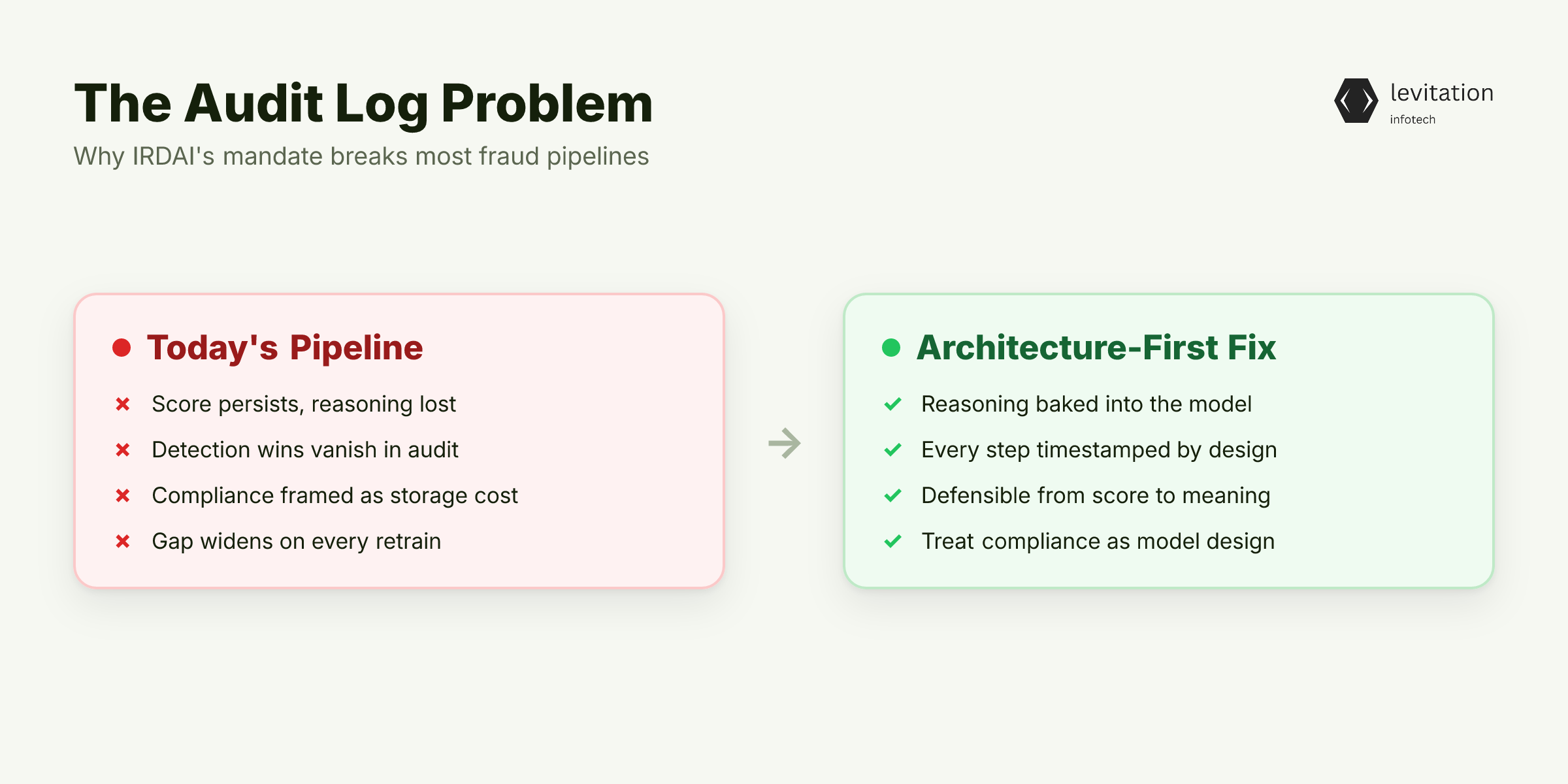
The pipeline was never built to persist the "why." This is the central tension behind IRDAI's mandate. The mandate calls for a timestamped record of every AI reasoning step and decision. It creates a compliance burden most fraud pipelines were never designed to carry.
The result: detection wins that vanish in audit. The audit rule is not the enemy of fraud AI. The current implementation pattern is silently eroding those wins. Most governance teams have not yet connected the two.
The typical assumption is that the cost of compliance is operational. More storage, more logging, more review cycles. The real cost is technical. It lives inside the model itself. It sits in the gap between what the score said and what can later be proven the score meant. This gap widens with every model retrain.
The fix requires looking at the ai compliance problem as a model architecture problem. It is not a logging problem. Most teams have it exactly backwards. The cost shows up first where the model was never designed to defend itself.
What IRDAI's Audit Rule Actually Demands From Your Pipeline
The rule is specific. It requires a complete, timestamped record of every customer interaction, AI reasoning step, and decision. Records must be retained for market conduct examinations, complaint investigations, and disputes.
This is not generic data retention. It targets the reasoning path itself, not just input and output. In practice, the audit trail must capture: - The exact model version that scored the claim - The feature contributions that drove the score - The threshold logic that converted score into action - The override history if a human reversed the decision - The preprocessing pipeline that produced the inputs
For fraud AI, this is uniquely punishing. Claims models make high-stakes binary decisions on sparse signals. The "why" behind a fraud flag is the most contested part of any disputed claim.
Examiners, grievance officers, and courts will all demand that same "why." They will demand it months after the original decision. Fraud rings are often investigated long after the claim is settled. The audit trail must be queryable long after the transaction has aged out of typical inference logs.
Most production inference logs are not designed for that. They do not reconstruct the reasoning behind a decision. The decision sits inside a claims stack that gets swapped out across retraining cycles.
Over time, the gap between what was logged and what is reconstructable grows. The harder problem is not knowing what must be logged. It is that the way fraud models are typically built makes the required logging hostile to model performance. As a result, regulatory compliance is forcing a redesign, not a wrapper.
Why High-Performance Fraud Models Resist Audit Logging
Production fraud models are optimized for low-latency scoring. They use ensemble methods, feature stores, streaming inputs, and precomputed embeddings. None of these components natively emit auditable reasoning. They emit predictions.
The first friction point is latency. Every SHAP or LIME explanation added to a fraud scoring call adds compute. At claims volume, that latency compounds into throughput loss.
Throughput loss in claims is not a soft cost. It is the time a policyholder waits for settlement. It is the time a hospital waits for pre-authorization. It is the time a fraud ring has to cash out before the SIU gets the alert.
Teams that cannot keep scoring fast enough lose the operational benefits the model was supposed to deliver. The second friction point is version drift. Effective fraud models retrain frequently to keep pace with evolving fraud patterns. If the audit trail does not capture which model version scored which claim, the explanation becomes invalid.
A SHAP value generated at inference time is meaningless. It is meaningless if the model has since been retrained on a new fraud pattern. The audit trail must bind the score to the exact artifact that produced it. The artifact includes weights, preprocessing code, and feature definitions. Otherwise the reconstruction is a guess. The artifact must travel with the explanation.
The third friction point is feature attribution decay. Fraud signals age quickly. A claim that looks anomalous at one point is explainable only with market context that emerged later. A new fraud ring, a policy renewal cycle, or a regional event can all change the reading.
Most logging systems freeze the explanation at inference time, then leave it to rot. By the time a dispute lands, the explanation describes a world that no longer exists. This is where governance teams stall.
They treat audit logging as a logging problem. It is actually a model architecture problem. Fixing claims AI explainability means rebuilding the inference stack. Scoring and reasoning must be decoupled. The reasoning must be durable, not ephemeral.
The Explainability Tax: Quantifying What Audit Readiness Actually Costs
The explainability tax is the combined latency, storage, and engineering overhead required. It is needed to make every fraud decision fully reconstructable under IRDAI's standard. It has three cost vectors. They compound.
First, per-decision explanation generation. SHAP, LIME, and counterfactual explanations all consume CPU or GPU cycles. Those cycles would otherwise go into scoring the next claim. At peak claims volume, this is not a marginal cost. It is a capacity ceiling.
Second, immutable audit log storage. Every claim now generates a record that must be retained, indexed, and queryable for years. The volume scales with claims volume. The retention horizon scales with the regulatory window. Together they produce a storage curve that bends upward faster than the underlying business.
Third, the human review overhead. When an auditor questions a flag, someone must reconstruct the decision and explain it. If reconstruction takes hours, the SIU loses time chasing the next ring. If reconstruction takes days, the audit team has become a bottleneck on the fraud function.
The second-order effect is worse. When the tax is too high, fraud teams respond. They simplify models, drop features, or lower decision thresholds. All of these degrade detection accuracy.
The insurer ends up with a model that is both less effective and more compliant. That is the worst of both worlds. The lesson is the same: the tax is not fixed. It is a function of how well the audit infrastructure is designed. Poor design makes the tax regressive. Regressive taxes are paid in detection accuracy.
The implementation path becomes obvious once the tax is visible. Stop bolting audit logging onto a fraud model. Start designing the fraud model around auditable inference from day one. That is the only way to keep the IRDAI model audit trail from silently shrinking the fraud win rate.
Designing Fraud AI That Is Audit-Compliant by Construction
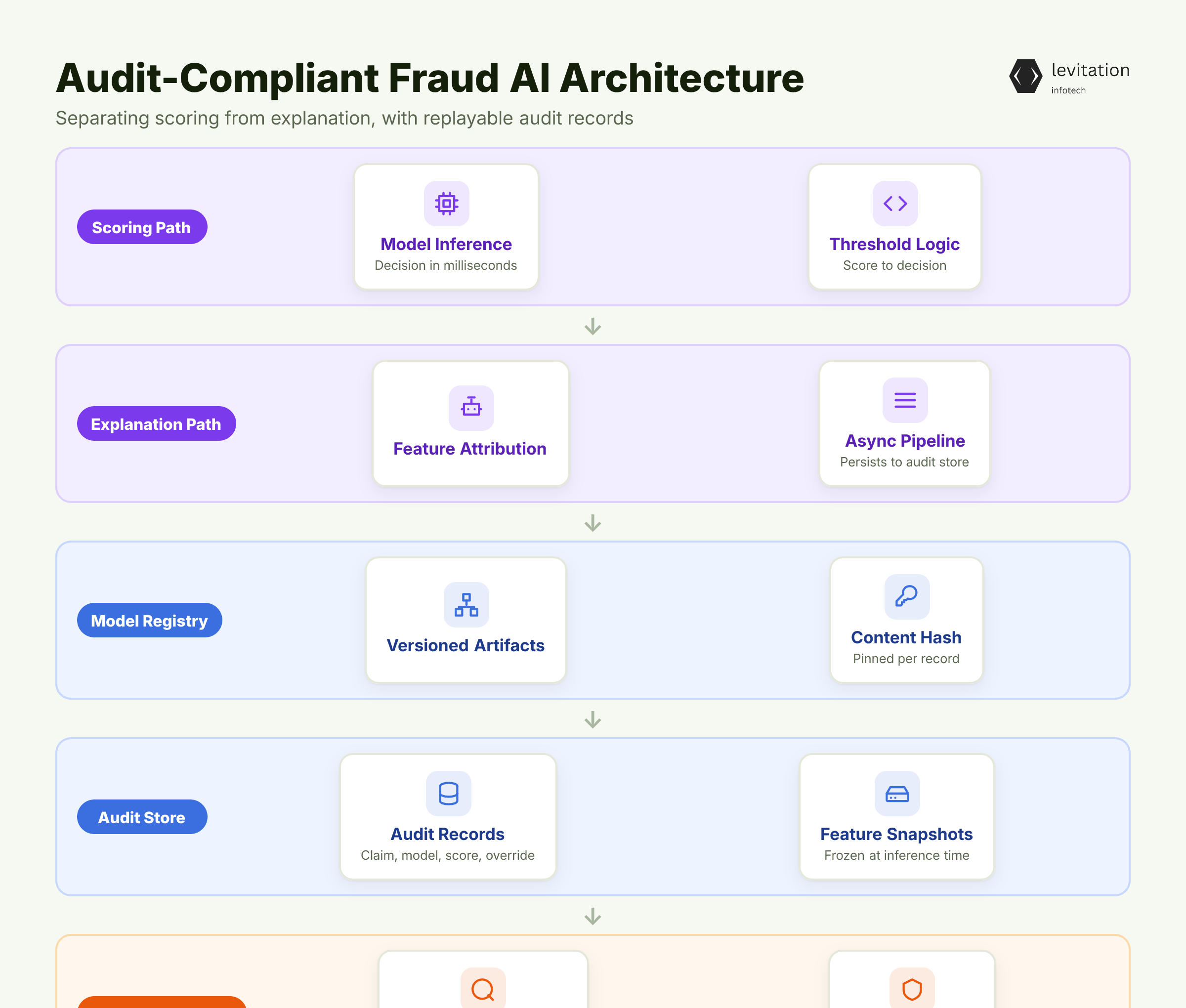
The architectural pattern that works is to separate the scoring path from the explanation path. Score synchronously for low latency. Generate and persist explanations asynchronously to a dedicated audit store. The model returns its decision in milliseconds. The reasoning catches up on its own schedule.
The audit record schema should include: - Claim identifier and timestamp - Model version with a content hash of the exact artifact - Feature snapshot, frozen at inference time - Raw score and the threshold applied to convert it to a decision - Explanation vector, persisted once generated - Human override flag and the override reasoning if present - Retention class, defining how long this record must remain queryable
The model versioning problem is the one most teams get wrong. Use a model registry that pins the exact artifact: weights, preprocessing code, feature definitions, and threshold logic. Generate a content hash for that artifact, and write the hash into every audit record.
When a reconstruction is requested, the audit store resolves the hash back to the artifact. It replays the inference. It returns the explanation the model would have produced.
This works only if the model registry is immutable for any artifact that has been used in production. It also requires the explanation pipeline to reproduce a feature attribution deterministically from the stored snapshot.
The governance loop matters as much as the schema. When an IRDAI examiner requests a reconstruction, the audit store should resolve to a replayable inference. It should not resolve to a static screenshot or a PDF report. The logging system must be queryable by claim, by feature, by model version, and by date range. It must return results quickly enough to keep pace with examiner expectations.
This kind of architecture is the only one that survives multiple regulatory regime changes. The compliance automation must be a property of the inference stack, not a downstream concern.
Turning IRDAI's Audit Rule Into a Fraud Model Advantage
Once the audit store exists, it stops being a compliance checkbox and becomes a forensic asset. A well-designed audit store is the SIU's best tool for pattern detection across historical fraud rings. It contains, in one place, every decision the model ever made and the reasoning behind it.
The feedback loop is the multiplier. When investigators confirm a fraud flag, that label flows back into the audit store and retrains the model. When they overturn a flag, that label flows back too. The compliance system actively improves detection, rather than just storing evidence.
The model that learns from its own audit trail is the model that compounds its advantage over time. The governance metric that matters is time-to-reconstruction. How fast can your team answer "why did this claim get flagged?" If the answer is slow, the system is losing fraud wins during investigations.
The examiner is waiting. The SIU is waiting. The case is going cold. Fast reconstruction time is the operational benchmark. It is the benchmark for a system that has its regulatory AI infrastructure in order.
The organizational shift is just as important. The Head of AI Governance should own the audit store specification. The Head should not delegate it to the data engineering team. The schema determines what is auditable. The schema is a governance decision, not an engineering detail. This ownership question is often the difference between a defensible system and one that falls apart. It falls apart the first time an examiner asks a sharp question.
When this architecture is in place, the tradeoff between compliance and fraud performance disappears. The audit rule becomes a structural advantage rather than a hidden cost. The next question is how to make that shift land inside a working claims stack.
What Changes When Audit Compliance and Fraud AI Align
The shift is from a defensive posture to an offensive one. Insurers stop hoping the audit trail is enough and start using it to win more fraud cases. The audit store becomes a corpus. The SIU queries it for pattern matching. The ML team uses it for retraining. The governance team uses it for examiner responses.
The concrete outcomes: - Market conduct responses measured in hours, not weeks - Investigator productivity up, because reconstruction is automated - Model accuracy up, because disputed-claim labels flow back into retraining - Regulatory risk down, because the audit trail is reconstructable on demand
Under IRDAI's evolving guidelines, insurers with audit-by-construction architectures will scale AI deployment without linear compliance overhead. Those without will quietly cap their model complexity to keep the explainability tax manageable. They will lose the fraud cases that more sophisticated models would have caught.
The governance leader's mandate is clear. The question is no longer "can we deploy this fraud model?" It is "can we reconstruct its decision under audit?" If the answer is no, the model is a liability, not an asset. Closing that gap is the single highest-leverage move an insurer can make on fraud AI right now. The teams that treat insurance AI compliance as a model design constraint will be the ones still winning fraud cases. They will still be winning cases three years from now.
Frequently Asked Questions
Q: What does IRDAI's AI audit rule require insurers to log?
A: The rule mandates a complete, timestamped record of every customer interaction, AI reasoning step, and decision. Records must be retained long enough to support market conduct examinations, complaint investigations, and disputes. This goes beyond input-output logging. It requires reconstructable reasoning.
Q: How does IRDAI's audit rule affect fraud detection AI performance?
A: Retrofitting audit logging onto a production fraud model introduces an explainability tax. The tax covers latency from per-decision explanations, storage from immutable audit logs, and engineering overhead from version pinning. When the tax is too high, teams simplify models and lose detection accuracy.
Q: Can fraud AI models be both explainable and high-performance under IRDAI guidelines?
A: Yes, but only if the model is designed for auditability from the start. The effective pattern separates synchronous scoring from asynchronous explanation generation. It pins the exact model artifact to every scored claim. It stores explanations in a queryable audit store rather than flat logs.
Q: What is the biggest governance mistake insurers make with IRDAI's AI compliance?
A: Treating audit logging as a data engineering problem rather than a model architecture problem. When logging is bolted on after deployment, the model cannot be replayed. Version drift invalidates explanations. The governance team cannot answer reconstruction requests under audit pressure.
Q: Does IRDAI require explainability for every AI decision, or only for disputed claims?
A: The audit rule requires reconstructability for every AI decision, not just disputed ones. Disputes and market conduct reviews often surface months after the original decision. Insurers cannot wait until a claim is flagged to begin logging reasoning.
Auditability has to live inside the model, not next to it. Levitation designs inference stacks where that property is part of the architecture from the first line of code. As a result, every fraud decision survives the examiner's review.
Sources
Research and references cited in this article:
- Strict Audit Trails for AI Support in Insurance (2026) | Lorikeet
- AI Audit Trail Requirements: 2026 Checklist for Finance, ...
- AI Governance in Insurance: A 2026 Guide for Leaders
- The Carrier’s Guide to Insurance AI Regulation | WaterStreet Company
- Model - Innovation, Cybersecurity, and Technology (H) Working Group
- AI Automated Claims Management Guide (May 2026)
- AI Claims Processing: The Complete 2026 Guide for US Carriers
- AI Is Shaping the Future of Underwriting, Fraud Detection, Risk Management - Actuary.org
- PDF The Role of Artificial Intelligence in Enhancing Efficiency and Fraud ...
- Artificial Intelligence - Insurance Topics - NAIC
- Top 10 AI Use Cases Transforming Indian Insurance in 2026 — YuVerse.ai
- India's insurance regulator steps in to govern AI adoption
About the author
Mayank Singh is a software developer at Levitation Infotech, where he builds web and AI-powered applications across the company’s fintech, healthcare, and enterprise projects.