CBDCs are gaining momentum as countries race to make money smarter and more secure.
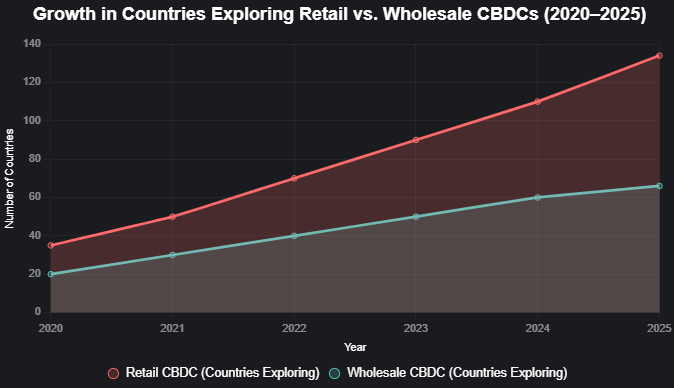
Governments want faster transactions, stronger control over monetary policy, and better ways to fight fraud and money laundering. Over 130 countries are now developing or testing their own digital currencies from China’s digital yuan to the EU’s digital euro. The impact? A future where payments are instant, cross-border transfers become seamless, and financial systems become more transparent and inclusive.
CBDCs combine the trust of traditional money with the convenience of digital payments. Unlike cryptocurrencies, they’re backed by central banks, so they’re stable and widely accepted.
For fintech companies, this is a big deal. CBDCs will change how we build payment systems, handle settlements, and manage compliance. They bring new opportunities like instant transactions and programmable money but also challenges around privacy, tech integration, and regulations.
The question isn’t if CBDCs will arrive, but when and whether your fintech stack is ready to work with them.
This blog will help you understand what CBDCs mean for your products, tech teams, and compliance needs, so you can stay ahead and turn this shift into an advantage. Let’s get started.
What Are CBDCs?
A Central Bank Digital Currency (CBDC) is a digital version of a country’s official money, issued and backed by its central bank. It has the same value as cash and can be exchanged one-to-one with physical money.
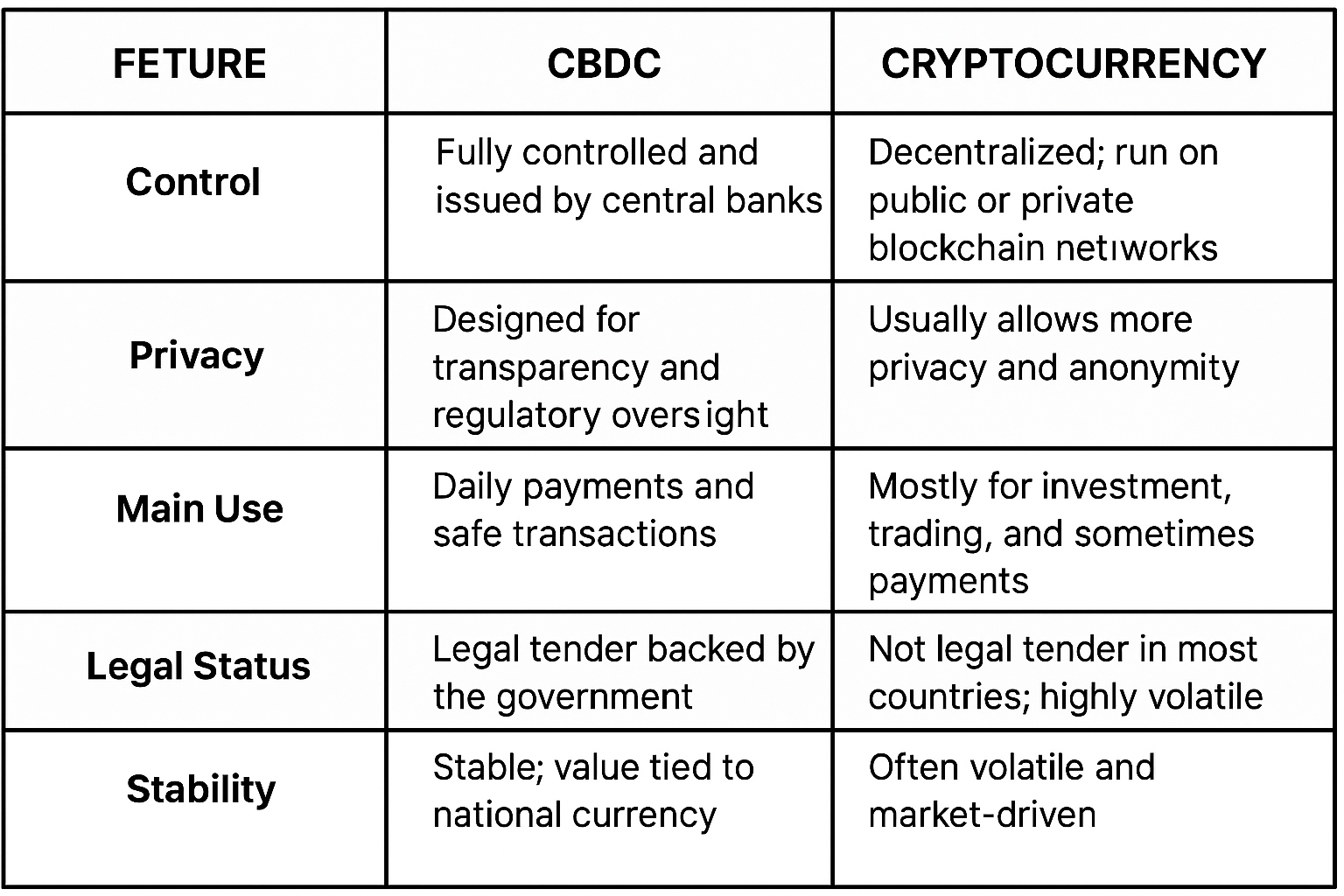
Unlike cryptocurrencies like Bitcoin, which are decentralized and often volatile, CBDCs are stable and centrally controlled. They are designed to offer the safety of traditional money with the speed and convenience of digital payments.
Types of CBDCs
- Retail CBDC: Made for everyday use by the public. People and businesses can hold and pay with it, just like cash but in a digital form. Example: The Bahamas’ Sand Dollar lets citizens make payments via mobile apps, even on remote islands.
- Wholesale CBDC: Used only between banks and financial institutions to make large transactions faster and safer. This helps improve settlement processes and cross-border payments.
CBDC Design Models
CBDCs can be built in different ways depending on what a country wants to achieve.
- Wholesale Model: This supports banks and large institutions to settle payments and move assets instantly. It makes cross-border transactions smoother and reduces costs. For example, banks can use it to transfer assets directly, minimizing risks.
- Retail Model: This allows everyday users and businesses to hold and pay using digital currency directly from their phones or digital wallets. It helps reduce the use of cash, lowers costs, and improves financial access for people without bank accounts.
There are also two ways people can access retail CBDCs:
- Account-based: Users have an account with the central bank. Transactions are verified through identity checks, just like with bank accounts today.
- Token-based: Works more like cash. Users hold digital tokens, and transactions are verified with keys and signatures rather than personal IDs. This offers more privacy but also carries a risk if you lose your private key, you lose access to your money.
How Are CBDCs Different From the Money in Your Bank App?
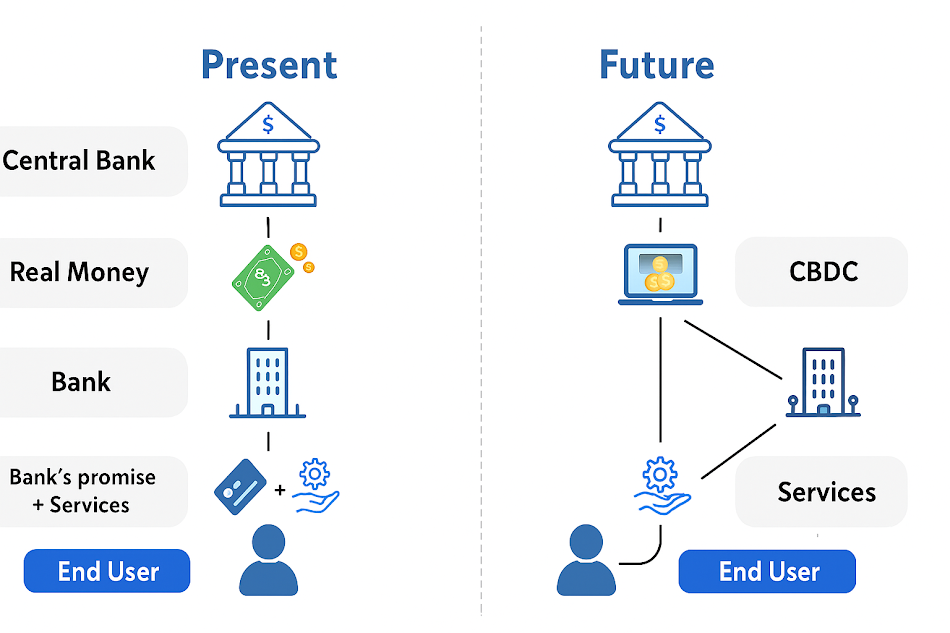
When you use money in your bank app today, it’s actually held and managed by your private bank. You rely on them to keep it safe and process payments.
CBDCs work differently. They come straight from the central bank. This means:
- You’re not relying on a private bank to protect your money.
- There’s no risk of losing your money if a bank fails.
- It’s legal tender, accepted everywhere (at least in theory), just like physical cash.
Think of a CBDC as "digital cash" issued by the government, made for a modern, cashless world.
Example:
Imagine you receive ₹1,000 from a friend using your bank app today. That money is actually a promise from your bank. They hold it and show it in your app balance.
With a CBDC, you would receive ₹1,000 directly from the central bank into your digital wallet, just like getting cash in hand, but in a digital form. You don’t need to depend on a private bank to hold or guarantee it.
CBDC vs Cryptocurrency: What’s Different?
Global Momentum and Real-World Examples
Recent Developments in CBDCs
Central Bank Digital Currencies have moved quickly from theory to reality. Over 130 countries, covering nearly 98% of global GDP, are now exploring or developing CBDCs.
Governments see CBDCs as a way to make payments faster, improve financial access, and reduce cash handling costs. From small island nations to large economies, the momentum is clear and it’s growing fast.
Notable CBDC Implementations
Some countries are already leading the way with real-world CBDC projects:
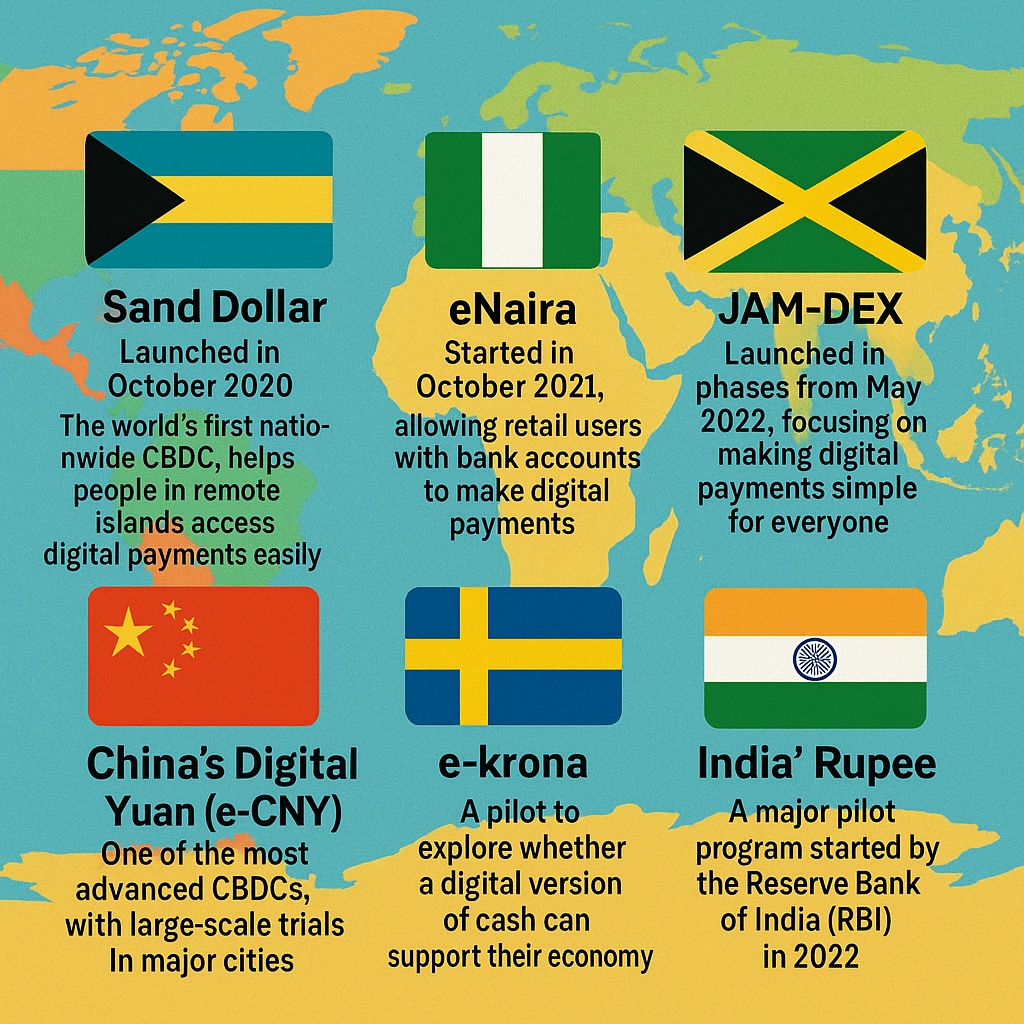
These examples show how countries are using CBDCs to modernize payments and reach more people.
Where Do Countries Stand on CBDCs?
Countries are at different stages when it comes to CBDCs:
- Live and launched: The Bahamas (Sand Dollar), Eastern Caribbean (DCash), and Nigeria (eNaira) already have fully launched digital currencies.
- Pilot stage: Countries like Jamaica, Uruguay, Sweden, Ukraine, Russia, South Africa, Saudi Arabia, UAE, China, Thailand, Malaysia, and Singapore are running pilot projects.
- Research and development: Nations such as Canada, Brazil, Switzerland, Turkey, Israel, Lebanon, Cambodia, Japan, and Australia are in advanced research phases. Many others, including the US (retail version), Mexico, Peru, Chile, Kenya, and several European and Asian countries, are still exploring or testing early-stage ideas.
This wide range shows that CBDCs are no longer a distant future; they're quickly becoming part of national financial systems.
India’s Exploration of CBDCs
India has been moving fast with its CBDC plans. In 2022, the Reserve Bank of India (RBI) launched its digital rupee, known as the e-rupee, using blockchain technology.
Two pilots kicked off: a wholesale version (CBDC-W) with nine banks in November 2022 and a retail version (CBDC-R) in December 2022 in cities like Mumbai, Delhi, Bengaluru, and Bhubaneswar. The retail pilot started small but quickly expanded to over 15 cities, reaching 50,000 customers and 10,000 merchants, including major retail chains.
By December 2023, India’s CBDC had already crossed 1 million transactions per day and has since grown to over 2 million daily transactions.
While the wholesale version focuses on making interbank payments faster and safer, the retail version is designed for everyday use, aiming to modernize how people handle cash and bring more people into the digital economy.
Why It Matters for Fintech
Why Should Fintech Teams Pay Attention?
CBDCs represent a big shift in how money is designed and used.
- For product teams: CBDCs enable instant payments, automatic refunds, and smart features like conditional or scheduled transfers.
- For engineers: You’ll need to integrate new APIs, handle real-time transactions, and possibly work with blockchain or similar technologies.
- Key advantages: Faster settlements, lower costs, and better visibility over money flows.
In short, CBDCs aren’t a new kind of money, they're your country’s official money in a new, digital form, backed by the central bank.
The Role of Fintech in CBDC Development
Fintech companies are essential to making CBDCs practical and user-friendly. They build secure apps, digital wallets, and payment systems to help people and businesses adopt CBDCs easily.
Beyond security and efficiency, fintech firms also support financial inclusion by designing tools that reach people who don’t have access to traditional banking services.
CBDCs and Banks: A New Chapter
Banks play a major role in distributing CBDCs. In India, for example, the Reserve Bank of India issues the digital rupee, but banks handle its distribution and customer interaction.
This change may reduce banks’ earnings from some traditional services but creates new opportunities. Banks can now offer faster payments, secure digital wallets, and innovative financial products tailored to modern users’ needs.
Modernising Banking Services
CBDCs push banks to update and improve their services. By adopting digital currency, banks can deliver quicker transactions, better security, and simpler user experiences.
For example, Indian banks can help customers hold digital rupees, making transactions seamless while opening new business models, like programmable payments and specialized wallets.
How CBDCs Are Reshaping Digital Payments in the Fintech Sector
Central banks have long ensured the stability of payment systems, but CBDCs mark a new era. These digital currencies modernize how we pay, enabling faster, safer, and more flexible transactions.
With fintech driving this change, CBDCs transform everyday payments into smarter, more automated experiences. This shift is not just technical, it changes how consumers, businesses, and governments think about money.
Implications for Fintech Stacks: Beyond Payments
CBDCs will impact more than just payment systems.
- Backend infrastructure: Fintech will need to update their ledgers and processing systems to connect directly to central bank platforms or through intermediary banks. Instant settlement and immutability will require new reconciliation and data structures.
- APIs: New APIs will emerge for managing CBDC transactions, digital wallets, and programmable payments. Fintech will need to adapt quickly to integrate these.
- Core banking integrations: Fintech working closely with banks will need to understand how core systems will handle CBDC accounts, possibly leading to new integrations and upgrades.
- Product architecture: Programmable money enables innovative features like automatic supplier payments, conditional subsidies, or expense-specific wallets giving fintech opportunities to build new products and services.
New Settlement Models and Opportunities
CBDCs open doors to faster and cheaper settlement models. By removing delays and intermediaries, businesses can move money instantly and securely.
Fintech firms can also create new services, such as programmable subsidies or targeted disbursements. These models unlock new revenue streams and help improve trust and efficiency in payments.
Enhancements in CBDC Capabilities
CBDCs continue to evolve with new features to boost adoption.
- In India, the integration of CBDC with UPI (Unified Payments Interface) in 2023 made CBDC payments even smoother.
- Offline capabilities are being developed to allow payments without an internet connection useful for rural areas and during outages.
- Programmable CBDCs can be tailored for specific uses, such as subsidies or targeted benefits. For example, a CBDC subsidy for cooking gas could only be used at authorized LPG dealers. In agriculture, subsidies could be restricted to buying fertilizer at approved stores.
These programmable options also apply to business expenses and supply chain payments, creating controlled, purpose-specific transactions.
Operational & Regulatory Readiness
Operational and Compliance Readiness
CBDCs bring new layers of rules and operational demands for fintech companies.
- KYC/AML: Fintech will need stronger Know Your Customer (KYC) and Anti-Money Laundering (AML) processes, including tighter customer onboarding and real-time transaction monitoring.
- Data reporting: With CBDCs, regulators may require detailed, real-time data on transactions, meaning fintech need to upgrade their reporting systems and data governance.
- Cross-border challenges: Different countries will have different CBDC rules, so fintech working globally must prepare for varied compliance standards.
In India, for example, banks working with the digital rupee must integrate KYC checks into CBDC wallets. Fintechs will need to adopt similar standards to stay aligned.
Security and Privacy Challenges with CBDCs
While CBDCs are more secure than many private digital assets, they introduce new risks:
- Cybersecurity: Centralized digital money systems can become attractive targets for hackers. Fintech must use strong encryption, multi-factor authentication, and advanced threat detection.
- Privacy: CBDCs are highly traceable, which can raise privacy concerns. Striking a balance between transparency (to stop illegal activities) and user privacy will be crucial. Fintech may need to adopt privacy-preserving tech such as pseudonymous addresses or zero-knowledge proofs.
- Data sovereignty: For cross-border operations, where and how transaction data is stored and controlled will be critical. Fintech will need to adjust data strategies to meet local laws.
- Consumer trust: Public trust will make or break CBDC adoption. Fintech can help by designing secure, clear, and user-friendly experiences that communicate safety and privacy protections.
Upgrading Your Product Strategy for CBDC Integration
To prepare for CBDCs, fintech product and engineering teams should start planning now:
- Feature roadmap: Explore new CBDC-based features like instant or micropayments, programmable transfers, or digital subsidies.
- Modular architecture: Build systems that can easily connect with CBDC APIs and protocols without a full overhaul.
- Participate in pilots: Join central bank sandbox programs to test CBDC use cases early and gain practical experience.
- Upskill your teams: Train engineers on blockchain, security, and digital currency integrations.
- Focus on UX: Create simple, intuitive interfaces to make CBDC use easy and build user confidence.
Collaborating with Banks and Central Authorities
Strong partnerships with banks and regulators are essential for a smooth CBDC rollout.
Banks will handle distribution and customer access in many models, so fintechs must align with them to ensure seamless experiences.
Engaging with central banks helps fintech stay ahead of changing standards, contribute feedback, and build trust with end-users by showing they follow official guidelines.
Implications for India’s Fintech Ecosystem
India’s move toward a digital rupee will deeply impact local fintech companies.
- Fintech must align their onboarding, compliance, and KYC processes with stricter RBI guidelines.
- Opportunities arise to create new products such as digital wallets, programmable payments for subsidies, and more inclusive financial services for unbanked users.
- With features like offline payments and integration with UPI, CBDCs in India will encourage more innovative services and partnerships, opening doors for fintech to serve broader customer segments.
Strategic & Policy Perspectives
Investor and Strategic Considerations: The CBDC Opportunity
For investors and venture capital firms focused on fintech, CBDCs open a whole new world of opportunities.
- Infrastructure providers: Companies building the tech backbone for CBDCs including distributed ledger technology (DLT), security systems, and API platforms will be in high demand.
- CBDC-focused applications: Fintech creating services around programmable money, automated cross-border payments, or specialized wallets will stand out.
- Compliance tools: With CBDCs comes stricter regulation. This will create a big market for tools focused on KYC/AML, real-time compliance, and risk monitoring.
- Financial inclusion: CBDCs can reach unbanked and underserved populations. Startups working on solutions for these groups will attract strong investor interest.
- Strategic watch-points: Investors should track how different countries design their CBDCs (retail vs. wholesale) and how quickly regulations evolve. Early movers who adapt can capture a big market share.
Policy and Advisory Perspective: Shaping the Future of Money
Policymakers and advisors play a key role in ensuring CBDCs are safe, inclusive, and trusted.
- Standardization and interoperability: Push for common standards so CBDCs can work smoothly across borders and systems, avoiding market fragmentation.
- Regulatory frameworks: Create clear and flexible regulations that support innovation while protecting consumers and financial stability.
- Public-private collaboration: Encourage partnerships between central banks, commercial banks, and fintech. This helps balance private innovation with public oversight.
- Education: Run campaigns to inform people about how CBDCs work and why they are safe, reducing confusion and building trust.
- Economic impact analysis: Study how CBDCs might affect banks, lending, monetary policy, and economic growth to guide future decisions.
Game-Changing Potential
CBDCs have the power to transform entire economies, reshape banking models, and change the way global payments work.
They can create faster, safer, and cheaper transactions, expand financial access to millions, and introduce new programmable financial services.
For fintechs, investors, and policymakers, CBDCs are not just another trend, they are a pivotal moment to reimagine the future of money.
The Future of CBDCs
Looking ahead, CBDCs hold great promise but also come with many challenges to navigate.
- Gradual rollout: More countries will continue to pilot and launch CBDCs over the coming years, but adoption will happen step by step.
- Coexisting with cash: Instead of replacing cash completely, CBDCs will work alongside physical money, at least for now.
- Cross-border potential: As more nations adopt CBDCs, there will be a growing push to set global standards and enable smooth cross-border payments.
- New rules and regulations: Governments and central banks will need to build new policies and frameworks to manage CBDCs safely and fairly.
- Tech evolution: Advances in technology will keep making CBDCs more secure, flexible, and user-friendly.
Overall, CBDCs offer a big opportunity to make payments faster, more inclusive, and more transparent. But to succeed, they need careful planning and a balance between pushing innovation and maintaining financial stability.
As we move into this new era, how we design, regulate, and adopt CBDCs will shape the future of money around the world.
Key Takeaways
- CBDCs are not just a tech trend; they represent a big shift in how money is created, moved, and managed.
- Success will rely on strong technology foundations, regulatory readiness, and public trust.
- Fintech companies have a unique chance to shape this new chapter and build future-ready products and services.
FAQs
Will CBDCs replace cash completely?
Not anytime soon. CBDCs will likely work alongside cash for the foreseeable future.
Are CBDCs the same as crypto?
No. CBDCs are government-issued and stable, while most cryptocurrencies are decentralized and volatile.
How soon should fintechs act?
Start now. Early planning helps you stay ahead of technical, compliance, and market shifts.
Is CBDC integration expensive?
It depends on your current systems. Modular, API-first architectures can reduce costs and make integration smoother.
Can CBDCs improve financial inclusion?
Yes. CBDCs have strong potential to reach underserved and unbanked populations if designed and distributed thoughtfully.