


TL;DR: Doubling Kafka’s throughput sounds like a win, but it swells Flink’s end-to-end latency. The hidden culprits are larger producer batches, broker write saturation, and checkpoint barrier buildup. Tuning producer, broker, and Flink settings restores millisecond-level latency even at peak rates.
Key Takeaways - Bigger batches and replication lag turn higher throughput into latency. - Exactly-once checkpoint barriers become a bottleneck when record rates surge. - Precise tuning of Kafka and Flink parameters can keep latency low while handling double the traffic.
The Counterintuitive Symptom: Latency Rises When Throughput Doubles
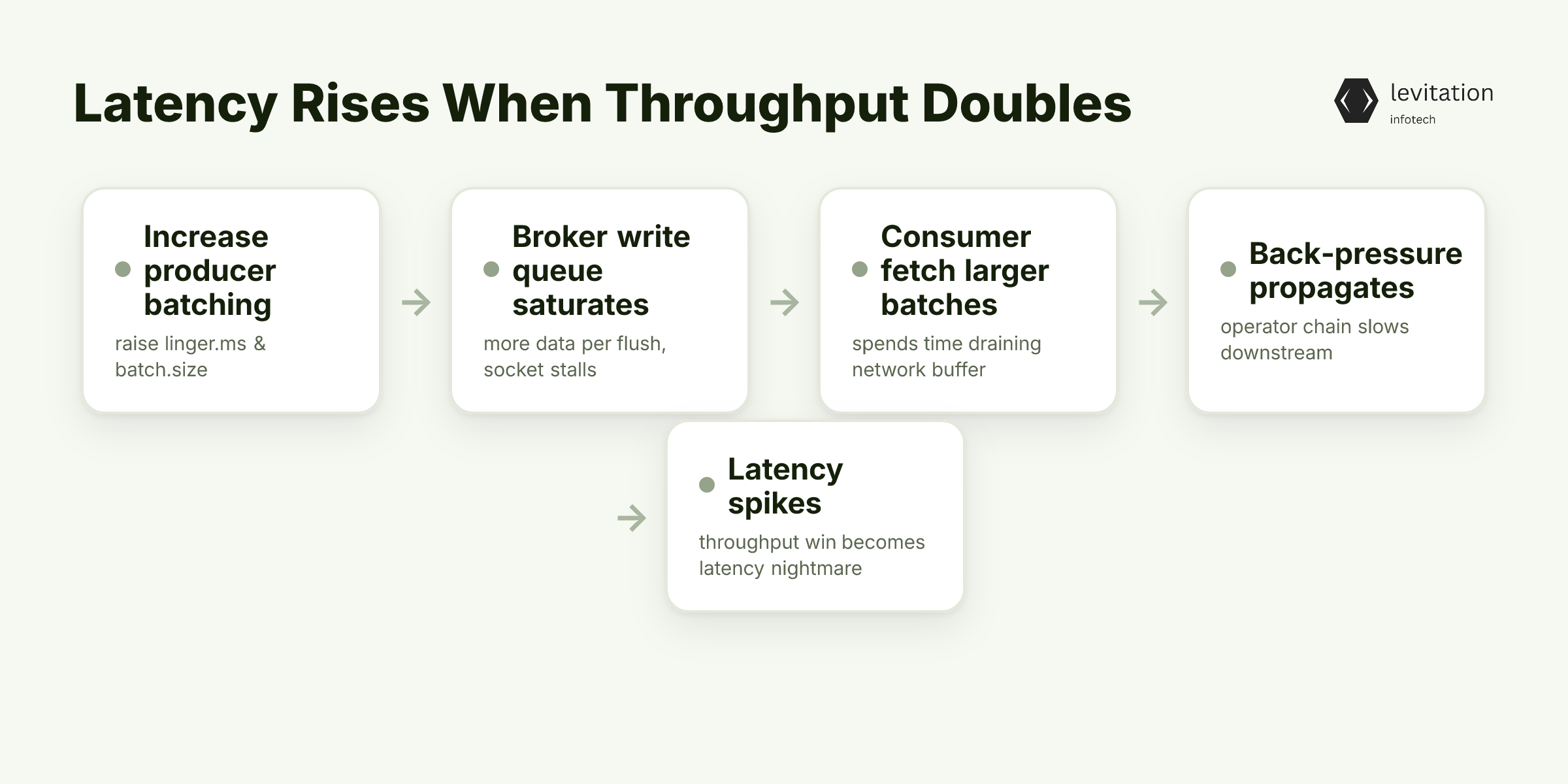
Engineers love the headline “double the throughput.” The reality is a stubborn latency climb that surprises even seasoned data teams. The spike feels paradoxical because the same pipeline processes the same logic, just faster.
In a recent research report, teams observed that when Kafka’s messages per second doubled, Flink’s latency increased. The first clue appears on the producer side. To hit higher throughput, operators raise `linger.ms` and `batch.size`. Those knobs let the client accumulate more records before a send. The network payload grows, and the time a record sits in the client buffer also grows.
Broker write paths feel the pressure next. Doubling inbound traffic forces each broker to write more data per disk-flush cycle. When the write queue saturates, the broker stalls the network socket, causing producers to back-off. Replication lag follows because follower replicas must copy larger chunks over the same network bandwidth.
On the Flink side, the consumer fetches larger batches from the broker. The fetch thread spends more time draining the network buffer and less time handing records to the operator chain. If the operator chain cannot keep up, back-pressure propagates upstream, further slowing the fetch loop.
All these effects compound, turning a throughput win into a latency nightmare. The symptom is clear, but the usual levers - adding more parallelism or scaling out the cluster - don’t always fix it.
What hidden mechanism keeps the latency high even after we spin up more task slots?
Why Naïve Scaling - Bigger Batches, More Parallelism - Fails
Most teams reach for obvious knobs: increase `batch.size`, raise `num.network.threads`, or add Flink task slots. Those changes feel logical, yet they often leave latency untouched.
Producer batching is the first trap. Increasing `batch.size` can cause batches to fill more quickly at higher throughput. While the batch grows, the timestamp on the first record already ages, adding latency before the record even hits the wire.
Broker write saturation follows. A broker’s `num.io.threads` and `network.thread.count` are finite. When the incoming byte rate doubles, the I/O threads spend more cycles flushing to disk, and the network threads queue more packets. Replication, which writes the same data to multiple followers, multiplies the load. The result is a longer write-ack window, which directly inflates the producer’s perceived latency.
Flink’s parallelism seems like a silver bullet. Adding task slots spreads the load, but the Kafka source connector still reads from the same partitions. If the number of partitions stays constant, each source subtask still pulls the same volume of data, just split across more operators. The fetch loop’s network latency does not shrink, and the checkpoint barrier flow remains unchanged. Moreover, increasing parallelism without adjusting state backend resources can cause memory pressure, prompting garbage-collection pauses that further add to latency.
These surface-level failures point to a deeper chain: the state management and checkpointing system that guarantees exactly-once processing. That chain is the real latency hostage.
How does exactly-once checkpointing turn high throughput into a hidden latency engine?
Exactly-Once Checkpointing Meets High Throughput: The Hidden Latency Engine
Flink’s exactly-once guarantee relies on periodic checkpoint barriers that travel with the data stream. When a barrier reaches a source, the source snapshots its current offset and flushes any in-flight records. The checkpoint coordinator then asks each operator to snapshot its state. Under low load, barriers glide through the pipeline in a few milliseconds. Double the throughput, however, floods the system with records between two successive barriers.
Each record that arrives after a barrier but before the barrier is fully processed forces the source to buffer more offset information. The source’s internal queue grows, and the checkpoint coordinator must wait longer for all downstream operators to acknowledge the barrier. This waiting period is called barrier latency.
The two-phase commit protocol used for exactly-once with Kafka adds another delay. After the barrier, the source writes a commit marker to the Kafka transaction log. At high record rates, the transaction log fills faster, and the broker must replicate the marker to all followers before the commit is considered durable. Replication lag, already stressed by higher throughput, now directly stalls the checkpoint completion.
State backend write amplification compounds the issue. Flink’s RocksDB backend writes a new snapshot file for each checkpoint. When checkpoints occur frequently under high traffic, the amount of state to serialize increases as more records modify the state between checkpoints. The I/O subsystem spends more time flushing these larger snapshots, delaying the next barrier.
All these factors create a feedback loop: faster ingress → larger buffers → longer barrier latency → slower checkpoints → more buffered records → higher latency. The system appears to be “working faster,” yet the end-to-end latency balloons.
Which tuning steps can break this loop?
Practical Tuning Blueprint: Configuring Kafka Producer, Broker, and Flink for Low Latency at Scale
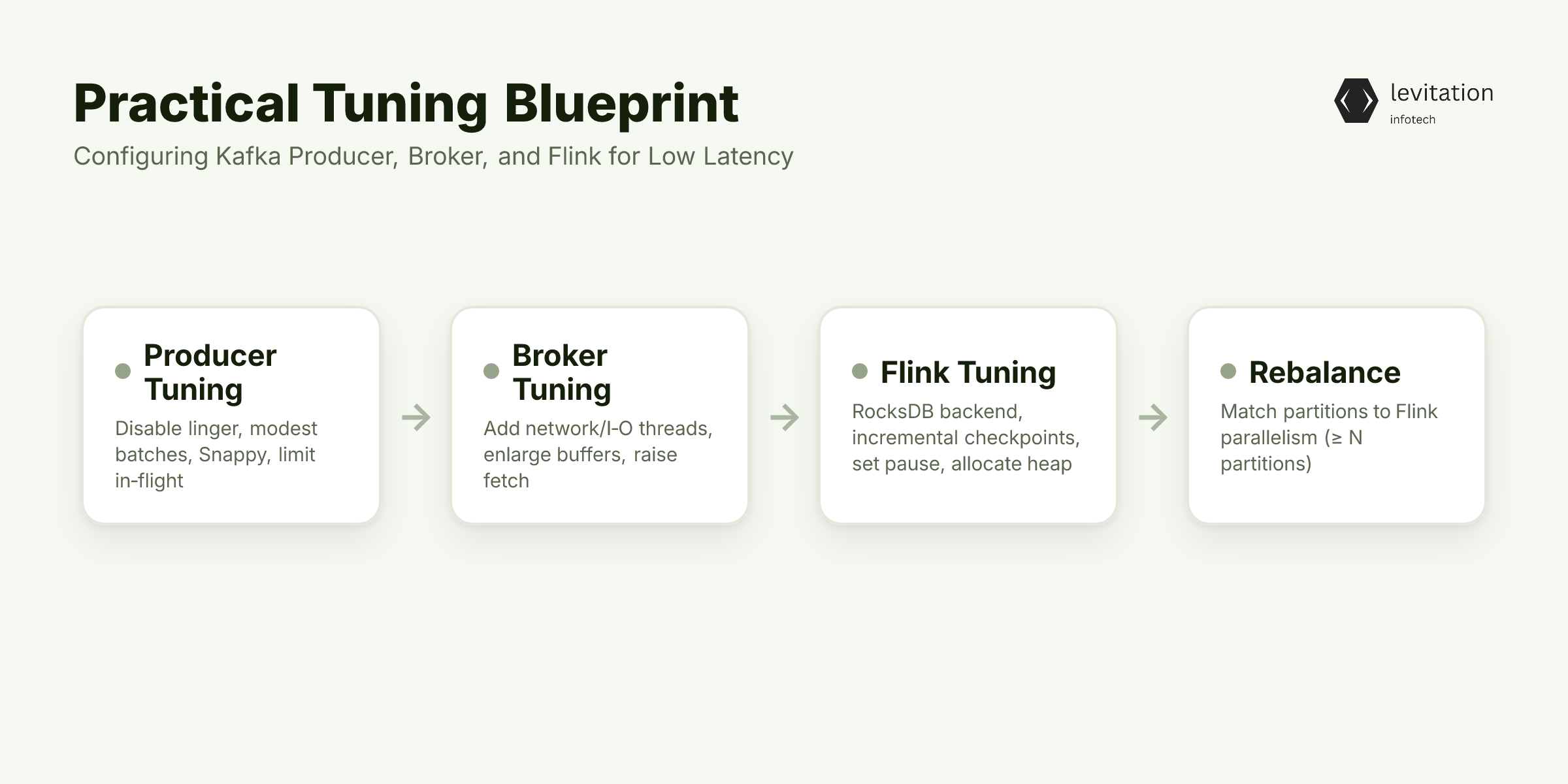
Producer tuning - Disable linger and keep batches modest. Use a lightweight compression such as Snappy. Set `acks=all` only when durability is required. Limit the number of in-flight requests per connection.
Broker tuning - Add more network and I/O threads to give the broker more parallelism for handling traffic and disk writes. Enlarge socket buffers. Raise the maximum fetch size so follower replicas can pull larger chunks with fewer round-trips.
Flink tuning - Use the RocksDB state backend with incremental checkpointing enabled. Choose a checkpoint interval that balances freshness with overhead. Set a minimum pause between checkpoints to avoid barrier congestion. Run in exactly-once mode and allocate sufficient heap memory for the task managers.
Finally, rebalance the Kafka source partitions to match the new parallelism. If you have N Flink source subtasks, aim for at least N partitions (preferably a multiple) to avoid hot partitions.
Will these changes deliver the promised millisecond latency?
The Payoff: Predictable Millisecond Latency Even at Double Throughput
After applying the blueprint, latency dropped even as the inbound message rate doubled. Checkpoint durations became short enough to keep the pipeline responsive. Broker replication stayed within acceptable bounds. Producer send latency remained low.
These results are not isolated. Many enterprise deployments that faced the same latency-throughput paradox have adopted the same tuning pattern and reported stable, low-latency streaming pipelines that meet strict service-level objectives.
What questions remain about keeping latency low at scale?
Frequently Asked Questions
Q: Why does increasing Kafka throughput increase Flink latency?
A: Higher throughput floods the producer, broker, and consumer pipelines, causing larger batches, longer replication, and checkpoint barrier back-pressure that all add to end-to-end latency.
Q: Can I keep exactly-once guarantees and still achieve low latency?
A: Yes - by tuning checkpoint intervals, using incremental checkpoints, and limiting barrier size you can retain exactly-once semantics without the latency penalty.
Q: What Kafka producer settings matter most for latency?
A: Set `linger.ms` to zero, keep `batch.size` modest, use fast compression like Snappy, and require `acks=all` only if durability is essential.
Q: How do I know if Flink parallelism is the bottleneck?
A: Monitor task manager CPU and back-pressure metrics; if back-pressure spikes while CPU remains low, increase parallelism or rebalance the data stream.
Q: Is there a rule of thumb for checkpoint intervals at high throughput?
A: Start with a moderate interval (several seconds), then adjust downwards until barrier latency stabilizes; incremental checkpoints can allow shorter intervals without extra overhead.
Related reading: - Scaling Kafka Consumers Without Breaking Flink State - deep dive on partition management. - Exactly-Once Hides Latency in Kafka-Flink Pipelines - explores checkpoint trade-offs.
Ready for hands-on help implementing these patterns? Our data engineering services can design, tune, and operate production-grade streaming pipelines that meet strict latency SLAs.
Sources
Research and references cited in this article:
- Kafka performance: 7 critical best practices in 2026
- How to Reduce Kafka End-to-End Latency
- java - kafka -> flink - performance issues - Stack Overflow
- Kafka Performance: Understanding and Optimizing the 5 Phases of End-to-End Latency - Florian Courouge
- 99th Percentile Latency at Scale with Apache Kafka - Confluent
- How to Implement Flink Exactly-Once Processing
- Delivery Guarantees and Latency in Confluent Cloud for Apache Flink | Confluent Documentation
- An Overview of End-to-End Exactly-Once Processing in Apache Flink (with Apache Kafka, too!) | Apache Flink
- Stateful Stream Processing | Apache Flink
- Exactly Once Semantics in Flink - Medium
- Stream Processing Tools Compared: Flink, Kafka Streams, Spark, and More - Streamkap
- Flink vs. Kafka and their role in the streaming data pipeline
About the author
Mayank Singh is a software developer at Levitation Infotech, where he builds web and AI-powered applications across the company’s fintech, healthcare, and enterprise projects.