

TL;DR: Karpenter's speed creates an audit-trail problem for HIPAA-regulated AI workloads. Ephemeral nodes vanish before compliance evidence can be collected. The fix is not to slow scaling down. It is to externalize every log, enforce tag-based IAM, and turn NodePool and EC2NodeClass into compliance controls. These should be more than just scaling primitives.
Key Takeaways: - Karpenter provisions nodes in 30-90 seconds. HIPAA requires 6 years of audit evidence. That gap is where healthcare AI deployments break. - Audit logs must live outside the node lifecycle. CloudTrail, EKS control plane logs, VPC flow logs, and PHI access logs all need to ship to S3, CloudWatch, or a SIEM before termination. - NodePool, EC2NodeClass, IMDS settings, and tag-based IAM policies make up the real compliance control surface for fast-scaling AI clusters. - Drift detection and expiration can be set up as automated HIPAA controls. They force patching and node rotation without manual intervention.
The 90-Second Node That Disappears Before the Auditor Arrives
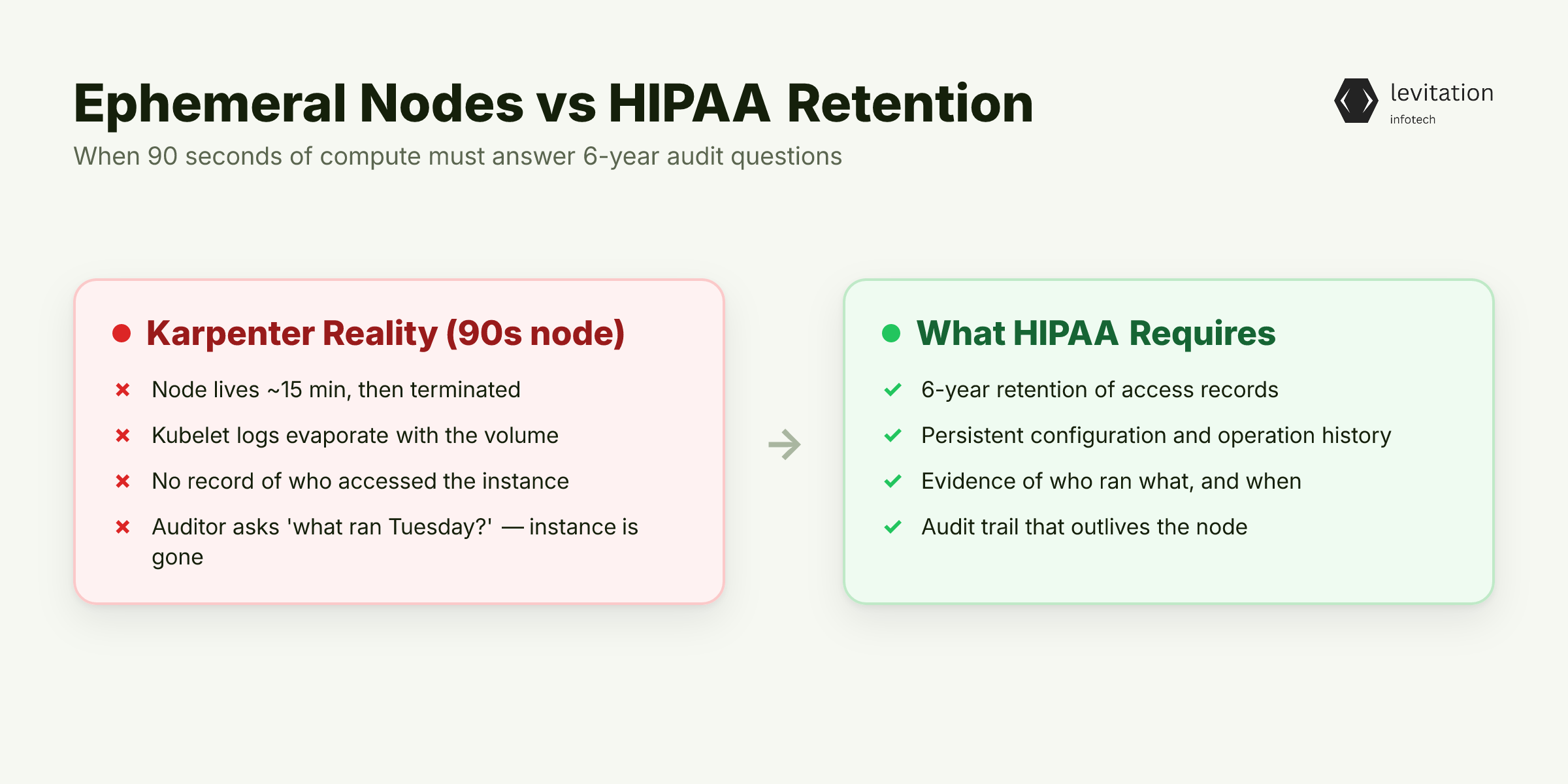
Karpenter provisions a GPU node in under 90 seconds. The HIPAA auditor wants to know what ran on it, who accessed it, and whether PHI was exposed 90 days later. That gap is where healthcare AI deployments die.
A 90-second provisioning loop is genuinely fast. Karpenter watches pending pods. It then checks NodePool constraints. Finally, it launches the right instance type from the cloud API directly.
Compare that to Cluster Autoscaler, which scales pre-warmed Auto Scaling Groups. It typically takes 2-5 minutes. For batch inference bursts or short-lived training jobs, Karpenter wins on raw velocity.
But velocity in healthcare has a price. A node that lives for 15 minutes for an inference spike leaves almost no local footprint.
The auditor asks, "Show me what ran on this instance last Tuesday." The instance is gone. The kubelet logs evaporated with the volume. The audit question has no answer.
This is the core mismatch. Infrastructure built for ephemerality meets a compliance regime built for 6-year retention. The HIPAA Security Rule wants evidence of access, configuration, and operation. This evidence must last long after the compute has been recycled into someone else's Spot pool.
Speed and durability sit on opposite ends of the same axis.
The speed itself is not the problem. The problem is that every second of speed generates compliance evidence. Most teams have no idea where that evidence goes. For healthcare technology teams running AI workloads, the question is not whether Karpenter scales.
It is whether your audit trail survives the node. The node was there for 90 seconds and is now permanently gone.
Why Ephemeral Nodes Create a Compliance Black Hole
Karpenter does not use a standing fleet. It provisions individual nodes straight from the cloud API. It does not pull from pre-warmed Auto Scaling Groups.
There is no warm pool to inspect during an audit walkthrough. There is no minimum node count that ensures a stable target for log shipping agents.
The black hole gets deeper through consolidation. When workloads can run cheaper elsewhere, Karpenter actively ends nodes. Your evidence window shrinks every time a Spot price changes.
If you run AI/ML training jobs, the controller can replace your node with a cheaper variant mid-workload. This changes the instance identity while the workload keeps running. The same training step and the same pod run on two different EC2 instances. A 90-second lifecycle erases the boundary between them.
GPU nodes for inference are the worst offenders. They are the most expensive and the most aggressively consolidated. This is exactly where PHI processing happens.
A medical imaging pipeline might need an A100 today and a G5 tomorrow. No audit record shows which instance processed which patient.
That black hole has a specific shape. The threat model page from the Karpenter project itself shows exactly where auditors will look first.
The Threat Model Auditors Actually Care About
The official Karpenter threat model treats tag manipulation as a primary attack vector. A cluster operator with CreateTags and DeleteTags permissions can effectively spawn or destroy EC2 instances. They do this by faking the tags Karpenter uses to identify its own resources.
The Karpenter controller is the only component that should be able to associate these tags with instances.
Karpenter lowers this risk by allowing tag changes only on instances it owns. That ownership is enforced through two tags: `karpenter.sh/nodepool` and `kubernetes.io/cluster/${CLUSTER_NAME}`. If a tag is changed, IAM `aws:ResourceTag` conditions ensure the controller can only act on instances it already controls.
This is not optional hardening. It is the primary control plane for who gets to influence node provisioning.
Auditors do not stop at the threat model page. They will ask who can create or modify NodePool and EC2NodeClass resources. They will ask what constraints exist on the instance types those resources can launch.
They will look for an audit trail of every change to those custom resources. Each change must have timestamps and identities attached.
For healthcare deployments, this is the first place HIPAA auditors walk when they see Karpenter in the stack. If your answers are vague, the rest of the audit gets harder.
Understanding the threat is necessary but not enough. The real question is: what gets logged, where, and for how long, when the node itself vanishes in 90 seconds?
How to Build an Audit Trail That Survives Node Churn
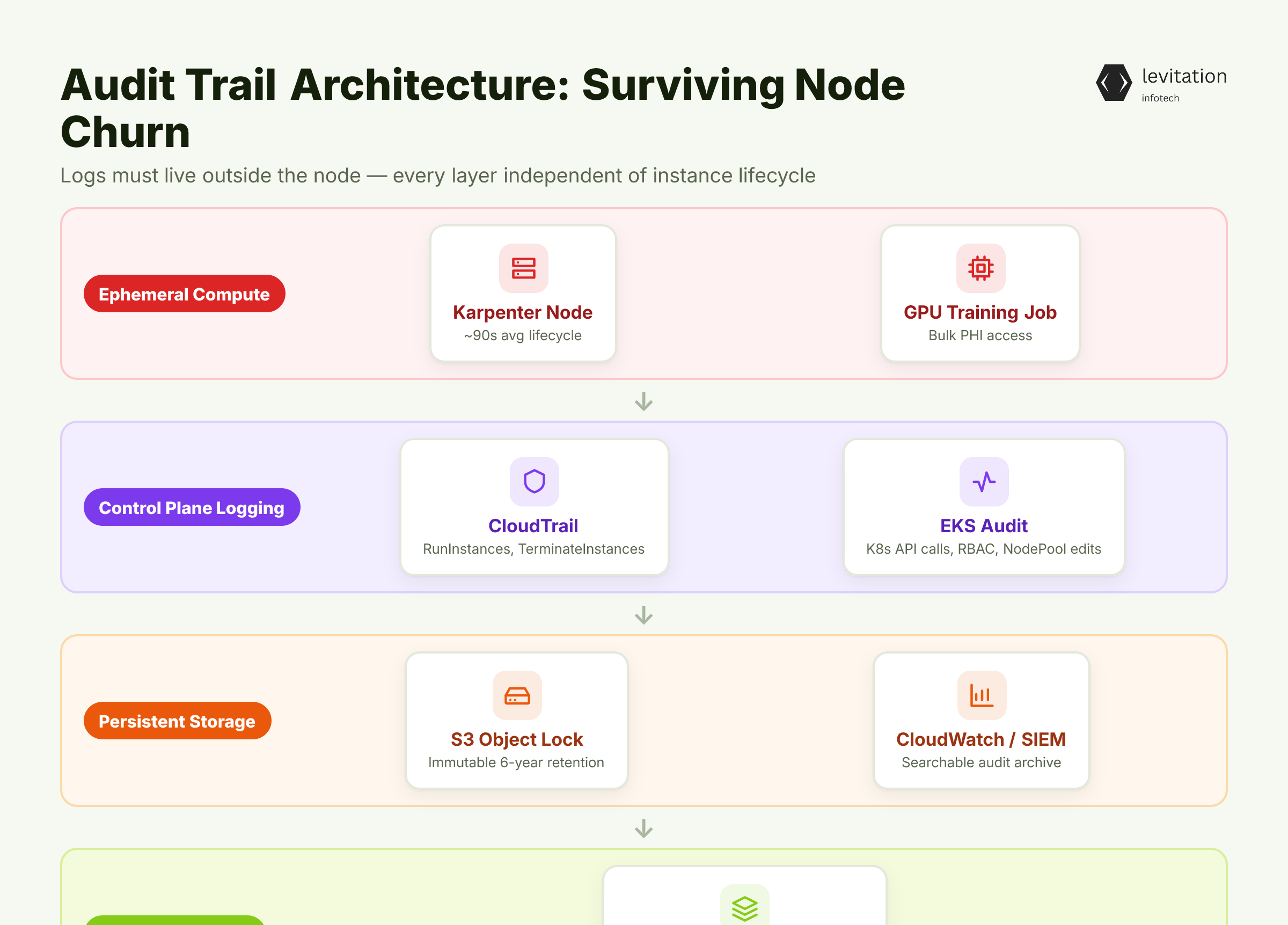
Logs do not care whether the node they came from still exists. The trick is to make sure those logs are written somewhere that outlasts the instance.
CloudTrail captures every RunInstances and TerminateInstances call at the AWS API layer. Karpenter's provisioning is fully visible there, regardless of how fast the node lived or died. Enable it for all regions. Route to a dedicated log bucket. Lock that bucket with object lock for immutability.
EKS control plane audit logs capture every Kubernetes API call regardless of node lifecycle. Pod scheduling, secret access, RBAC changes, and NodePool edits all show up here.
These logs persist for as long as you set them to, independent of the nodes that served the cluster.
VPC flow logs and application-level PHI access logs are the two layers most teams forget. They must ship to a destination outside the node. That destination can be S3, CloudWatch, an external SIEM, or an immutable log archive.
If the log shipper lives on the node, the logs die with the node. Design your pipeline with this assumption from day one.
The 6-year HIPAA retention requirement applies to logs, not to nodes. That is the framing shift most teams miss. Your node can live for 90 seconds. Your audit log lives for 2,190 of those lifecycles. Design accordingly.
For AI/ML training and model training workloads, this matters even more. Training jobs often pull PHI in bulk to a GPU node. They fine-tune on it and then write checkpoints to S3.
The audit trail must show which instance saw which batch of records. It must also show where the resulting weights went. If your log pipeline only ships from the node, the trail dies when the node does.
When clinical AI retrains daily, the node churn rate goes up. The evidence window shrinks for every retrain.
Logs answer "what happened." But auditors also want to see preventive controls. That is where NodePool and EC2NodeClass stop being a scaling tool and start being a compliance layer.
NodePool and EC2NodeClass: Your Compliance Control Surface
NodePool lets you restrict which instance types are allowed. This is more than a cost control. It is a PHI-workload control.
If your AI/ML training jobs touch patient data, decide that only vetted instance families are eligible. Reject everything else at the scheduling layer.
EC2NodeClass (formerly AWSNodeTemplate) defines subnet selection, security groups, AMI family, and IMDS settings. Each field is a compliance control point.
Enforce IMDSv2-only and disable the IMDS hop limit. This helps prevent SSRF-based credential theft on auto-provisioned GPU nodes. Pick AMIs from a controlled golden image pipeline.
Pin subnets to private ranges that route only through approved egress.
Use `spec.disruption.consolidationPolicy: WhenUnderutilized` with care. Aggressive consolidation is a cost win and a GPU budget saver. But it is also an audit-evidence challenge.
Every consolidation event is another node that needs logs captured before termination. If your retention math does not account for the consolidation rate, the trail breaks.
Tag-based IAM policies must enforce that only the Karpenter controller role can create or delete tags on its own instances. This is the literal guidance from the project threat model.
If a developer with broad EC2 permissions can tag a node, the tag-based IAM conditions stop working. Lock the controller role down. Audit every tag change through CloudTrail.
Teams that survive multiple audit cycles usually treat autoscaling as inseparable from healthcare compliance posture. Your NodePool defines what is allowed.
But compliance is not just about initial provisioning. It is about what happens when configurations drift or nodes age past their security baseline.
Drift Detection and Expiration as Compliance Features
Karpenter's drift feature marks nodes that have diverged from the desired spec and replaces them. This is normally framed as an operational convenience.
For healthcare teams, it is a patching mechanism. When a CVE hits your base AMI, change the AMI reference in EC2NodeClass. Drift then rotates every node onto the patched image.
Expiration is the second lever. Setting `spec.template.spec.expireAfter` periodically recycles nodes after a fixed lifetime.
This is a built-in node-rotation policy. It satisfies patching frequency requirements without a maintenance window. For AI/ML training and fine-tuning pipelines, it also means your GPU nodes do not accumulate months of unpatched surface area.
Interruption handling for Spot nodes is the third lever. Karpenter watches for upcoming interruption events. It cordons and drains the node before termination. It gives workloads a window to flush PHI-related state cleanly.
That grace period is also your window to ship final logs. If your application has a preStop hook that flushes buffered PHI access events to S3, interruption becomes a feature, not a bug.
The shift is conceptual. Drift, expiration, and interruption are not just operational conveniences. They are automated compliance controls.
When set up deliberately, they enforce HIPAA hygiene. This would otherwise require manual intervention, ticket queues, and on-call rotation. The point is not that Karpenter scales fast. The point is that the same control plane that scales fast also keeps you audit-ready.
What Changes When Speed and Compliance Actually Coexist
A GPU training job spins up in 90 seconds and tears down cleanly. The full audit trail stays intact for the 6-year retention window.
Auditors get answers in hours, not weeks. This happens because logs, IAM boundaries, and node lifecycle are pre-mapped to HIPAA Security Rule controls.
The team stops choosing between fast scaling and compliant scaling. The same NodePool configuration serves both.
Healthcare AI teams can iterate on models and inference pipelines at cloud-native speed. They can do this without treating compliance as a gating review. The compliance work moves from the end of the project to the design of the autoscaler.
That is a real shift.
The investment is a one-time setup of log pipeline architecture, IAM boundaries, and NodePool templates. After that, every new model or inference workload inherits the same compliance posture.
Your auditors stop asking "where did this node come from." They start asking which dashboard you would like to review.
Teams that survive their first HIPAA audit usually treated the autoscaler as part of the audit boundary, not separate from it.
The pattern is not exotic. It is just rarely discussed in the same breath as 90-second scaling. Whether the next 90-day audit cycle is a confirmation exercise or a discovery exercise depends entirely on the configuration choices made today.
Frequently Asked Questions
Is Karpenter itself HIPAA compliant?
Karpenter is an open-source autoscaler, not a covered entity under HIPAA. Compliance depends entirely on how you set up NodePool, EC2NodeClass, IAM policies, logging, and the broader EKS architecture it runs within.
How long does a HIPAA audit take for a Kubernetes-based AI system?
Audit duration depends on the scope of PHI-processing systems. It also depends on the completeness of pre-collected evidence. It further depends on the complexity of the Kubernetes architecture. Teams that externalize logs and pre-map control planes to HIPAA Security Rule requirements answer auditor questions in hours. They do not need to rebuild evidence from scratch, because every log line already lives outside the node lifecycle.
What audit logs are required for HIPAA on EKS with Karpenter?
You need CloudTrail for AWS API calls, including Karpenter's RunInstances and TerminateInstances. You need EKS control plane audit logs for Kubernetes API activity. You need VPC flow logs for network traffic. You need application-level logs for PHI access. All of these must be retained for 6 years in immutable storage outside the node lifecycle.
**Can Karpenter safely use Spot instances for healthcare AI workloads?
About the author
Mayank Singh is a software developer at Levitation Infotech, where he builds web and AI-powered applications across the company’s fintech, healthcare, and enterprise projects.