


TL;DR: Your staging cluster doesn't test your upgrade. It tests your workloads. The real risk lives in version skew, deprecated APIs, and the etcd storage version flip.
Build an upgrade-specific test harness, follow a phased rollout, and never skip the etcd snapshot. That sequence turns Kubernetes upgrades from fire drills into routine maintenance.
Key Takeaways: - The most under-tested part of a Kubernetes upgrade is the upgrade path itself, not the workloads on top of it - Node version skew and deprecated APIs are the two failure mechanics that catch teams off guard - An upgrade harness that replays your real version jump catches what static staging environments miss
You Test the Workload. You Don't Test the Upgrade.
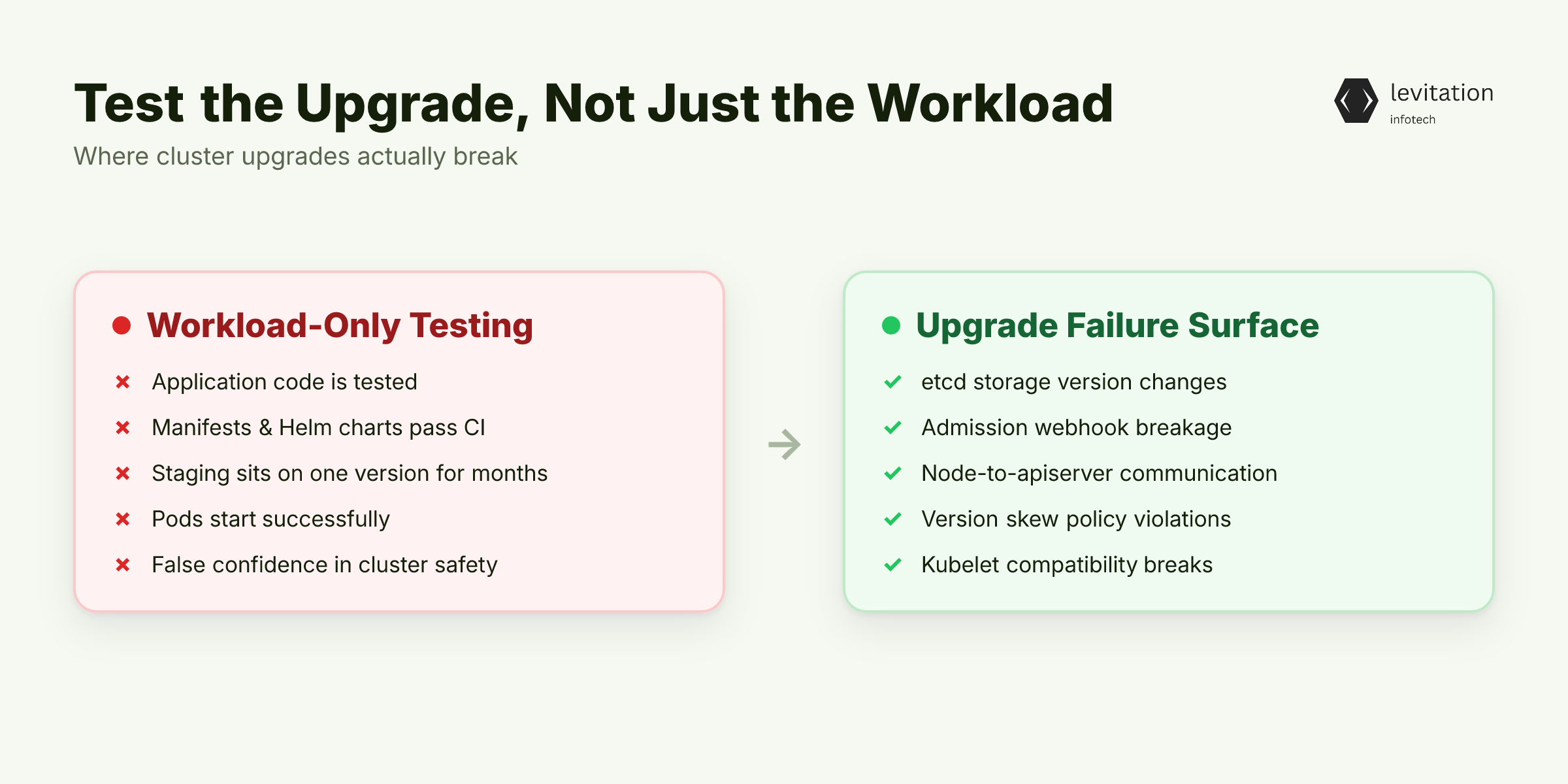
You test your application. You test your manifests. You even test your Helm charts in CI.
But the thing that takes clusters down during a Kubernetes upgrade is the upgrade path itself. Almost nobody tests that.
Most SRE teams treat the upgrade as a one-time operational event. You run the playbook, you hope it works, you write the postmortem. The failure surface isn't the workload, which you already know runs.
It's the act of moving the cluster from one version to the next. Version skew policies, API deprecation timelines, and kubelet compatibility are where the real damage happens.
Staging clusters that stay on a single version for months give false confidence. They prove your pods start. They don't prove your upgrade is safe.
A control plane upgrade touches etcd storage versions, admission webhooks, and node-to-apiserver communication in a single motion. If any of those break, your workload test results don't matter.
The pattern shows up across cloud security solutions work too. Teams validate the workload, then get blindsided by the control plane moving under it.
And the failure modes aren't random. They cluster around two specific mechanics that almost every team under-tests.
Node Version Skew: The Silent Window Between Control Plane and kubelet
Kubernetes supports up to three minor versions of skew between the control plane and nodes. That sounds generous. In practice, it creates a long window where mixed kubelets serve traffic during a rolling node upgrade.
Picture a cluster with five worker nodes. You start upgrading from 1.31 to 1.32. The control plane flips first.
For the next hour, the apiserver is on 1.32 while some kubelets are still on 1.31. That's a supported state, but the negotiation between versions is exactly where bugs hide.
A kubelet on 1.31 doesn't speak every new feature gate the apiserver expects. It just silently degrades.
Device plugins, CNI, and CSI sidecars layer their own skew policies on top of kubelet skew. A CNI upgrade that runs only on 1.32 nodes. The 1.31 nodes run an older dataplane against a newer apiserver. Most teams don't audit this during upgrades because it's not visible in the workload's behavior until it is.
The worst case is a drain that times out. Pods stay on an old kubelet while the control plane has moved on. Scheduling decisions get made on assumptions the old kubelet can't honor. The result is split-brain symptoms that look like "the cluster is haunted." Cloud infrastructure monitoring rarely catches this because the metrics say everything is healthy at the component level.
Version skew is the upgrade path's most visible risk. The less visible one hides in your manifests, waiting for the upgrade to expose it.
Deprecated APIs Don't Migrate Themselves
Ingress v1, PodSecurityPolicy, and dozens of beta APIs sit in production manifests long after their removal versions land. They keep working on your current version. The moment the apiserver stops recognizing the stored resource version, every object of that kind becomes invisible garbage.
The trap is that etcd only rewrites the cluster's internal representation when the storage version changes, and that happens on upgrade. Your old `extensions/v1beta1` Ingress objects are still in etcd, still being served, until the upgrade forces a decode. Then they're undecodable, and your ingress controller can't list them.
Tools like `pluto` and `kubent` can scan manifests. They catch what you wrote. They don't catch what was written three years ago by a different team and never re-committed. The long-lived manifests are exactly where the deprecated APIs hide, as Your Oldest Kubernetes YAML Is Your Next Outage shows.
`kubectl convert` rewrites YAML between API versions, but it operates on files, not on what's actually live in etcd. Scanning manifests misses the gap between what's in your repo and what's stored in the cluster. The secure cloud posture of an upgrade is only as good as the worst object you forgot to migrate.
So the obvious fix (scan your YAML) misses the live cluster state. The right fix requires a different testing approach entirely.
Build an Upgrade-Specific Test Harness, Not Just a Staging Cluster
A staging cluster that never gets upgraded tests nothing about the upgrade. It tests your workloads, which you already know work. You need a separate harness. The harness goes through the version jump you plan, control plane first, then node by node, against a production-shaped workload.
The harness isn't a permanent environment. It's a job you run before scheduling the real upgrade window. Spin it up, replay the upgrade path, capture the breakage, tear it down.
The test categories that actually matter: - API conversion of stored objects: fetch every object in etcd, decode it against the new apiserver, count failures - Admission webhook behavior on the new apiserver: webhooks that worked on 1.31 reject valid payloads on 1.32 if their TLS certs or timeout defaults changed - Drain timeout behavior with real PodDisruptionBudgets: do your PDBs force the drain to hang past the kubelet's grace period - etcd storage version migration: confirm the new apiserver can read every object written under the old storage version - kubelet-to-apiserver negotiation: watch the apiserver logs during a node roll for repeated failed feature-gate negotiations
The harness catches what the staging cluster can't because it runs the actual transition. Teams running kubernetes clusters in production five or more years after deployment tend to operate this way.
The cluster isn't special. The discipline is.
Once the harness tells you the upgrade is safe in principle, the next question is execution. How do you run the upgrade without painting into a corner?
Phased Rollouts and Real Rollback: The Mechanics That Save You
The mechanics are well known. Most teams skip the rehearsal and pay for it later.
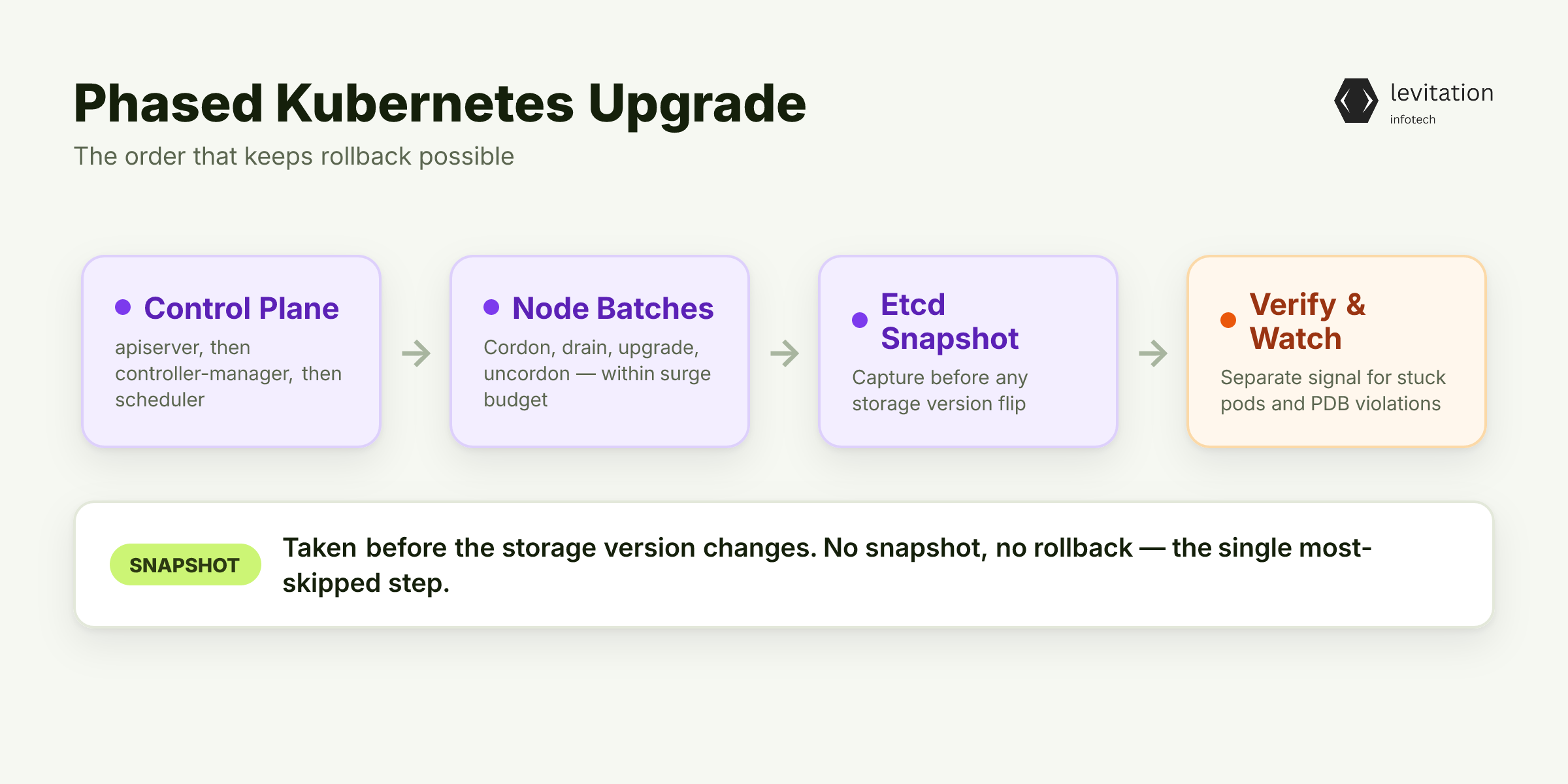
Control plane first, one component at a time. Upgrade `kube-apiserver`, watch etcd logs for storage version flips, then `controller-manager`, then `scheduler`.
The order matters: the apiserver has to be able to decode every object before anything writes back. Skip the order and you can corrupt cluster state mid-upgrade.
Nodes next, in batches smaller than your disruption budget allows, with explicit surge capacity. A typical production node roll looks like this:
1kubectl cordon node-072kubectl drain node-07 --ignore-daemonsets --delete-emptydir-data --grace-period=3003kubeadm upgrade node4systemctl daemon-reload && systemctl restart kubelet5kubectl uncordon node-076kubectl get node node-07 -w
The `--ignore-errors` flag is a load-bearing decision. It prevents one stuck pod from blocking the entire drain.
It also means a real eviction failure won't stop the upgrade. You need a separate signal (PDB violation alerts, pod pending too long) to catch that case.
Rollback for a control plane upgrade means restoring etcd from a snapshot taken before the storage version changed. No snapshot, no rollback. This is the single most-skipped step.
Once etcd objects have been rewritten into the new storage version, downgrading the apiserver will fail to decode them. The cluster is committed.
Teams that ship upgrade playbooks quickly tend to treat upgrades as routine maintenance, not fire drills. The gap between teams that upgrade confidently and teams that treat each upgrade as a crisis is rehearsal, not tooling. The mechanics covered in k8s operations guides are identical; the difference is whether you've run them once on production-shaped traffic.
The difference is whether your team has actually rehearsed these steps end to end before the change window opens. The checklist below turns that rehearsal from a hope into a procedure.
The SRE Checklist for the Next Upgrade Window
Run this before the upgrade window opens, not during it.
Snapshot etcd and validate the snapshot. Don't just take the backup. Restore it into a disposable cluster and confirm the restored cluster boots the current control plane. A backup you can't restore is a wish.
Scan both your repo and your live cluster. Run `kubent` against your repo manifests. Then run it against a live dump:
1kubectl get --raw /api | jq '.paths[]' > live-apis.json2kubectl get --raw /apis | jq '.groups[].name' >> live-apis.json
Diff the two lists. The gap between what your YAML uses and what the cluster exposes is your deprecated API surface.
Audit every admission and mutating webhook. Check each webhook's deployment manifest against the new apiserver's expected TLS version and request timeout defaults. A webhook that worked on 1.31 fails on 1.32 if the apiserver tightened its cipher suite list.
Drain a single canary node first. Measure the time-to-ready for rescheduled pods against a real workload with a real PodDisruptionBudget. Extrapolate to the full node pool. If the canary takes 15 minutes, your surge capacity needs to absorb 15 minutes of churn per batch.
This is the devops discipline that separates teams that upgrade quarterly from teams that delay. The delaying teams pay three versions of deprecated API cleanup at once.
Run that checklist once and the upgrade stops being a war room event. The payoff is structural, not procedural.
What Changes When Upgrades Stop Being Emergencies
You stop skipping minor versions out of fear. That means smaller diffs per upgrade and fewer deprecated APIs to chase. The upgrade itself becomes a scheduled, low-risk activity instead of a quarterly hostage negotiation with the security team.
Your cluster's mean time to recovery drops because the rollback path has been rehearsed, not improvised. When something goes wrong, you don't debug the upgrade.
You restore etcd and investigate calmly. The cluster becomes an asset that compounds in value, not one you're afraid to touch.
The teams that get this right are the same ones who stopped treating upgrades as special events and started treating them as engineering work that deserves the same rigor as a production deploy.
Sources
Research and references cited in this article:
- Managed K8s Cluster Upgrades are a total nightmare.. - Reddit
- Chapter 5: Upgrading - Kubernetes Guides - Apptio
- 5 Challenges you might face during a Kubernetes upgrade
- Cluster upgrade strategy - Discuss Kubernetes
- Upgrade Safely: Avoid the Pitfalls of Kubernetes Versioning ...
- How to Plan Kubernetes Cluster Upgrades with Version Skew Policies
- About Kubernetes’ version skew policy - 2i2c Infrastructure Guide
- What Do You Need To Know When Upgrading Kubernetes?
- Standard cluster upgrades | Google Kubernetes Engine (GKE) | Google Cloud Documentation
- Version Skew Policy | Kubernetes
- Kubernetes Upgrade Automation: A Comprehensive Guide - Kubegrade
- Best Practices for Regular Kubernetes Cluster Upgrades - KubeOps
About the author
Mayank Singh is a software developer at Levitation Infotech, where he builds web and AI-powered applications across the company’s fintech, healthcare, and enterprise projects.