


TL;DR: Even with mTLS enabled, data can leak inside your cluster. The hop between an app container and its sidecar often remains clear-text. Extending identity verification to that intra-pod link closes the leak. It also restores true zero-trust guarantees.
Key Takeaways - mTLS protects only sidecar-to-sidecar hops. The app-to-sidecar channel is usually unencrypted. - The leak exists because identity checks stop at the proxy boundary. This leaves the local loop exposed. - Adding Envoy filters and an inbound AuthorizationPolicy forces TLS on localhost traffic. This eliminates the hidden attack surface.
mTLS Isn't the Silver Bullet You Think It Is
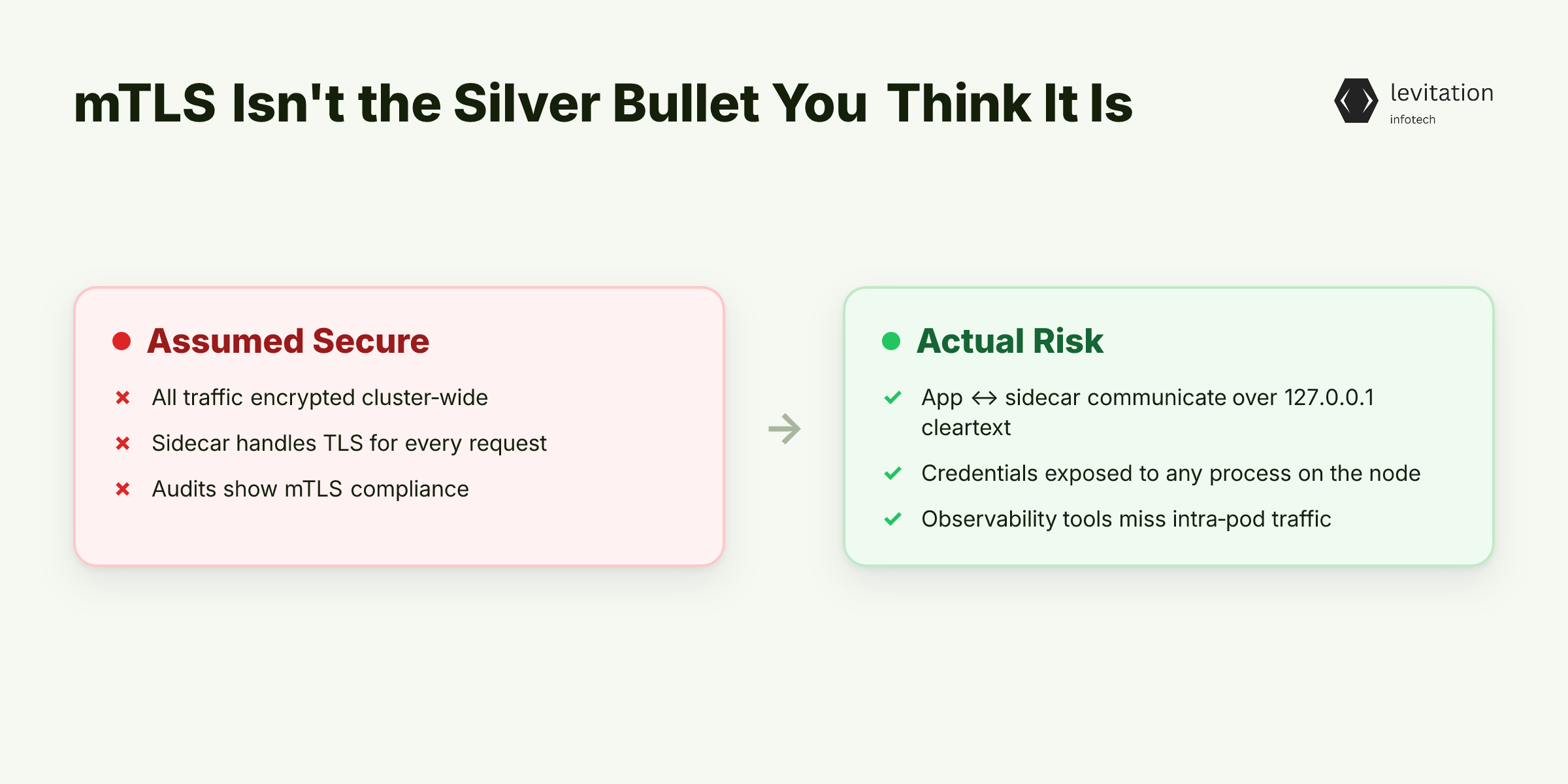
Most security architects assume that flipping the global mTLS switch locks down every byte inside their cluster. The reality is far messier. Inside each pod, the application talks to its sidecar over `127.0.0.1`. That loop bypasses the mesh’s TLS handshake entirely. It leaves credentials exposed to any process that can reach the loopback interface.
1# Example of a typical pod spec with a sidecar2apiVersion: v13kind: Pod4metadata:5 name: payment-service6spec:7 containers: - name: app8 image: myorg/payment:v19 ports: - containerPort: 8080 - name: istio-proxy10 image: istio/proxyv2:1.1911 args: - proxy - sidecar - --domain - $(POD_NAMESPACE).svc.cluster.local
The `app` container sends HTTP to `http://127.0.0.1:15001`. Istio’s sidecar receives the request, then opens an outbound TLS connection to the destination service. The inbound leg never sees a TLS handshake because the traffic never left the pod.
Why does this matter? An attacker who gains a foothold in the node can sniff the loopback interface. They can extract API keys or inject malicious payloads before the sidecar encrypts anything. The breach surface is invisible to mesh observability tools because they only monitor encrypted outbound streams. - Clear-text exposure: Data moves unencrypted between app and proxy. - Privilege escalation vector: Any co-located container can read or tamper with the traffic. - False sense of compliance: Audits that only check sidecar-to-sidecar TLS will miss this gap.
The leak isn’t a configuration typo; it’s baked into the sidecar architecture. But the reason this gap exists is deeper than a simple oversight. Then what part of the architecture hides it?
Why Traditional mTLS Configurations Miss the In-Pod Leak
Sidecar proxies act as a data plane that intercepts outbound calls. They wrap them in TLS and forward them to the destination’s sidecar. The control plane injects a `DestinationRule` that tells the proxy to use mTLS. What the control plane never tells the proxy is to encrypt traffic that never leaves the pod.
When the mesh boots, it creates two distinct security zones:
- External zone - traffic that traverses the network.
- Internal zone - traffic that stays inside the same pod.
Only the external zone gets the `tlsContext` with a server certificate. The internal zone runs with plain HTTP because the proxy assumes the app already trusts the local process.
1# DestinationRule enabling mTLS for external traffic2apiVersion: networking.istio.io/v1beta13kind: DestinationRule4metadata:5 name: default-mtls6spec:7 host: "*.svc.cluster.local"8 trafficPolicy:9 tls:10 mode: ISTIO_MUTUAL
Because the `tls` block is scoped to the host pattern, it never matches `127.0.0.1`. The result is a silent blind spot that persists even when `global.mtls.enabled` is true.
Common pitfalls that keep the leak open - Relying on `peerAuthentication` alone. It only enforces identity at the proxy boundary. - Skipping `Sidecar` resources. Without an explicit inbound rule, Istio does not apply TLS to localhost ports. - Assuming `AuthorizationPolicy` covers the loopback. Then policies evaluate after the request reaches the sidecar, not before the app sends it.
A mesh that only validates the source principal at the sidecar entry point never sees the app’s identity. The verification chain stops at the proxy, leaving the local hop unchecked. Understanding the gap reveals a surprising lever. What could you pull to seal it?
The Hidden Lever: Enforcing Identity Verification at the Application Edge
If you want true zero-trust, you must make the application process a first-class citizen. Then it sits in the mesh’s trust model. Istio (and other Envoy-based meshes) let you attach custom filters. These filters run before any inbound request is accepted. By inserting an Envoy HTTP filter that starts TLS for `127.0.0.1` traffic, you force the same mutual authentication. Then it protects external calls.
The filter tells the sidecar to require a client certificate even for localhost connections. The client (your app) must present a workload identity certificate, which Istio can mount automatically via a secret volume.
Next, bind that identity to an AuthorizationPolicy that matches the source principal:
1apiVersion: security.istio.io/v1beta12kind: AuthorizationPolicy3metadata:4 name: require-local-mtls5spec:6 selector:7 matchLabels:8 app: payment-service9 action: ALLOW10 rules: - from: - source:11 principals: ["cluster.local/ns/default/sa/payment-service"]
Now the mesh verifies that the request originates from the exact service account that owns the pod. If an attacker injects a rogue container without the proper service account, the request is rejected. Then it is blocked before it reaches the app.
Zero-trust principles demand that every hop be authenticated and authorized. By extending the mesh’s policy engine to the application edge, you eliminate the silent loopback exposure. What concrete steps can lock down that hidden path?
Step-by-Step: Harden Your Mesh to Close the Leak
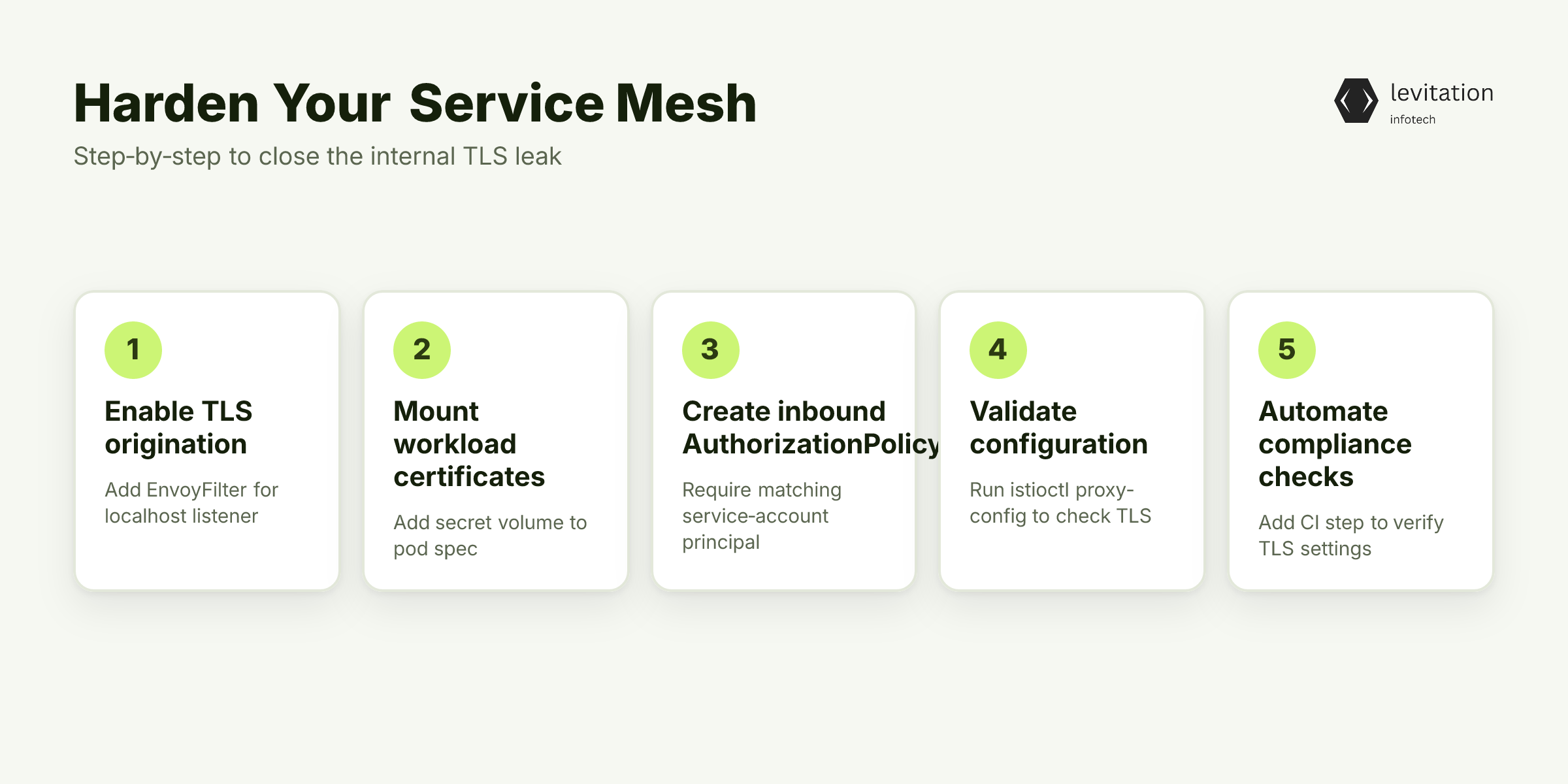
- Enable TLS origination for localhost
Add an EnvoyFilter that matches the sidecar’s inbound listener on `127.0.0.1`. The filter injects a tlsContext identical to the one used for external traffic.
- Mount workload certificates inside the app
Modify the pod spec to include the secret that Istio generates for the service account.
1# Adding the secret volume to the app container2apiVersion: v13kind: Pod4metadata:5 name: payment-service6spec:7 containers: - name: app8 image: myorg/payment:v19 volumeMounts: - name: istio-certs10 mountPath: /etc/istio-certs11 readOnly: true - name: istio-proxy12 image: istio/proxyv2:1.1913 volumes: - name: istio-certs14 secret:15 secretName: istio.default
- Create an inbound AuthorizationPolicy
Require the source principal to match the pod’s service account. This policy blocks any process that cannot present the correct certificate.
- Validate the configuration
Use `istioctl proxy-config` to dump the listener and confirm the TLS settings.
1istioctl proxy-config listeners payment-service-xxxx -o yaml | grep -A5 tlsContext
- Automate compliance checks
Add a CI step that runs the above `istioctl` query and fails if the tlsContext is missing for localhost. - [ ] EnvoyFilter targeting `127.0.0.0/8` applied. - [ ] Service account certificate mounted in `/etc/istio-certs`. - [ ] AuthorizationPolicy with matching principal. - [ ] Validation script integrated into CI pipeline.
By tightening both the data plane (TLS origination) and the control plane (policy), you lock the pod’s internal traffic behind the same cryptographic wall. Then it protects inter-service calls. Will these changes survive a real attack?
What Happens When the Leak Is Closed: Real Benefits
Eliminating clear-text intra-pod traffic reduces the exposure of unencrypted data and aligns the deployment with encryption-in-transit expectations. An attacker who compromises a node would need a valid workload certificate to tamper with traffic. Then it raises the difficulty of successful exploitation. - Encrypting intra-pod traffic improves security posture and supports compliance with encryption-in-transit requirements. - The same principle works for sidecar-based meshes such as Istio, Linkerd, or Consul.
Frequently Asked Questions
Q: Does enabling mTLS automatically encrypt traffic inside a pod?
A: No. mTLS secures traffic between sidecars. However, the communication between the app container and its sidecar can remain unencrypted unless explicitly configured.
Q: How can I verify that intra-pod traffic is encrypted?
A: Use tools like `istioctl proxy-config` or packet captures inside the pod to ensure TLS handshakes occur on the localhost interface. This confirms encryption.
Q: What policy changes enforce identity verification on app-to-sidecar calls?
A: Add an AuthorizationPolicy that requires a source principal matching the workload’s identity. Then configure an EnvoyFilter that forces TLS origination for localhost traffic.
Q: Will hardening mTLS impact service latency?
A: There is a modest latency overhead from the additional TLS handshakes. But the security gain typically outweighs the performance cost for most enterprise workloads.
Q: Is this approach compatible with all service mesh implementations?
A: The concepts apply to any mesh that uses sidecar proxies (Istio, Linkerd, Consul, etc.), though exact configuration syntax may differ. Adjust the YAML as needed for each implementation.
Related reading - [Zero Trust Mesh: Why mTLS Isn't Enough](/posts/zero-trust-mesh-mtls) - dives deeper into why identity checks must span every hop. - [Why Your Service Mesh mTLS Is a Hidden Backdoor](/posts/service-mesh-mtls-backdoor) - explains broader security implications of intra-pod leaks.
By treating the application container as just another endpoint in the mesh, you finally close the data leak. This leak has haunted mTLS deployments for years. The path to true zero-trust is clearer. It is also shorter than you thought. Learn more on our site.
Sources
Research and references cited in this article:
- Trying to deep dive service mesh mutual TLS, what am I missing here?
- PDF MisMesh: Security Issues and Challenges in Service Meshes _(academic)_
- Advanced Istio mTLS Explained: Securing Microservices with Service Mesh
- Cloud Service Mesh security best practices
- Why We Need mTLS in Kubernetes Service Meshes - Thomas Stringer
- Securing Microservices Identity with a Service Mesh.
- mTLS in Service Mesh - DEV Community
- Use service mesh and mTLS to establish secure routes and TLS ...
- Zero trust, mTLS, and the service mesh explained
- Service mesh mTLS hides a process identity gap in zero trust
- Service Meshes in 2026: mTLS, Traffic Shaping, and ...
- Technical Report: Performance Comparison of Service Mesh Frameworks: the MTLS Test Case _(academic)_
About the author
Mayank Singh is a software developer at Levitation Infotech, where he builds web and AI-powered applications across the company’s fintech, healthcare, and enterprise projects.