


Automated MLOps pipelines promise safety, but they often hide fatal flaws until a model misbehaves in production.
When the alarm finally rings, the damage is already done. Then the fix is far more expensive than a manual review would have been.
The False Promise of Automated Safety
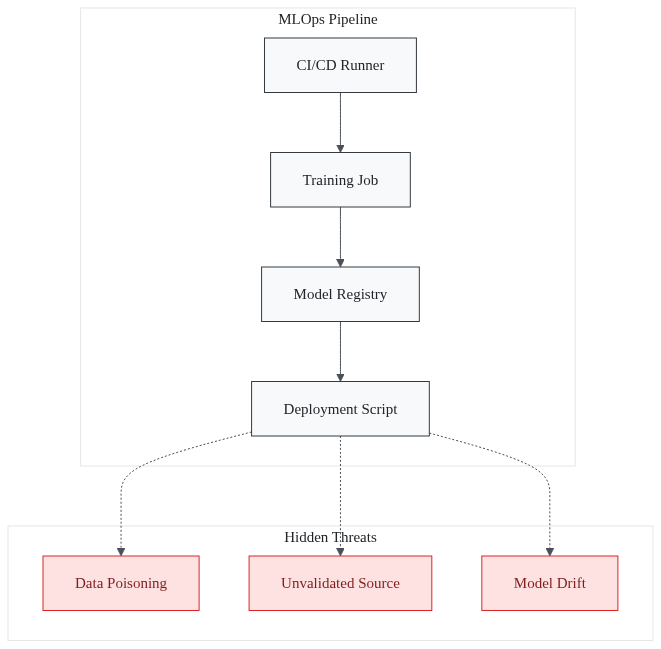
Automation feels like a shield.
A CI/CD runner spins up a training job.
A model registry tags the artifact.
A deployment script pushes the container to Kubernetes.
Teams celebrate the speed, then assume the pipeline has already vetted every risk.
That assumption is wrong.
- Data poisoning thrives on the assumption that “any data that lands in the lake is good.”
- Unvalidated third-party sources slip in because the pipeline never checks provenance.
- Model drift goes unnoticed when validation steps are reduced to a single accuracy check.
Research on MLOps pipelines notes that data engineering and model development can introduce risks. These include data poisoning and insecure data sources.
When you rely on a black-box pipeline, those risks become invisible.
What hidden threats could still slip through?
Why Speed-First MLOps Leaves Critical Gaps
A typical “fast-track” deployment lands a model in production within three to six months.
In-house teams that spend eighteen to twenty-four months on the same project can afford deep security reviews. Then they can do exhaustive data audits and staged rollouts.
The trade-off is clear: speed versus rigor.
Automation tools rarely embed provenance verification.
They assume the data lake is immutable, yet most cloud storage lacks built-in signatures.
The tools also skip model integrity checks.
A Docker image is built and pushed without a signed digest.
A malicious actor could replace the layer during a supply-chain attack.
When this policy is enforced by the admission controller, any pod that tries to run an unsigned image is rejected. As a result, the pipeline blocks unsafe deployments.
The cost is a few extra seconds in the CI pipeline. However, the benefit is a guarantee that only vetted artifacts reach the cluster.
Key observations: - Fast pipelines often omit data provenance checks. - They rarely enforce runtime attestation of containers. - Security reviews become optional, not mandatory.
But faster delivery isn’t the only reason pipelines fail; the architecture itself can amplify risk.
The next section will reveal how those missteps manifest.
Hidden Failure Modes That Compromise Model Safety
Seeing the gaps is one thing; understanding how they manifest is another.
Below are the three most insidious failure modes that slip through a speed-first pipeline.
1. Data Engineering - Poisoned Third-Party Datasets
A data engineer adds a public CSV to enrich features.
The source claims “open-source” but provides no checksum.
The pipeline ingests the file, merges it, and the model learns a hidden trigger.
Because the pipeline never recorded the file’s hash, the poison remains undetected.
2. Model Development - Missing Experiment Traceability
Data scientists run dozens of experiments in Jupyter, but only the final model is registered.
Without reproducible pipelines and versioned experiment metadata, a back-door introduced in an early run can persist. Then it appears in the final artifact.
3. Deployment Automation - Absent Runtime Attestation
A CI job builds a container, pushes it to a registry, and a Helm chart deploys it.
The chart does not verify the image digest, so a compromised registry could serve a malicious layer.
The production cluster, trusting the chart, runs the tampered model.
These modes share a common thread: lack of immutable, verifiable artifacts.
When each stage produces a signed, hash-verified output, the chain of trust is restored.
What steps can rebuild that chain of trust?
A Safety-First MLOps Architecture Blueprint
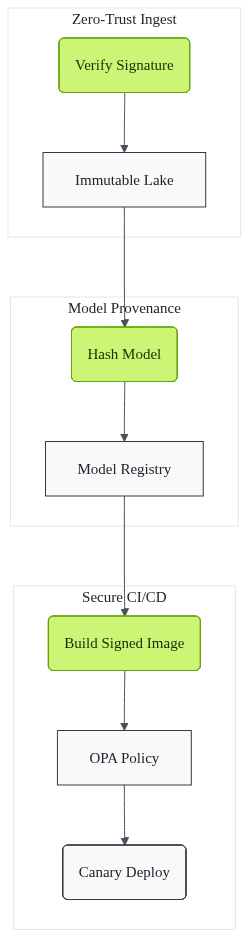
Imagine a pipeline built on three pillars: zero-trust ingest, provenance-rich model storage, and secure CI/CD.
The design mirrors a bank vault: every entry point is sealed, every movement is logged. Then every exit requires multiple confirmations.
Zero-Trust Data Ingest - Store raw data in an immutable lake (e.g., S3 with Object Lock). - Require cryptographic signatures for every upload. - Verify signatures with a serverless function before data lands in the lake.
1import boto3, hashlib, base6423def verify_signature(bucket, key, sig):4 s3 = boto3.client('s3')5 obj = s3.get_object(Bucket=bucket, Key=key)6 data = obj['Body'].read()7 computed = hashlib.sha256(data).digest()8 return base64.b64encode(computed).decode() == sig
Model Provenance Layer - Every model artifact gets a SHA-256 hash. - The hash is stored alongside metadata in a model registry that enforces schema validation. - Automated compliance checks run on each new version (e.g., fairness metrics, resource usage caps).
Secure CI/CD - Build containers with `docker build --sign` to embed a digest. - Enforce OPA policies that reject unsigned images. - Deploy via a staged rollout: canary pods first, monitor for drift, then full rollout. - Immutable artifacts - no one can replace a model without changing its hash. - Policy-as-code - security rules live in version control, audited like any code change. - Canary monitoring - early detection of anomalies before they affect all users.
Which steps matter most for immediate impact?
Operational Playbook: Safeguarding Every Stage of the ML Lifecycle
A blueprint is only as good as its execution.
Below is a step-by-step playbook that translates the architecture into daily practice.
Step 1 - Data Validation Gate
- Schema checks - enforce column types with Great Expectations.
- Provenance verification - compare incoming file hash against a trusted registry.
- Bias audit - run a statistical parity test on protected attributes.
1import great_expectations as ge2df = ge.read_csv("s3://trusted-bucket/raw.csv")3df.expect_column_values_to_be_of_type("age", "int")4df.expect_column_values_to_be_between("income", min_value=0, max_value=1_000_000)
Step 2 - Model Training Guardrails - Use Kubeflow Pipelines to orchestrate reproducible runs. - Pin Docker images and Python packages with exact versions. - Enable real-time drift alerts via Prometheus rules:
1# Prometheus rule for feature drift2groups: - name: drift.rules3 rules: - alert: FeatureDriftDetected4 expr: avg_over_time(feature_distribution{model="v1"}[5m]) > 0.25 for: 2m6 labels:7 severity: warning8 annotations:9 summary: "Feature drift exceeds threshold"
Step 3 - Deployment Hardening - Sign every container image (`docker trust sign`). - Apply OPA policies at the cluster admission layer. - Use Argo Rollouts for canary releases with automatic rollback on failure.
1apiVersion: argoproj.io/v1alpha12kind: Rollout3metadata:4 name: model-service5spec:6 strategy:7 canary:8 steps: - setWeight: 10 - pause: {duration: 5m} - setWeight: 30 - pause: {duration: 10m}
Step 4 - Continuous Monitoring - Run integrity checks on model predictions (e.g., out-of-distribution detection). - Perform adversarial testing nightly with Foolbox. - Archive audit logs to a tamper-evident store for compliance reviews. - Hash verification of incoming predictions. - Automated adversarial sample generation. - Immutable log shipping to CloudWatch Logs.
How does continuous monitoring keep the pipeline safe?
The Business Payoff of a Safe MLOps Pipeline
Safety and speed are often framed as opposites, but a safety-first pipeline actually accelerates value creation. - Reduced incident cost - early detection turns weeks of firefighting into minutes of automated rollback. - Regulatory confidence - audit-ready pipelines satisfy emerging AI governance standards without extra effort. - Strategic speed - embedding security into automation eliminates the eighteen-to-twenty-four-month rework loop, keeping the three-to-six-month cadence intact.
Companies that adopt this approach see models stay in production for five years or more. Then they deliver consistent revenue streams while avoiding costly outages.
Fortune 500 enterprises trust such architectures for mission-critical AI, proving that safety scales with business impact.
Levitation helped several enterprises retrofit their pipelines with the blueprint above, achieving measurable risk reduction. Then they saw higher model uptime.
What could your organization gain by following this path?
Frequently Asked Questions
Q: How can I detect data poisoning in an existing MLOps pipeline?
A: Implement automated data provenance checks, statistical outlier detection, and continuous adversarial testing during the data validation gate.
Q: What are the best practices for securing model deployment automation?
A: Use signed container images, enforce policy-as-code in CI/CD, and stage rollouts with canary monitoring. Then it automatically rolls back on integrity failures.
Q: Why does faster deployment often mean lower model safety?
A: Speed prioritizes throughput over thorough security reviews, skipping provenance verification and runtime attestation that catch hidden threats.
Q: Can a safety-first MLOps pipeline still meet aggressive time-to-market goals?
A: Yes - by embedding security checks into automated stages, you eliminate rework later and keep deployments within three to six months. Then you maintain safety.
Ready to start building a safer pipeline?
About the author
Mayank Singh is a software developer at Levitation Infotech, where he builds web and AI-powered applications across the company’s fintech, healthcare, and enterprise projects.