


TL;DR: Mutual TLS in a service mesh is not a silver bullet. Misconfigurations and missing controls let data slip out in plain text. Combine strict mTLS with identity-aware routing, deny-all policies, and continuous audits to truly seal the mesh.
Key Takeaways - mTLS guarantees encryption only when every proxy and policy is correctly scoped. - Hidden gaps - cluster-wide message paths, out-of-sync sidecars, permissive namespaces - let data leak. - A zero-trust hardening plan that adds AuthorizationPolicy, Envoy filters, and automated audits closes those gaps.
Why mTLS Alone Isn't Enough in a Service Mesh
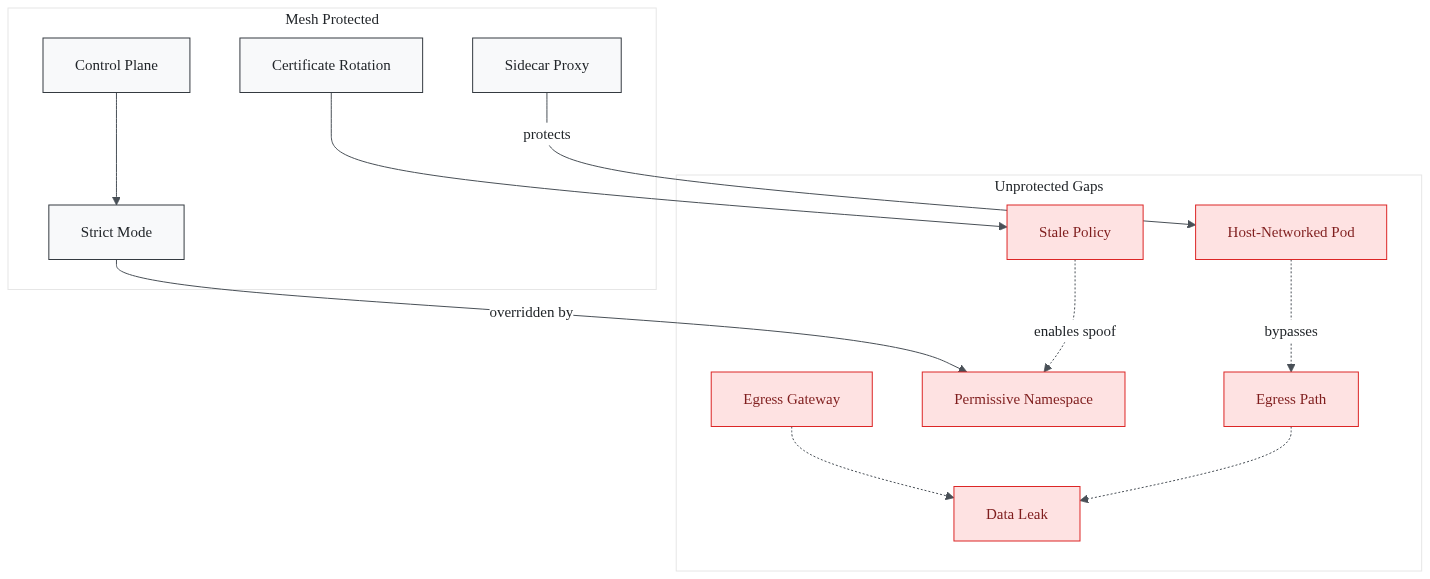
Most teams flip a switch and assume the mesh is now airtight. The myth is tempting: “mutual TLS guarantees confidentiality and integrity for all service-to-service traffic.” In practice, the toggle hides a cascade of assumptions.
First, mTLS secures traffic between sidecar proxies. It does nothing for traffic that never touches a proxy, such as host-networked pods or egress paths that bypass the mesh.
Second, the control plane must enforce a strict mode everywhere. Then a single permissive namespace reverts to plain HTTP for all its pods.
Third, certificates rotate, but policies rarely keep pace, leaving stale identities that attackers can spoof.
Research notes that even with mTLS enabled, “common misconfigurations can still lead to data breaches.” A mesh that encrypts 90 % of its hops. However, it leaves a single egress gateway unprotected, so it still leaks sensitive payloads.
So the problem runs deeper than a missing certificate.
What hidden gaps let data escape despite the TLS handshake?
Hidden Misconfigurations That Leak Data Even with mTLS
The first leak often occurs at the cluster boundary. When a pod sends data to an external service, the mesh may route the request outside the sidecar. Then it produces clear-text traffic on the host network.
Second, sidecar injection is not always atomic. Upgrading Envoy versions or rolling out new sidecar images can leave a window. Then some pods run without a proxy.
Those pods talk in the clear, even though the mesh reports mTLS as “enabled.”
Third, PeerAuthentication resources are scoped by namespace. If a critical namespace is left in PERMISSIVE mode, its services accept both mTLS and plain HTTP. Attackers can simply downgrade the connection and read data.
A concise checklist of typical gaps: - Cluster-wide egress, no TLS termination for outbound traffic - Sidecar drift, pods without injected Envoy proxies - Permissive namespaces, `PeerAuthentication` set to `PERMISSIVE` - Mismatched certificate rotation, stale certs accepted by old proxies
Understanding these gaps leads to a clearer security blueprint.
Which controls can fill the cracks and enforce true zero-trust?
Zero-Trust Made Real: Combining mTLS with Complementary Controls
Zero-trust is more than “encrypt everything.” It means every request is authenticated, authorized, and audited, regardless of network location.
In a mesh, that translates to identity-aware routing and policy enforcement that sit on top of TLS.
Identity-aware routing uses the client’s SPIFFE ID to make decisions. An Envoy filter can reject any request that lacks a verified identity, even if TLS is active. This prevents a rogue pod that somehow bypasses the sidecar from slipping through.
AuthorizationPolicy adds a deny-all baseline. Instead of trusting the mesh’s default allow-all, you explicitly whitelist the services that may talk. Any stray traffic triggers a 403, which is easy to spot in logs.
API gateway integration extends zero-trust to the edge. By placing an Istio-compatible gateway before external traffic enters the mesh, you enforce the same policies for inbound and outbound calls. The gateway can also perform JWT validation, rate limiting, and threat detection.
Telemetry and audit close the loop. Prometheus metrics like `istio_requests_total` with label `source_principal` let you verify that every request carries a valid identity. Grafana alerts on spikes of `plaintext_requests_total` catch misbehaving pods instantly.
Putting these pieces together yields a defense-in-depth stack: - mTLS - encrypts the wire. - Envoy filter - validates identity on every hop. - AuthorizationPolicy - enforces least-privilege access. - API gateway - secures ingress/egress with the same policies. - Telemetry - continuously proves compliance.
That theory sounds solid, but how do you apply it step-by-step without breaking production?
Step-by-Step Hardening Your Mesh: Config, Audits, and Tooling
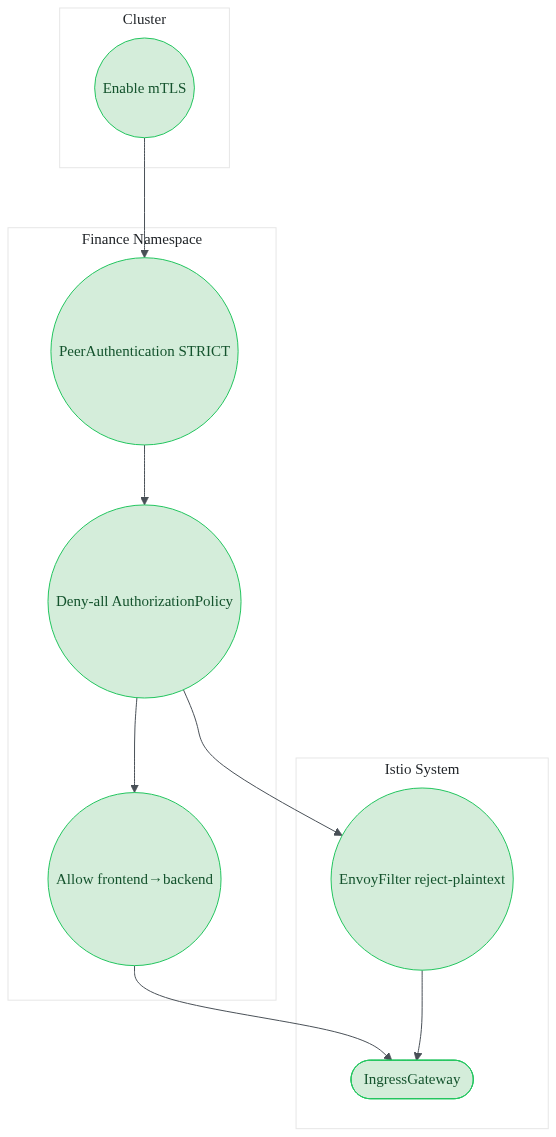
Start by making mTLS strict across the entire cluster. The Istio CLI makes it a one-liner:
1istioctl install --set values.global.mtls.enabled=true \2 --set values.global.mtls.auto=true
Next, lock down every namespace with a `PeerAuthentication` set to `STRICT`:
1apiVersion: security.istio.io/v1beta12kind: PeerAuthentication3metadata:4 name: default5 namespace: finance6spec:7 mtls:8 mode: STRICT
Create a deny-all `AuthorizationPolicy` that forces you to list allowed services:
1apiVersion: security.istio.io/v1beta12kind: AuthorizationPolicy3metadata:4 name: deny-all5 namespace: finance6spec:7 action: DENY8 rules: - {}9---10apiVersion: security.istio.io/v1beta111kind: AuthorizationPolicy12metadata:13 name: allow-frontend-to-backend14 namespace: finance15spec:16 action: ALLOW17 rules: - from: - source:18 principals: ["spiffe://cluster.local/ns/finance/sa/frontend"]19 to: - operation:20 methods: ["GET", "POST"]21 ports: ["443"]
Deploy an Envoy filter that rejects any request lacking a verified principal:
1apiVersion: networking.istio.io/v1alpha32kind: EnvoyFilter3metadata:4 name: reject-plaintext5 namespace: istio-system6spec:7 configPatches: - applyTo: HTTP_FILTER8 match:9 context: SIDECAR_INBOUND10 patch:11 operation: INSERT_BEFORE12 value:13 name: envoy.filters.http.rbac14 typed_config:15 "@type": type.googleapis.com/envoy.extensions.filters.http.rbac.v3.RBAC16 rules:17 action: DENY18 policies:19 require-principal:20 permissions: - any: true21 principals: - "spiffe://*"
Add an Istio-compatible API gateway, such as `istio-ingressgateway`, and bind the same `AuthorizationPolicy` to it. This way, external calls are subject to the same deny-all baseline.
Now automate audits. In your CI pipeline, run:
1istioctl authz check --namespace finance
The command fails the build if any pod lacks a strict policy. Pair it with a Prometheus rule:
1 expr: sum(rate(istio_requests_total{source_principal="unknown"}[5m])) > 02 for: 2m3 labels:4 severity: warning5 annotations:6 summary: "Plaintext traffic detected in the mesh"7 description: "One or more services are sending unencrypted traffic."
Finally, visualize the metrics in Grafana. A dashboard that shows `plaintext_requests_total` alongside `istio_requests_total` gives you instant visibility. The result is a dashboard that instantly flags any deviation from the strict policy.
All these steps lock down the mesh, but what does the new posture look like in practice?
What Happens When Your Mesh Is Truly Zero-Trust
When every hop is encrypted, every request is authorized. Then every anomaly is alerted on, so the breach surface shrinks dramatically.
Incidents that once stemmed from a mis-routed HTTP call now require an attacker to compromise both a valid certificate. Then they must also break a policy rule, which adds a second independent hurdle.
Regulators ask for proof of encryption and policy enforcement. With mTLS plus deny-all policies, you can generate audit logs that show every request’s principal, method, and outcome. Those logs satisfy most compliance checks without extra tooling.
Operationally, teams gain confidence to expose internal services to the internet. The API gateway enforces the same zero-trust rules, so developers no longer need ad-hoc VPNs or firewalls. Incident response times drop because alerts point directly to a policy violation rather than a vague network anomaly.
Organizations that adopt this hardened mesh report faster remediation and lower overall risk. The approach scales across clusters, clouds, and hybrid environments, keeping the security model consistent wherever code runs.
The journey from “mTLS on” to a truly zero-trust mesh is a disciplined series of configurations, audits. Then it adds observability.
How can you verify that this posture holds over time?
Levitation’s expertise in cloud-native platforms helps enterprises adopt these controls at scale. Then it ensures that the mesh remains a fortress, not a leak.
Frequently Asked Questions
Can mTLS still expose data if the mesh is misconfigured?
Yes. Misaligned `PeerAuthentication` or missing sidecar proxies can leave traffic unencrypted, allowing data to be read despite mTLS being enabled.
What additional controls complement mTLS in a zero-trust mesh?
Add API gateways, strict `AuthorizationPolicy` rules, Envoy filters that validate identities. Then use continuous audit tooling to enforce identity-based access and detect plaintext traffic.
How do I verify that all mesh traffic is truly encrypted?
Use `istioctl authz check` in CI, monitor Prometheus metrics for `plaintext_requests_total`. Then enforce a deny-all policy that only allows traffic with validated TLS identities.
Is enabling strict mTLS enough for compliance in regulated industries?
Strict mTLS is a core requirement, but compliance also demands audit trails, policy enforcement, and evidence of no plaintext paths. Then it highlights the need for complementary controls.
Where can I learn more about building zero-trust policies?
See our guide on Zero-Trust Isn’t Optional Anymore: Why Fintech AI Needs Granular Access Control. And the checklist in Why Your Business Needs a Security Audit - Before It’s Too Late. Both dive deeper into policy design and audit strategies.
Learn how to secure your mesh today.
Sources
Research and references cited in this article:
- Service Meshes in 2026: mTLS, Traffic Shaping, and Operational ...
- PDF MisMesh: Security Issues and Challenges in Service Meshes _(academic)_
- Why you should NOT use Service Mesh | Google Cloud - Medium
- What is a Service Mesh? Architecture, Benefits, Risks, and Best ...
- Cloud Service Mesh security best practices | Google Cloud Documentation
- How service mesh supports a zero trust architecture | Solo.io
- Zero Trust Security for Kubernetes with a Service Mesh - HashiCorp
- How to Implement Zero Trust Security with Service Mesh | Kong Inc.
- PDF Securing Cloud-Native Infrastructure with Zero Trust Architecture
- Applying zero trust to reinforce cloud security architecture | CBTS
- 8 Essential Example Microservices Architecture Patterns for 2026
- Performance Comparison of Service Mesh Frameworks: the MTLS ... _(academic)_
About the author
Mayank Singh is a software developer at Levitation Infotech, where he builds web and AI-powered applications across the company’s fintech, healthcare, and enterprise projects.