

TL;DR: Orphan microservices, services with no assigned owner, account for 41% of outages across 1,200 tracked services. The root cause is organizational, not architectural. Decomposition velocity outpaces team reassignment, and unowned services accumulate faster in microservice estates than in monoliths. Detection requires a four-signal framework. Resolution requires tiered reassignment with quarterly re-checks. VPs who track ownership coverage as a KPI shift outage ownership from invisible catch-all routes to named on-call rotations.
Key Takeaways: - 41% of microservice outages hit services with no team assigned to own them - Orphan services accumulate faster in microservices than monoliths because Conway's Law runs in reverse during reorgs - A four-signal detection framework (CODEOWNERS, alert routing, committer patterns, runbook currency) identifies orphans in estates of 200+ services - Tiered reassignment by downstream consumption, deployment frequency, or decommission restores ownership in 90-day cycles - Ownership coverage tracked quarterly outperforms annual audits as a reliability multiplier
The 41% Outage Problem Nobody Is Tracking
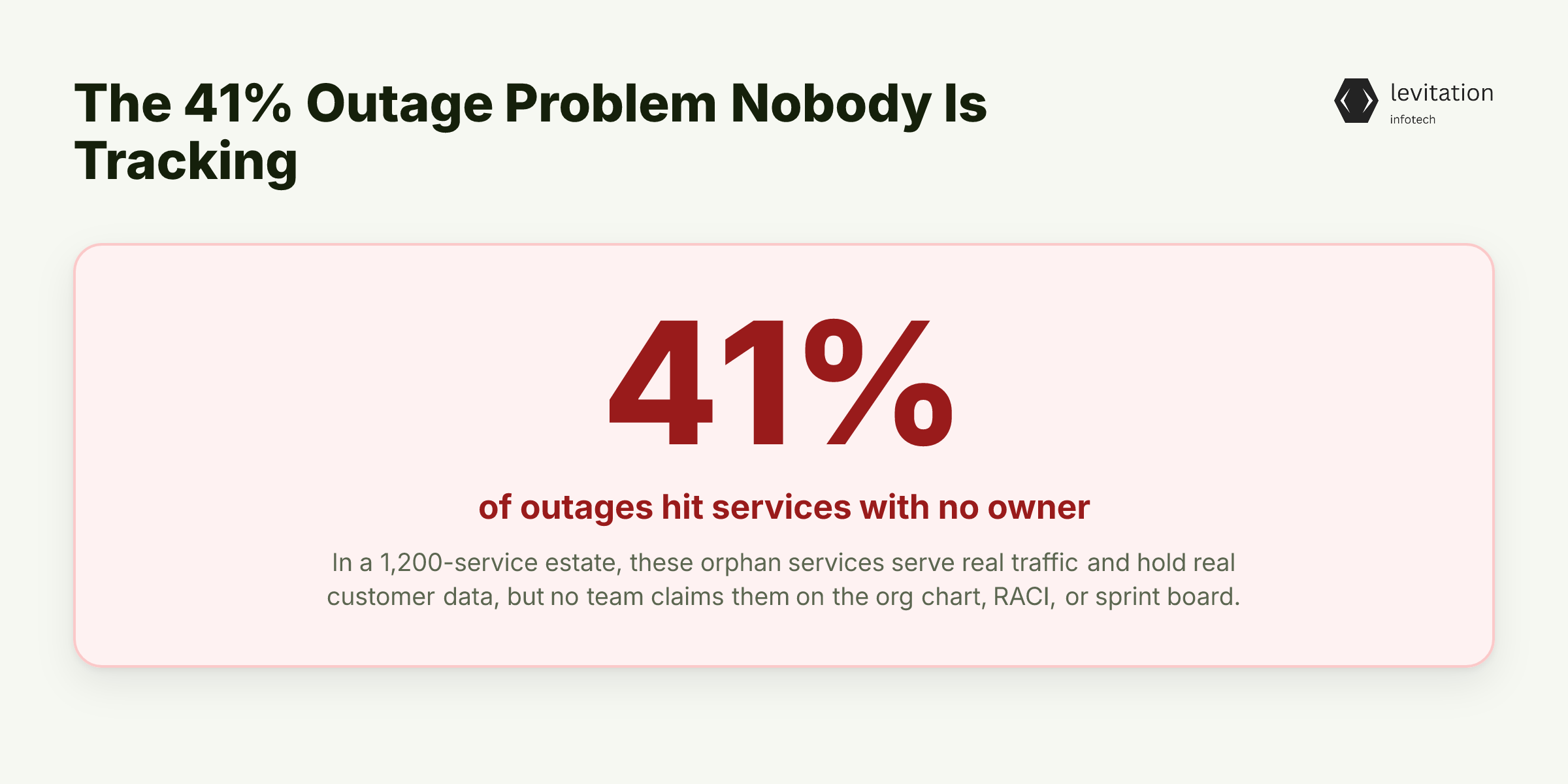
In a 1,200-service production estate, 41% of outages hit services that no team would claim on a whiteboard. These aren't legacy prototypes or test harnesses. They serve real traffic, hold real customer data, and break in ways nobody is positioned to fix.
The reason this stays invisible to most engineering VPs is structural. Orphan services don't appear in org charts because the people who used to own them left, were reassigned, or never existed.
They don't show up in RACI documents because nobody writes a RACI for a service they didn't build. They don't surface in sprint boards because there's no team running a sprint for them. The service is real. The owner is not.
The cost isn't only MTTR, though that alone is brutal. An ownerless service has no one pushing for hardening, no one reviewing dependency upgrades, and no one who loses sleep when latency creeps.
It runs in silent degradation mode until the day it doesn't. The first responder is whoever happens to be on the hook for a catch-all alert. Patterns in microservice reliability failures and the service ownership metrics that surface them are well documented. The gap is in execution.
A domain boundary with no owner fails more often than a slightly bloated service that has a caring team. This is the inversion most platform teams refuse to accept.
If orphan services are this damaging, why do they accumulate faster in microservices than in the monoliths teams came from?
Why Microservices Breed Orphans Faster Than Monoliths
Conway's Law runs in reverse. In a monolith, ownership is implicit: the team that owns the codebase owns everything in it. When teams reorg, the code moves with them.
The inverse is true in microservices. A reorg can leave dozens of services stranded in a single afternoon because nothing physically pulls them along. You can see this play out across Conway's Law in practice at almost every org past 100 services.
The "one team per service" ideal from the empirical ownership literature rarely survives contact with reorgs, acquisitions, and attrition. It's a starting condition, not a steady state.
Decomposition velocity outpaces team reassignment. A team splits a service into three, ships the new pieces, and the reassignment conversation gets deferred to next quarter. Next quarter becomes next reorg.
The "it works, don't touch it" trap compounds the problem. Ownerless services often run fine for years. They process traffic, they pass health checks, they don't page anyone.
Until a dependency deprecates, a certificate expires, or a CVE drops. Then there's no one who understands the service well enough to fix it without archaeology. By the time the outage hits, the original authors have moved on and the runbook is a stub. The org chart fails these services.
The Three Orphan Archetypes - Reorg Orphans. Created when a team is split, merged, or reassigned and the service inventory doesn't follow. Most common. Worst lifetime impact because the service stays in production for years under a defunct team name. - Departure Orphans. Created when a key engineer leaves and nobody formally inherits their services. The team still exists; the service-specific knowledge doesn't. - Acquisition Orphans. Created when a company acquires another company's stack. The acquired services run, but no one in the new org has context on them. Often the longest-lived orphans because the new org doesn't even know they exist. Orphan services in acquired estates are routinely the largest source of unexpected toil.
So what actually breaks mechanically when a service has no owner?
The Outage Mechanics of an Ownerless Service
No on-call rotation means longer MTTR. The first responder is whoever happens to be awake and paged by a default catch-all routing rule. That person has no context, no runbook, and no relationship with the service.
They're debugging someone else's system under pressure. Standard MTTR benchmarks assume a primary owner exists. Orphan services blow past those numbers because the primary doesn't.
No monitoring ownership means alerts route to a Slack channel that nobody reads, or worse, to no channel at all. The dashboard shows green because nobody wired the right metrics.
The incident response for orphan services protocol follows a sequence: find a human, then find context, then find the bug. All under paging pressure.
No business context means nobody knows if a degraded endpoint is revenue-critical or internal noise. The fix priority is wrong by default. Engineers treat a five-second latency on a checkout endpoint the same as a five-second latency on a reporting job. Both endpoints are "ownerless" and equally mysterious.
The research conclusion is direct: observability and monitoring tools are only as effective as the humans accountable for acting on their output. A Grafana dashboard with no owner is a decoration. A PagerDuty rotation with no runbook is a lottery.
Similar dynamics show up in cases where the observability stack lies about Kubernetes health. Tooling outruns accountability.
The compounding effect is what kills estates at scale. Each failure in an unowned service gets deferred because the cost of fixing it now exceeds the cost of the next failure.
Over months, this becomes latent technical debt that surfaces as a major incident. The kind that lands in the board deck.
In a 1,200-service estate, you can't fix what you haven't found. How do you detect orphans before they break?
Detecting Orphan Services at Scale
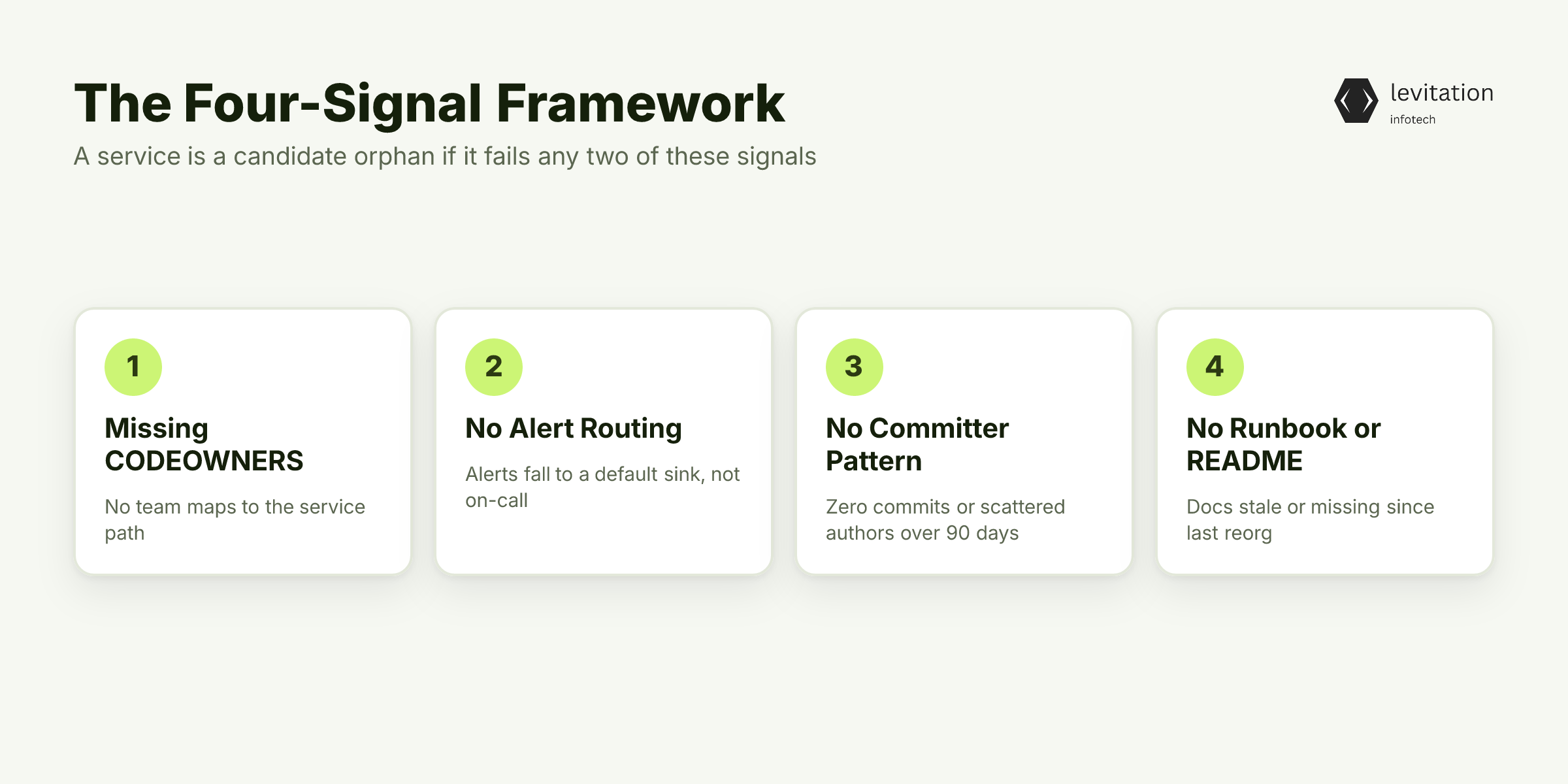
The four-signal framework. A service is a candidate orphan if it fails any two of these:
- Missing CODEOWNERS entry. No path in `.github/CODEOWNERS` maps to a current team. The file exists but the team reference is stale.
- No alert routing rule. No PagerDuty schedule, Opsgenie rotation, or alertmanager route tied to a current on-call. Alerts fall to a default sink.
- No consistent committer pattern in the last 90 days. Git log shows either zero commits, or commits spread across many authors with no clear owner.
- No runbook or updated README. The service repo's `RUNBOOK.md` is missing, or last touched before the most recent reorg.
Building the Detection Pipeline
Query your source control, CI, and observability stack for these four signals and join them into a single ownership-coverage view. A minimal example showing what an orphan's alert path looks like before the fix:
1# alertmanager.yml - what orphan routing looks like before the fix2routes: - matchers: - severity =~ "critical"3 receiver: 'default-critical-sink'4 # Note: no per-service routing exists5receivers: - name: 'default-critical-sink'6 slack_configs: - channel: '#unowned-alerts'
1# Detection query: services with no CODEOWNERS and no alert route2comm -23 \3 <(git ls-files | xargs -I{} dirname {} | sort -u | grep -E '^services/') \4 <(grep -rE '^/services/' .github/CODEOWNERS | awk '{print $2}' | sort -u)
The output is your orphan list. Cross-reference against alertmanager receivers and you're done.
Operational CODEOWNERS enforcement is the lever that makes this enforceable later. Detection comes first. Mature service catalog best practices treat the catalog as a product with its own SLO tied to ownership freshness and coverage.
The 'Last Touched By' Heuristic
Git blame combined with deployment frequency reveals drift between the original authors and current committers. If the top committer in the last 90 days is not in the CODEOWNERS file, that's a signal.
If the deployment count has been zero for an extended period, that's a stronger signal. Neither alone is conclusive. Together they catch services the first three signals miss.
The same drift shows up in oldest Kubernetes YAML becoming the next outage. Artifacts outlive their owners.
Speed advantage for VPs: a purpose-built platform can surface this ownership layer faster than building the detection stack in-house. Building the stack in-house demands sustained platform engineering effort. Manual audits fail at 200+ services because the ratio of auditors to services makes quarterly review impossible without automation. You'll burn a quarter catching up and a quarter arguing about definitions.
Detection without assignment is just a more colorful dashboard. What's the framework for actually putting names on these services?
The Ownership Assignment Framework
The reassignment tiers, in priority order: - Tier 1: Reassign to the team that consumes most of the service's downstream calls. They have the business context. If Team A's checkout flow depends on Service X, Team A is the natural owner whether they asked for it or not. - Tier 2: Reassign to the team that has deployed the service most in the last six months. They've shown tacit ownership already. Codify what's already true. - Tier 3: Decommission if usage metrics show low traffic and no critical dependencies. Orphaned services are often low-value. That's why nobody fought to keep them. Sunset beats reassignment. - Tier 4: Assign to a platform team rotation with a sunset date. Some services need a temporary home while a real owner is negotiated. The sunset date is non-negotiable. Good platform engineering team models bake this in as standard procedure.
Making Ownership Enforceable
CODEOWNERS as a merge gate, not a documentation suggestion:
1# .github/CODEOWNERS2/services/payments-gateway/ @payments-team3/services/legacy-reports/ @platform-team4/services/checkout-orchestrator/ @checkout-team
Branch protection rules should require review from the matching team. No CODEOWNERS entry, no merge.
This is the cheap enforcement; branch protection is free, governance is free. The discipline is what's hard. Service decomposition strategy work should always end with CODEOWNERS updates, not before.
The 90-Day Recheck
Ownership assignments decay. People leave. Teams reorg.
Quarterly detection runs are the only way to catch the new orphans the first wave missed. Treat the coverage score as a tracked KPI alongside deployment frequency and change failure rate.
If coverage drops noticeably, escalate. A service estate's reliability is bounded by its ownership discipline, not its architecture.
What does the service estate look like after ownership discipline is enforced?
What a Fully-Owned Service Estate Actually Looks Like
The shift is structural. Outage distribution moves as unowned services get reassigned to teams with runbooks and context. The services that used to page the catch-all now page a real team with a runbook and a context model.
MTTR drops. The first responder is no longer whoever happened to be online. It's the on-call for the owning team, who has the runbook open before the page arrives.
Time-to-diagnosis compresses because the context is local, not archaeological.
Deployment frequency increases on previously-orphaned services. Someone is now incentivized to ship improvements, fix latent bugs, and clean up tech debt. The service starts moving again.
The maturity marker: systems with enforced ownership discipline mature into long-term reliability multipliers, not short-term process wins. Services that were stable because nobody touched them become stable because someone is actively maintaining them.
The VP-level metric is ownership coverage percentage, tracked quarterly alongside reliability and deployment frequency. This is the number to put in the board deck.
The engineering governance frameworks that treat ownership as a first-class concern outperform those that bolt it on later.
The microservice ownership KPIs that surface it as a dashboard signal are the ones that survive a reorg.
Frequently Asked Questions
What is an orphan microservice?
An orphan microservice is a production service with no team or individual clearly accountable for its reliability, maintenance, and incident response. Orphans typically emerge after reorgs, departures, or acquisitions when ownership is never formally reassigned.
How do you measure microservice ownership?
The primary metric is ownership coverage: the percentage of services with a verified owner in your service catalog. Secondary signals include CODEOWNERS presence, alert routing rules, recent committer consistency, and runbook currency.
What is a good ownership coverage target for a microservice estate?
Engineering VPs should treat any ownership gap as an elevated risk for production services. Coverage gaps correlate with elevated outage risk per the 41% finding. Coverage should be audited quarterly, not annually, because ownership decays faster than most teams expect.
Can a single team legitimately own hundreds of services?
Yes, but only if the team is a dedicated platform or infrastructure group with formal service-tier assignments. The risk emerges when a product team owns hundreds of services across multiple domains. That distribution usually signals impending orphans and should trigger a decomposition review.
How often should microservice ownership be audited?
Quarterly audits are the minimum for estates above 200 services. The four-signal detection pipeline (CODEOWNERS, alert routing, committer consistency, runbook currency) should run continuously if possible, with quarterly audits establishing the minimum reporting cadence for ownership coverage.
Sources
Research and references cited in this article:
- Top 10 Microservices Architecture Best Practices for 2026
- Microservices Anti-Patterns - DEV Community
- Troubleshooting the Top 10 Microservices Issues
- How to Avoid Microservice Anti-Patterns - vFunction
- Microservices Architecture: Pitfalls & Implementation Tips
- Monitoring Performance in Microservices Architecture - Semaphore
- State of the Art on Microservice Performance Metrics
- The socio-technical aspects of microservices: ownership · Together We Code
- How to Monitor Microservices Effectively
- Monitoring Microservices the Right Way | Logz.io
- 5 Key Strategies for Ensuring Microservices Resiliency
- Fault Tolerance: 6 Strategies for Service Resilience in Microservices
About the author
Mayank Singh is a software developer at Levitation Infotech, where he builds web and AI-powered applications across the company’s fintech, healthcare, and enterprise projects.