


TL;DR: Noida's manufacturing founders are walking away from Odoo. They are not leaving because of price. The open-source flexibility they bought into becomes a customization ceiling once operations cross a complexity threshold. At that point, module-level tweaks stop scaling.
The long-term total cost of ownership of a heavily-customized off-the-shelf ERP often exceeds a purpose-built custom system. This happens once module licensing, upgrade labor, and integration debt are counted honestly. The real question isn't "can we afford to build?" The question is whether we can afford to keep translating our workflow into someone else's data model every quarter.
Key Takeaways: - Odoo's "customize anything" promise locks founders out of seamless updates once deep customization accumulates. - The honest comparison is long-term TCO, not license cost. Research on on-premise ERP shows TCO running 30-70 percent higher than cloud alternatives over multi-year horizons. - Indian manufacturing workflow DNA, from job-work to multi-tier vendors to batch traceability, doesn't map cleanly to any Odoo app store module. - An experienced custom ERP deployment finishes far faster than a first-time in-house build, because pattern recognition cuts the discovery phase. - The best signal of ERP success isn't features shipped at go-live, but whether the system is still in production years later.
Odoo's Global Growth Story Has a Noida-Shaped Blind Spot
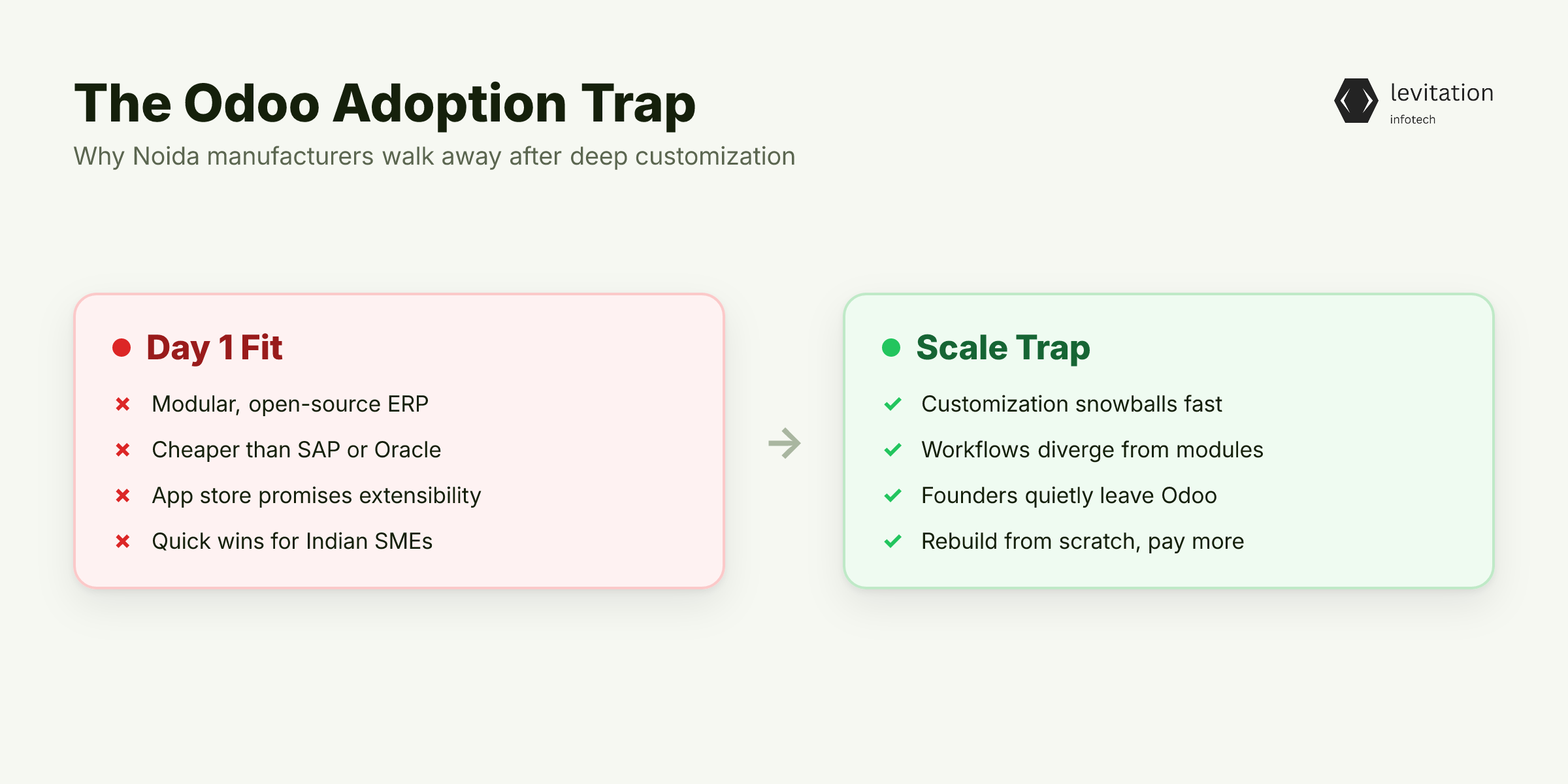
Odoo is the fastest-growing ERP ecosystem in the world. The pitch is clean. It is modular, open-source, and cheaper than SAP. It also has an app store that promises infinite extensibility. It has won real adoption across Indian SMEs and manufacturing.
But here is the part the growth charts don't show. Several of Noida's manufacturing founders are quietly walking away from Odoo after deep customization accumulates. They aren't switching to SAP or Oracle.
They are paying engineers to build something from scratch. Often this costs more than Odoo ever cost them.
The tension isn't Odoo versus the legacy giants. It is Odoo versus an internal ceiling. This ceiling only becomes visible after a business scales past a certain complexity.
The same modular flexibility that made Odoo feel like a perfect fit early on starts cracking as operations grow. Workflows diverge from the standard module assumptions.
Odoo implementation partners sell the first version. Nobody warns you about the third.
But the open-source flexibility everyone celebrates is exactly what creates the trap founders don't see coming.
The Customization Ceiling That Breaks at Scale
Odoo's app store model means every business-specific tweak becomes a dependency on a third-party module. Each module ships on its own release cycle. Each one ties into Odoo's core through APIs that change during the annual version upgrade.
Here is what that looks like in practice. A founder buys a custom procurement module from an Odoo development partner. It works perfectly. Time passes.
Odoo ships its next major version. The procurement module's author hasn't updated it. The founder's engineering team now faces a multi-week upgrade project just to keep the lights on.
The visible damage shows up in three places: - Annual upgrades turn into engineering projects instead of routine maintenance. - Custom modules diverge from upstream, creating a fork that nobody wants to own. - Every new feature request turns into a negotiation with a third-party vendor.
The "you can customize anything" promise collides with a quieter reality. Deep customization locks you out of seamless updates. It is a tradeoff Odoo's marketing page never mentions.
Founders discover it on a Tuesday afternoon when finance needs a new GST field. The team is told the upgrade will take a quarter.
Multi-plant manufacturers in Noida's industrial belt hit this wall hardest. Their procurement workflow doesn't map to any standard Odoo module. The result is bolt-on Python work that nobody owns. It sits in a fork that diverges further from upstream with every release.
And the version-update pain is only the visible cost. The number that actually breaks the build-vs-buy math lives somewhere else entirely.
Odoo Implementation Cost in India: The Numbers Nobody Quotes You Upfront
The Odoo implementation cost in India looks attractive on paper. A community edition setup is pitched as the affordable entry point. The pitch feels too good to argue with.
Then the second year arrives: - Module licensing for the enterprise edition kicks in. - Third-party connector fees for payments, e-invoicing, and shipping APIs arrive as separate line items. - Odoo.sh hosting bills arrive monthly. - The implementation partner charges premium rates for customization work the original quote didn't include.
By year three, a founder who started with Odoo at a modest scale watches annual ERP spend climb far beyond the original quote. The license line is only a fraction of that total. Customization debt, integration work, and quarterly upgrade projects do most of the damage.
The honest comparison isn't license cost versus license cost. It is long-term total cost of ownership. That includes engineering hours, upgrade labor, and the opportunity cost of features the team can't ship because they're busy keeping the ERP alive.
Research on on-premise ERP systems shows TCO running 30-70 percent higher than cloud alternatives over multi-year horizons. The same dynamic applies when a heavily-customized Odoo self-hosted stack is compared against a purpose-built custom system.
This is the pattern we unpacked in Off-the-Shelf Looks Cheaper. Year Two Tells Otherwise.. The first invoice is never the real one.
So if the price tag isn't the real reason founders are leaving, what is? The answer has less to do with software. It has more to do with what Indian manufacturing actually needs.
Why Indian Manufacturing Hits a Wall With Off-the-Shelf ERP
Indian manufacturing has a workflow DNA that no generic ERP was designed to model: - Multi-tier vendor networks where Tier 2 and Tier 3 suppliers feed Tier 1. - Job-work subcontracting where raw material moves between factories under partial processing. - GST-integrated e-invoicing and excise-style compliance layered on top of standard inventory. - Batch traceability that must survive a regulatory audit at any moment.
Indian manufacturers hit a wall when their internal systems can't keep up with scale. The system that worked for one plant chokes when multiple plants need consolidated procurement. A buyer audit demanding lot-level quality history breaks workflows that fit standard Odoo assumptions.
Odoo's strength is breadth. The app suite covers CRM, HR, eCommerce, accounting, and manufacturing. The weakness is depth.
Indian manufacturers need production planning that handles shift-wise output, batch genealogy, and machine downtime analytics. None of this fits Odoo's manufacturing module without heavy customization.
A custom ERP lets you model the actual production flow, not an abstraction of it. Shift-wise output. Raw-material yield variance. Machine downtime correlated with operator shifts. These aren't exotic asks. They are the daily reality of a Noida shop floor.
The fact that Odoo's app store can't model them cleanly is a structural mismatch, not a feature gap.
We have written about the same dynamic in Your Cloud CRM & ERP Strategy Is Bleeding Money. The logic holds whether the stack is CRM, ERP, or both.
Once you accept that the workflow mismatch is structural, the build vs buy ERP question stops being ideological. It becomes a practical architecture decision.
The Build vs Buy ERP Question, Reframed for Founders
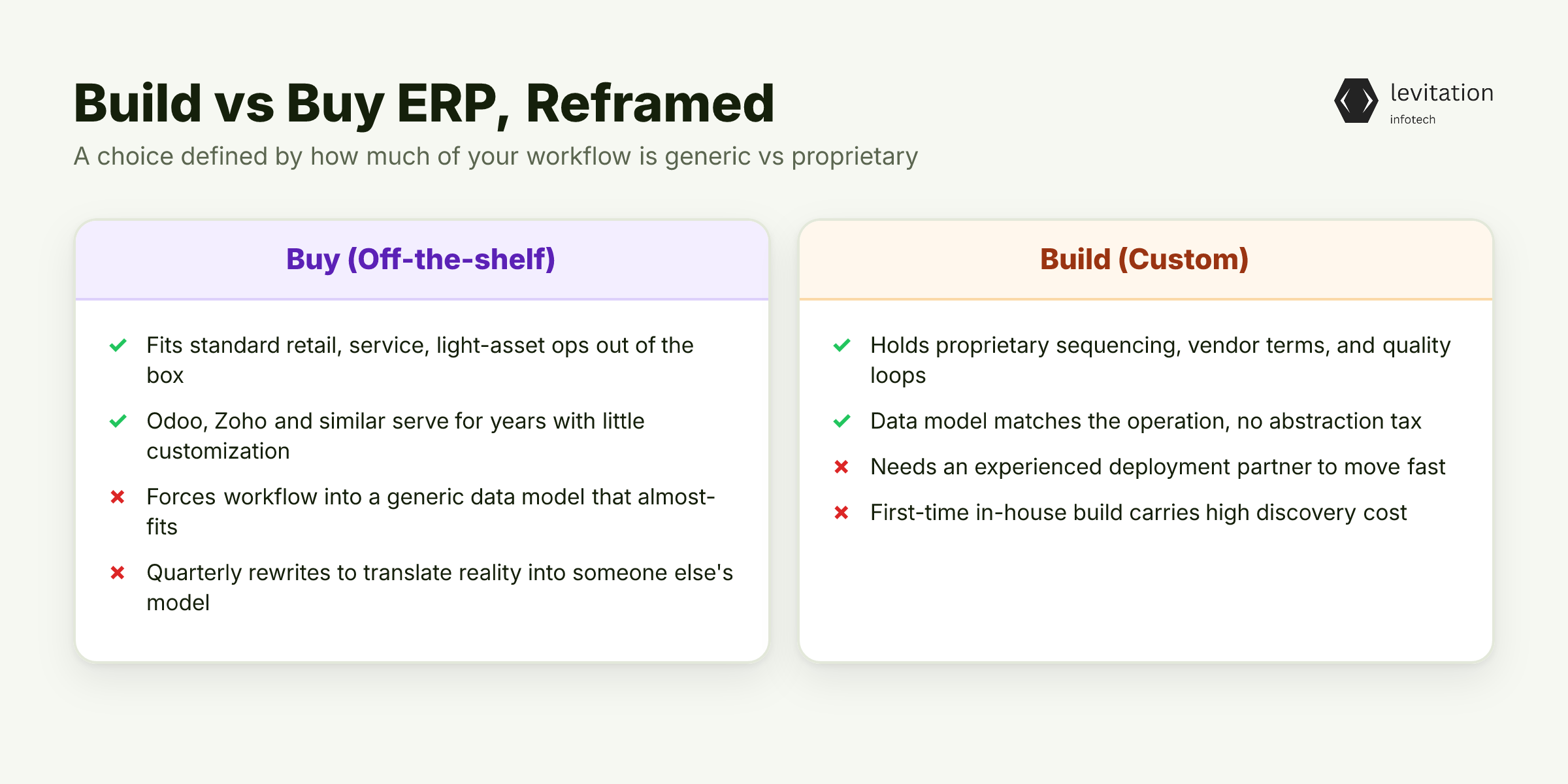
Build vs buy ERP isn't a binary. It is a spectrum defined by how much of your core workflow is generic versus proprietary.
Buy when your operations are standard enough that most of an off-the-shelf solution works out of the box. The remaining gap is tolerable. Most retail, service, and light-asset operations sit here.
Odoo, Zoho, and similar platforms will serve them well for years.
Build when your competitive advantage lives inside your operations. Your production sequencing. Your vendor terms. Your quality loop.
Generic modules force you to abstract these away into fields and workflows that almost-fit. That abstraction costs you decisions. Decisions cost you margin.
The right question is "can I afford to keep translating my workflow into someone else's data model every quarter?" Every quarter your operations team reworks the ERP because the underlying model doesn't match reality. That quarter, your competitors spent improving their actual product.
ERP integration is the bridge, but the bridge has to point at something. If the destination is a foreign data model, no amount of integration will save you.
The other half of the decision is timing. An experienced deployment partner finishes in a fraction of the time of a first-time in-house build. Pattern recognition and pre-built frameworks collapse the discovery phase. That gap isn't productivity. It is accumulated opportunity cost.
Accepting the build case is one thing. Knowing what a realistic deployment actually looks like is where most founders stall.
How a Custom ERP Deployment Actually Works
A serious custom ERP deployment is not a six-week sprint and a big reveal. It runs in four phases. Each phase has a defined output and a clear go/no-go decision.
The first phase is the discovery sprint. Process mapping, data audit, integration inventory. The output is a locked requirements document, not a Jira backlog full of assumptions. The team sits with the founder, operations head, and finance lead. The goal is to write down the business as it actually runs today, warts and all.
The second phase is architecture lock-in. Stack selection happens here, typically Python with Django, or Node with TypeScript, paired with PostgreSQL. API contracts are defined. The data model is finalized before a single screen is built. This is where most failed ERP projects go off the rails, because teams start coding before the model is settled.
The third phase is iterative build in two-week sprints. The founder sees a demo at every sprint boundary. No surprise reveal at the end. No scope discovered late in the timeline. If the team cannot demo working software every two weeks, the engagement has a problem.
The fourth phase is hardening. Load testing against production-scale data. Security audit. Parallel run with the legacy Odoo setup so cutover is a flag flip, not a fire drill. The old system stays live until the new one proves itself on real traffic.
This is what ERP software development looks like when it's done by people who have done it before. The framework already exists. The deployment isn't a research project. It is an engineering exercise with known steps.
The deployment timeline matters less than what the system looks like years after go-live.
What Changes When You Get the ERP Architecture Right
The honest payoff of getting ERP architecture right isn't software. It is the disappearance of the weekly meeting where operations, finance, and sales argue about why the numbers don't match. The system is the source of truth. The argument is over.
Founders stop spending engineering attention on ERP workarounds. That attention gets redirected toward product and customer-facing features that actually move revenue. The ERP becomes invisible, which is exactly what infrastructure should be.
Systems built with this discipline are still running in production years after deployment. They don't get ripped out at the next funding round because they actually model the business. The codebase can evolve with the company because the company owns it. There is no annual release cycle to wait for. There is no third-party module author to chase.
Enterprise-grade ERP architecture is also what makes a company credible when selling to large buyers. The same engineering discipline trusted by Fortune 500 brands for enterprise AI systems in India separates an ERP that survives the next decade from one that gets replaced quietly in year three. This is the level of rigor teams like Levitation bring when an enterprise resource planning engagement actually needs to last.
The founders who get this right don't talk about their ERP much. The ones who got it wrong can't stop talking about it.
Frequently Asked Questions
Q: How much does custom ERP cost vs Odoo in India?
A: A custom ERP for a mid-size Indian manufacturer typically costs more in absolute terms than a community Odoo license. The long-term TCO often lands below a heavily-customized Odoo once module licensing, upgrade labor, and third-party connector fees are counted. The Odoo implementation cost in India looks cheaper at the quote stage. However, it compounds over multi-year horizons.
Q: Can a custom ERP integrate with my existing Odoo or Tally setup?
A: Yes. Most Noida founders run a phased migration where the new custom ERP handles core production and inventory. Tally continues for statutory accounting. The two systems stay connected via API. This avoids the risk of a big-bang cutover. It also lets you validate module by module.
Q: How long does a custom ERP really take to deploy?
A: With an experienced ERP software development partner, a typical custom ERP for Indian manufacturing deploys in a fraction of the time compared to an in-house team building their first ERP. The speed difference comes from having pre-built frameworks for common manufacturing modules rather than starting from a blank codebase.
Q: Is custom ERP overkill for a company under 50 people?
A: Usually yes. If your operations fit cleanly into Odoo's standard modules, stay on Odoo. Custom ERP starts making sense when your workflow includes multi-plant operations, job-work subcontracting flows, or compliance requirements that Odoo's app store can't model without heavy customization. The threshold is workflow complexity, not headcount.
Q: What happens to a custom ERP when business requirements change?
A: This is the actual reason to go custom. You own the codebase and your team can ship changes in days. You don't have to wait for Odoo's annual release cycle. You also don't have to pay a partner for every module tweak. The tradeoff is you need either an in-house maintainer or a long-term support contract with the ERP development partner who built it.
For teams weighing the move, a two-week discovery sprint on the actual production flow usually answers the build-or-buy question faster than another year of Odoo upgrades.
Sources
Research and references cited in this article:
- Odoo ERP for Manufacturing Industry | Optimize Production
- Customize Odoo ERP for Unique Business Needs in India
- 25 Best ERP Systems For Custom Manufacturing In 2026
- Transforming Manufacturing with Odoo ERP
- 10 Odoo ERP Features | Revolutionize Your Manufacturing ...
- Odoo Community vs Enterprise 2026: Cost, Pricing & Hidden Fees
- Custom ERP vs Odoo: When to Build, When to Buy
- Why Are Startups Paying Lakhs for ERPs When Odoo Exists?
- Why strategic Odoo ERP development services are ...
- Scaling Smarter: Why India’s Next-Gen Businesses Are Tuning In to Odoo Community Days 2025
- Cloud ERP vs On-Premise ERP for Manufacturers
- Manufacturing ERP Cost in 2026: Real Pricing ...
About the author
Mayank Singh is a software developer at Levitation Infotech, where he builds web and AI-powered applications across the company’s fintech, healthcare, and enterprise projects.