


You think open-source AI agents are a cost-free shortcut. However, they silently inflate your cloud bill by orders of magnitude. The moment you spin up a ReAct-style crew, API calls start ticking and token counters climb. The data-transfer meter spins faster than a CDN cache miss. As a result, the monthly invoice soon shows a line-item that could fund an entire microservice platform.
The Hidden Cloud Bleed: Why ‘Free’ Open-Source Agents Aren’t Free
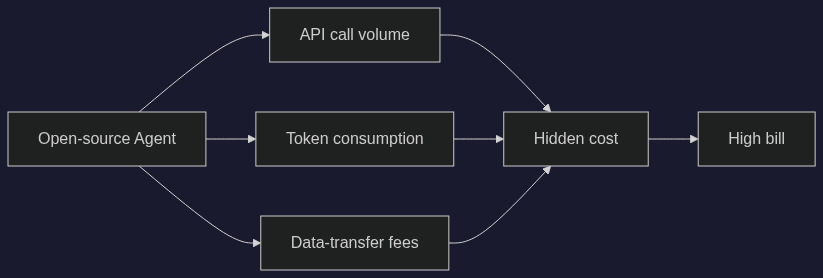
Most teams assume “open-source = no-cost”. The code lives on GitHub, the docs are public, and the license says “free to use”. That assumption ignores three hidden bill drivers.
- API call volume - Every agent step translates into an HTTP request to an LLM provider. A single reasoning loop can fire ten calls; a multi-step workflow can fire dozens. Multiply that by thousands of daily users and the request count explodes.
- Token consumption - LLM pricing is per-token. A prompt that seems innocuous on paper can consume hundreds of tokens. Once the agent adds context, tool outputs, and system messages, the total grows. The total token count often dwarfs the original user input.
- Data-transfer fees - Agents that fetch documents, images, or vector embeddings move gigabytes across regions. Cloud egress charges apply even when the payload is just a JSON payload for a knowledge-base lookup.
The math is simple:
1# Rough token-cost estimator2requests = 120_000 # daily LLM calls3tokens_per_req = 350 # average prompt + response4price_per_1k = 0.00075 # $ per 1,000 tokens (example)5daily_cost = requests * tokens_per_req / 1_000 * price_per_1k6print(f"≈ ${daily_cost:,.2f} per day")
If the daily cost reaches a few hundred dollars, the monthly bill can climb into the five-figure range. That gap between expectation and reality drives many CTOs to see a $20 budget balloon. It can grow into tens of thousands. In practice, understanding what is charged and why is the first step.
Simply slashing the agent or throttling calls only masks the problem. How can you cut costs without killing the agent?
Why Cutting Costs by Killing the Agent Fails
The first instinct is to impose hard limits: cap calls, disable tool use, or turn off logging.
These quick fixes feel like a band-aid, but they break the value the agents were meant to deliver.
Hard limits kill multi-step reasoning - An agent that can’t fetch a document midway aborts. It then returns a generic error instead of a refined answer.
Disabling tools removes the advantage because many agents rely on external APIs. However, turning them off forces the LLM to hallucinate, eroding trust.
Silencing logs hides latency spikes. But without observability you can’t tell whether a slowdown comes from a flaky downstream service. Or it may be a token surge. So, guesswork rarely saves money.
Orchestrating agents is already a complex choreography of retries, back-offs, and state persistence. Adding arbitrary caps creates hidden retry loops that double the request count. This happens because the agent repeatedly attempts a failed step. The net effect is more calls, not fewer.
The real remedy lies not in pruning feature but in smarter, observable orchestration. What kind of observability can turn this chaos into control?
The Counterintuitive Leverage: Governance-Driven Observability

Imagine seeing in real time exactly how many tokens each agent consumes. You also see which model it chose and how much data left the VPC.
Governance platforms make that possible. They instrument every LLM call and expose a per-action cost surface that can be queried, audited, and policed.
- Token-level telemetry tags each request with an agent ID and aggregates token counts. It allows alerts when a daily quota is exceeded.
- Model-selection rules mandate that low-risk queries use the smallest, cheapest model. Then, high-value tasks get the flagship model, automatically driving cost down.
- Data-transfer limits cap egress per agent or enforce region-local processing, preventing surprise cross-region fees.
Visibility creates discipline. Teams seeing the dollar impact of each token start optimizing prompts, caching results, and pruning unnecessary steps. Restrictions become a side effect of informed design, not a blunt instrument.
With granular visibility in place, you can start engineering concrete cost-controls. What concrete steps turn insight into savings?
Implementing Cost-Aware Agent Frameworks
Below is a practical recipe you can drop into any Python-based agent stack.
1. Install a token-tracking SDK
1pip install langchain[all] langsmith
The `@traceable` decorator records prompt length, response length, and model name in LangSmith. You can query it via its UI or API.
2. Tag calls with agent metadata
1def run_agent_step(step_name: str, user_input: str):2 response = llm_call(user_input)3 LangSmithClient().log_event(4 name="agent_step",5 metadata={"agent_id": "order_processor", "step": step_name}6 )7 return response
The custom tags let governance policies filter and audit each step.
3. Set up budget alerts with the cloud provider
1# GCP budget alert config (YAML)2budget:3 display_name: "AI Agent Budget"4 amount:5 specified_amount: 5000 # USD6 thresholds: - threshold_percent: 807 spend_basis: CURRENT_SPEND8 email_recipient: [email protected]9 alerts: - alert_type: NOTIFICATION
When spend reaches 80 % of the budget, the cloud console sends an alert. Then, the alert can trigger a function to throttle agents.
4. Enforce model-selection policies
1def select_model(prompt: str) -> str:2 if len(prompt.split()) < 20:3 return "gpt-4o-mini"4 return "gpt-4o"
The simple rule swaps models automatically, keeping token cost low for routine queries.
5. Enable caching and checkpointing
1import redis2cache = redis.Redis(host="cache", port=6379)34def cached_tool_call(key, func, *args):5 if cache.exists(key):6 return cache.get(key)7 result = func(*args)8 cache.set(key, result, ex=3600) # 1-hour TTL9 return result
Store the result of expensive tool calls in Redis keyed by the request hash. Then, repeat calls fetch from cache instead of re-issuing the LLM call.
6. Deploy with a realistic timeline
Typical open-source agents become production-ready in three to six months when you follow this disciplined approach. Teams that ignore governance often stretch to eighteen to twenty-four months. Moreover, many never survive past a year because costs spiral out of control. When these controls run in production, the financial picture flips dramatically. Then, it prompts the question: how does aligned budgeting change outcomes?
What Happens When Budgets Align with Governance
Predictable spend lets finance lock in multi-year cloud contracts, eradicating surprise overruns.
Teams can plan feature roadmaps without fearing a sudden $10k spike.
Rapid, cost-aware deployments also accelerate time-to-value. Companies that adopted the governance-first stack delivered 300+ enterprise AI agents in under six months. This pace was impossible with ad-hoc budgeting.
Long-running stability follows. Fortune 500 brands that baked observability into their agents keep them in production for over five years. This is because the cost model never drifts.
The payoff isn’t just dollars saved; it’s the ability to iterate confidently. It also lets you ship new capabilities and keep compliance teams happy.
Levitation helped several enterprises embed these exact patterns, turning open-source curiosity into a predictable, scalable AI platform.
What steps can you take to bring this discipline to your own projects?
Frequently Asked Questions
How can I estimate the monthly cost of an open-source AI agent?
Instrument token usage per request, multiply by your
About the author
Mayank Singh is a software developer at Levitation Infotech, where he builds web and AI-powered applications across the company’s fintech, healthcare, and enterprise projects.