


TL;DR: Clinical AI trust is not a UX or messaging problem. It is an architectural and governance problem. Roadmaps that treat it as a transparency layer will see override rates stay high and adoption stall within the first deployment cycle.
Key Takeaways: - A JAMA Network Open study found patients rate physicians as less competent, less trustworthy, and less empathetic when they use AI in clinical practice. - Override rates climb when system outputs do not match how clinicians actually think about a case. Workflow alignment, not transparency alone, is the lever. - Bidirectional trust requires treating override rate as a first-class engineering metric and adding longevity as an explicit governance pillar.
The JAMA Finding That Should Rewrite Your AI Roadmap
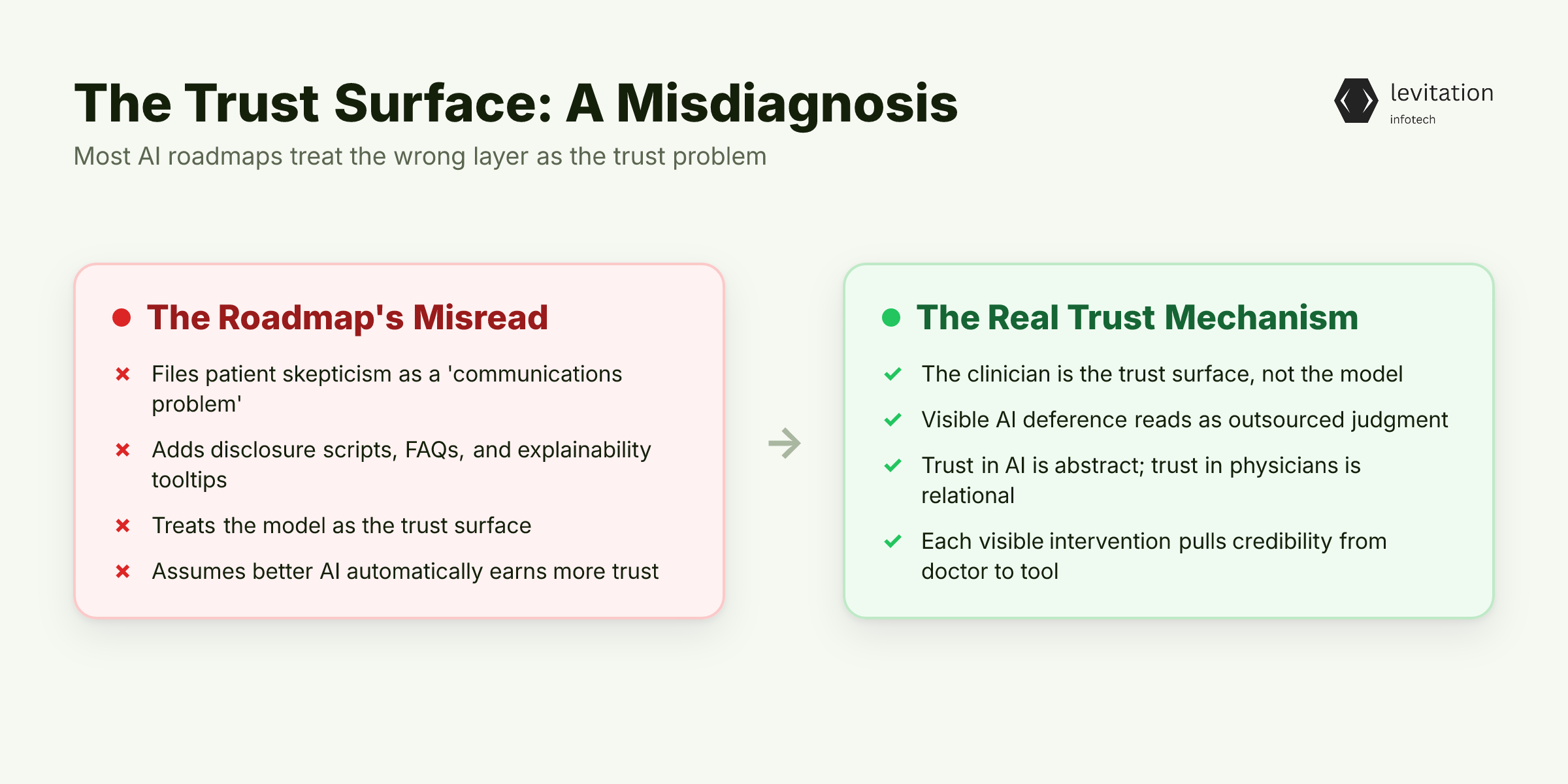
In a JAMA Network Open study, patients rated physicians as less competent, less trustworthy, and less empathetic when those physicians used AI in their practice. Administrative tasks, diagnostic tasks, therapeutic tasks: the direction was the same. The technology meant to elevate clinical care is quietly eroding the relationship it was meant to support.
Most CTOs read that finding and file it under "communications problem." Add a disclosure script, write a patient FAQ, move on. That misses the point. The damage is not what patients were told. The damage is what they observed. They saw a clinician defer to a screen, and they read that deferral as a competence signal.
This creates a trust asymmetry most roadmaps cannot see. Patients say they trust AI nearly as much as their doctors. But they punish doctors who visibly use it. Those two statements sound contradictory until you separate the variables: - Trust in the AI is abstract and conditional. - Trust in the physician is relational and earned. - The visible act of using AI pulls credibility from the second bucket into the first.
Healthcare technology roadmaps that treat the model as the trust surface get the polarity wrong. The model is a tool. The clinician is the trust surface. When the tool becomes visible at the wrong moment, it competes with the surface instead of supporting it.
Better AI does not automatically produce more trust. In some cases, it produces the opposite. Each visible intervention is one more moment the patient can read as judgment outsourced. The natural response is to publish model cards, add explainability tooltips, and call it a transparency problem.
That is the wrong fight. The mechanism behind patient skepticism has a name, and it does not live in the explainability layer.
Why Transparency Patches Don't Move the Needle
Override rates climb when the system's outputs do not match how the clinician actually thinks about the case. The output has to match the clinician's reasoning sequence. It needs the same clinical signals they would have used, or it gets overridden and ignored.
Most "explainability" features today are designed for regulators and model reviewers. SHAP plots, feature-importance bars, token-level attributions. Useful for a quarterly review.
Useless for a clinician who is already time-constrained, managing a full patient queue, and facing a decision in the moment. When the explanation does not match the workflow, the clinician does not read it. They override the output and move on. So the system collects more overrides. The override rate gets reported to leadership as a "trust metric." Leadership commissions a transparency project. The cycle repeats.
Patient-facing transparency (disclosure scripts, consent flows, "this note was generated with AI assistance" footers) is necessary. It does not address the competence-perception damage documented in the JAMA study. That damage happens at the moment of the visit, not the moment of the disclosure.
If transparency is not the lever, the actual mechanism behind patient skepticism has to be named. It is not fear of bad output. Patients fear loss of the human connection more than they fear algorithmic error. Their trust is relational before it is technical, and no model card fixes a relational deficit. A top AI companies for healthcare in India partner that has shipped the trust layer before is the only kind of vendor that understands this distinction.
The interesting question is what architecture actually produces bidirectional trust, not just one-way transparency.
The Trust Paradox Nobody Is Designing For
Here is the paradox. Patients report trusting AI almost as much as their physicians. But they want that trust demonstrated through clinical judgment, not through visible AI use. The more visibly AI is deployed, the more the clinician's perceived competence drops, even if outcomes are improving.
The same patient who says "I trust AI" will downgrade a physician they saw use it. The mechanism is not rational. It is relational. Patients read AI use as a signal that the clinician is replacing judgment rather than extending it. The signal lands hardest when the AI is visible at the moment of decision. The same dynamic explains why clinical AI gets routed around by frontline staff in production, even when its outputs are validated.
Clinician trust in AI depends on more than transparency. Autonomy is the underweighted variable in most governance frameworks. The clinician needs both the technical ability and the cultural permission to override the system without penalty.
If overrides are tracked and used in performance reviews, autonomy is theater. If overrides require a ticket and a justification, autonomy is theater. Real autonomy is hard-coded into the runtime: a gate that blocks downstream action until the clinician signs off, with no friction to bypass.
Three principles follow from the paradox: - The AI must be a second opinion, not a first opinion that requires rebuttal. - The clinician must be visible doing the thinking, not visible deferring to the screen. - The patient must leave the visit feeling the clinician held the case, not the software.
The answer is not more explainability tooltips. It is a different kind of healthcare technology stack entirely, one where architecture is decided before functionality.
Engineering Trust Into the Stack, Not Onto It
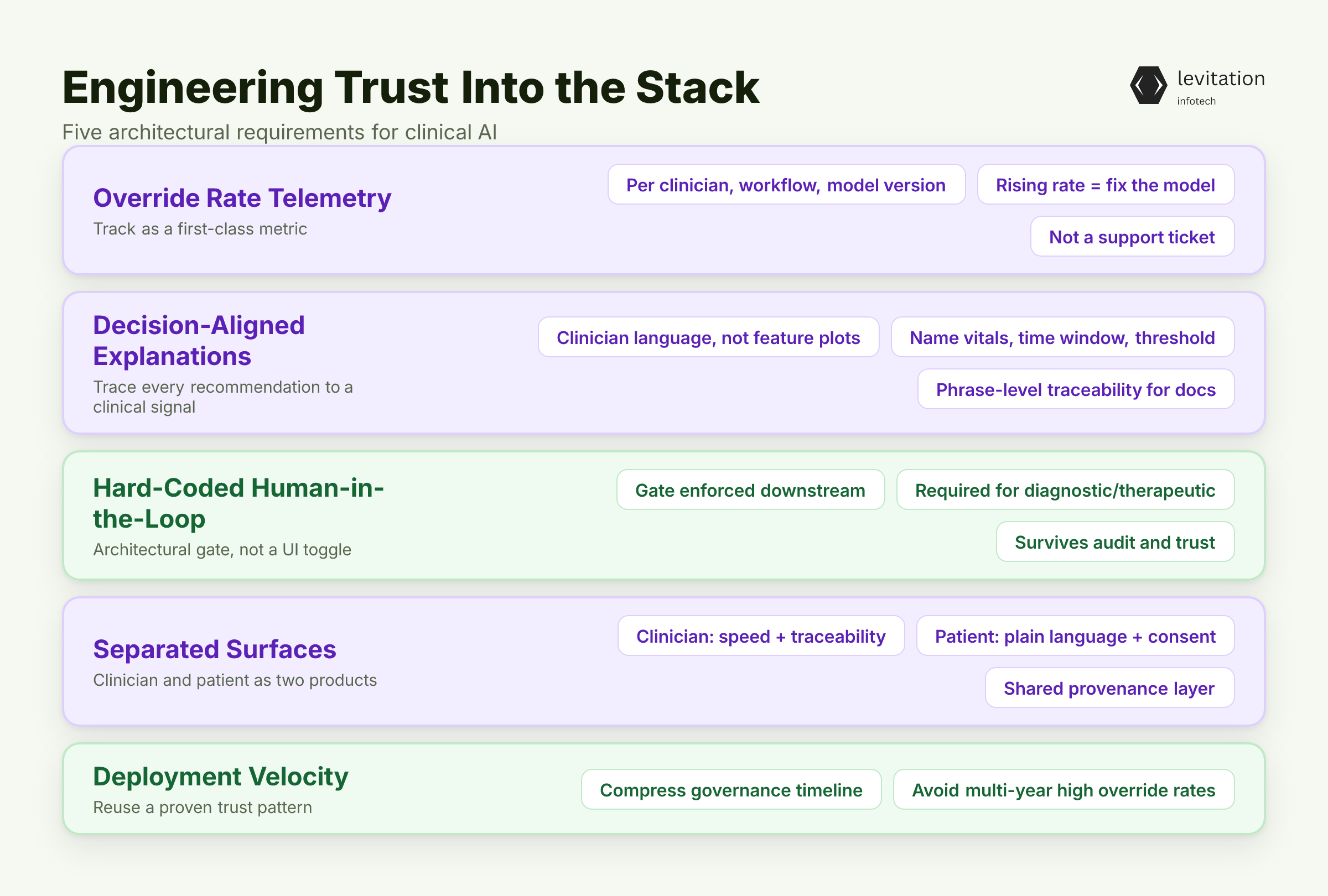
Treat override rate as a first-class engineering metric, not a support ticket. Track it per clinician, per workflow, per model version. A rising override rate on a specific note template is a signal that the model's reasoning does not match the clinician's reasoning on that template. Fix the model. Do not write a training memo.
A decision-aligned explanation layer is the second requirement. Every AI recommendation should be traceable to the specific clinical signal it acted on, in clinician language, not feature-importance plots. If a sepsis alert fires, the explanation should name the vitals trend, the time window, and the threshold breached. If a documentation suggestion appears, it should be traceable to the phrase the clinician actually said. Without that trace, the explanation layer does not address the override behavior it is meant to reduce.
Third, hard-code human-in-the-loop at the architecture level. A toggle in the UI is not the same as an architectural gate that blocks downstream action. A toggle is removable. A gate is enforced. For anything that crosses into therapeutic or diagnostic territory, the gate pattern is the only pattern that survives an audit and a clinician's trust at the same time.
Passing a HIPAA compliance review on data handling is not the same as passing a clinical review on the AI's role in the decision loop. A clean compliance clearance feels hollow when frontline trust has not been earned, and the same dynamic applies here.
Fourth, separate the surfaces. Clinician-facing explanations and patient-facing disclosures are different artifacts. They should not share a render path. Optimizing one degrades the other.
The clinician surface needs speed and traceability. The patient surface needs plain language and consent clarity. Build them as two products on a shared provenance layer, not one product with two skins.
Fifth, deployment velocity is a trust lever. Reusing a proven deployment pattern from a top AI companies for healthcare in India partner that has shipped the trust layer before compresses the governance timeline. Building governance from scratch, in-house, is how override rates stay high for years.
Architecture is half the problem. The other half is governance, and the most common governance frameworks leave out the one pillar that actually predicts long-term adoption.
A Five-Pillar Governance Model for Clinical AI
Most governance frameworks cover the same ground: transparency, accountability, evidence, and security. Necessary. Incomplete. A governance framework without a fifth pillar ages into irrelevance the first time a model update ships.
Add longevity. Longevity means the system is still trusted after multiple years in production, with model updates that do not break clinician workflows. It is the only pillar that predicts whether the system survives the second and third leadership changes, the first re-validation cycle, and the inevitable model drift.
Systems running in production for years after deployment signal something a freshly certified system cannot. The governance works when the original team has moved on.
Accountability must be a named role with a named owner, not a committee. Clinicians need to know exactly who to contact when the system produces a suspect output. A shared inbox is not accountability. A role with a phone number is.
Evidence cannot be static citation. Evidence pipelines must be versioned and re-validated against current clinical guidelines on a published cadence. The model that shipped last year was trained on a guideline that has since been revised. Without a re-validation loop, the evidence pillar becomes a historical artifact.
Compliance as a one-time checkbox is a trust killer. The systems that earn long-term trust are the ones whose HIPAA controls have been tested in real audits, repeatedly, by teams that have built this stack across multiple hospital chains. Pair governance with the retention signal: clients who renew after multiple model updates and audit cycles are the operational evidence that governance is not theater. When clients renew after their third model update and second audit cycle, the governance is working.
A healthcare technology stack with four pillars passes the first audit. A stack with five pillars passes the fifth audit too. That is the difference between a system that gets replaced early and one that gets expanded. Bidirectional trust in production looks different from bidirectional trust on a slide. The metrics are the tell.
What Bidirectional Trust Looks Like in Practice
Bidirectional trust means three things holding at the same time. Patients trust the provider. Providers trust the AI. The AI's outputs are calibrated well enough to trust the human input feeding it. Most deployments optimize the middle condition and ignore the outer two. That is why override rates stay flat and patient satisfaction scores quietly decline.
When bidirectional trust is working, override rates decline as a curve, not a flatline. The decline correlates with specific architecture changes, not training videos. Clinician acceptance stops being a survey metric and starts showing up in workflow telemetry: - Time-to-decision drops per template after the explanation layer lands. - Note-completion without edits climbs as the model's phrasing matches the clinician's. - Referral patterns stabilize as diagnostic suggestions become accepted rather than dismissed.
Enterprise deployments that have survived multiple years in production share a pattern. The trust layer was designed before the feature layer, not after. Architecture before functionality. Governance before product. The opposite of the typical in-house build, where feature velocity outruns trust engineering and override rates climb for years before anyone notices.
Teams that get this right treat the trust layer as the product. The clinical features are the surface. The override rate is the canary. The five-pillar governance is the foundation. The clinical AI that started as a model becomes a system clinicians will use in front of a patient, because it protects their judgment instead of competing with it, and that is the line between a system clinicians defend and one they route around.
Frequently Asked Questions
Q: Why do patients lose trust in doctors who use AI?
A: A JAMA Network Open study found that patients perceive physicians as less competent, less trustworthy, and less empathetic when AI is involved in their care. The mechanism is relational. Patients read AI use as a signal that the clinician is outsourcing judgment, even when the AI improves diagnostic accuracy.
Q: What is the biggest barrier to clinical AI adoption?
A: It is not model accuracy. The biggest barrier is the trust asymmetry between clinicians and patients. That produces high override rates, poor satisfaction scores, and workflows that route around the system. The override rate is driven by outputs that do not match how the clinician actually thinks about a case.
Q: How do you engineer trust into a clinical AI system?
A: Treat override rate as an architectural metric, not a support metric. Build a decision-aligned explanation layer that traces every recommendation to a specific clinical signal in clinician language. Hard-code human-in-the-loop at the infrastructure level, and separate clinician-facing explanations from patient-facing disclosures so each surface can be optimized on its own.
Q: How long should a clinical AI deployment actually take?
A: Deployment timelines vary widely depending on scope, governance maturity, and integration complexity. A well-scoped deployment with proper governance and trust architecture compresses that timeline. The shorter timeline depends on reusing a proven deployment pattern rather than building governance from scratch.
If your AI roadmap still treats trust as a UX problem, the next override report will show the cost. Start with the architecture.
About the author
Mayank Singh is a software developer at Levitation Infotech, where he builds web and AI-powered applications across the company’s fintech, healthcare, and enterprise projects.