


TL;DR: Retrieval-Augmented Generation looks like a quick win, but its static retriever and vector store become bottlenecks as data and traffic grow. Replace the monolithic RAG stack with a modular pipeline that separates memory, planning, and tool orchestration, then migrate incrementally. The result is a resilient, cost-effective enterprise AI platform.
Key Takeaways - RAG’s hidden debt shows up as stale answers and exploding latency at scale. - A layered architecture - orchestrator, knowledge graph, planner, and adapters - breaks those limits. - A phased migration lets you keep production stable while unlocking long-term value.
RAG Is the Shortcut That's Holding Your AI Back

Most CTOs treat Retrieval-Augmented Generation as a quick fix, not realizing it's the fastest way to lock themselves into a dead-end. The promise looks seductive: drop a vector store, point a LLM at it, and you get “grounded” answers in minutes. Teams sprint to pilots, win executive buy-in, and ship a demo that looks like magic.
But the magic is an illusion. The research consensus is clear: RAG’s limitations stem from data quality, ineffective retrieval, and scaling challenges. When the underlying knowledge base drifts, the system starts spitting out outdated or wrong facts.
The retriever, often a single-vector search, misses relevant documents, and the whole pipeline collapses under load.
Enterprises love RAG because it sidesteps the long-haul of building a full data lake, a semantic graph, and a workflow engine. The shortcut bypasses the heavy lifting of MLOps, versioned data pipelines, and governance. The trade-off is hidden technical debt that surfaces only when the product moves from sandbox to production. - Stale knowledge - Vector embeddings are frozen until you re-index. - Retriever blindness - Single-nearest-neighbor queries ignore context and hierarchy. - Non-linear latency - As document count grows, query time grows faster than linearly because the index must scan more shards.
The result is a system that feels fast in a proof-of-concept but sputters when millions of requests hit it daily. That’s why teams keep reaching for RAG: the hype of instant grounding masks a deeper problem. What happens when you try to scale this pattern?
Why the Easy Fix Keeps Failing: Data, Retrieval, and Scale
The moment you replace a demo dataset with a production corpus, the cracks appear.
Out-of-date or incomplete knowledge bases produce stale or wrong answers. The research notes that “if the knowledge base is outdated, incomplete, or inaccurate, the RAG system will provide suboptimal results.” In practice, frequent re-indexing is required for domains with rapid regulatory changes.
Retrievers miss relevant documents, leading to hallucinations and gaps. A single vector similarity search cannot understand that “customer A’s latest transaction” lives in a relational table. It also cannot see that “risk policy B” lives in a PDF. The system therefore returns the nearest text chunk, which may be unrelated.
The hallucination rate climbs, and downstream validation teams drown in false positives.
Scaling the vector store and query latency grows non-linearly as data volume expands. Adding more shards reduces per-node load, but cross-shard coordination adds network hops. As vector count grows, query latency can increase due to larger index scans and cross-partition coordination.
If latency exceeds service expectations, timeouts occur and the pipeline stalls. - Data freshness - Incremental indexing pipelines are needed, not one-off batch jobs. - Retriever diversity - Combine BM25, hybrid search, and graph traversal to cover structured and unstructured sources. - Scalable indexing - Use sharded, tiered storage and async refresh to keep latency flat.
These technical gaps explain why pilots succeed while production breaks. So what's the alternative that actually scales beyond these bottlenecks?
Beyond Retrieval: Building a True Scalable Enterprise AI Architecture
The answer is to treat AI as a service, not a single component glued to a vector store.
A modular pipeline separates concerns. An orchestrator decides what to do, a memory layer stores facts, a planning engine charts a path. Adapters fetch from many sources.
This design mirrors proven microservice patterns and gives you the elasticity you need.
A knowledge graph becomes the memory layer. Instead of raw vector hits, entities and relationships are stored with explicit semantics. Queries first resolve to graph nodes, guaranteeing that the retrieved facts respect business rules.
The graph can be backed by Neo4j or Amazon Neptune, both of which support ACID guarantees and fine-grained access control.
The orchestrator, Temporal, Airflow, or a custom event-driven controller, receives the user request, invokes the planner, and stitches together tool calls.
The planner translates high-level intent (“draft a compliance report”) into a sequence. It fetches the latest policy from the graph, pulls transaction logs from Kafka. It runs a summarization model and finally pushes the draft to a document store.
Adapters act as thin wrappers around existing systems: legacy databases, SaaS APIs, or real-time streams. Because each adapter is independent, you can replace or upgrade a source without touching the rest of the pipeline.
The benefits are immediate: - Semantic consistency - Graph edges enforce business logic, reducing hallucinations. - Dynamic planning - The orchestrator can reroute around failures, improving resilience. - Tool integration - The system can write to databases, call external APIs, or trigger alerts, moving beyond “answer-only” behavior.
A layered approach also aligns with existing enterprise AI solutions, allowing you to reuse data pipelines and security policies. Next, see how to implement it without disrupting your business. How can you migrate without breaking existing services?
Step-by-Step Migration Blueprint for CTOs
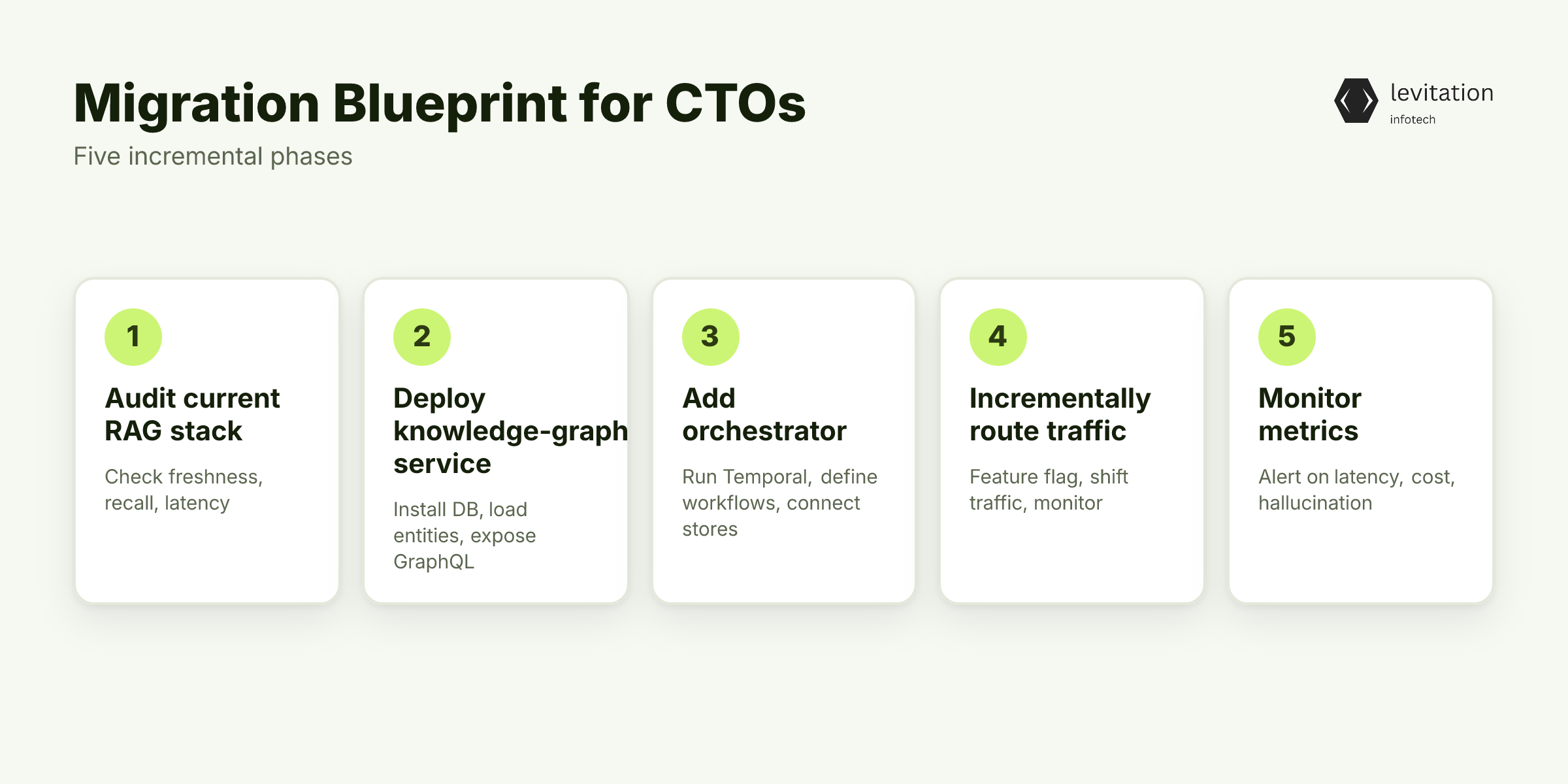
Migration must be incremental; a big-bang rewrite will break SLAs. The following five phases let you keep the old RAG stack alive while you roll out the new architecture.
Phase 1 - Audit the current RAG stack - Measure data freshness: how often are embeddings refreshed? - Compute retriever recall: run a benchmark set and record missed hits. - Record latency distribution under peak load.
Phase 2 - Deploy a knowledge-graph service - Install a graph database in a Kubernetes namespace, load high-value entities (e.g., customer profiles, regulatory rules), and expose a GraphQL endpoint.
Phase 3 - Add an orchestrator - Spin up Temporal on the same cluster. - Define workflows that mirror the most common RAG use cases (FAQ answering, report generation). - Connect the orchestrator to both the vector store and the graph.
Phase 4 - Incrementally route traffic - Introduce a feature flag (e.g., `use_new_pipeline`). - Gradually increase the proportion of requests handled by the new pipeline while monitoring latency and hallucination metrics.
Phase 5 - Monitor cost, latency, and hallucination metrics - Set up alerts for latency spikes, cost anomalies, and a custom “hallucination score” derived from human-in-the-loop validation. - If any metric regresses, roll back the flag for that segment.
Throughout the migration, keep the original RAG endpoint alive as a fallback. This approach respects existing SLAs and lets you prove ROI at each step. What measurable gains can you expect after the switch?
What Success Looks Like: Cost Savings, Performance, and Longevity
A fully migrated system delivers three measurable wins.
Reduced hallucinations cut downstream validation costs - By grounding answers in a knowledge graph, the need for manual fact-checking drops dramatically. Teams can focus on higher-value work.
Unified orchestration lowers compute spend per query - The orchestrator batches similar sub-tasks, reuses LLM calls, and caches intermediate results. This reduces GPU seconds per request, delivering noticeable cost reductions.
Production stability improves - Systems built on modular pipelines remain stable over long periods with minimal re-engineering. The graph schema evolves without breaking downstream services, and the orchestrator can hot-swap activities.
Faster time-to-value - New capabilities, such as a compliance-report generator or a real-time recommendation engine, launch in weeks because you only need to add a new adapter and a workflow step, not rebuild the whole stack.
Enterprises that have adopted this pattern report lasting value and higher confidence from regulators, reflecting the importance of sustainable model operations. Explore the migration guide and start building a resilient AI platform today.
Sources
Research and references cited in this article:
- RAG Limitations: 7 Critical Challenges You Need to Know in 2026
- PDF RAG Does Not Work for Enterprises - arXiv _(academic)_
- 10 RAG Architectures in 2026: Enterprise Use Cases & Strategy
- Best Practices for Scaling Complex Multi-User Enterprise RAG AI ...
- RAG Architecture: Scalability and Security in Enterprise AI - LinkedIn
- Why Companies Need to Understand Retrieval Augmented Generation - CDInsights
- How Retrieval-Augmented Generation Drives Enterprise AI Success
- Business benefits of retrieval-augmented generation - Hyland
- Five reasons enterprises are choosing RAG
- Retrieval-augmented generation (RAG) for business: Full guide | Meilisearch
- Transforming Workflows with AI: A Roadmap to Efficiency - LinkedIn
- Three AI Shifts That Will Impact Enterprise Architects in 2026 Webinar
About the author
Mayank Singh is a software developer at Levitation Infotech, where he builds web and AI-powered applications across the company’s fintech, healthcare, and enterprise projects.