


TL;DR: Most enterprise RAG projects fail, but not because retrieval is broken. The reason is that nothing sits between retrieved context and the decision the business must make. The fix is a decision layer that reasons over conflicting sources, calibrates confidence, and enforces business rules. It turns a RAG pipeline into a production system that survives its second year.
Key Takeaways: - Retrieval is solved. The hard problem starts after the right chunk is returned. - The decision layer is the architectural gap between a working RAG demo and a production system. - A focused 3-6 month decision-intelligence build beats an 18-24 month in-house platform rebuild.
Your RAG System Retrieves Perfectly. It Still Makes Bad Decisions.
Retrieval is solved. Your RAG system returns the right document for most queries, and your team celebrates. Six months later, the project stalls, gets abandoned, or quietly gets shelved. Nobody can explain why.
The reason is that nobody was solving the hard problem. The evidence sits in plain sight. Most teams that build internal AI knowledge bases abandon them within 6 to 18 months.
The postmortems almost never blame retrieval. They blame "trust," "adoption," or "accuracy," as if those were mysterious forces. They are architectural decisions the team never made.
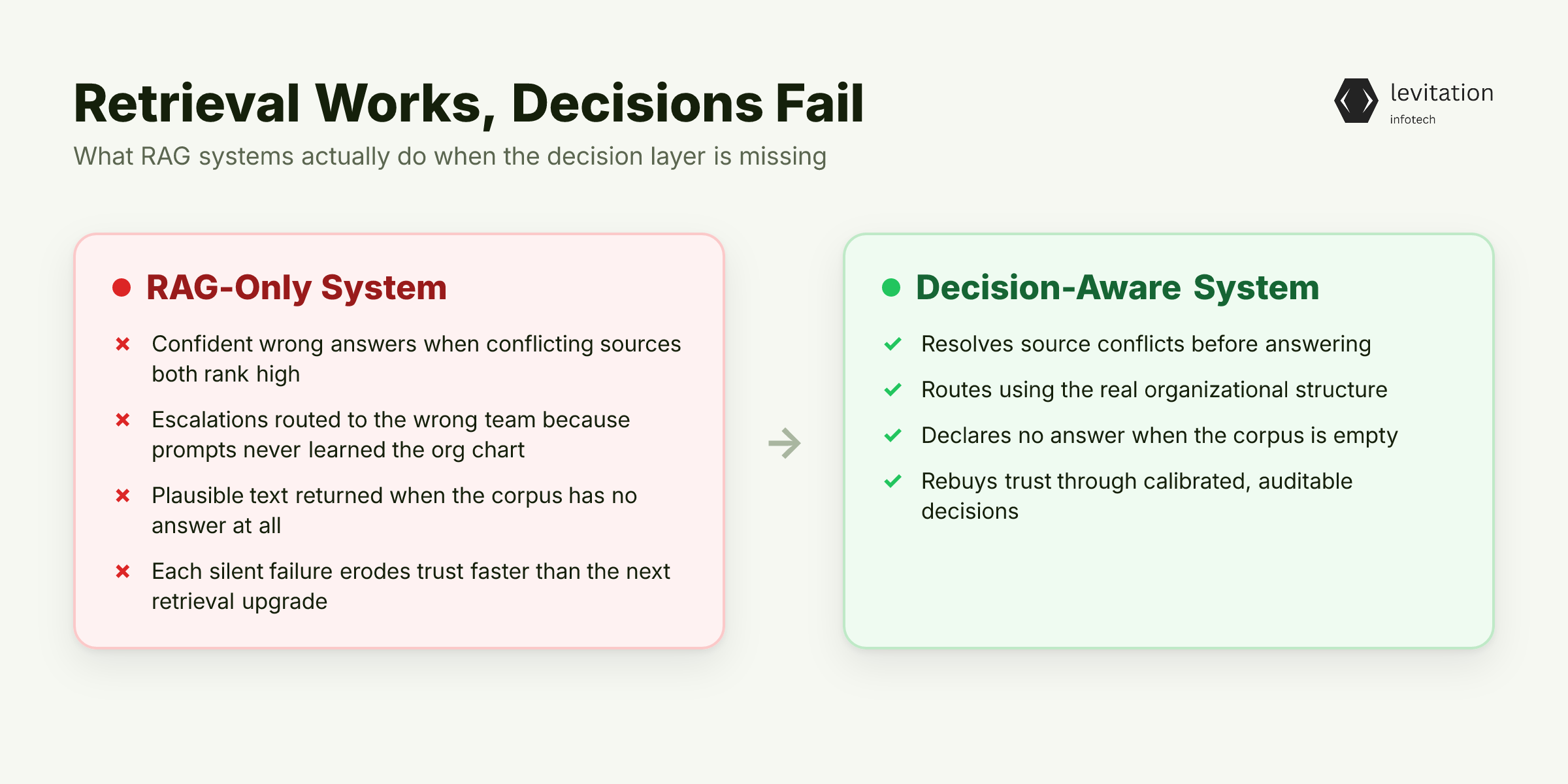
What the systems actually do is worse than missing answers. They return confident wrong answers because two conflicting sources both ranked high. They route escalations to the wrong team because the prompt never learned the org chart.
They fail silently, returning plausible text when the corpus has no answer at all. Each failure erodes trust faster than the next retrieval upgrade can rebuild it.
The pattern shows up in every enterprise AI systems project that treats RAG as the destination instead of a component. Teams swap embedding models, expand context windows, and re-rank results. None of it touches the layer where the decision happens.
The result is a system that knows everything and decides nothing. Here's why.
Why Better Embeddings, More Context, and Bigger Models Won't Fix This
The instinct is reasonable: if retrieval is off, fix the retriever. The data does not support that instinct.
Research on production RAG systems shows that architectural decisions outweigh embedding choices once retrieval and model quality reach a basic balance. The model you pick matters less than the data underneath it.
Retrieval quality depends far more on how data is represented, chunked, and filtered than on which embedding model you run. A well-chunked corpus with metadata filters beats a frontier embedding with sloppy chunking every time.
The same research points to where the real failures live. They sit in the document store schema, chunking logic, embedding freshness, and the absence of any retrieval evaluation framework.
Longer context windows create a worse trap. The model attends to more tokens, but the signal-to-noise ratio collapses.
A 200K context window filled with ten conflicting policy documents does not produce better decisions. It produces average answers that look reasonable while quietly violating whichever source mattered most.
Fine-tuning helps with style, not reasoning. It cannot teach a model how to weigh conflicting sources or know when to abstain. Those are architectural problems, not weight problems.
The bottleneck is neither retrieval quality nor model capability. It is a layer that most RAG and embedding strategy work never builds.
The Missing Layer: Decision Architecture Above Retrieval
Decision intelligence is a distinct layer that sits between retrieved context and the action the system takes. Three sub-systems make it work, and most RAG pipelines have none of them.
Reasoning Over Retrieved Context
A decision layer must reconcile conflicting sources, weigh recency, and flag when the corpus does not support a confident answer. This is not a prompt engineering trick. It is a small reasoning module that knows the difference between a 2024 policy and a 2026 policy, and can tell the user which one applies.
Confidence Calibration and Escalation
Every retrieved result needs a mapped confidence score. It ties to a routing rule, not a single threshold the team picked during a demo. When the score drops below the rule, the system escalates to a human with full context.
When it holds, the system acts. The rule is encoded, not guessed.
Action Selection and Constraint Enforcement
The decision layer encodes business rules, risk tolerances, and compliance gates. The model's output becomes an executable decision with an audit trail, not a paragraph a human has to re-read and re-interpret.
This is the layer that turns a RAG pipeline into an AI agent. The agent acts on enterprise decisions with the governance that regulators expect.
None of this requires a new model. It requires a layer the current architecture does not have. The shift from a RAG demo to a production enterprise AI platform is the shift from "generate a paragraph" to "make a decision and prove it."
Building Decision Intelligence: What the Architecture Actually Looks Like
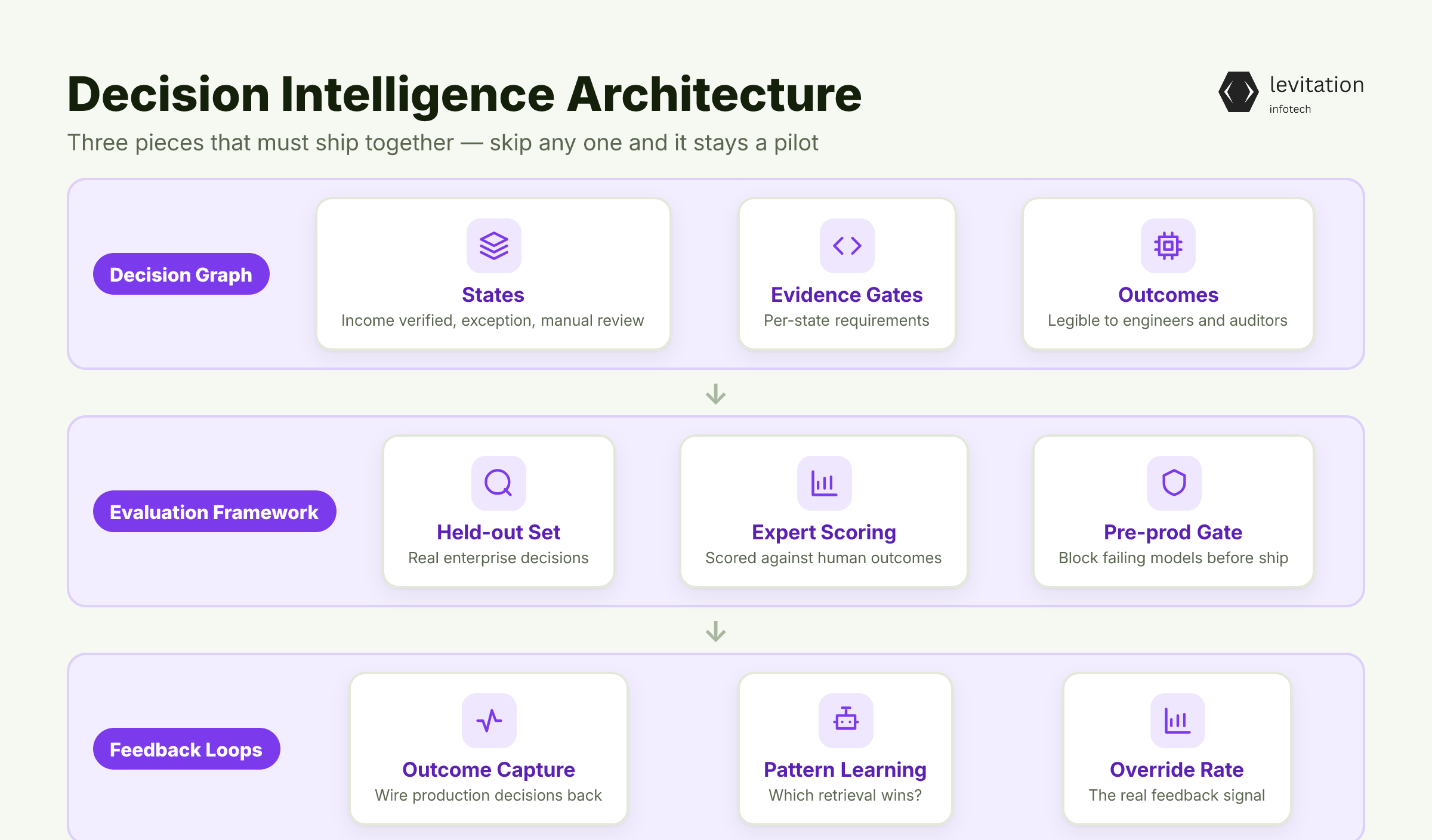
Three pieces have to ship together. Skip any one and the system stays a pilot.
Decision Graph Design
Model the decision as a directed graph of states, evidence requirements, and outcomes. Not as a single prompt with retrieved context bolted on.
A loan decision has states like "income verified," "policy exception requested," and "manual review required," each with its own evidence gates. The graph makes the decision legible to engineers, auditors, and the model itself.
Evaluation Framework Before Production
Build a held-out eval set of real enterprise decisions, scored against human expert outcomes, before you ship the decision layer. This is the single highest-impact investment you can make.
Without it, you cannot tell whether the system improved or just feels better in demos. Most teams skip this step and ship evals that approve failing models.
Feedback Loops Tied to Outcomes
Wire production decisions back to a feedback store so the system learns which retrieval patterns led to good decisions and which led to corrections. The loop has to close on outcomes, not clicks.
A "thumbs up" button is not a feedback signal. An override rate is.
Treat the machine learning and model training lifecycle for the decision layer as production infrastructure, not as a research notebook.
Inference latency, KV cache behavior, and attention patterns all change when decisions are gated by rules and confidence scores. A system that responds quickly in a notebook can slow dramatically once you add reasoning steps and rule checks. Each step adds compute and serialization overhead that compounds.
RAG without this layer is a stopgap, not a scalable AI architecture. The deployment path that avoids the 18-month rebuild starts with a tight scope.
From RAG Pilot to Production Decision System: A 3-6 Month Path
Three phases, scoped tight, land a decision system in production while your in-house team is still drafting the platform charter.
Phase 1 (Weeks 1-4): Instrument. Log every decision your existing RAG pipeline makes or recommends, with retrieved context, confidence, and the human override outcome. This is your labeled dataset without labeling anything new.
Phase 2 (Weeks 5-10): Decision graph. Build the decision graph for the top three decision types by volume. Narrow scope forces you to encode rules and constraints explicitly. This is where the enterprise AI implementation earns its keep, because vague scope is what kills every other attempt.
Phase 3 (Weeks 11-18): Eval framework. Ship the eval framework, wire feedback loops, and move one decision type fully into production with human-in-the-loop escalation for the other two. Prove the pattern works before you scale it.
In-house teams typically take 18 to 24 months to reach this stage because they build the full stack from scratch. A focused decision-intelligence build lands it in 3 to 6 months because the scope is the decision layer, not a from-scratch platform. The math favors focus, and so does every CTO who has watched an 18-month platform charter miss three model cycles.
What Changes When Decisions Stop Being the Bottleneck
Pipelines that used to break on edge cases now route those cases to humans with full context, and handle the long tail autonomously. The system does not pretend to know what it does not know.
That single change is why leadership stops asking "can we trust this." They start asking "which decisions should we automate next."
Confidence calibration changes the conversation. A system that tells you "I'm 94% confident, here is the source, here is the override path" is fundable. A system that returns a confident paragraph with no provenance is not.
Regulated industries keep these enterprise AI systems running for years. The audit trail satisfies the people who sign the compliance reports, not just the people who wrote the demo.
The decision layer is sticky infrastructure. It is not a feature that gets swapped when the next model drops.
Teams that treat RAG as the whole system keep rebuilding it. Teams that build the decision layer keep the system and swap the model underneath.
That difference compounds over five years of production operation, where every model release becomes an upgrade instead of a rebuild.
Frequently Asked Questions
What is the difference between RAG and decision intelligence?
RAG retrieves relevant context and generates a response. Decision intelligence adds a layer that reasons over that context, calibrates confidence, enforces business rules, and selects an action or escalation path. RAG is a component; decision intelligence is the system that uses it to make auditable enterprise decisions.
Why does RAG fail at enterprise decision-making?
RAG was optimized to return the right chunk, not to weigh conflicting sources, enforce compliance gates, or know when to abstain. The brittleness comes from missing decision architecture, not from retrieval quality or model capability.
Can fine-tuning fix RAG's decision problems?
Fine-tuning adjusts style and domain fluency, but it does not encode the business rules, risk tolerances, and escalation logic that make enterprise decisions auditable. The decision layer above retrieval is where that logic lives, and fine-tuning is not a substitute for it.
How long does it take to build a decision intelligence layer?
A focused build for the top three decision types in an organization typically takes 3-6 months. In-house teams building the full stack from scratch take 18-24 months.
What is agentic AI in the enterprise?
Agentic AI refers to systems that reason, act, and escalate autonomously within defined guardrails. In practice, enterprise agentic AI is decision intelligence with tool use: the agent retrieves, reasons, and executes, all governed by the decision layer described above.
If you are weighing the next move, start by mapping your top three decisions to the layer above and measuring where the current pipeline breaks.
About the author
Mayank Singh is a software developer at Levitation Infotech, where he builds web and AI-powered applications across the company’s fintech, healthcare, and enterprise projects.